千窑难得一宝 · A Thousand Kilns for One Treasure
The most technically demanding colour in Chinese ceramics.
Copper oxide, a ten-degree firing window, and a thousand years of kiln failure.
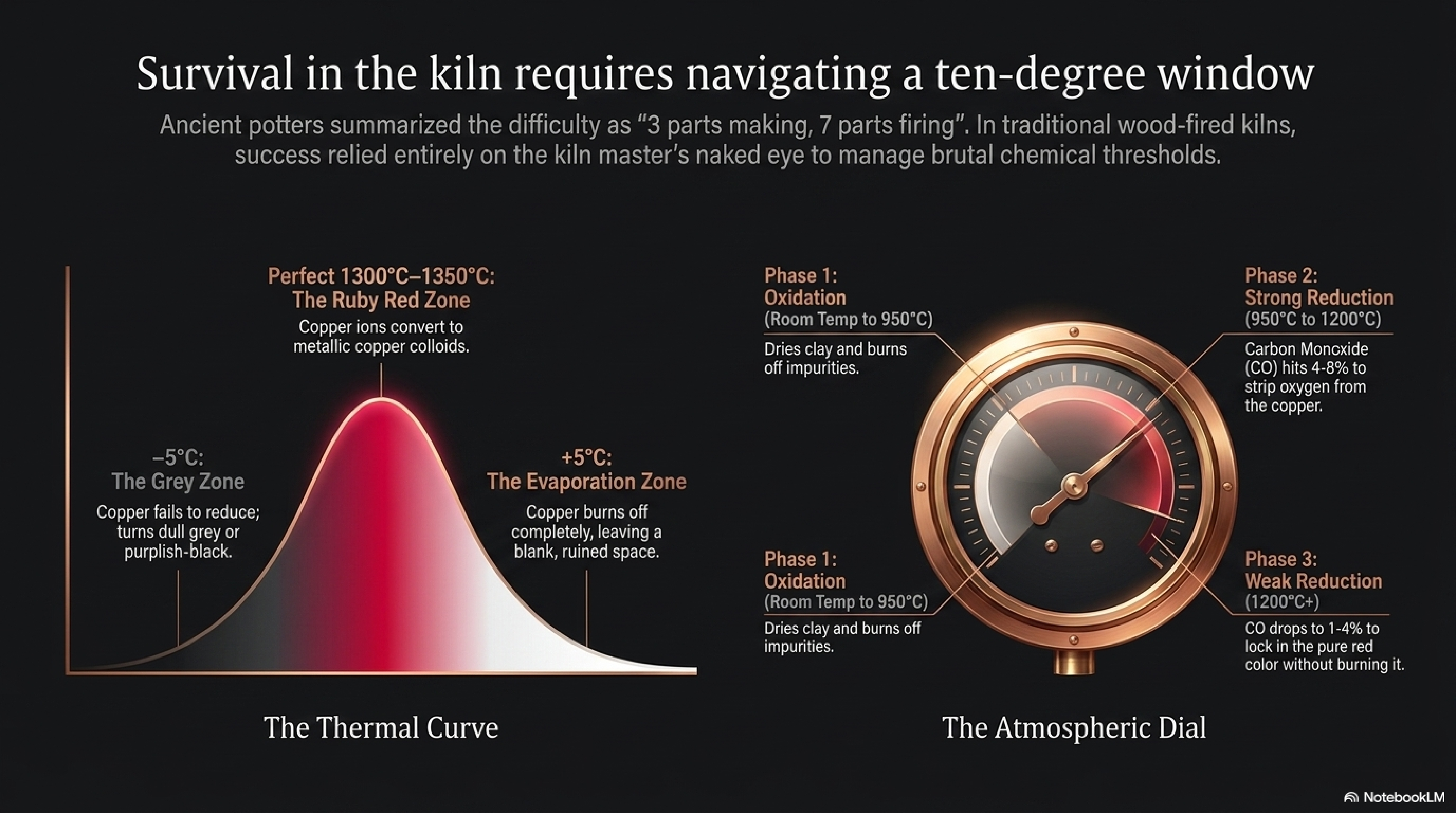
In the entire history of Chinese high-fire ceramics, no colour has been more difficult to achieve or more prized when achieved than the deep, clear red of 釉里红 (underglaze red). The Chinese saying is exact: 千窑难得一宝 — "a thousand kilns for one treasure." It is not hyperbole. The copper oxide that produces underglaze red is chemically sensitive to temperature within a window of approximately ten degrees Celsius. Too high, and the copper volatilises entirely — the pattern disappears, leaving a ghost of grey-white. Too low, and the copper fails to fully reduce, producing a muddy blackish-grey. The bright ruby red that collectors prize exists only in the narrow middle: found, not made.
This physical difficulty has defined the tradition's history: periods of success tied to exceptional kilnmasters, periods of abandonment when the technical knowledge was lost, and a final resolution only in the Qing dynasty when consistent high-quality firing became possible. Understanding underglaze red is understanding the limit of what a kiln can be asked to do.
Cobalt on white. Stable, reproducible, globally traded. The foundation of Jingdezhen.
Copper on white. Thousand kilns, one treasure. The rarest high-fire colour. This guide.
Underglaze blue outlines, overglaze enamel fills. Ming Chenghua — the rarest formula.
Opaque pink enamels. Qing Yongzheng / Qianlong. The auction market's summit.
Five-colour overglaze. Ming Jiajing / Wanli. Bold and vivid energy.
Fire, metal oxide, restraint. From Ming sacrificial red to Qing peachbloom. One colour, one fire.
"千窑难得一宝。"
— The definitive Chinese assessment of underglaze red: "A thousand kilns for one treasure." This is not a figure of speech — it is a technical description. For most of Chinese ceramic history, a kiln firing underglaze red expected the overwhelming majority of pieces to fail. The few that emerged with clear, bright ruby colour were, and remain, among the most prized objects in Chinese decorative art.The history of underglaze red is a story of discovery, loss, partial recovery, and final mastery — spanning eight centuries from the first accidental copper-red flashes in Tang kilns to the controlled, jewel-bright productions of Qing Yongzheng. No other Chinese ceramic tradition has such a discontinuous history, and that discontinuity is directly explained by the copper oxide chemistry at its core.
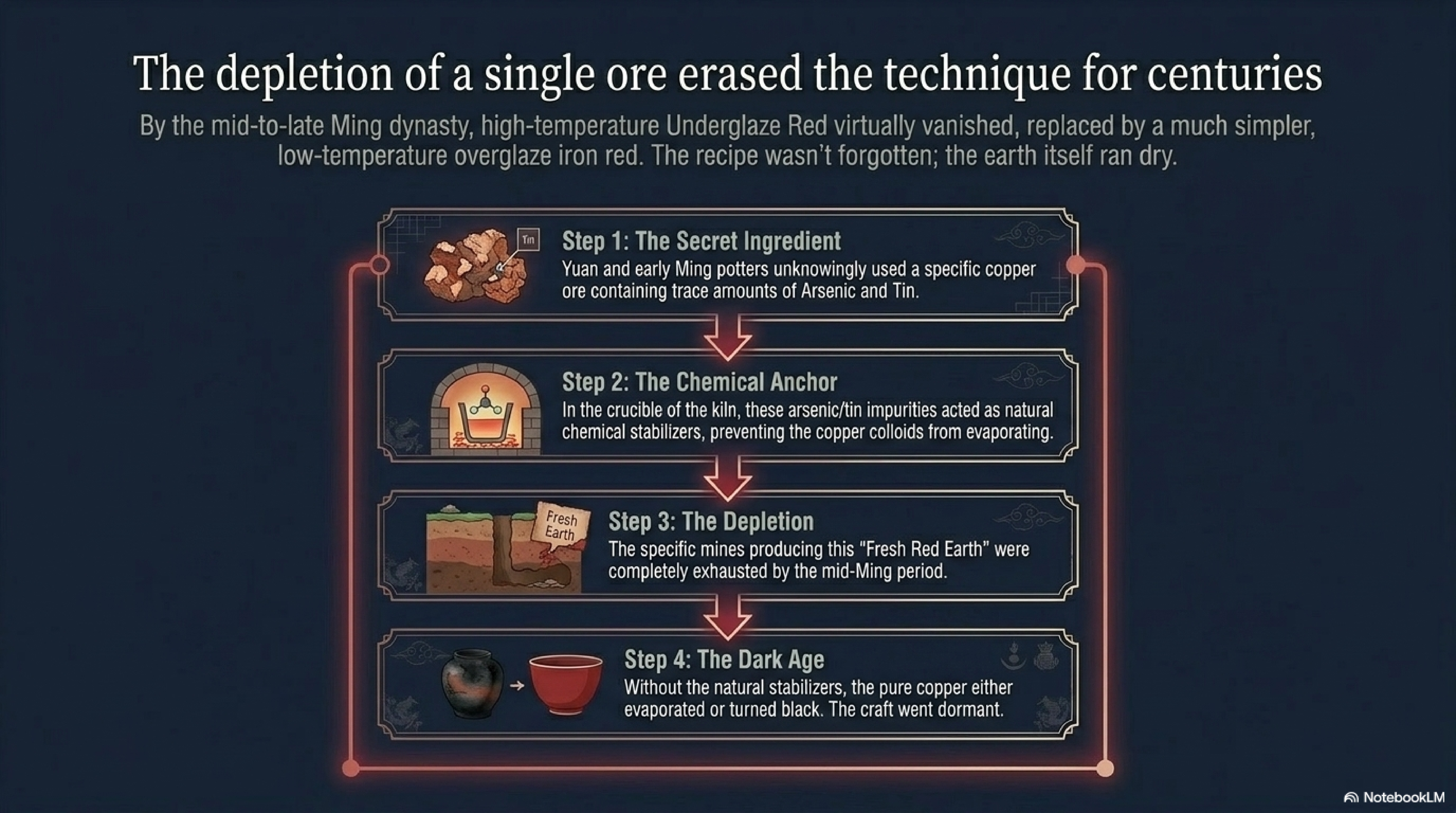
The arc of underglaze red. Tang Changsha kiln: copper glazes occasionally produced red flashes — accidental, not deliberate. Yuan Jingdezhen: deliberate creation of mature underglaze red, contemporary with the blue and white breakthrough. Ming Hongwu–Xuande: the first peak, including the legendary Xuande "ruby red" (宝石红). Ming mid-period: technical interruption — loss of the key raw material (鲜红土), replaced by low-temperature alum red (矾红). Qing Kangxi–Yongzheng: full recovery and summit — controlled, reproducible, jewel-like.
Accidental origins. Copper-bearing glazes at Changsha kiln occasionally reduced to produce patches of red — a kiln accident rather than a deliberate technique. The conditions that produced it were not understood or controlled.
Deliberate creation. Jingdezhen introduces mature underglaze red, contemporaneous with blue and white. Firing atmosphere difficult to control in the large wood-fired dragon kilns; colour often unstable — dark red, murky grey-red, or absent. Numbers are small; surviving Yuan underglaze red is extremely rare.
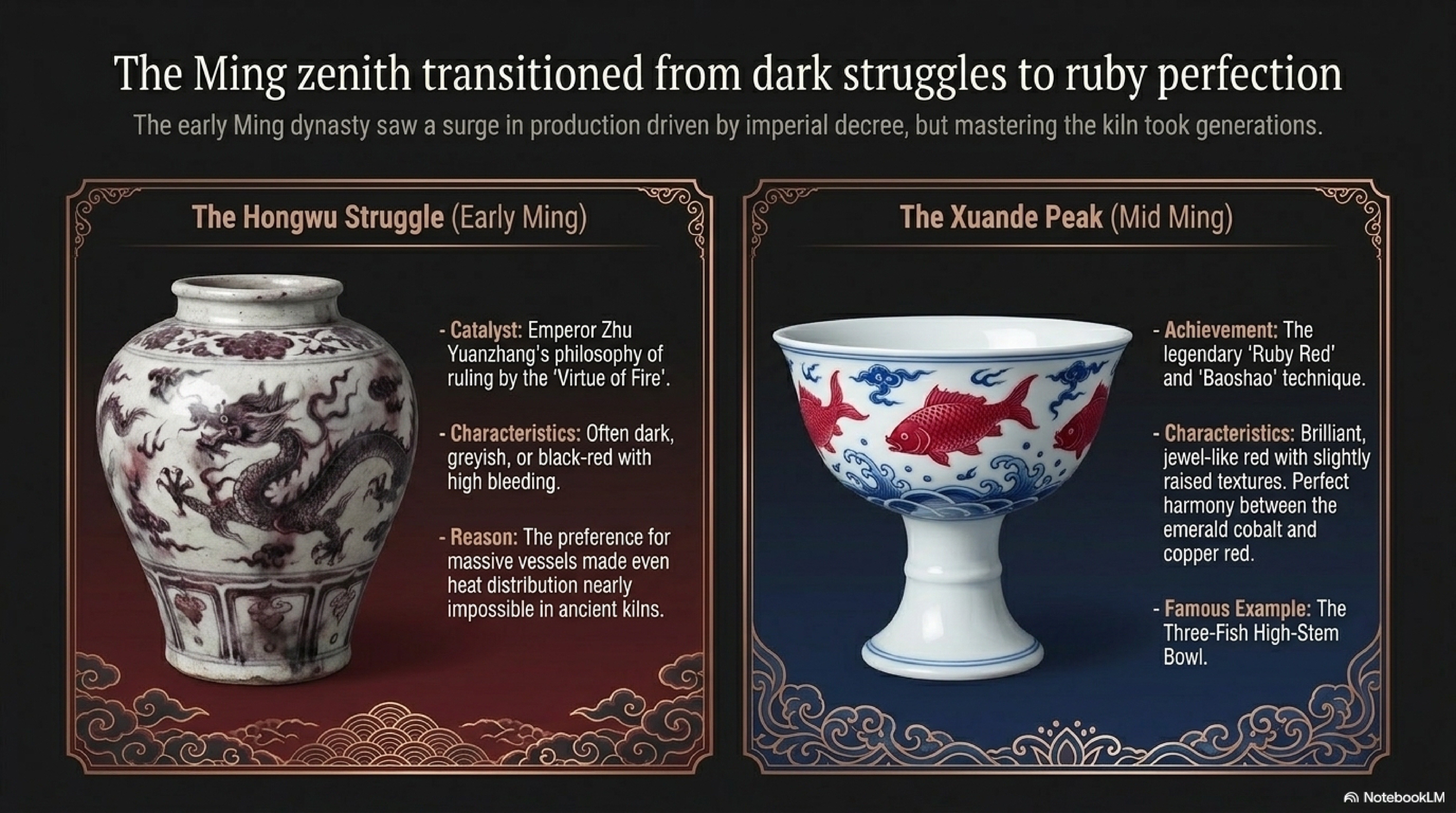
The imperial commitment. Zhu Yuanzhang's "fire-virtue" ideology and deep red cultural symbolism elevated underglaze red above blue and white. Large-scale Hongwu underglaze red production — but the colour is frequently grey-red or pale due to uneven heating of large vessel forms.
The first summit. 宝石红 (ruby red / jewel red) — a clear, saturated crimson with a slight convex texture (orange-peel surface). The most celebrated underglaze red in Chinese history. Also the period of 青花釉里红 (blue and white combined with underglaze red) — the tradition's most technically complex achievement.
Technical interruption. The specific raw material (鲜红土) supplying the copper ore is exhausted. Underglaze red production effectively ceases. The court substitutes low-temperature overglaze alum red (矾红) — a fundamentally different, inferior material that merely simulates the colour.
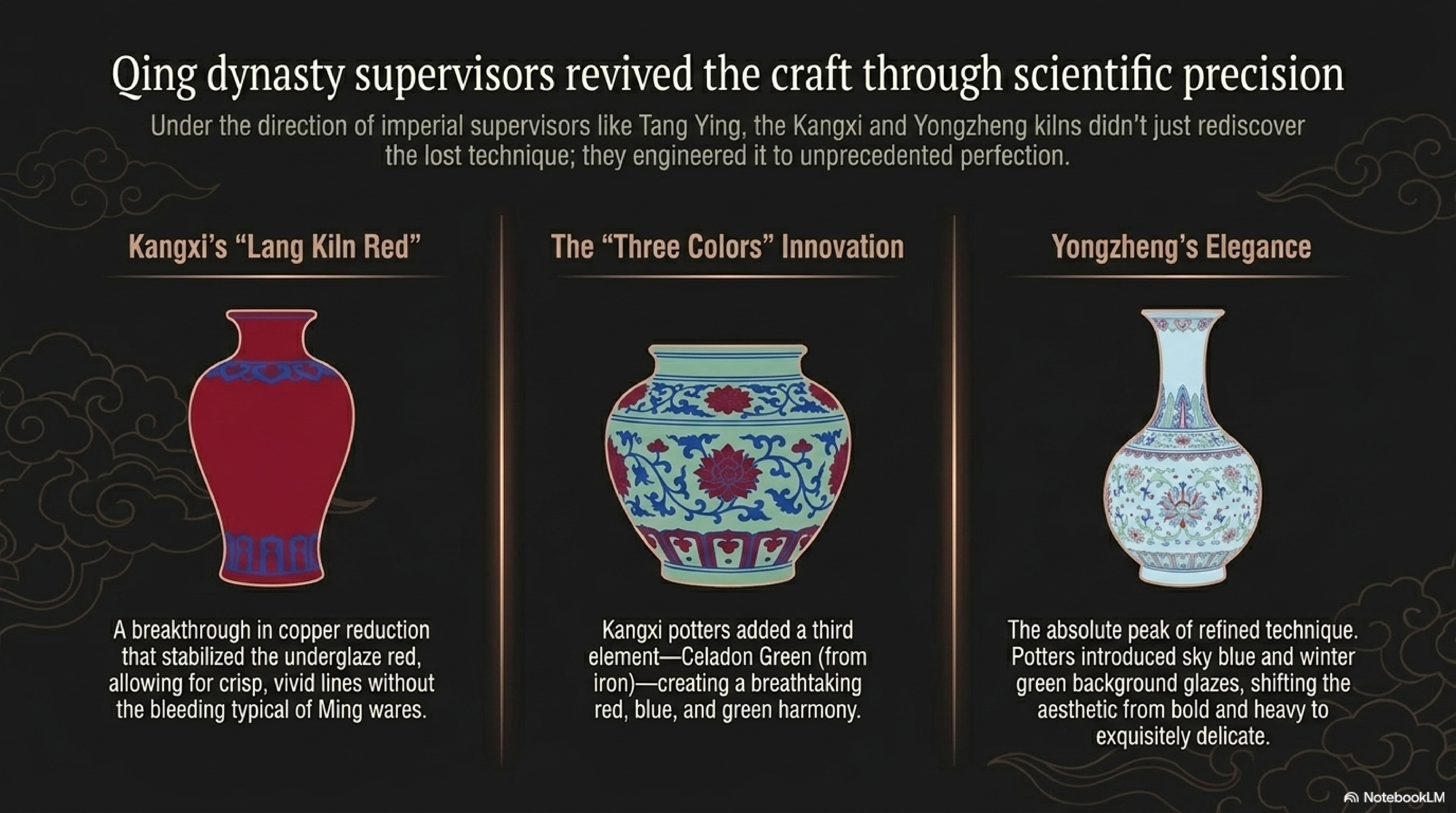
Revival and mastery. Kangxi successfully resurrects underglaze red. Yongzheng achieves the historical peak: colour bright and evenly distributed, "red flowers and blue leaves" (青花釉里红) at maximum chromatic harmony, 釉里三色 (three-colour underglaze — blue, red, and bean green) introduced. The Qing achievement is more consistent than the Ming peak; if less romantic, it is technically superior.
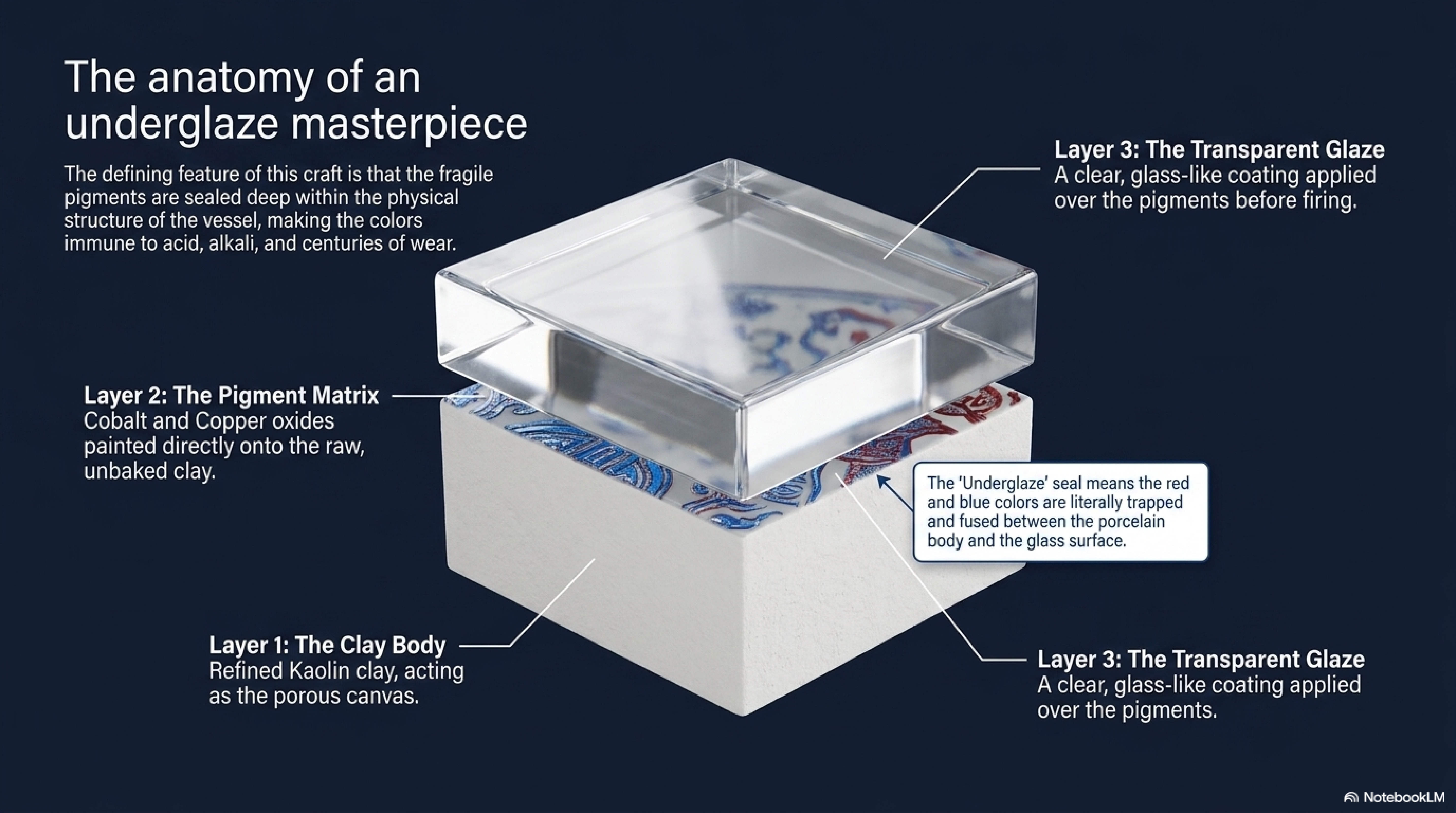
Underglaze red is a high-temperature underglaze colour: copper oxide is applied directly to the unfired clay body, a transparent glaze is applied over it, and the piece is fired in a single high-temperature reduction firing between 1250°C and 1350°C. The category it belongs to — alongside blue and white — is defined by this single-firing, high-temperature underglaze application. Everything else about the two traditions is different.
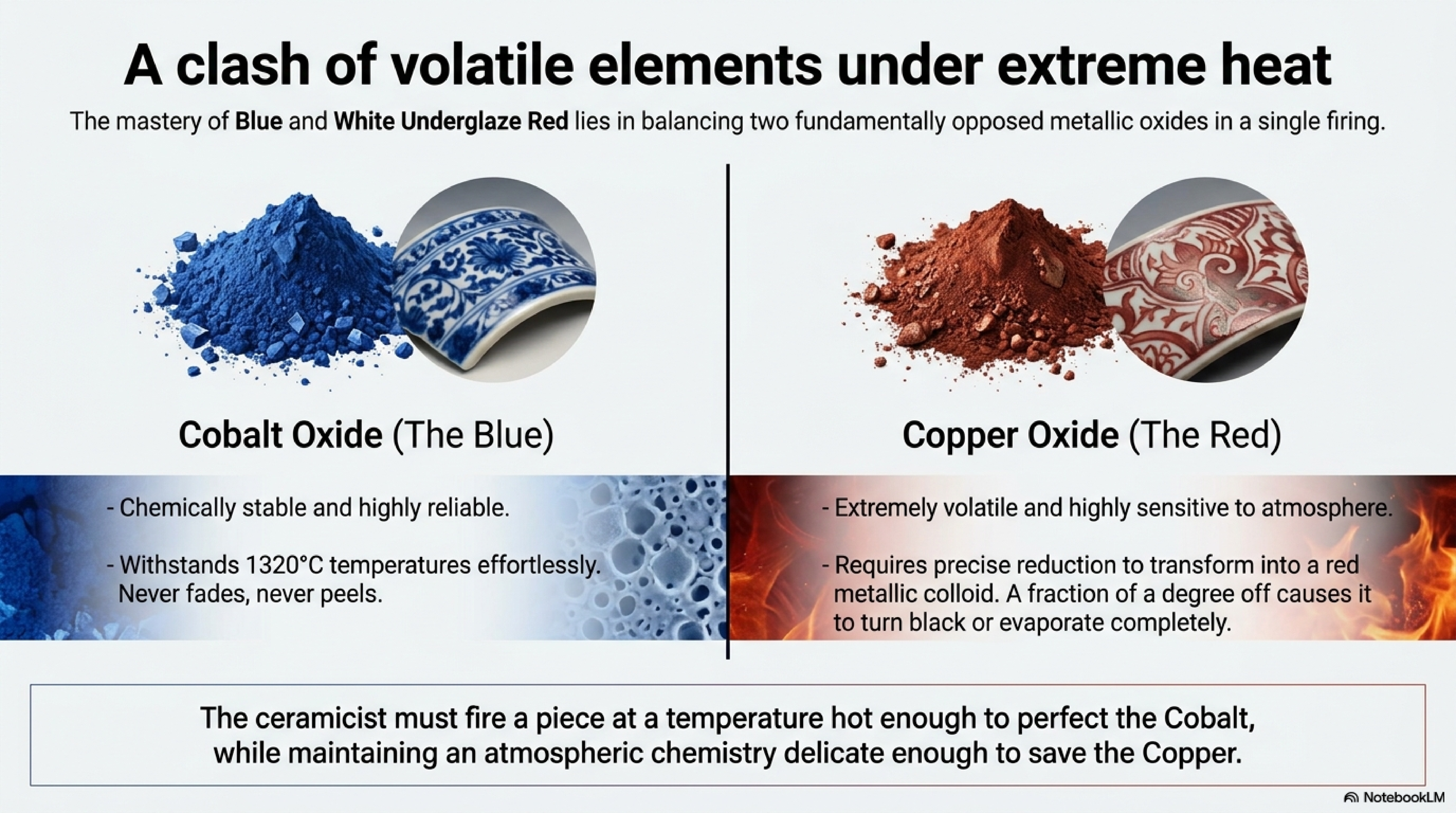
The copper chemistry. Copper oxide (CuO) in an oxidising kiln atmosphere (oxygen present) produces green or brown — the colour of celadon-adjacent glazes. In a reduction atmosphere (oxygen depleted, CO present), Cu²⁺ is reduced to Cu⁺ and, ultimately, to metallic copper nano-particles — which scatter red light and produce the ruby tone. But if the temperature exceeds the ideal zone, copper volatilises as CuO vapour and migrates away from the painted surface, leaving the painted area blank — known as "flying red" (飞红). The more common failure is the inverse: insufficient temperature or inadequate reduction produces grey, dark grey-purple, or black tones, as the copper fails to fully convert. Both failure modes flank the narrow ideal zone on either side.
The fundamental difficulty of underglaze red is the narrowness of its ideal firing zone. The copper must be hot enough to fully reduce (below this threshold: grey or black), but not so hot that it volatilises (above this threshold: nothing at all). This window is approximately 10°C wide — a tolerance that pre-modern kilns, fired with wood and managed by reading flame colour and smoke, could not reliably maintain across an entire firing load.
The temperature envelope. Below ideal zone (insufficient reduction): copper fails to fully convert, producing murky grey, dark grey-purple, or blackish tones — the characteristic failure mode of Yuan and Ming Hongwu underglaze red where kiln temperature was uneven. Ideal zone (~10°C range): full copper reduction to Cu⁺ nano-particles; clear, bright, saturated ruby red. Above ideal zone: copper volatilisation; the painted design vanishes, leaving a ghost of grey-white where the decoration should be. Modern electric kilns can hold ±2°C; traditional wood kilns varied by 50°C or more across a single firing.
Large vessels (Hongwu jars, Ming vases) present an additional challenge: thermal gradients. In a large pot firing in a wood kiln, the upper and lower halves of the same piece may differ by 30–50°C. This explains why Hongwu underglaze red frequently shows pure red at the shoulder and grey or absent colour at the base — same piece, different temperature zones, different copper conversion results.
Authentic Xuande underglaze red has a distinctive micro-texture on the red-painted areas: a slight convex surface with fine undulation, known as 橘皮纹 (orange-peel texture). This is caused by the slight expansion of copper-bearing areas during firing. It is a diagnostic marker of genuine Xuande production — later reproductions that achieve the right colour often lack this surface texture.
Xuande 宝石红 in detail. The orange-peel surface texture (橘皮纹) is clearly visible: the red-painted areas are microscopically convex and undulating — the physical record of copper expansion during the ideal-zone firing. Colour: a deep, saturated ruby with no grey or brownish component. The white ground: pure, cold white — not the warm ivory of older porcelain stone bodies, because Xuande clay was already using the mature two-material formula. Together, these three markers (orange-peel texture + ruby tone + pure white ground) define the peak achievement of Ming underglaze red.
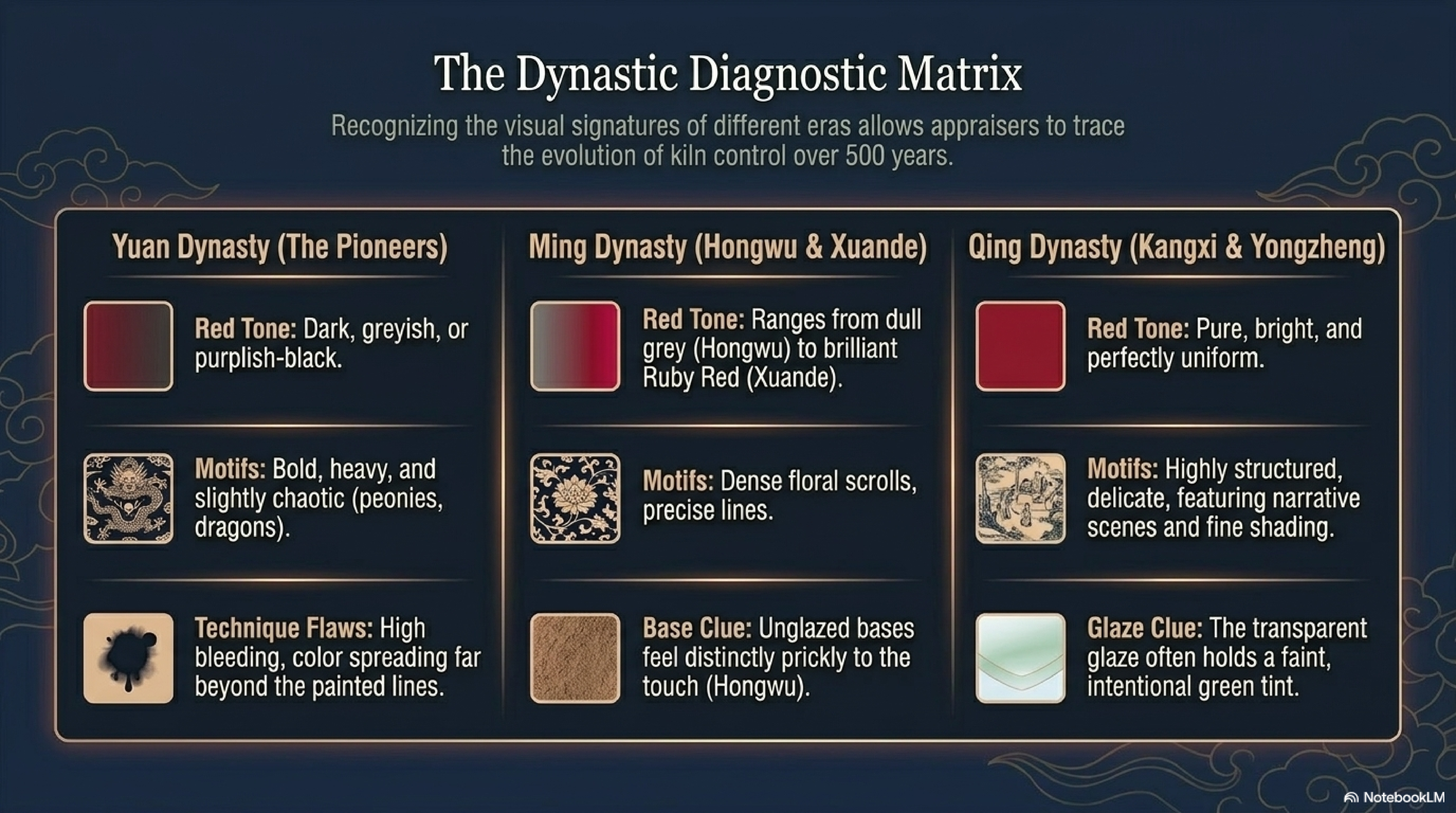
Each major production era of underglaze red has a characteristic colour tone, resulting directly from kiln technology, raw materials, and firing practice of its period. Reading these colour signatures is the first step in dating an unattributed piece.
Yuan underglaze red. Ground: qingbai (青白) or egg-white (卵白) glaze — warm, slightly blue-green in thick areas. Colour: unstable, frequently dark red with brown component or grey-red where the firing fell outside the ideal zone. Motifs: relatively simple — lotus scrolls, rabbits, cloud-dragons (云龙纹). Volume: small. Yuan underglaze red is the rarest category; most surviving examples show the characteristic colour instability of early experimental production.
Ground: qingbai or egg-white. Colour: dark red, grey-red, or near-absent — reflecting kiln temperature instability. Simple motifs. Surviving examples are extremely rare and command exceptional prices.
Large vessel scale. Ground: warm white, thick glaze. Colour: pale grey-red or shallow red at best, with frequent loss of colour at base due to thermal gradient in large forms. Unglazed sandy foot (糙底) on most pieces except specific forms.
Ground: pure cold white. Colour: deep ruby (宝石红) with orange-peel surface texture. The technical summit of Ming underglaze red — never surpassed in the Ming period. Also produced 青花釉里红 combining both colours. Reign mark: six-character regular script.
Qing Yongzheng — the historical summit. By the Yongzheng reign, underglaze red had achieved complete technical mastery: colour bright and uniformly distributed across the entire surface, no temperature gradient failures, no grey or dark areas. The most celebrated Yongzheng achievement is 青花釉里红 (blue and white combined with underglaze red) at maximum chromatic contrast: vivid red flowers against blue leaves and white ground. For sheer technical precision, Yongzheng underglaze red exceeds even the Xuande peak — though it lacks Xuande's romantic rarity value.
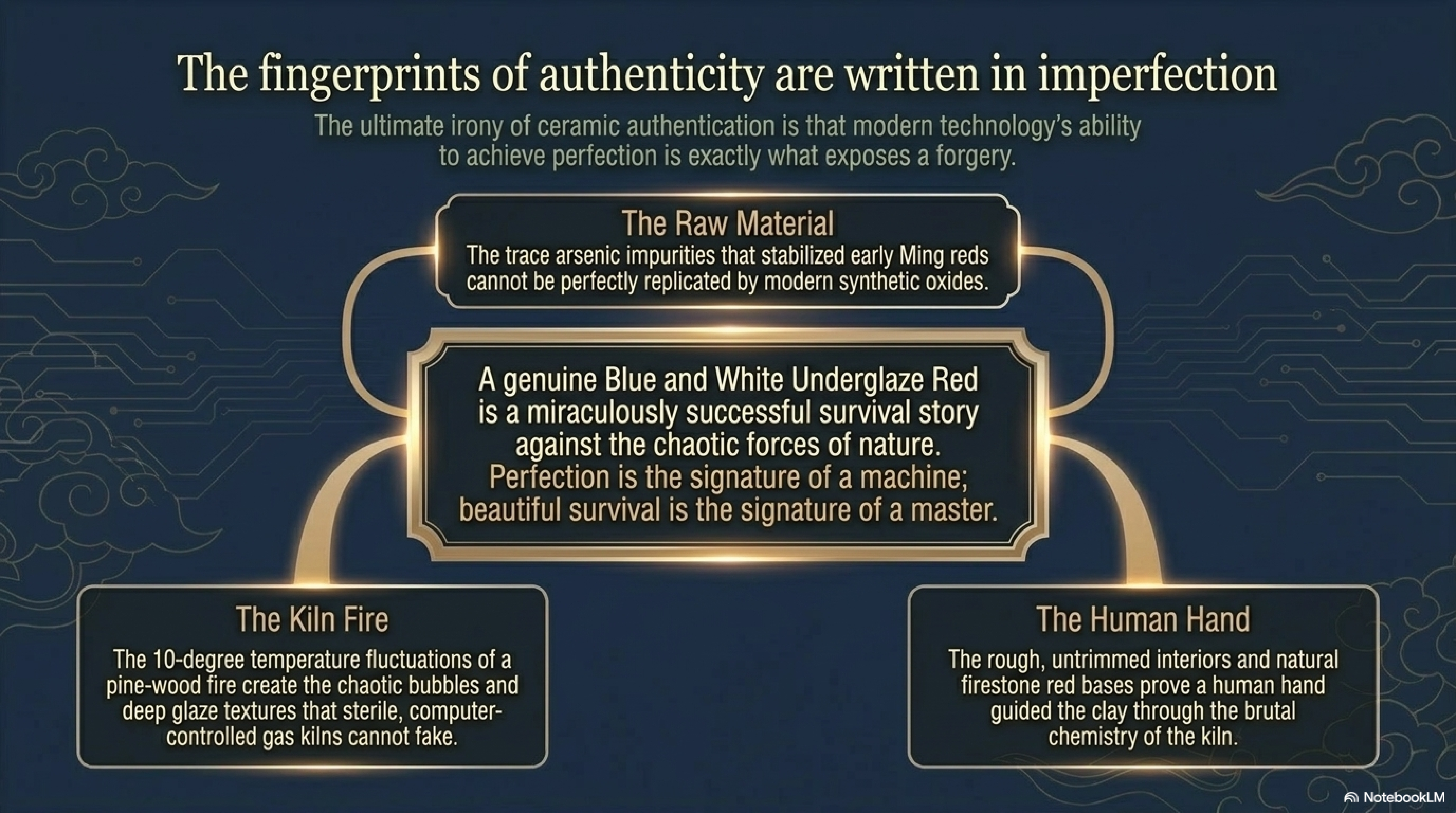
Ming Hongwu underglaze red: the political peak, the technical failure. Zhu Yuanzhang's imperial ideology elevated the red tradition above blue and white — but the kiln technology of the period could not reliably achieve the colour in the large vessel forms the court demanded. The characteristic Hongwu result: pale, greyish-red tones, frequent colour loss at the base of large jars where kiln temperature was lowest. The large unglazed sandy foot (糙底) is a distinctive Hongwu marker on most non-ritual forms.
Underglaze red is a prime forgery target — its rarity and high auction prices make it commercially attractive, and the visual appearance (a red-painted white porcelain) is superficially achievable with modern materials. Authentication focuses on four physical markers that are difficult to replicate simultaneously.
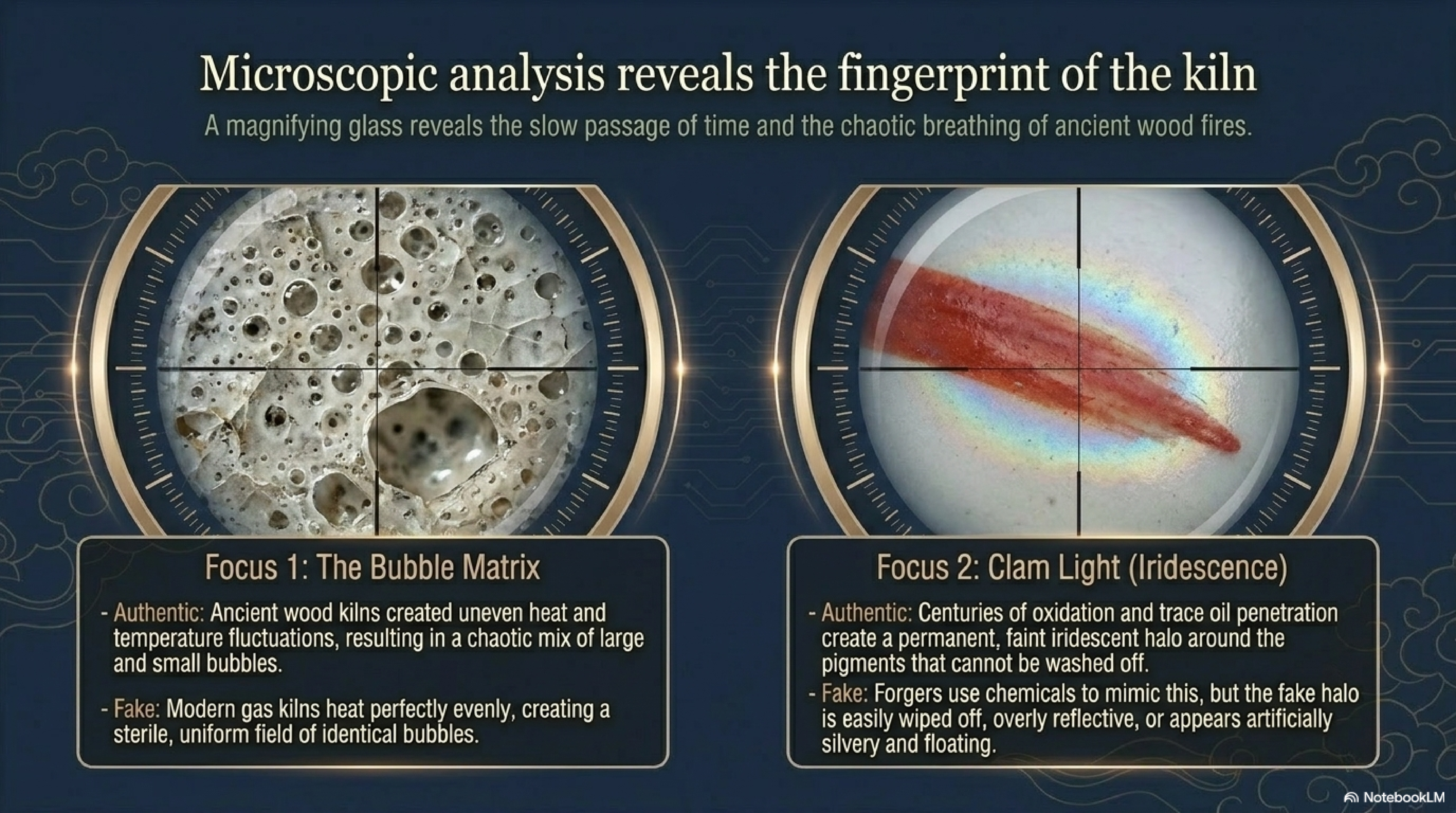
Glaze surface. Authentic old underglaze red: glaze warm and mellow, with a "sunken" internal luminosity — the light enters the glaze rather than bouncing off it. Long-transmitted pieces develop 蛤蜊光 (clam-shell iridescence) — a rainbow sheen on the glaze surface from mineral infiltration that cannot be washed off. Modern forgeries: "fire flash" (刺眼火刺光) — an over-bright, flat reflectiveness from rapid modern firing. Chemically treated fakes: a dead, matt surface that simulates age but lacks the warmth of genuine aging.
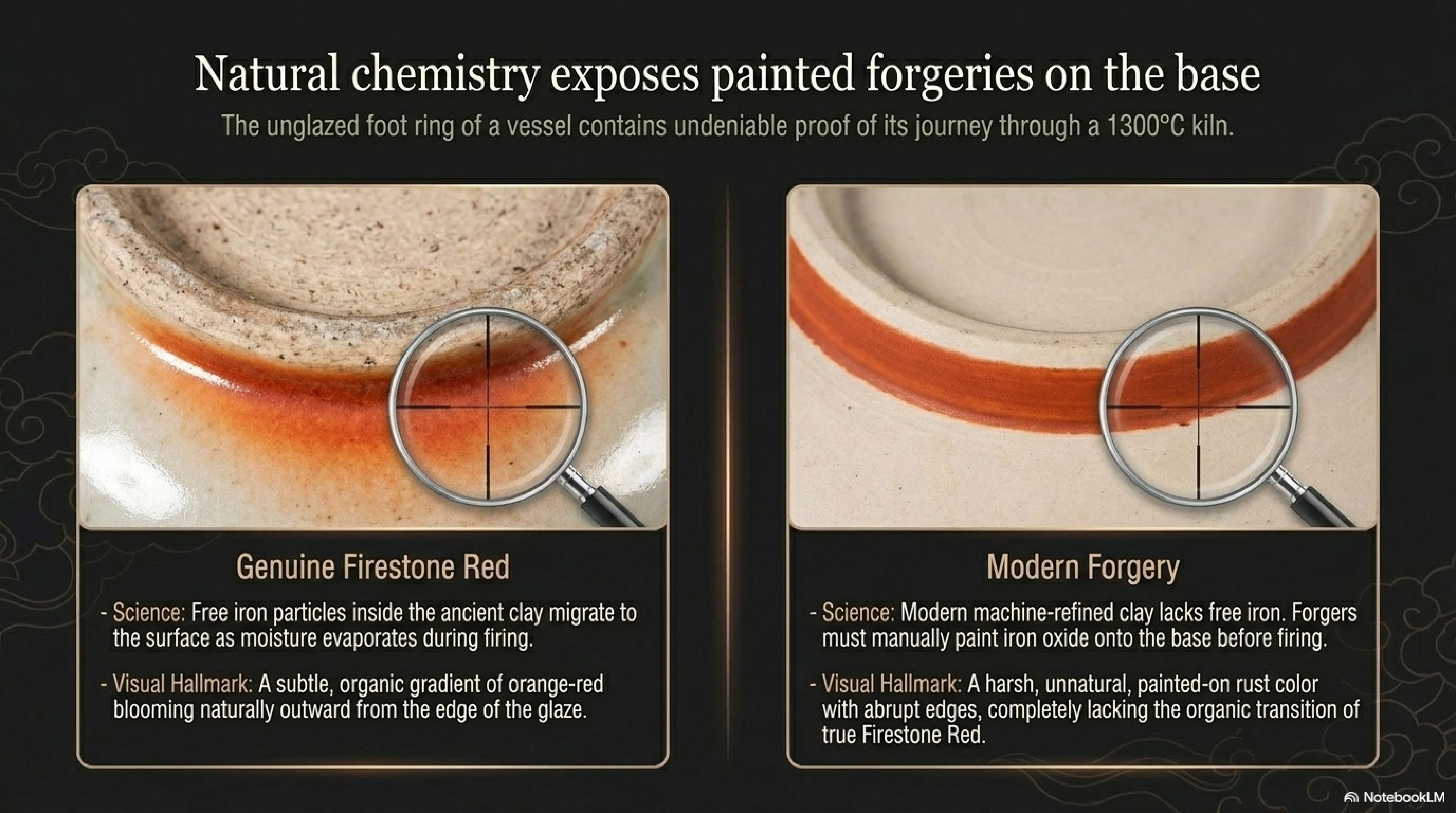
Foot rim. Authentic old pieces: foot rim dry to the touch, natural "sunken" quality from moisture loss over centuries. Natural fire stone red (火石红) — an organic iron-oxidation ring at the glaze-clay boundary — is irregular, fading naturally inward. Modern forgeries: foot rim too dense, too white (modern refined clay), or the fire stone red is painted too uniformly. Critical modern tell: if quartz sand or aluminium oxide powder is visible adhered to the foot rim, it indicates firing in a modern gas kiln — a standard practice in Jingdezhen reproduction workshops.
Underglaze red's most significant legacy is not the single-colour tradition itself, but what Kangxi and Yongzheng craftsmen created by combining it with other underglaze colours — achieving a chromatic range no single pigment could produce alone.
釉里三色 (Three-colour underglaze) — Kangxi's greatest innovation. By combining cobalt blue, copper red, and iron-bearing bean green (豆青) in a single underglaze application and firing them together, Kangxi kilnmasters produced the first three-colour underglaze tradition in Chinese ceramic history. The technical challenge is multiplicative: each pigment has its own temperature sensitivity and reduction requirements. Achieving all three simultaneously in the correct colours, in a single firing, required an unprecedented level of kiln control.
The cultural weight of red. In Chinese cosmological symbolism, red represents fire virtue (火德), south, summer, and imperial authority. The Hongwu emperor's elevation of red above blue and white was not merely aesthetic — it was an assertion of dynastic identity. Ming sacrifice vessels in red glaze were specifically made for the Temple of the Sun (日坛), completing the five-altar colour system: red (sun), blue (heaven), yellow (earth), white (moon), black (north). Underglaze red occupied the summit of this hierarchy because its production difficulty encoded the value of what it symbolised: the rarest colour for the rarest ritual.
"The kiln makes the colour. The painter makes the form. But between them, there is a ten-degree gap that neither controls."
— On the fundamental character of underglaze red: unlike every other ceramic colour in the Chinese tradition, the final quality of underglaze red is determined not by the painter's skill or the glaze chemist's formula, but by the ten-degree zone of atmospheric and thermal conditions that no one, in any dynasty, has ever fully mastered.