Jingdezhen · Six Great Ceramics · No. 1

Blue and White
青花瓷

素坯勾勒出青花 · The Most Global Chinese Ceramic

Seven centuries of cobalt and fire. The first ceramic tradition
to become a global commodity — traded from Persia to Portugal.

7世纪 Tang Dynasty Origins
1300°C Reduction Firing
苏麻离青 Yuan–Ming Cobalt
五彩青花 Kangxi Peak

The World's Porcelain:
Blue Cobalt on White Clay

Of all the ceramic traditions China has ever produced, none has travelled further or influenced more. Blue and white porcelain — 青花瓷 — is simultaneously the most technically straightforward of Jingdezhen's great traditions and the most globally consequential. For seven centuries, from the Yuan dynasty to the present, its visual language — cobalt-blue brushwork on a pure white ground — has been recognised, imitated, and coveted on every continent.

It ranks first among Jingdezhen's Four Great Ceramics (四大名瓷), and for good reason: no other Chinese ceramic tradition was exported in such quantities, sparked so many regional imitation traditions (Delft, Imari, Talavera), or shaped the visual identity of Chinese art in the Western imagination as completely. To collect seriously, you must understand blue and white — not just as a decorative style, but as a thousand-year technical and cultural project.

青花 Blue & White

Cobalt on white. Yuan to Qing. The most globally traded Chinese ceramic. This guide.

釉里红 Underglaze Red

Copper on white. "A thousand kilns for one treasure." The rarest high-fire colour.

斗彩 Doucai

Underglaze blue outlines, overglaze enamel fills. Ming Chenghua — the rarest formula.

粉彩 Famille Rose

Opaque pink enamels from Europe. Qing Yongzheng / Qianlong. The auction market's summit.

五彩 Wucai

Five-colour overglaze. Ming Jiajing / Wanli. Bold, vivid, folk-inflected energy.

颜色釉 Monochrome

Fire, metal oxide, restraint. From Ming sacrificial red to Qing peachbloom. One colour, one fire.

"素坯勾勒出青花,瓶身描绘的牡丹一如你初妆。"

— Jay Chou's 2011 cultural shorthand for a tradition seven centuries old: white clay body outlined in blue, peonies painted as if on a bride's first morning. The lyric captures what makes blue and white enduringly legible — the intimacy of the drawn line against white silence.

From Tang Prototype
to Global Phenomenon

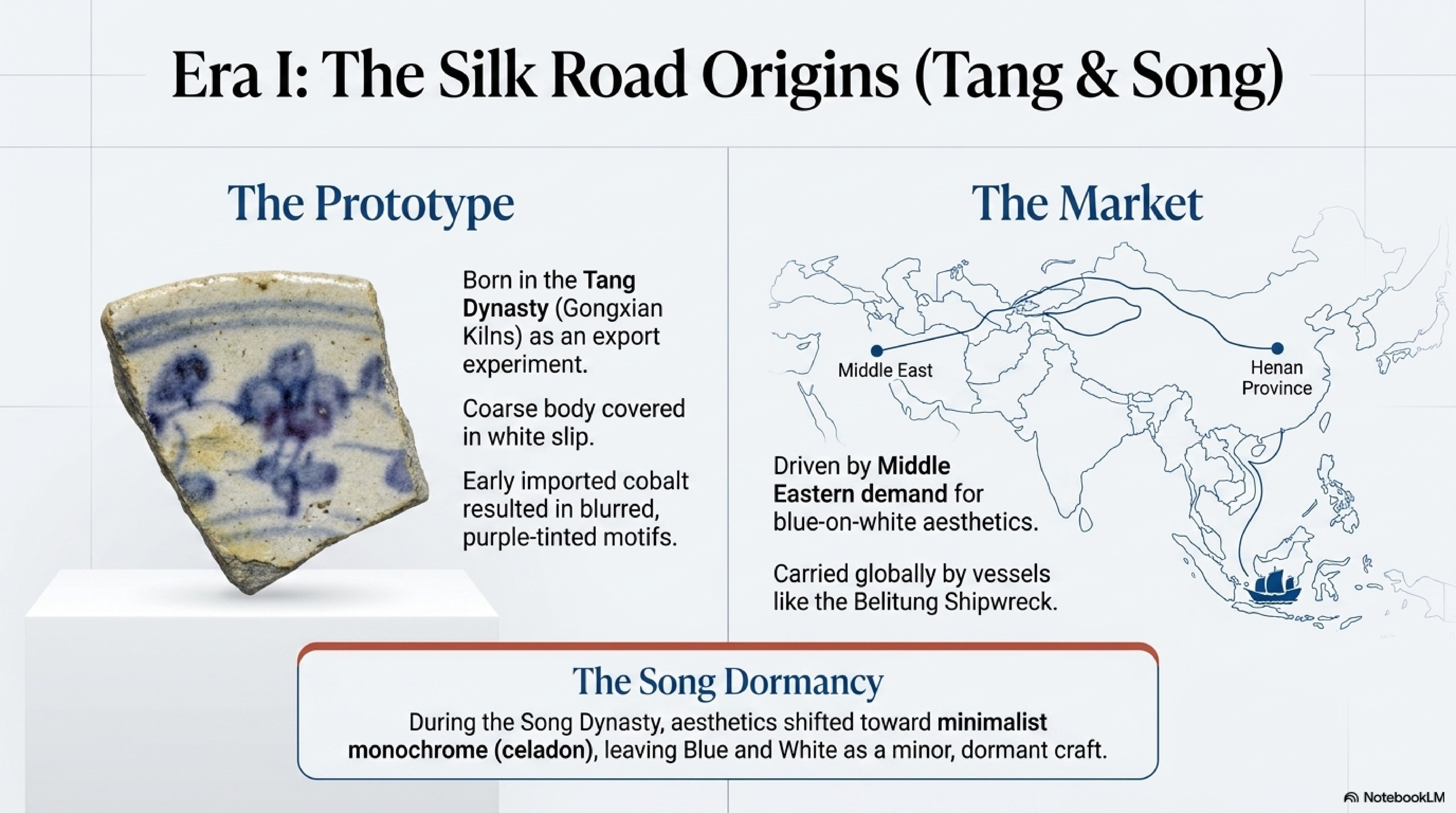
Blue and white did not emerge fully formed. Its history is one of gradual refinement across six centuries — a Tang prototype, a Yuan breakthrough, a Ming canon, and a Qing technical summit — each phase building on what preceded it and responding to new materials, court tastes, and commercial pressures.
The arc of blue and white — Tang proto-blue and white from Gongyi kiln through Yuan maturity to Ming canonical forms and Qing technical pinnacle

The developmental arc. Tang Gongyi kiln produced China's first cobalt-decorated white ware — primitive, Persian-influenced, technically raw. The Yuan breakthrough at Jingdezhen transformed this into the mature tradition: a dense white body (the new two-material formula of porcelain stone plus kaolin), imported Persian cobalt, and the full vocabulary of narrative and floral painting that defined blue and white for all subsequent centuries.

Tang (618–907)

Proto blue and white at Gongyi kiln (巩义窑), Henan. Coarse body, white slip ground, cobalt decoration influenced by Middle Eastern geometry. Not true porcelain; the mature tradition lies ahead.

Yuan (1271–1368)

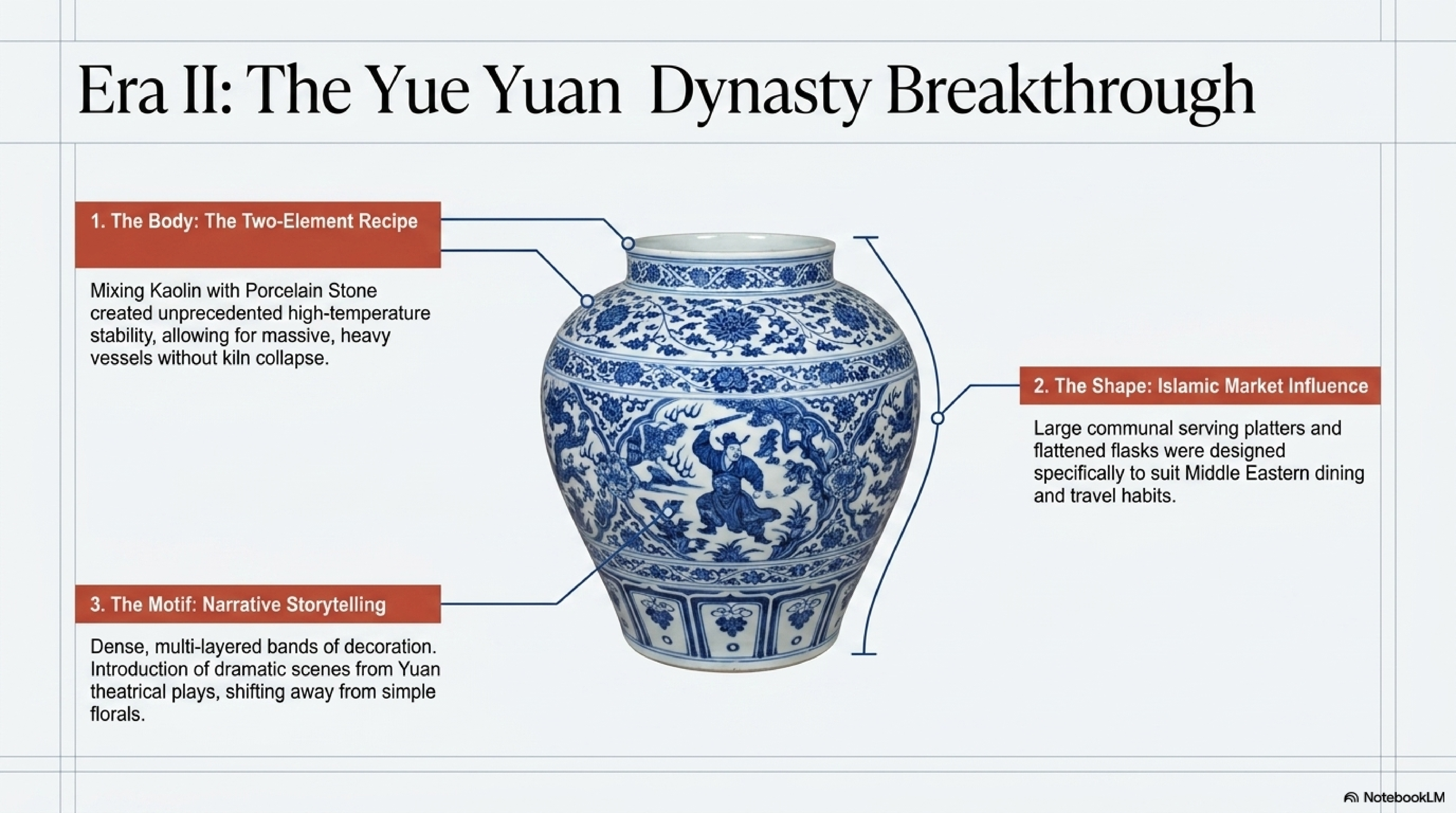
The breakthrough. Jingdezhen adopts the two-material body formula (瓷石 + 高岭土). Persian imported cobalt (苏麻离青) — high iron, low manganese — produces the deep, lustrous blue with characteristic iron-rust spots (锡斑). Large-scale vessels: the monumental Yuan blue and white that commands today's record prices.

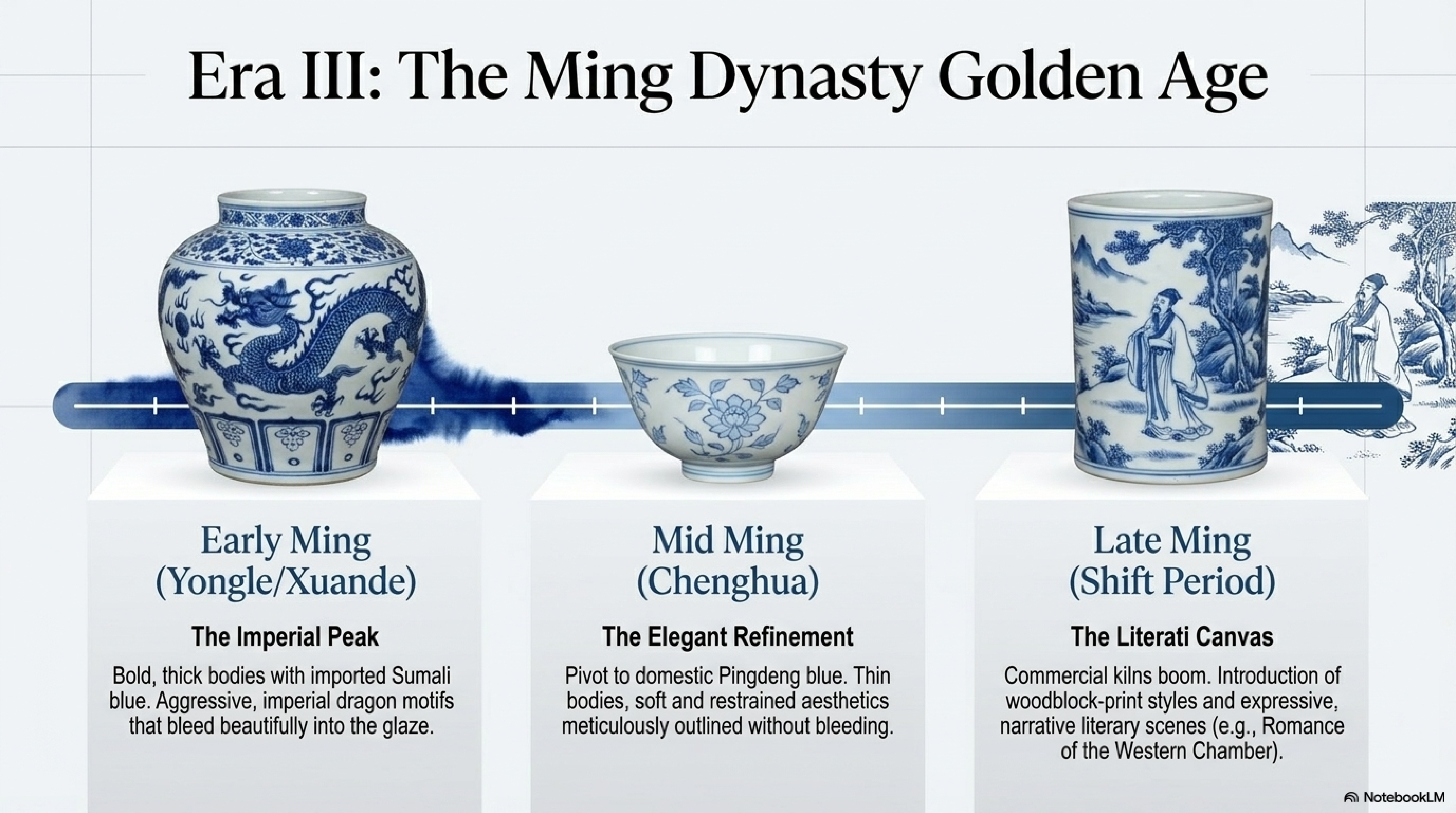
Ming Yongle–Xuande (1403–1435)

The golden age. Continued use of 苏麻离青. Characteristic 浓艳晕散 brushwork — rich, saturated colour that naturally bleeds and diffuses at stroke edges — with natural iron-rust sunken spots. Xuande pieces show the most confident draughtsmanship in Chinese ceramic history.

Ming Chenghua–Hongzhi (1465–1505)

Domestic cobalt era. Shift to local Pingdengqing (平等青): low iron, low manganese. Colour: pale, even, elegant — "cloud-veiled" (云遮雾障). Delicate small-scale forms, refined brushwork. A completely different aesthetic from the Yuan–early Ming boldness.

Ming Jiajing–Wanli (1522–1620)

Huiqing cobalt. Imported cobalt (回青) returns a blue-purple intensity: deep, vivid, tinged with violet. Bold decorative schemes, dense narrative coverage. Also the era of large-scale export production for the Western market.

Qing Kangxi (1662–1722)

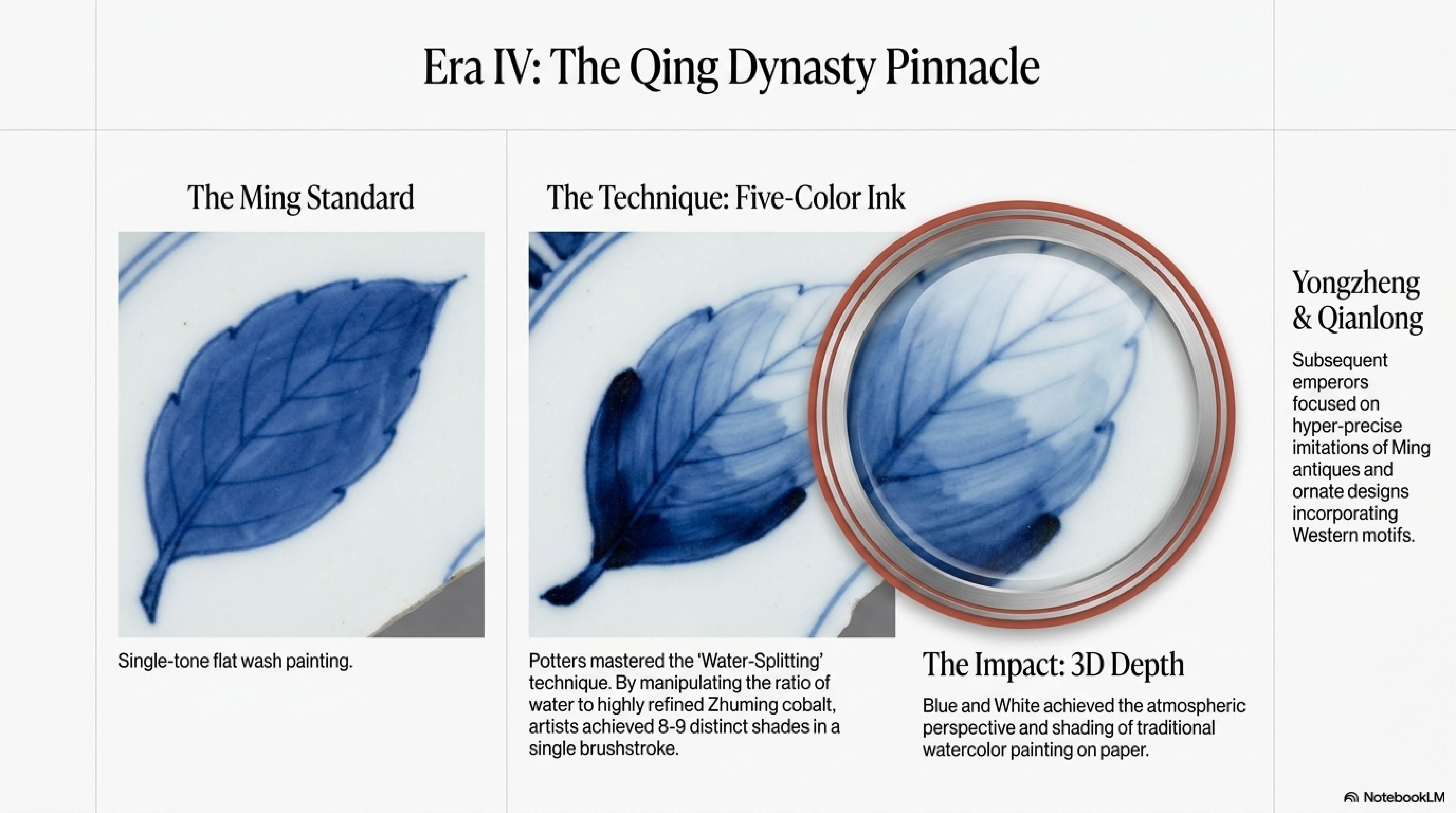
Technical summit. Use of Zhejiang / Zhuming cobalt (浙料/珠明料), perfected "graded wash" technique (分水皴法) — a single brushstroke produces up to five distinct tonal gradations. "Kingfisher blue" (翠毛蓝). Dubbed 五彩青花 for its tonal range: blue and white that achieves what coloured enamels aspire to.
Yuan blue and white — monumental jar with narrative scene, showing the mature two-material body, 苏麻离青 cobalt, and confident figurative painting

Yuan blue and white at its peak. The two-material body (porcelain stone + kaolin) enabled the large-scale forms — monumental jars, dishes, ewers — that defined Yuan production. The 苏麻离青 cobalt, sourced from Persia through the Mongol trade networks, produced a blue of exceptional depth and vibrancy. The narrative scenes (Yuan opera figures, dragons, phoenixes) were drawn with a confidence and freedom that court-controlled Ming production would never quite recapture.
The 3+1 Formula:
Body, Cobalt, Glaze, Fire

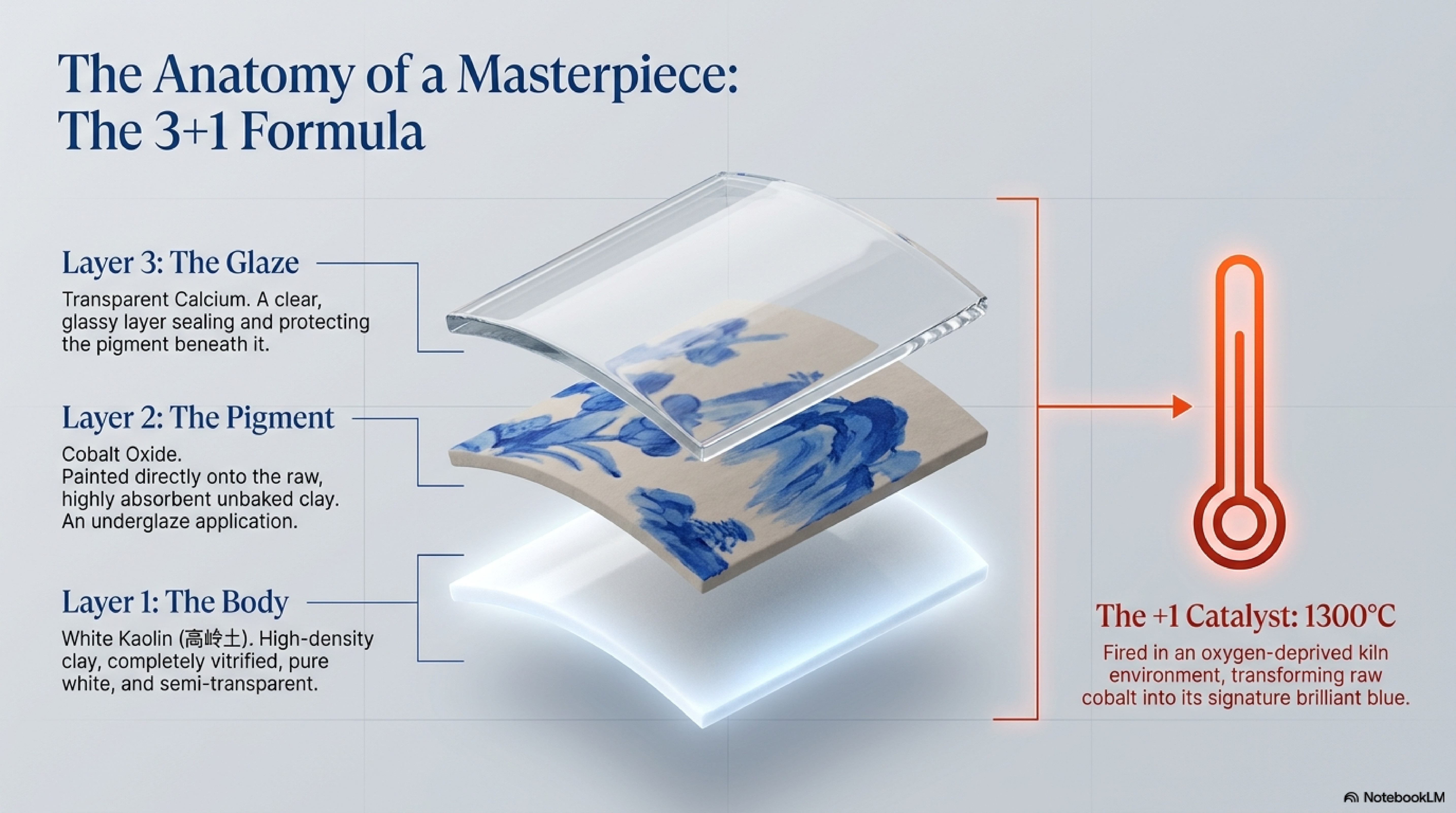
Blue and white porcelain is defined by four technical requirements that together constitute what the field calls the "3+1 core logic." Mastering this framework is the foundation of all informed collecting and authentication work.

The 3+1 formula diagram — pure white translucent porcelain body, cobalt underglaze pigment, transparent high-fire glaze, and 1300°C reduction firing atmosphere

The 3+1 formula. Three raw material requirements: (1) A pure white, semi-translucent fully vitrified porcelain body — no stoneware, no grey clay. (2) A cobalt-based underglaze pigment applied directly to the unfired body before glazing. (3) A transparent high-fire glaze applied over the painted surface. Plus one firing requirement: 1300°C+ in a reduction atmosphere (oxygen-depleted kiln environment) — the condition that suppresses iron impurities co-present in the cobalt mineral from firing to red-brown iron oxides, allowing the cobalt blue to dominate the finished colour.

The Two-Material Body Revolution

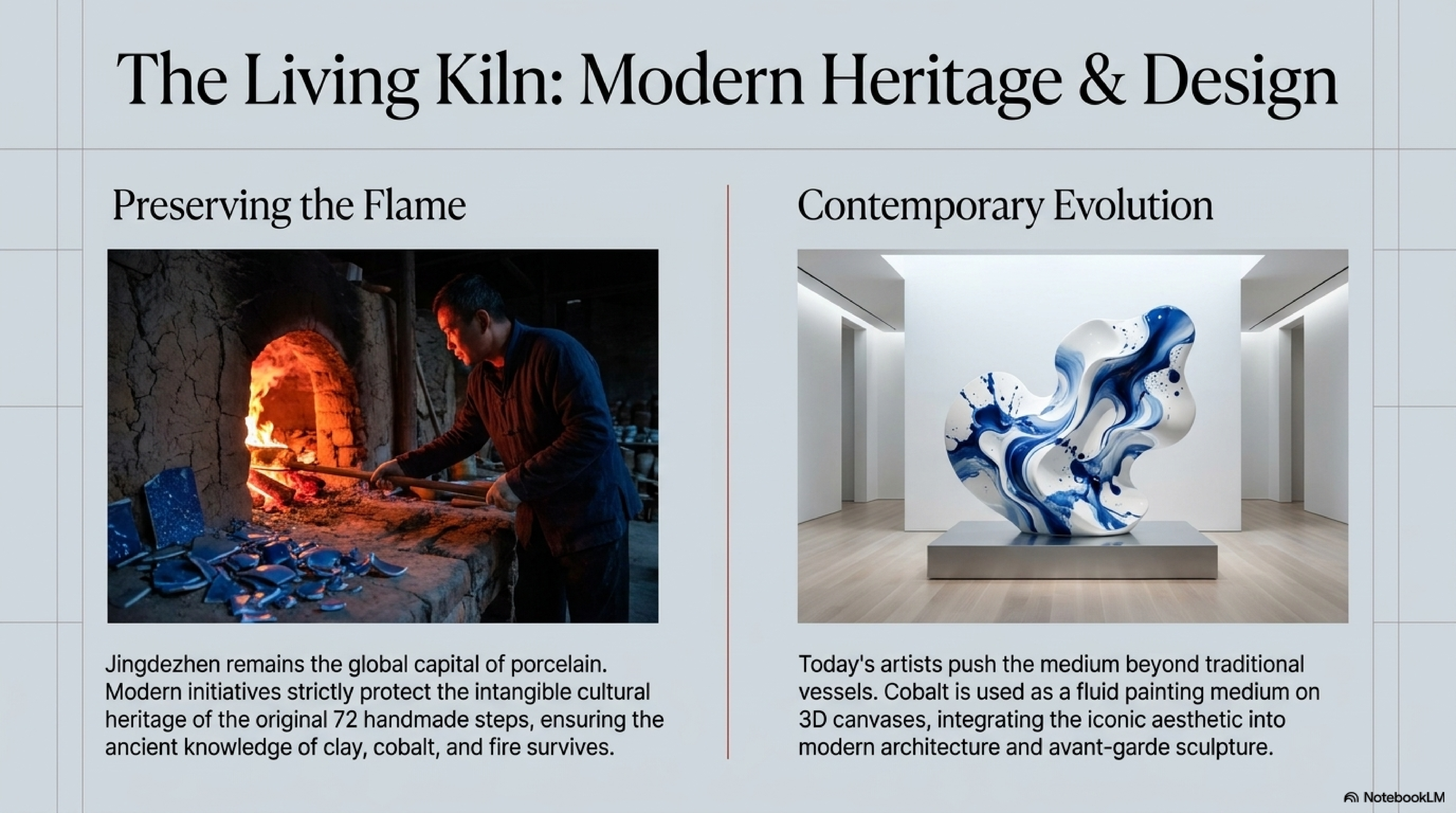
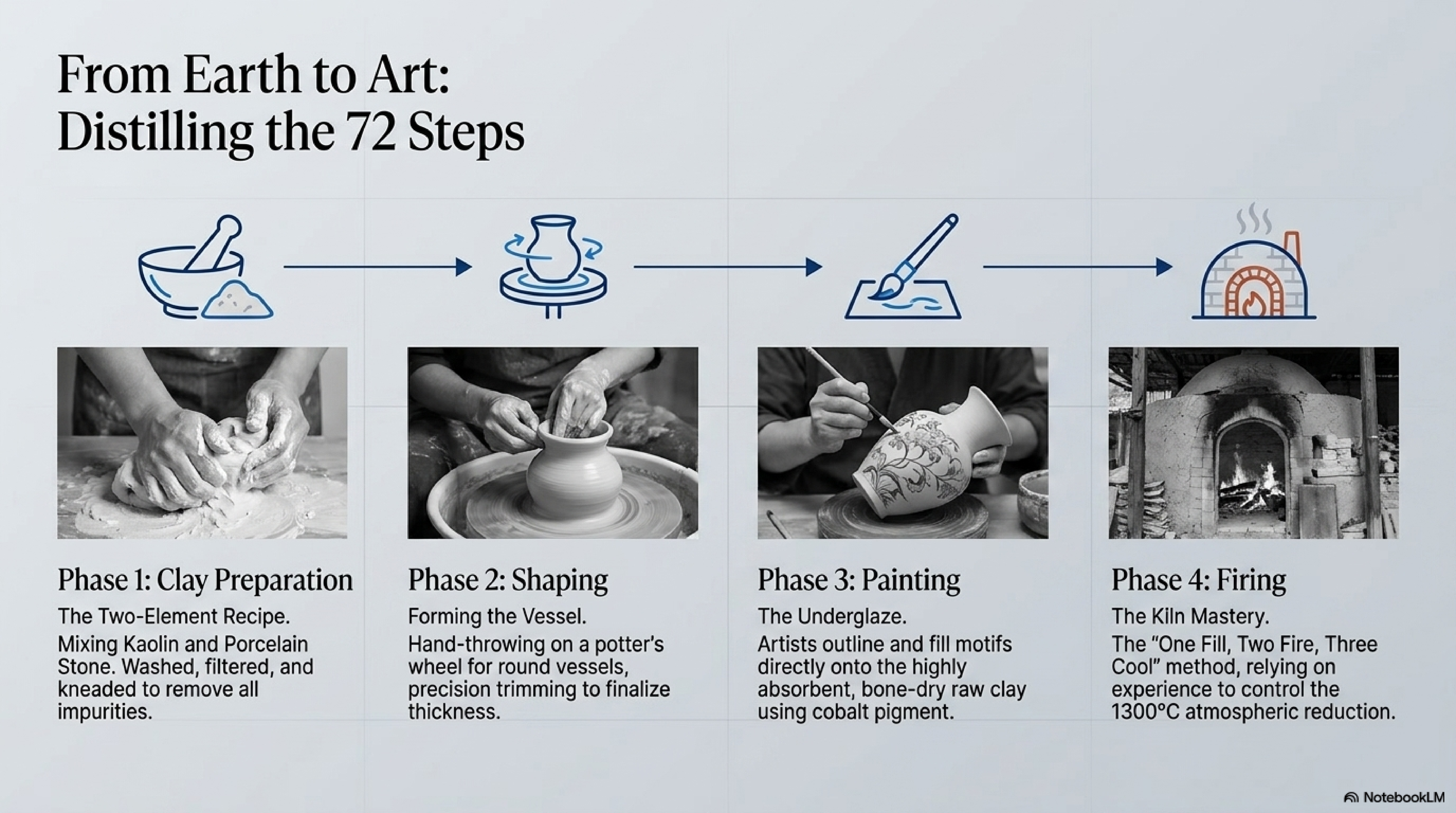
The Yuan dynasty's most significant technical contribution was the adoption of the 二元配方 (two-material body formula) — combining porcelain stone (瓷石) from the Sanbaoshanmine with kaolin (高岭土) from the Gaoling hills. The porcelain stone alone (the pre-Yuan Hutian formula) produced a beautiful, translucent body but one that collapsed at high temperatures when made large. The addition of kaolin dramatically increased alumina content and structural integrity, enabling the monumental Yuan and Ming vessel forms without kiln collapse.

Two-material body formula — porcelain stone plus kaolin, Al₂O₃ increase enabling large vessel production, compared with single-material pre-Yuan Hutian body

The two-material revolution. Single-material porcelain stone body (pre-Yuan): high silica, low alumina — beautiful translucency but structural limits on scale. Two-material body (Yuan onwards): kaolin addition raises Al₂O₃, stabilises the body at high temperature under the weight of large forms. This single change unlocked the monumental jar and dish forms that define Yuan and early Ming blue and white — and the same formula, refined over centuries, underpins all subsequent Jingdezhen porcelain production.

Large-Vessel Construction: The Joining Seam

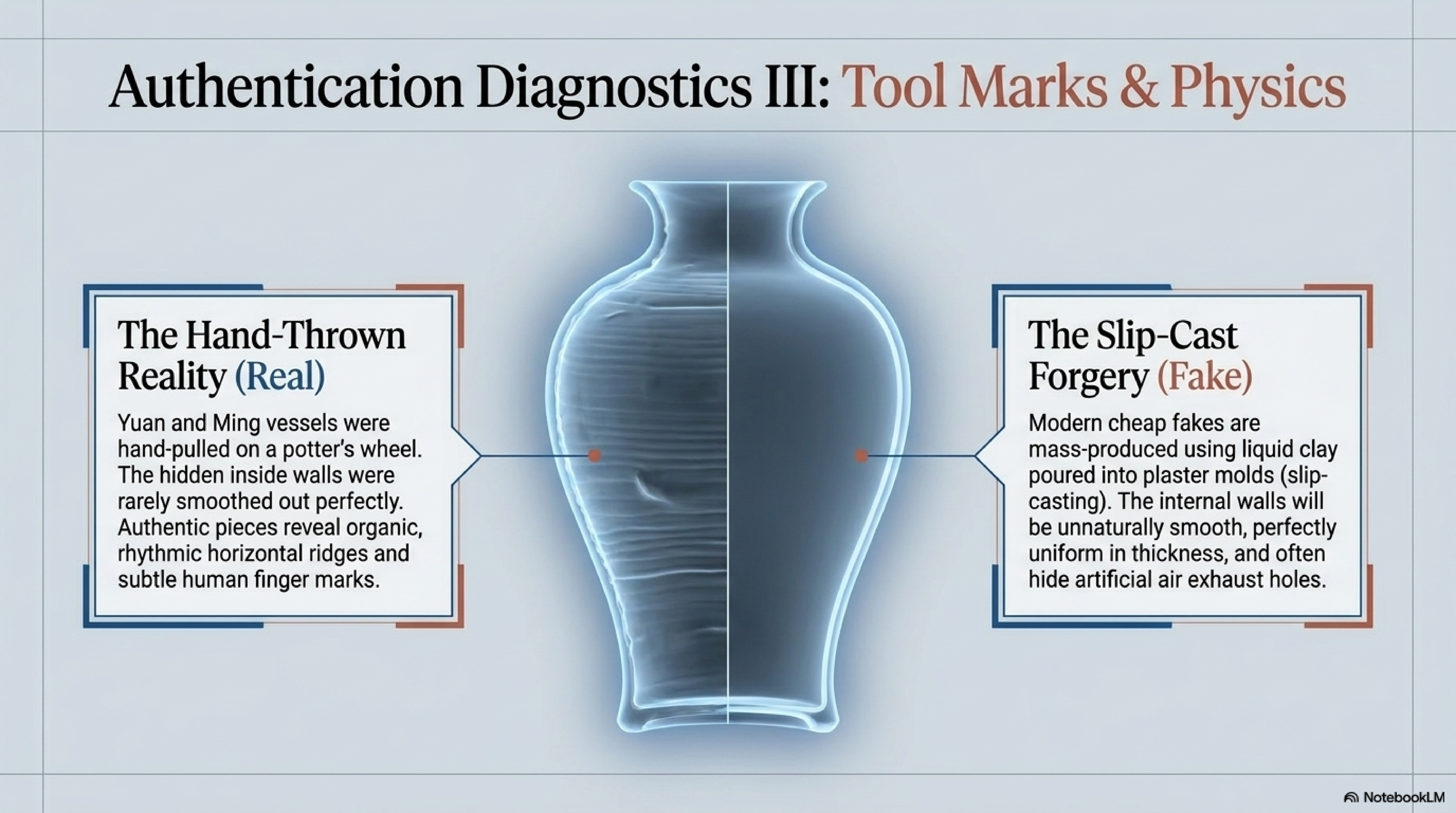
Large blue and white pieces — Yuan jars, Ming garlic-head vases, large dishes — were not thrown as single units. They were assembled in sections, joined at the leather-hard stage before glazing. The joining seam (接痕) is visible on authentic pieces as a subtle raised ridge around the widest circumference of large vessels. Its presence confirms hand-construction; its absence on a large piece is a red flag for mould-cast reproduction.

Reading the Blue:
Cobalt Type and Reign Mark

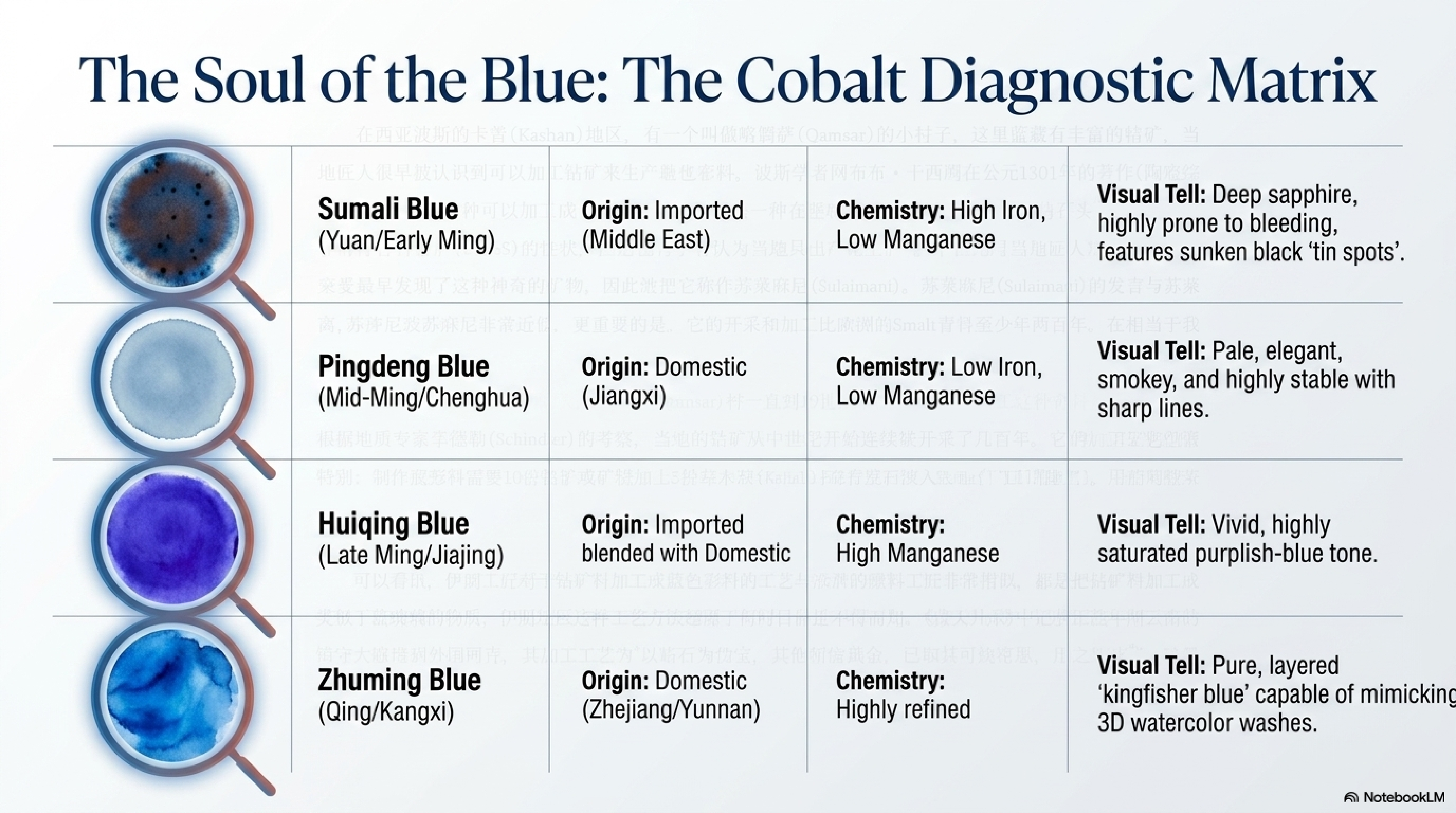
The fastest route to dating an unattributed blue and white piece is reading two things in combination: the cobalt tone and the reign mark (款识). Each dynasty and reign used characteristic cobalt sources with distinctive visual signatures — mastering these is the core skill of blue and white collecting.

Cobalt type comparison chart — 苏麻离青 deep blue with iron rust spots, 平等青 pale even elegant, 回青 blue-purple vivid, 浙料 bright clear multi-tonal

The four canonical cobalt types. 苏麻离青 (Yuan–Ming Yongle/Xuande): high iron, low manganese. Colour: deep, saturated, with naturally sunken black iron-rust spots (锡斑). 平等青 (Ming Chenghua–Hongzhi): low iron, low manganese. Colour: pale, even, cloud-like — the most refined and understated tone. 回青 (Ming Jiajing–Wanli): vivid, blue-purple intensity. 浙料/珠明料 (Ming late–Qing Kangxi): clear, bright, multi-tonal gradient possible.

Sumali Blue · 苏麻离青 Yuan · Ming Yongle / Xuande

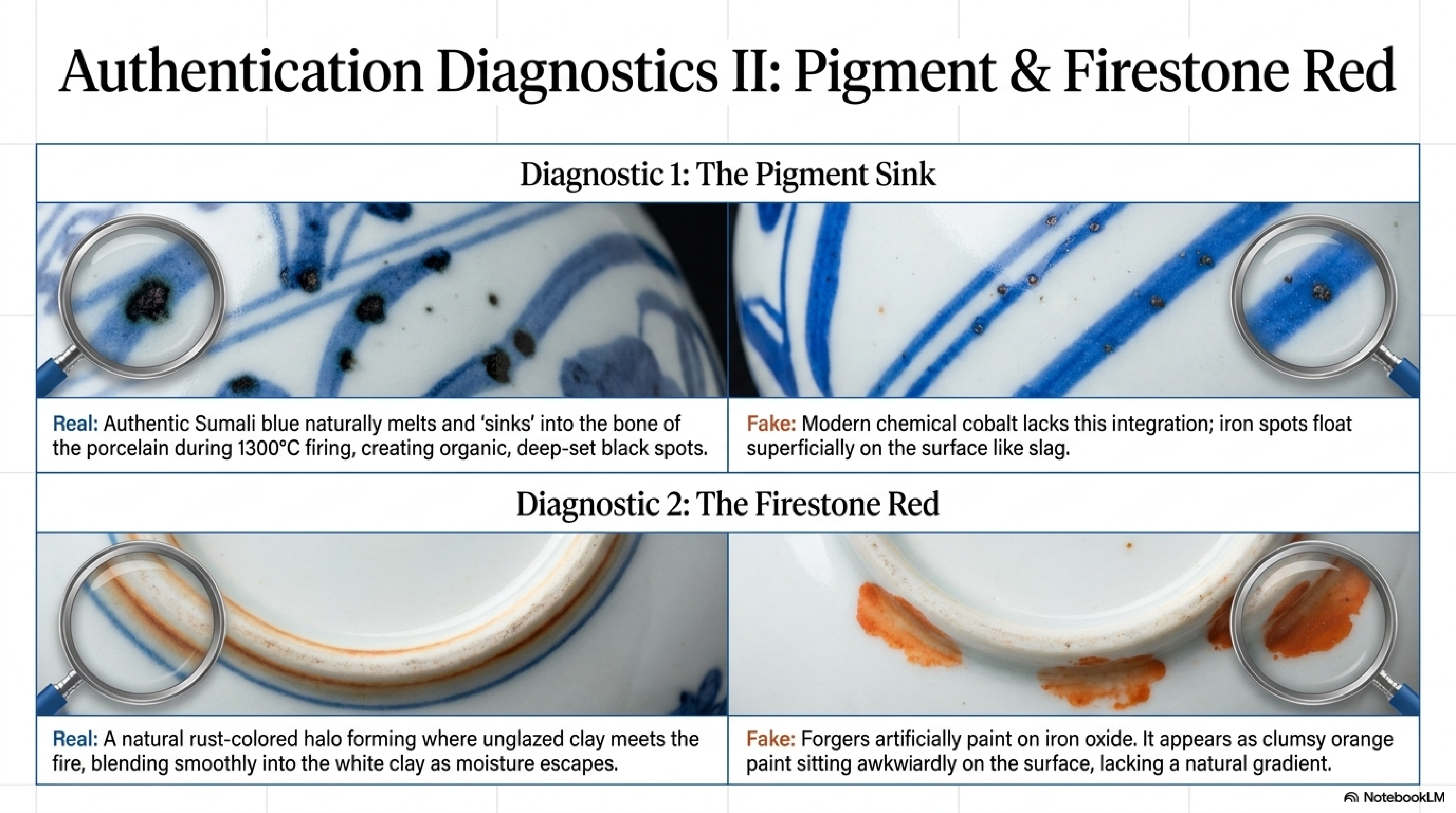
High iron, low manganese. Imported from Persia via Mongol trade. Deep, saturated blue with spontaneous black iron-rust spots (锡斑) that sink into the body — a physical marker no forgery has fully replicated. Brushwork: bold and saturated, with characteristic edge diffusion (浓艳晕散).

Pingdeng Blue · 平等青 Ming Chenghua · Hongzhi

Low iron, low manganese. Domestic source. Colour: pale, uniformly distributed, elegant — described as "cloud-veiled" (云遮雾障). Produces the delicate, refined tone of Chenghua chicken cups and Hongzhi dishes. Completely different character from Sumali — thinner, quieter, aristocratic.

Huiqing Blue · 回青 Ming Jiajing · Wanli

Imported cobalt with high manganese. Colour: deep blue tinged with purple-violet — vivid, assertive, unmistakable. Often blended with domestic cobalt to moderate intensity. The blue of densely decorated Jiajing jars and Wanli export pieces. Visually loud compared to Chenghua delicacy.

Zhejiang Blue · 浙料 Ming Late · Qing Kangxi

Domestic Zhejiang / Zhuming cobalt. Low iron, moderate manganese, high purity. Combined with Kangxi's perfected "graded wash" (分水皴法) — a single loaded brush producing five distinct tonal gradations — this produces the most painterly blue and white ever made. "Kingfisher blue" (翠毛蓝).

Reign mark (款识) guide — Ming dynasty mark characteristics from Yongle through Wanli, Qing Kangxi through Qianlong, with calligraphic style notes

Reading the reign mark (款识). Ming: Yongle marks are rare (usually incised, not painted); Xuande marks abundant and confident; Chenghua marks "fat" (肥) and rounded; Hongzhi marks "elegant" (秀); Zhengde marks "respectful" (恭); Jiajing marks "varied" (杂) — sometimes with Taoist inscriptions added. Qing: Kangxi marks neat and regular; Yongzheng marks vigorous and slightly archaic; Qianlong marks dense and formulaic (often seal script). Critical caveat: reign marks were routinely copied in later periods as a mark of respect — a Xuande mark does not guarantee a Xuande piece.

Dynasty-by-dynasty blue and white comparison — actual pieces shown side by side from Yuan through Kangxi, with cobalt tone and decorative style notes

Dynasty comparison. Left to right: Yuan (deep, spontaneous 苏麻离青, bold figurative scenes), Xuande (refined 苏麻离青, controlled draughtsmanship), Chenghua (pale 平等青, delicate small-scale), Jiajing (vivid 回青, dense crowded decoration), Wanli (blue-purple 回青, export-oriented open compositions), Kangxi (brilliant 浙料, five-tonal gradients, landscape scenes). The visual shift across these six is greater than between any other comparable sequence in world ceramics.

Old vs. New:
Five Authentication Tells

Blue and white is the most extensively forged category in Chinese ceramics — its visual recognisability, broad price range, and technically achievable appearance make it a constant forgery target. Authentication requires reading a convergence of physical markers, not any single feature in isolation.

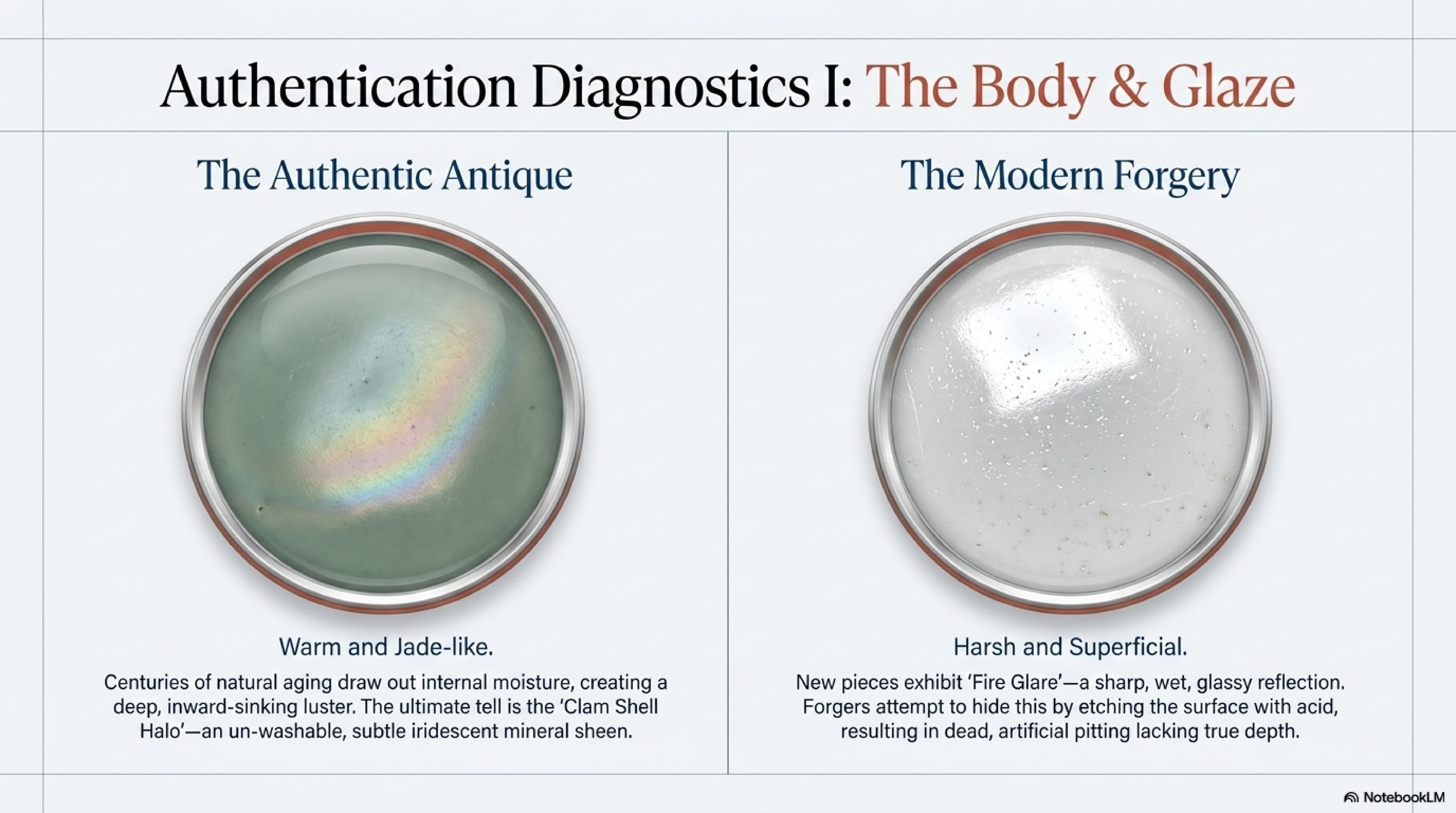
Glaze surface authentication — genuine soft jade-like luster with 蛤蜊光 iridescence versus modern 'fire flash' brightness and chemical treatment deadness

The glaze surface test. Authentic old blue and white: glaze surface is warm, jade-like, with a soft internal luminosity — described as "moist" (温润如玉). After centuries, the outer glaze surface develops 蛤蜊光 (clam-shell iridescence) — a rainbow-like shimmer caused by mineral infiltration of micro-surface pores, which cannot be washed off. Modern forgeries exhibit either "fire flash" (火刺光) — a harsh, over-bright surface from rapid modern firing — or an artificially deadened matt surface from chemical acid-washing that mimics age.

Foot rim authentication — authentic dry aged foot with natural fire stone red versus modern wet over-white body and artificial painted fire stone red

The foot rim. Authentic old pieces: foot rim is dry to the touch, with a natural "sunken" quality — centuries of moisture loss. The exposed clay shows natural "fire stone red" (火石红), an orange-iron oxidation ring at the foot-glaze boundary that forms gradually in natural aging. Modern forgeries: foot rim is too white or too dense (refined modern clay); fake fire stone red is painted uniformly and too evenly — genuine fire stone red fades naturally inward from the boundary. One more marker: pre-Kangxi pieces typically show tool marks on the exterior foot but not the interior.

Brushwork comparison — genuine Yuan blue and white free confident strokes versus forgery hesitant traced lines under magnification

Brushwork under magnification. Authentic Yuan–Ming brushwork (top): each stroke is complete, directional, and confident — the cobalt pigment flows with the loaded brush, leaving edge variations that record the painter's hand movement. Forgery (bottom): the stroke profile is uniform and pressured — it was traced over a sketch rather than drawn freely. The hesitation points (where the brush slowed or lifted) are visible as pressure concentrations at stroke terminations. No amount of post-firing treatment conceals this difference.

Two Worlds of Blue:
The Court and the People

Blue and white production always operated on two parallel tracks: the imperial kilns (官窑) and the folk kilns (民窑). Understanding their differences is essential for any serious collector — they differ not just in quality and price but in aesthetic intent, decorative vocabulary, and cultural meaning.

Imperial versus folk kiln comparison — court dragon and phoenix motifs with regulated spacing versus folk opera scene, fishing scene, baby play with expressive freedom

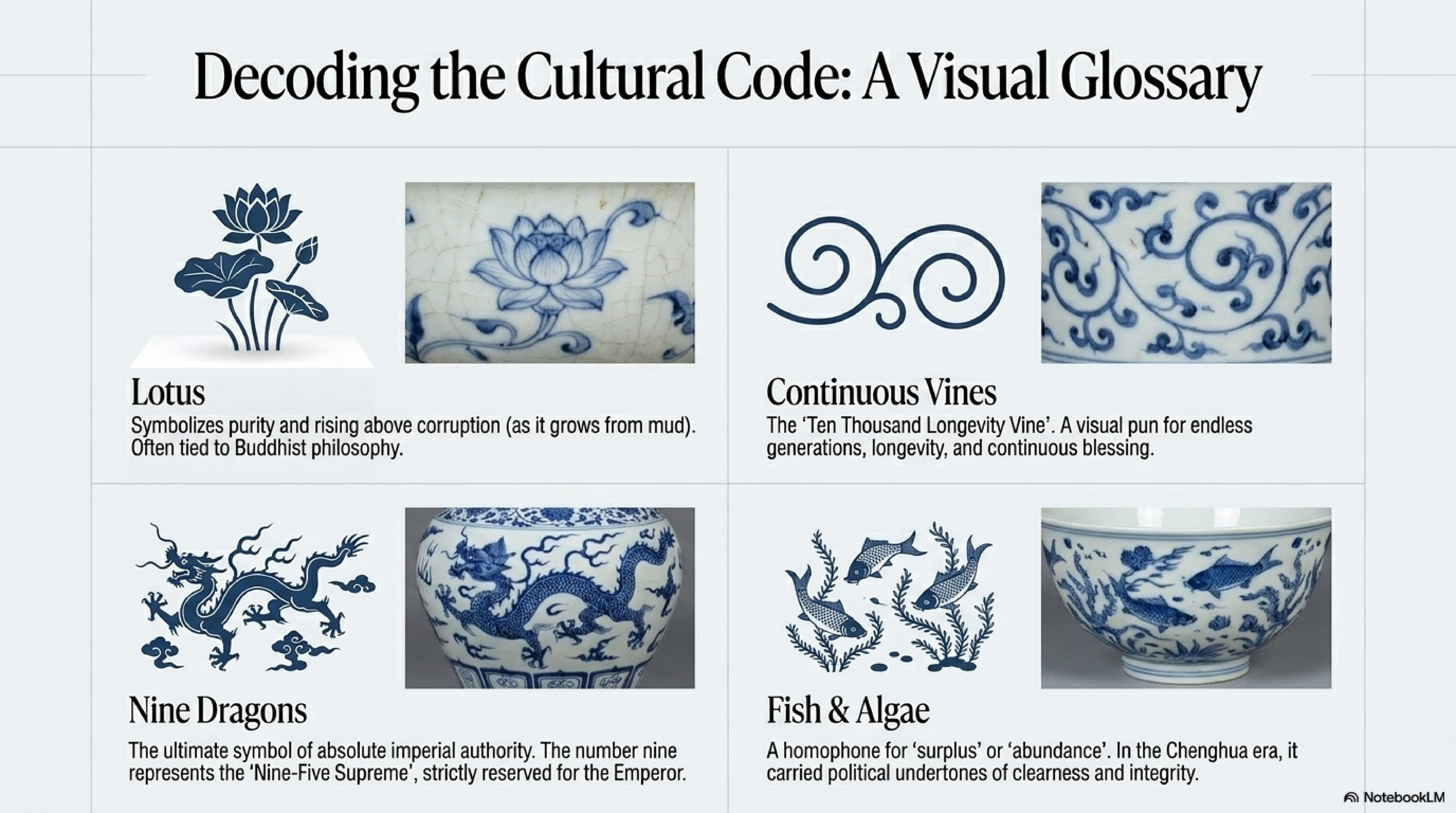
Two aesthetic worlds. Imperial (官窑, left): court production monopolised the finest cobalt and clay, prohibited commercial sale, and prescribed strict decorative rules. Motifs — dragons, phoenixes, lotus scrolls — follow rigid iconographic laws. The brushwork is meticulous, the spacing deliberate, the composition controlled. Folk (民窑, right): freed from court prescription, folk painters expressed the full range of Ming-Qing popular culture: opera scenes (戏曲故事), children at play (婴戏图), fishermen and woodcutters (渔樵耕读). The brushwork is faster, freer, more alive — and for many collectors, more interesting.

Imperial Kiln (官窑)

Court-supervised production at Jingdezhen. Access to the finest "official clay" (官土) and best-grade imported cobalt. Strict iconographic rules: dragons have five claws (court) vs. four (commoner). Decorative schemes follow approved templates — no improvisation. Rejects were systematically smashed to prevent civilian use. Reign marks mandatory and standardised.

Folk Kiln (民窑)

Commercial production for domestic and export markets. More varied clay and cobalt quality. Decorative freedom: opera stories, children playing, auspicious symbols, written poetry. The "three-stroke painting" (三笔画) tradition — entire motifs rendered in two or three confident strokes — produces pieces with a spontaneous vitality that court production rarely matches. Workshop marks ("张家造") begin appearing from the Ming period, reflecting an already well-developed commercial brand awareness among folk kiln operators.

Export blue and white — Kraak porcelain (克拉克瓷) with European heraldic panels and geometric borders, showing Eastern form adapted to Western commission

The export tradition: Kraak porcelain (克拉克瓷). From the late Ming, European trading companies commissioned blue and white to European decorative specifications — heraldic devices, geometric border panels, and Western figure scenes rendered by Chinese painters working from prints they had never seen in context. These pieces represent the earliest sustained cross-cultural design commission in ceramic history, and the beginning of the "China trade" aesthetic that would define European decorative arts through the 18th century.

"青花瓷不仅是中国的,也是世界的。"

— Blue and white as cultural evidence: the Persian cobalt in Yuan pieces, the European heraldry in Kraak export ware, the Japanese Imari that copied Chinese blue and white back to China — every layer of the tradition is a record of cultural exchange. Understanding blue and white is understanding how the world traded ideas through objects.
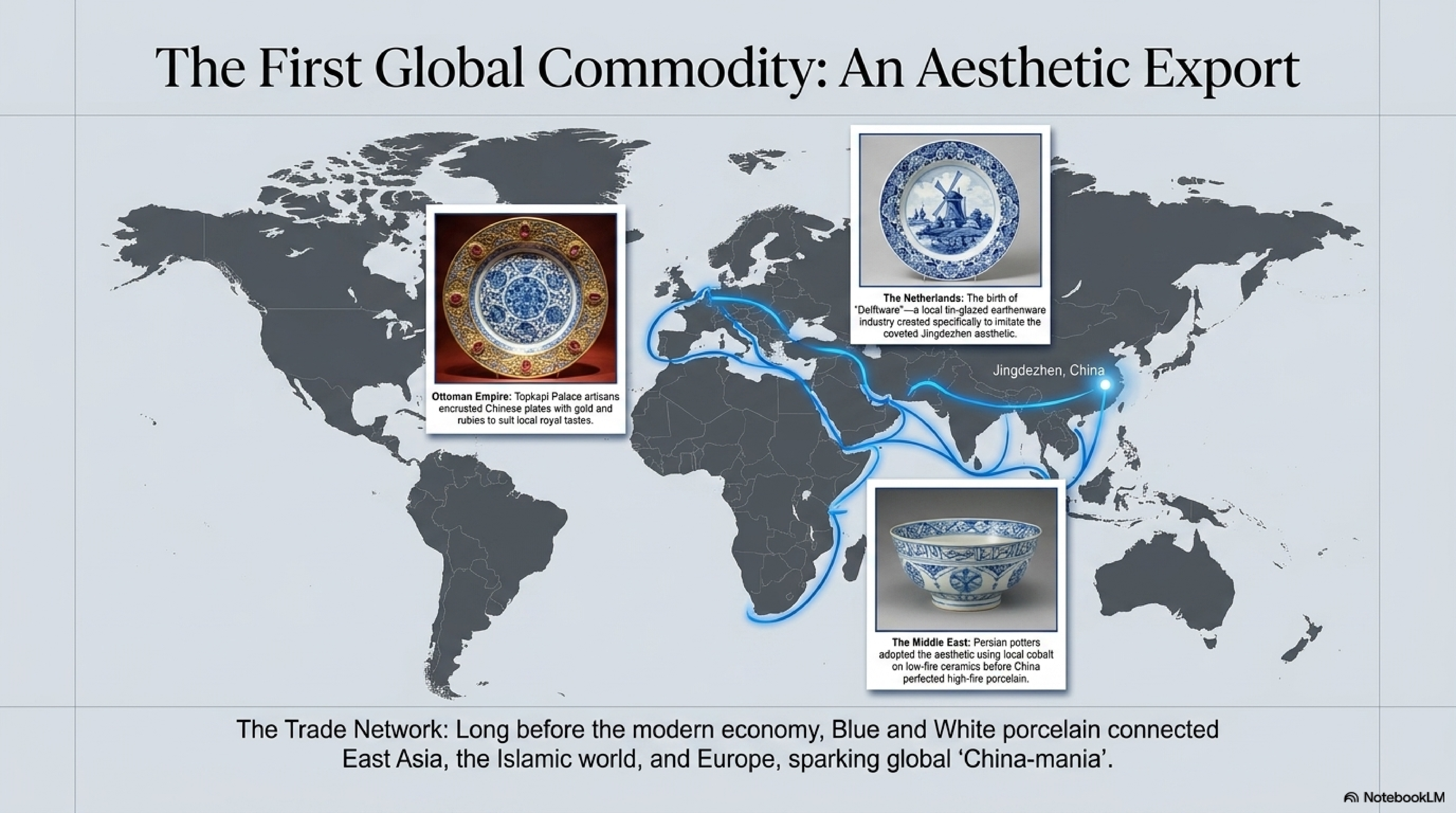
Global blue and white influence — Delft (Dutch), Imari (Japanese), Talavera (Spanish-Mexican) traditions all directly derived from Chinese blue and white prototypes

The global imitation network. Every major European and Japanese blue and white tradition derives directly from Chinese prototypes. Delft (Netherlands): Dutch East India Company imports sparked a domestic imitation industry by 1600. Imari (Japan): Arita kilns began producing blue and white from the 1610s–1640s, initially for domestic use. As political instability in the Ming disrupted Chinese exports in the 1640s–1650s, European traders turned to Arita to fill the gap — ironically selling Japanese-made "Chinese" blue and white back to European buyers. Talavera (Spain / Mexico): Spanish colonial workshops adapted the tradition for local taste, creating a distinct regional vocabulary still in production today.

From Our Collection

A selection of antique Blue and White porcelain currently available for acquisition. Each piece has been individually sourced and authenticated. Ships from the United Kingdom.

Antique Chinese Blue & White Tulip Vase with 8 Immortals within floral, 19th C

View on eBay →

Large Antique Chinese Blue & White Landscape Mug with Dragon Handle, Qianlong

View on eBay →

Delicate Antique Chinese Blue & White Landscape Small Cup with Lid, Qianlong Period

View on eBay →

A Pair of Antique Chinese Square Blue and White Dish with "Shou" and Chi Dragon

View on eBay →

A Pair of Chinese Blue and White 'Eight Steeds' Plates, Kangxi and of Period

View on eBay →

18th C Antique Chinese Export Blue and White Porcelain Tureen with 17th C Charger

View on eBay →

Antique Chinese Blue & White Bell-Shaped Beaker, Kangxi and of Period, H: 7.8cm

View on eBay →

Antique Chinese Blue and White Ogee Plate, Yongzheng and of the Period, D 21.5cm

View on eBay →

Antique Chinese Rare Blue and White Bamboo Ice Ginger Jar, Late Qing Dynasty

View on eBay →

Antique Chinese Blue & White Dragon and Phoenix Garlic-Shaped Vase with Mark, 19th C

View on eBay →

Antique Chinese Blue & White Ladies and Flowers Mini Jar, Kangxi and of Period

View on eBay →

All pieces ship from the United Kingdom.  ·  View all available pieces →