釉下青花为骨,釉上五彩为魂 · Contrasting Colours in Perfect Harmony
Two firings, two worlds of colour. Underglaze cobalt outlines, overglaze enamels fill — a technique born in the Xuande court and perfected under Chenghua into China's rarest polychrome formula.
Of Jingdezhen's Four Great Ceramics, Doucai (斗彩) stands apart as the most technically exacting — and the most market-defining. Its name, drawn from Jingdezhen dialect, means "to join" or "to assemble": underglaze cobalt blue and overglaze polychrome enamels brought together in a visual dialogue that no other ceramic tradition has replicated. A complete, precisely drawn cobalt outline beneath the glaze; enamel fills of three to five colours applied above — fired twice, at two entirely different temperatures, in two entirely different atmospheric conditions.
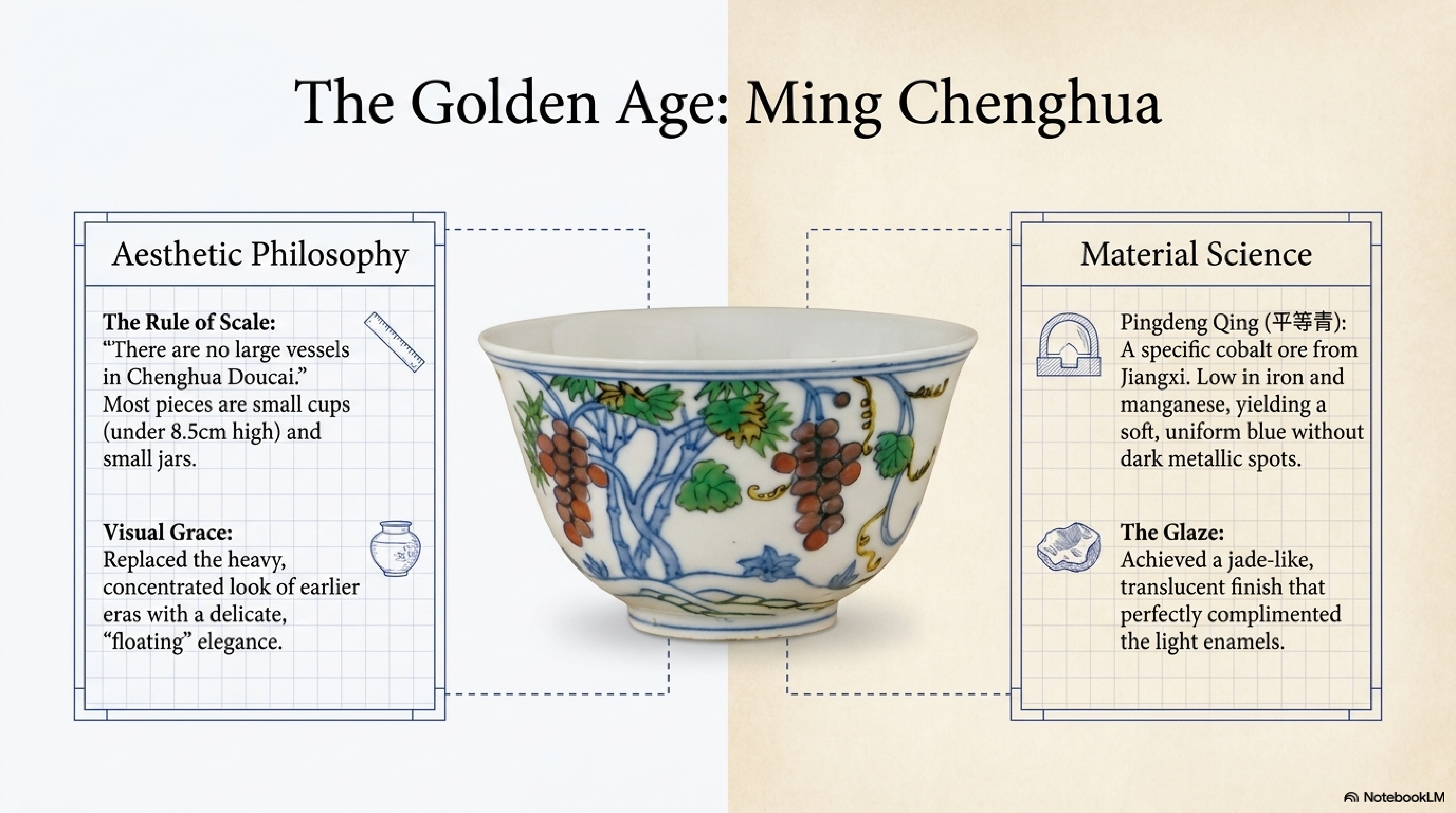
The technique was pioneered in the Xuande court (1426–1435), but its canonical form was established under the Chenghua Emperor (1465–1487) — an emperor who was, by most accounts, far more interested in his ceramics than in ruling. The Chenghua chicken cup (鸡缸杯) is its emblem: a small vessel, barely 8.5 cm high, that sold in 2014 for RMB 281 million. Understanding why requires understanding Doucai in full.
Cobalt on white. Yuan to Qing. The most globally traded Chinese ceramic.
Copper on white. "A thousand kilns for one treasure." The rarest high-fire colour.
Underglaze blue outlines, overglaze enamel fills. Ming Chenghua — the rarest formula. This guide.
Opaque pink enamels from Europe. Qing Yongzheng / Qianlong. The auction market's summit.
Five-colour overglaze. Ming Jiajing / Wanli. Bold, vivid, folk-inflected energy.
Fire, metal oxide, restraint. From Ming sacrificial red to Qing peachbloom. One colour, one fire.
"成化无大器" — No grand Chenghua vessel exists.
The most revered Doucai pieces in history are almost all small: cups, bowls, jars no taller than a hand. The Chenghua court valued refinement over scale. This restraint — so contrary to later Qing taste for monumental forms — is precisely what makes Chenghua Doucai the pinnacle of the tradition.Doucai did not emerge fully formed. Its development moves from an experimental conjunction of techniques under Xuande to a defined independent category under Chenghua, followed by a long decline and a Qing court revival that never quite recaptured the original's delicacy.
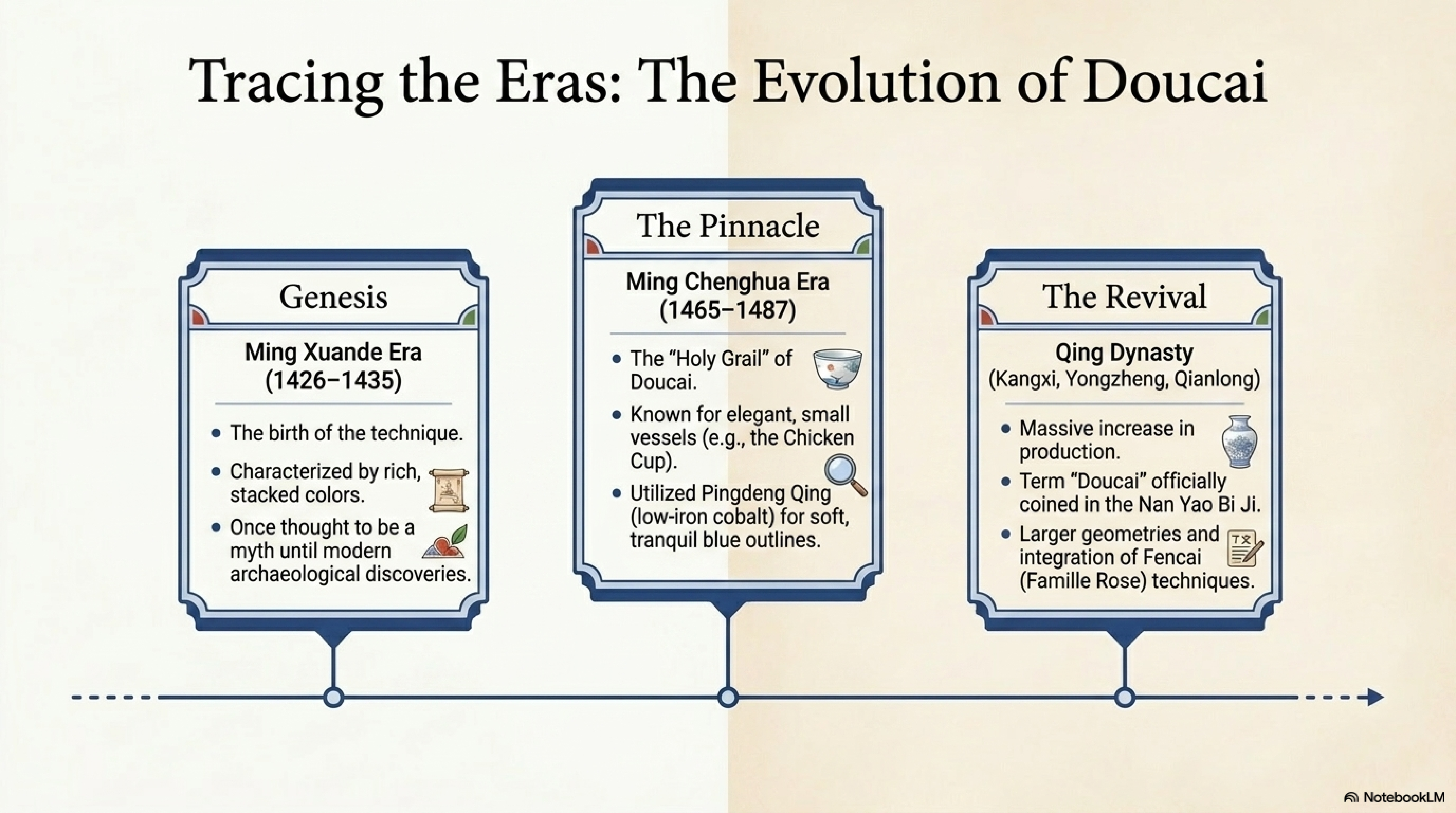
The developmental arc of Doucai. The Xuande prototype (西藏博物馆青花五彩莲池鸳鸯纹碗) established the conjunction of underglaze blue and overglaze enamel. Chenghua codified it as a distinct, named category — small, meticulous, technically exacting. The mid-Ming "blank period" (空白期 — Zhengtong, Jingtai, Tianshun reigns) produced few documented survivors. Jiajing and Wanli saw a coarser revival under the banner of 青花五彩. Qing three reigns (康雍乾) rebuilt Doucai production at scale, with Yongzheng integrating Famille Rose (粉彩) techniques to create a richer tonal range.
The prototype. The Xuande court produced the first documented conjunction of underglaze cobalt outline and overglaze polychrome enamel — most notably the 青花五彩莲池鸳鸯纹碗 now in the Tibet Museum. Not yet called "Doucai" by name, but the technique is established.
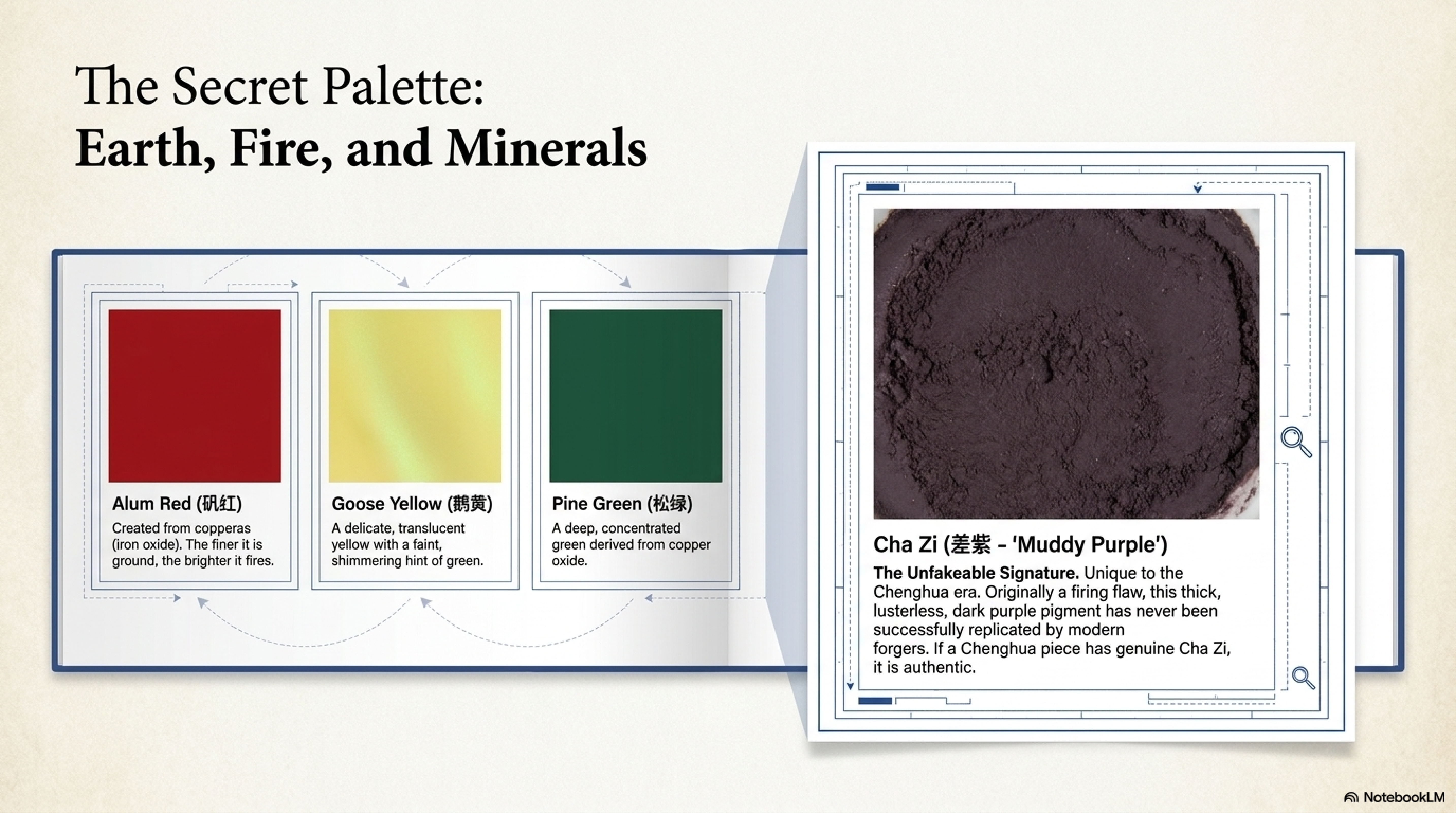
The pinnacle. Doucai emerges as a defined, named category. Chenghua pieces are exclusively small (成化无大器) — cups, bowls, jars under 25 cm. Characteristic colours: 鲜红 (blood red), 鹅黄 (pale translucent yellow), 姹紫 (deep opaque purple-brown). Reign marks ubiquitous and precisely calligraphed.
The gap. The three "blank reigns" (Zhengtong, Jingtai, Tianshun) — no reign-marked court porcelain documented. Fragment evidence shows production continued, but no major Doucai tradition survives.
Coarser revival. The dominant mode is now 青花五彩 rather than true Doucai — cobalt used as a colour rather than a structural outline. Brushwork is looser; colour fills are less precise. Quantity over refinement.
Scale revival. Doucai production resumes at the imperial kilns, with larger vessel forms previously unseen. Kangxi Doucai is more colourful and assertive than Chenghua, but lacks the minute precision of the original.
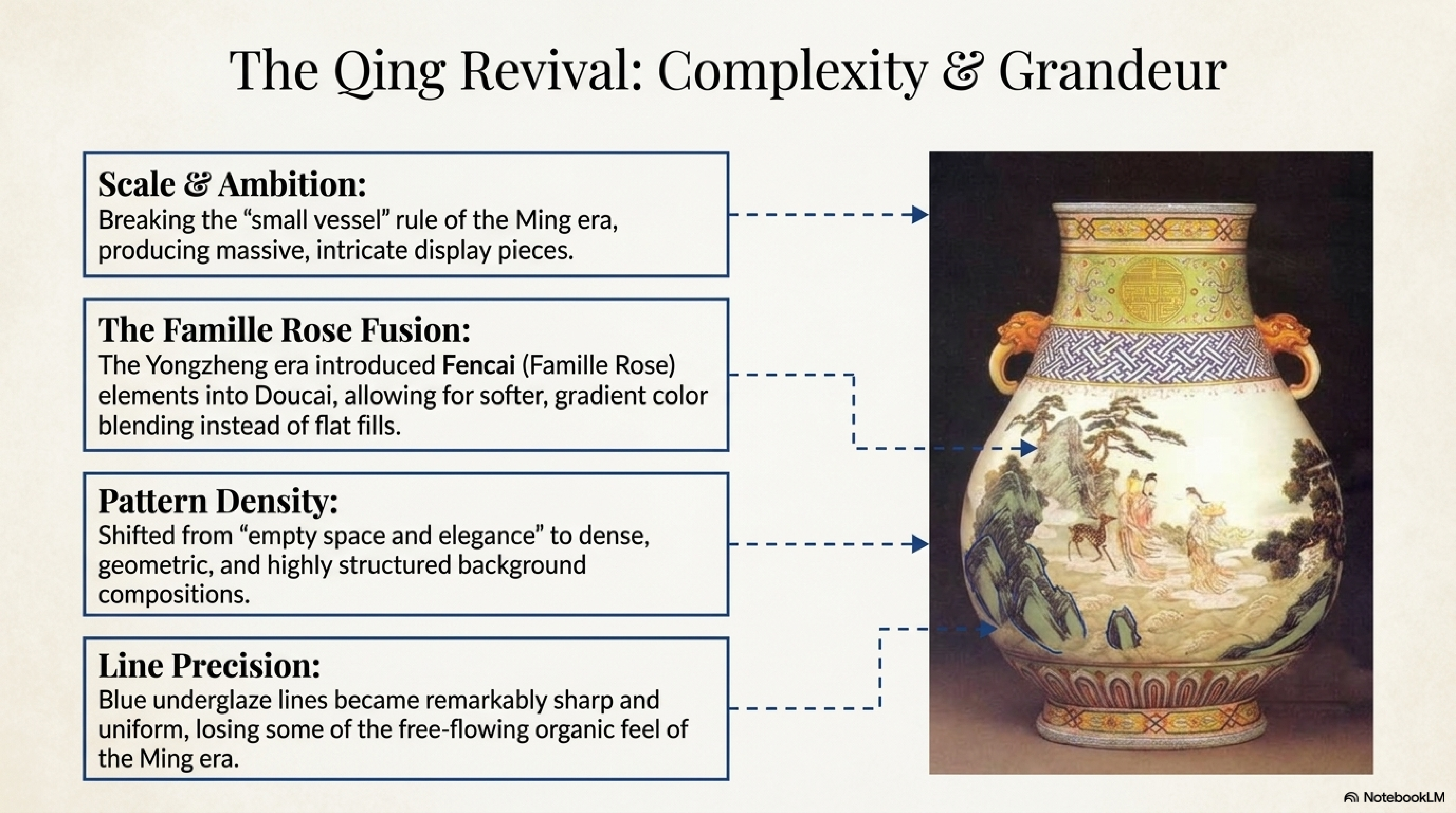
The Qing pinnacle. Yongzheng Doucai integrates Famille Rose (粉彩) techniques — the shading and tonal gradation of European-derived enamels applied within the Doucai framework. A more lavish and painterly result; aesthetically different from but technically superior to Chenghua's austere simplicity.
The Chenghua chicken cup (鸡缸杯). A rooster, a hen, and chicks among garden rocks and flowers — the complete iconographic programme painted in the tiniest possible scale, with cobalt outlines beneath the glaze and enamel fills of at least four colours above. The vessel is barely cup-sized. Its 2014 auction price of RMB 281 million reflects not merely rarity but the centuries-long consensus that Chenghua Doucai represents the pinnacle of Chinese polychrome porcelain making.
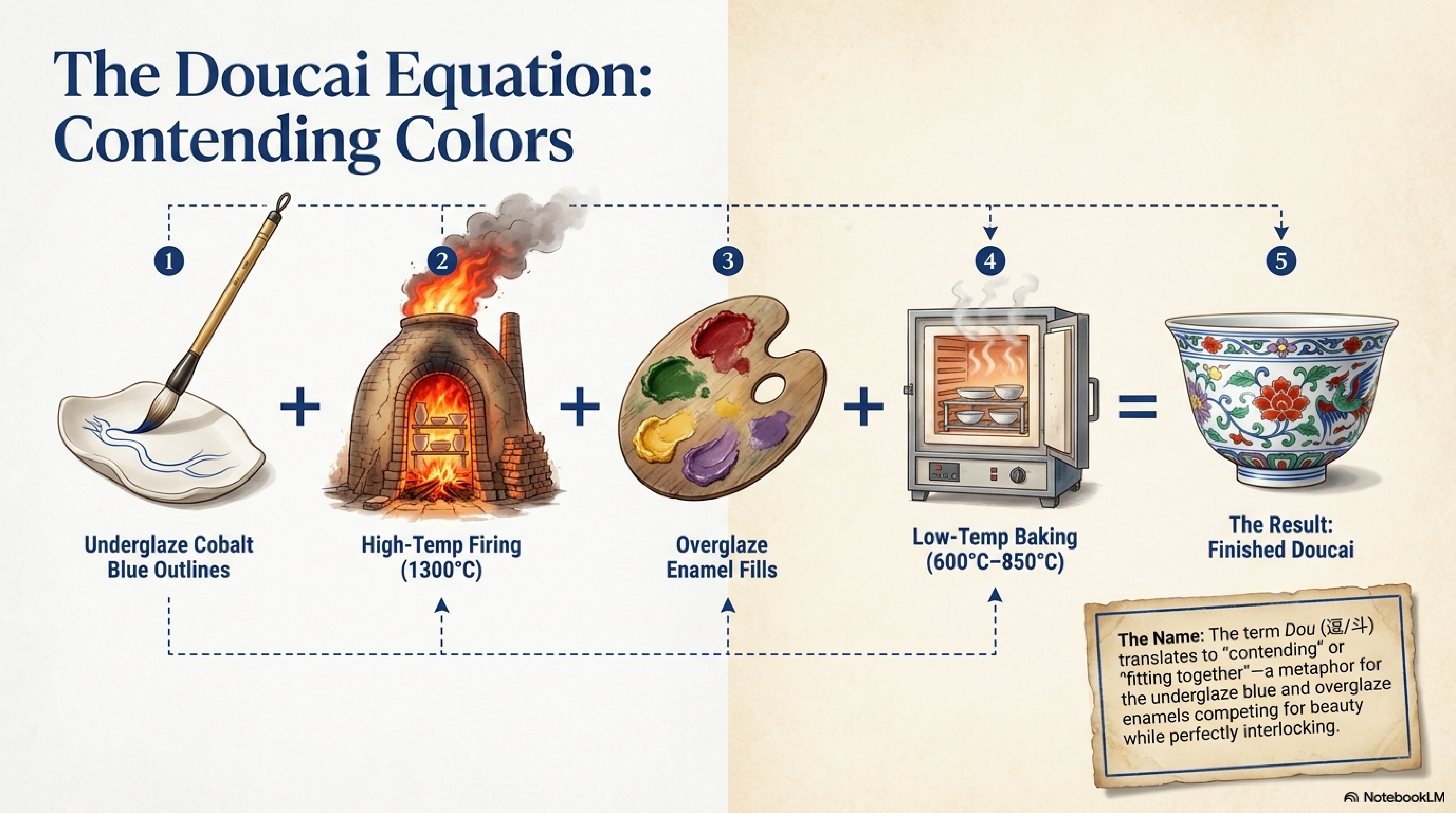
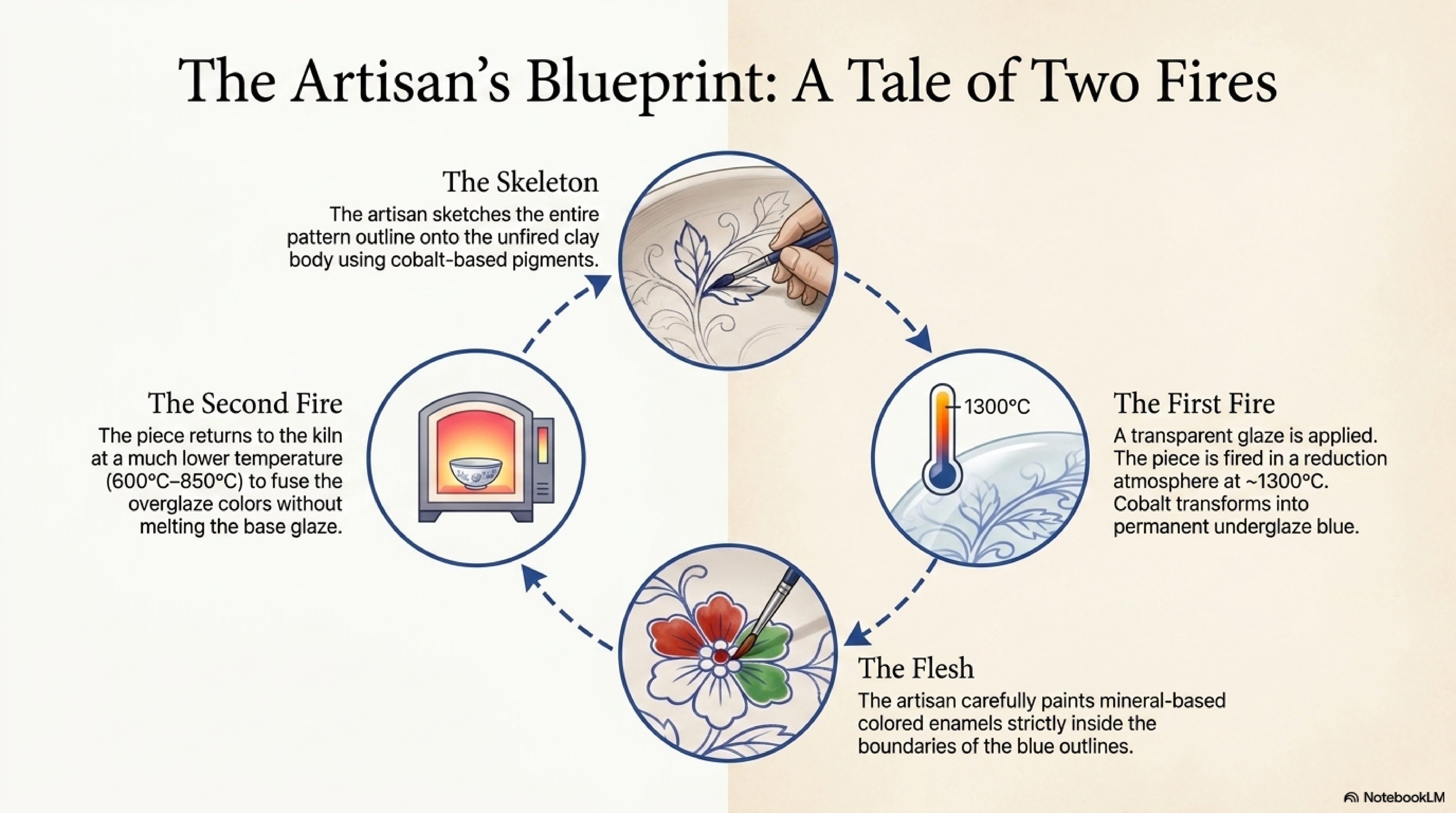
The defining technical characteristic of Doucai is its two-stage firing sequence — a process that requires the painter to complete two distinct phases of work at two different temperatures in two different atmospheric conditions, and to coordinate their visual outcome across a temporal gap that cannot be undone once committed.
The four-stage Doucai process. Stage 1 (釉下): Cobalt-blue pigment is applied to the unfired body, drawing complete outline contours for all decorative elements. Every line is decisive — nothing can be corrected after glazing. Stage 2 (高温): Transparent glaze is applied over the painted surface; the piece enters the kiln at approximately 1300°C in a reduction atmosphere (oxygen-depleted). The cobalt fires to its characteristic blue, permanently sealed under the glaze. Stage 3 (釉上): The fired piece is returned to the painter, who fills the cobalt-outlined areas with three to five overglaze enamel colours — the "filling" (填彩) step. Stage 4 (低温): The piece re-enters a smaller enamelling kiln at 700–800°C in an oxidising atmosphere; the overglaze enamels fuse to the glaze surface without disturbing the underglaze cobalt.
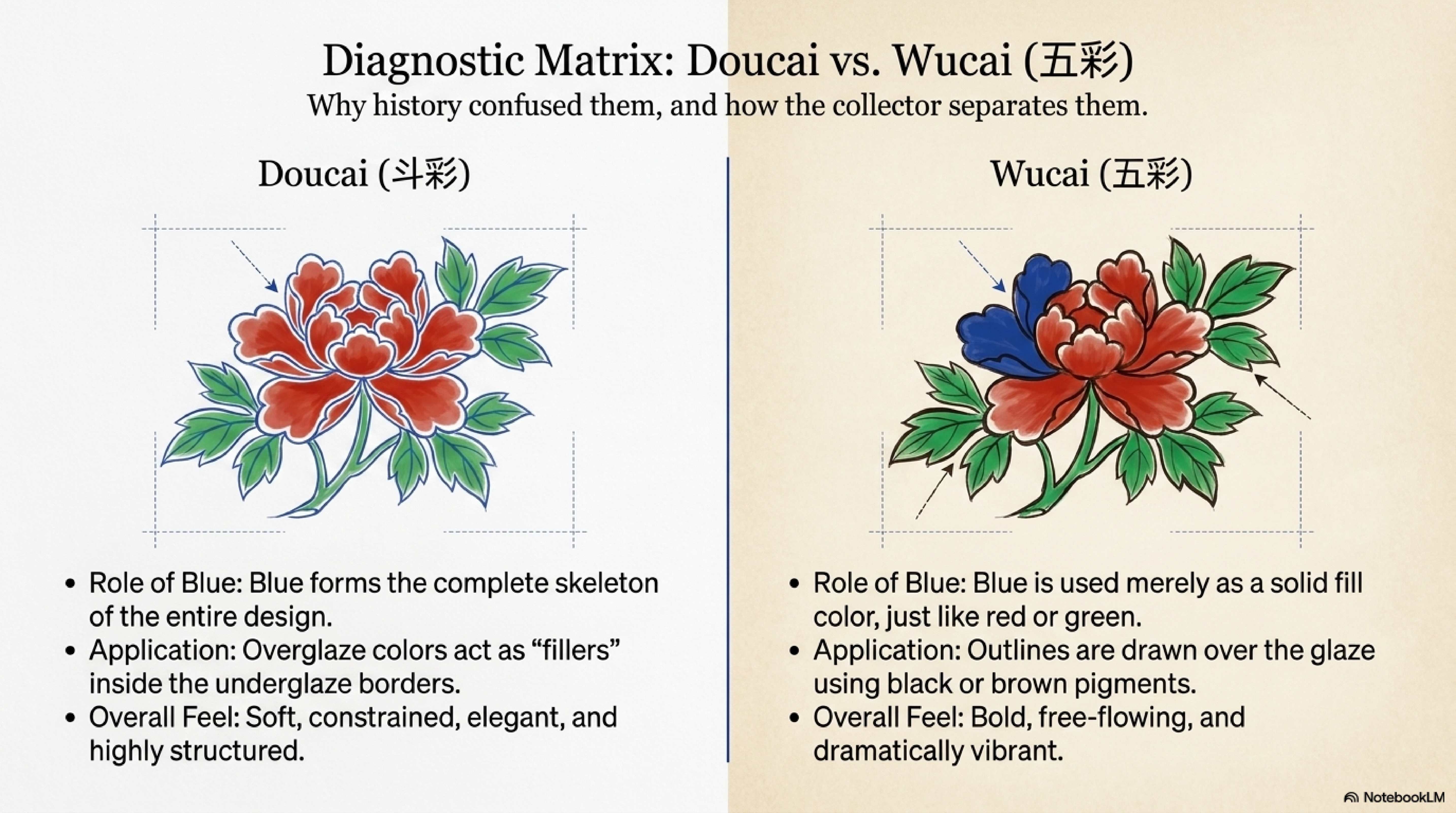
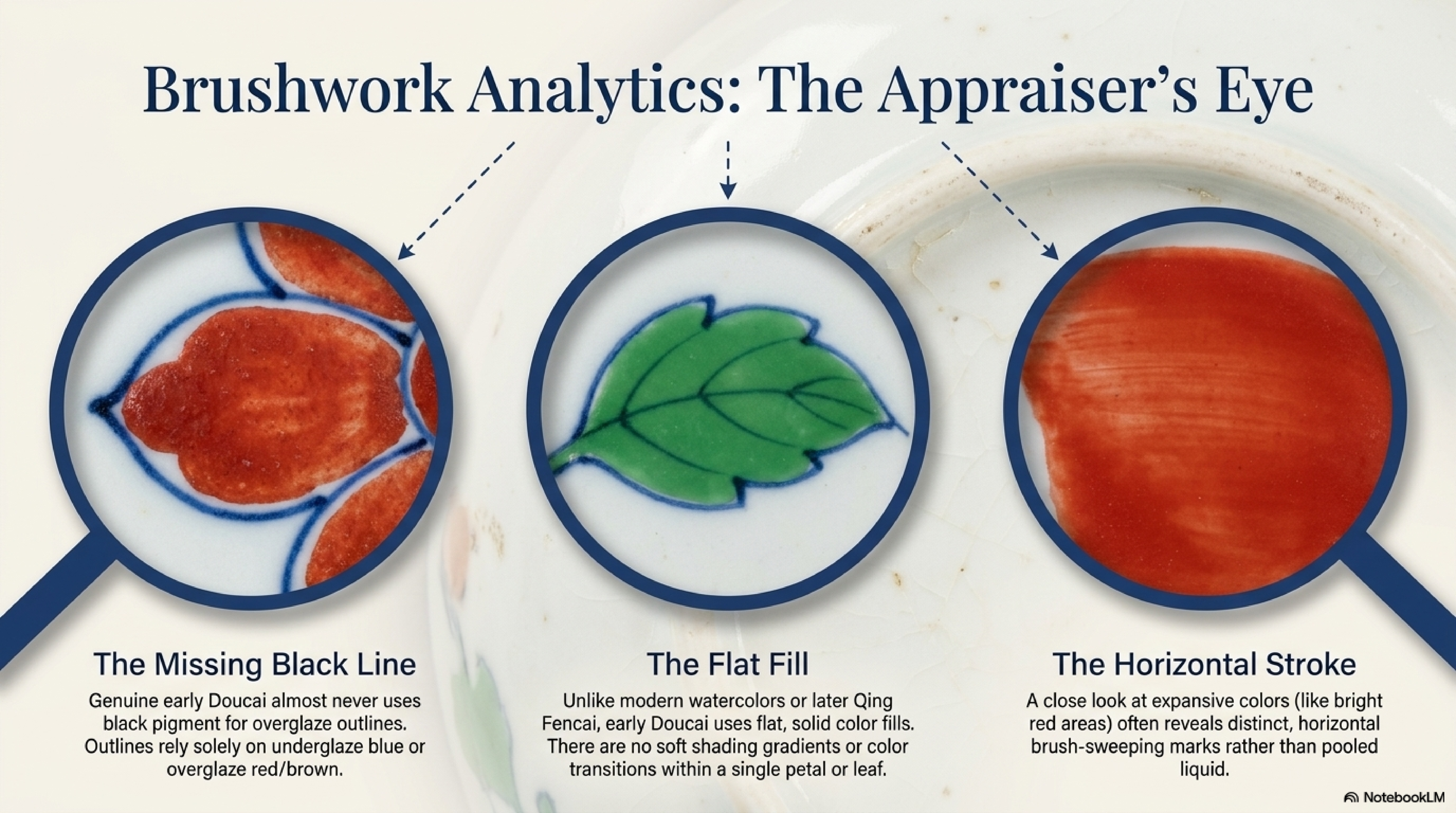
What distinguishes Doucai from all related polychrome traditions — particularly Wucai (五彩) — is the structural role of the underglaze cobalt. In Doucai, the cobalt line is not one colour among many: it is the drawing, the defining contour of every decorative element. The enamel fills occupy the spaces created by the cobalt outline. Remove the outline and the decoration collapses. In Wucai and 青花五彩, cobalt appears as a colour field among other colour fields — it defines an area but does not draw the entire composition. This structural difference is the diagnostic criterion for attribution.
The three canonical Chenghua enamel colours that appear in period descriptions are:
The Chenghua enamel palette. Three colours define the Chenghua Doucai signature. 鲜红 (blood red): fully saturated, assertive, visually primary. 鹅黄 (goose yellow): thin, pale, semi-transparent — a colour of restraint and delicacy. 姹紫 (deep purple-brown): the most diagnostic marker — an opaque, colour-concentrated purple-brown with a notably dull (non-glossy) surface. No subsequent dynasty has convincingly replicated all three in combination. Forgeries almost always fail on the 姹紫: it is either too bright (Qing-style purple enamel) or too flat (modern reproduction).
Three converging criteria allow preliminary period attribution for Doucai: vessel scale, enamel palette character, and reign mark calligraphic style. No single criterion is sufficient — a large vessel with a Chenghua mark is not Chenghua; a small, precise vessel with faded 姹紫 and a "fat" (肥) mark almost certainly is.
Period comparison. Chenghua (left): small scale, the 姹紫/鹅黄/鲜红 palette, cobalt outlines of absolute precision, reign mark in the "fat" (肥) rounded calligraphic style. Yongzheng (centre): larger forms appear; Famille Rose (粉彩) techniques — the 洗染 shading method, the 玻璃白 ground — are integrated with the Doucai outline-and-fill structure, producing a more painterly, tonally richer result. Jiajing-Wanli (right): cobalt used as one colour among many rather than as structural outline; fill colours are coarser; the result is closer to 青花五彩 than true Doucai.
The definitive Doucai. Vessel scale invariably small (bowls under 25 cm, cups under 8.5 cm high). Palette: 鲜红/鹅黄/姹紫. Reign mark: "大明成化年制" in rounded, full ("fat") calligraphy with double-circle border. Body: translucent in transmitted light, showing a warm pinkish-ivory tone (肉红色).
Looser Doucai — closer to 青花五彩 in character. Cobalt serves as one colour field rather than complete structural outline. Larger vessels appear. Brushwork is bolder and less precise. Dense decorative schemes covering the full vessel surface. Historical and mythological narratives dominate.
Large-scale Doucai returns. Colour palette expands significantly — the constraints of Chenghua's three-colour scheme are abandoned. Brushwork is confident and painterly. Kangxi Doucai is visually assertive and colourful, but the delicate Chenghua balance between outline and fill gives way to broader decorative ambition.
The Qing pinnacle. Famille Rose (粉彩) integration: the 洗染 shading technique and 玻璃白 ground are used within the Doucai structure, producing compositions with genuine tonal gradation within colour fills — a technical sophistication Chenghua never attempted. Reign mark: "大清雍正年制" in regular, vigorous clerical script.
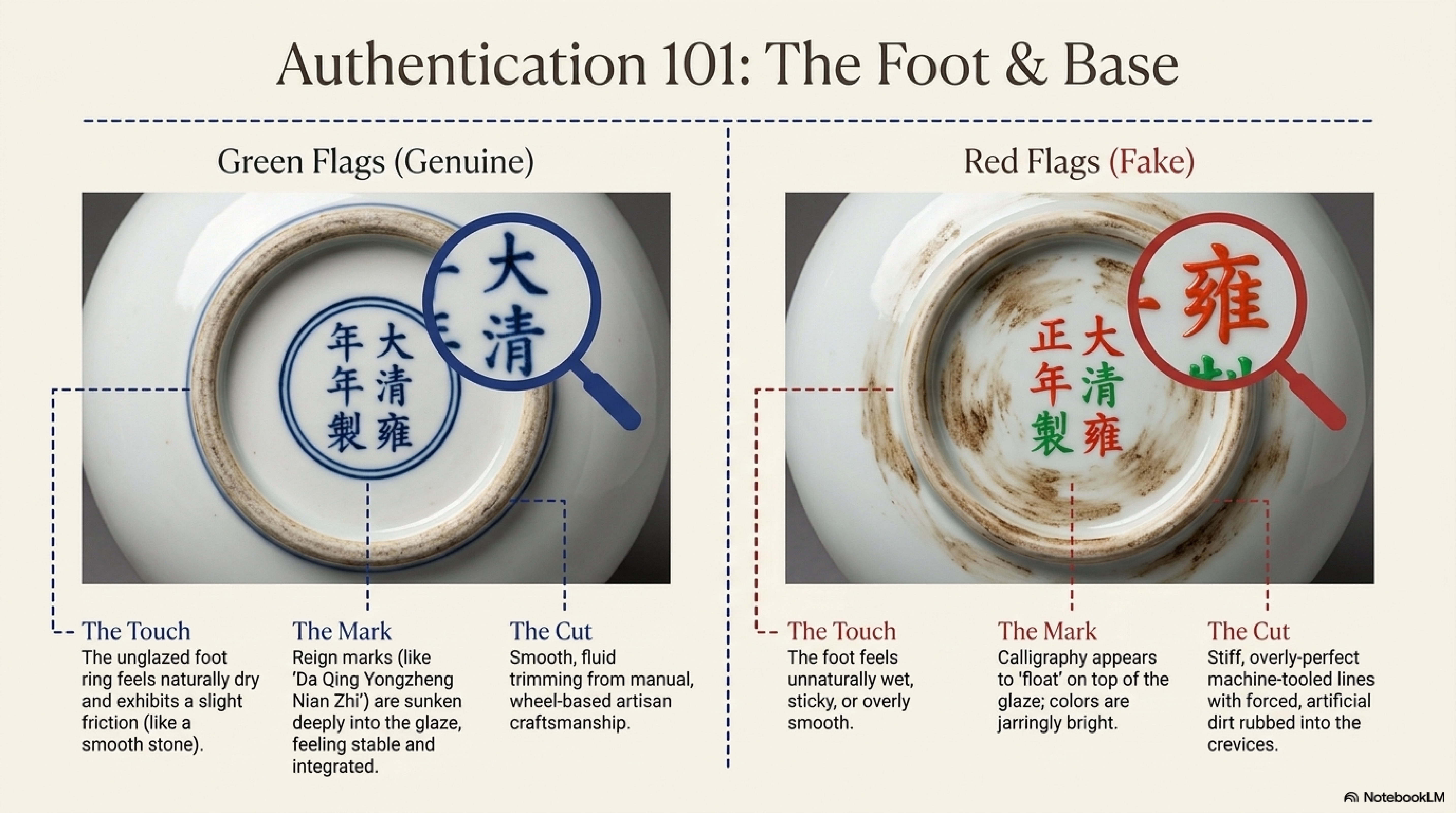
The Chenghua reign mark (款识). The standard Chenghua Doucai mark reads 大明成化年制 in six-character regular script within a double-circle border. Its calligraphic character is described as "肥" (fat, rounded) — the strokes are full and slightly thick, with a distinctive rounded termination rather than the sharp, angular endings of later Qing clerical script. The mark was among the most extensively copied in Chinese ceramic history — a Chenghua mark alone proves nothing; it must converge with scale, palette, and body character.
Doucai — especially Chenghua Doucai — commands some of the highest prices in Chinese ceramics. This makes it the most intensively forged category in the Ming polychrome tradition. Authentication requires a hierarchy of converging evidence; no single marker is dispositive.
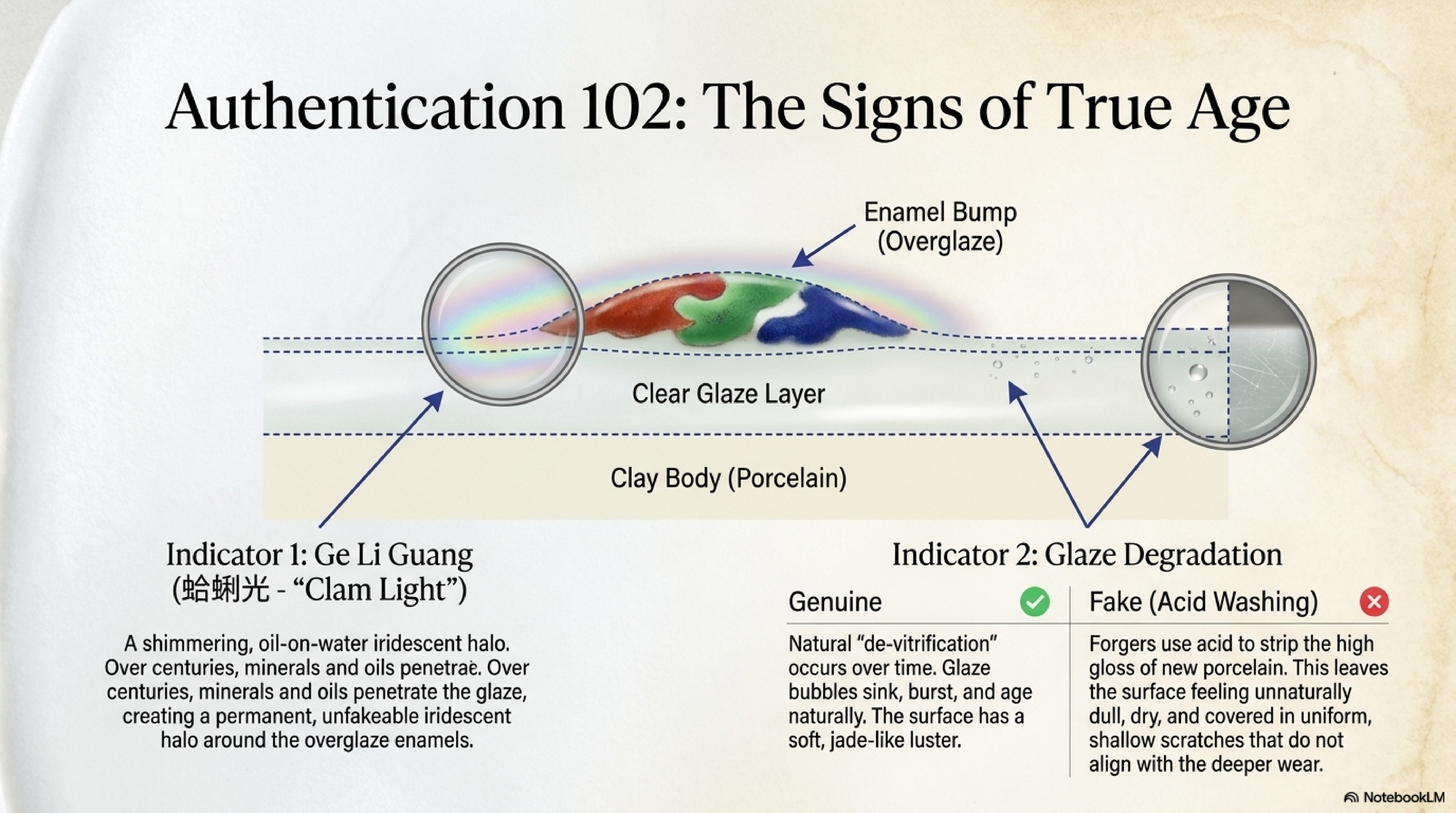
The authentication hierarchy. Layer 1 (visual): 蛤蜊光 (clam-shell iridescence) on the enamel and glaze surface — a rainbow shimmer from mineral infiltration of micro-surface pores, formed over centuries, impossible to wash off. Layer 2 (material): the 姹紫 enamel character — dull, opaque, distinctly non-glossy. Modern reproductions invariably produce a brighter, more lustrous purple. Layer 3 (scientific): XRF (X-ray fluorescence) analysis of the glaze and enamel layers — excessive zinc, zirconium, or titanium (modern opacifiers) in the enamel composition immediately identifies post-1900 production.
Forgery tells. Modern Doucai reproductions fail in characteristic ways. The 姹紫 is wrong: too glossy, too purple-blue in tone rather than the dull brown-purple of the original. The 蛤蜊光 is absent or unconvincing — either non-existent (new piece) or applied chemically (too uniform, wrong colour range). The body in transmitted light is too cold and white — modern refined clay with low iron content. Any one of these, in isolation, might be dismissed; the convergence of all three makes the case conclusive.
The single most common misattribution in Ming polychrome ceramics is conflating Doucai with Wucai (五彩) or 青花五彩. All three traditions use cobalt blue and multiple overglaze enamels. The distinction lies not in the colours used but in the structural role of the cobalt — and this structural role changes everything about how the piece is painted, fired, and authenticated.
The structural distinction. Doucai (left): the underglaze cobalt forms a complete, closed-contour outline for every decorative element — a drawn framework that the overglaze enamels then fill, like a coloured-glass window lead. Every element in the composition has its cobalt border. Wucai (right): cobalt appears as a colour zone — a blue leaf, a blue wave — among other coloured zones (red flowers, green stems). The cobalt in Wucai is not drawing the composition; it is colouring part of it. A Wucai piece from which the cobalt were removed would still have a legible composition. A Doucai piece without the cobalt outline would have coloured fragments floating on white.
Cobalt role: Complete structural outline (完整轮廓线) — draws the composition
Overglaze: Fills within outlines; always contained
Firing: Two separate firings coordinated across the outline boundary
Key period: Chenghua Ming (1465–1487)
Diagnostic: No underglaze outline = not Doucai
Cobalt role: One colour field among several — no outline function
Overglaze: Independent colour fields; may overlap or extend freely
Firing: Same two-firing logic but compositionally unconstrained
Key period: Jiajing–Wanli Ming, Kangxi Qing
Diagnostic: Cobalt serving as one zone of colour = Wucai / 青花五彩
"斗彩者,青花与釉上五彩相争相斗,以青花为骨,以五彩为魂。"
The etymology of "Dou" in Doucai: in Jingdezhen dialect, 斗 means "to join" or "to assemble in contention" — underglaze and overglaze brought together in visual dialogue. The cobalt is the skeleton (骨); the enamels are the spirit (魂). One without the other is neither Doucai nor art.
The complete vocabulary. A Chenghua Doucai cup at its finest: the cobalt outline is decisive and complete — no gap, no correction, no hesitation. The 鲜红 fills the reserved areas with full saturation. The 鹅黄 is thin and semi-transparent, like light through amber. The 姹紫, true to its nature, reads as a dull, deep, almost mat purple-brown under raking light. Five centuries of analysis, scholarship, and forgery have never produced a consensus on how the Chenghua painters achieved this palette at this scale with this precision. It remains the unreplicated summit of Chinese polychrome ceramics.