Origins & History
From Song Experiment to Kangxi Hard Colour
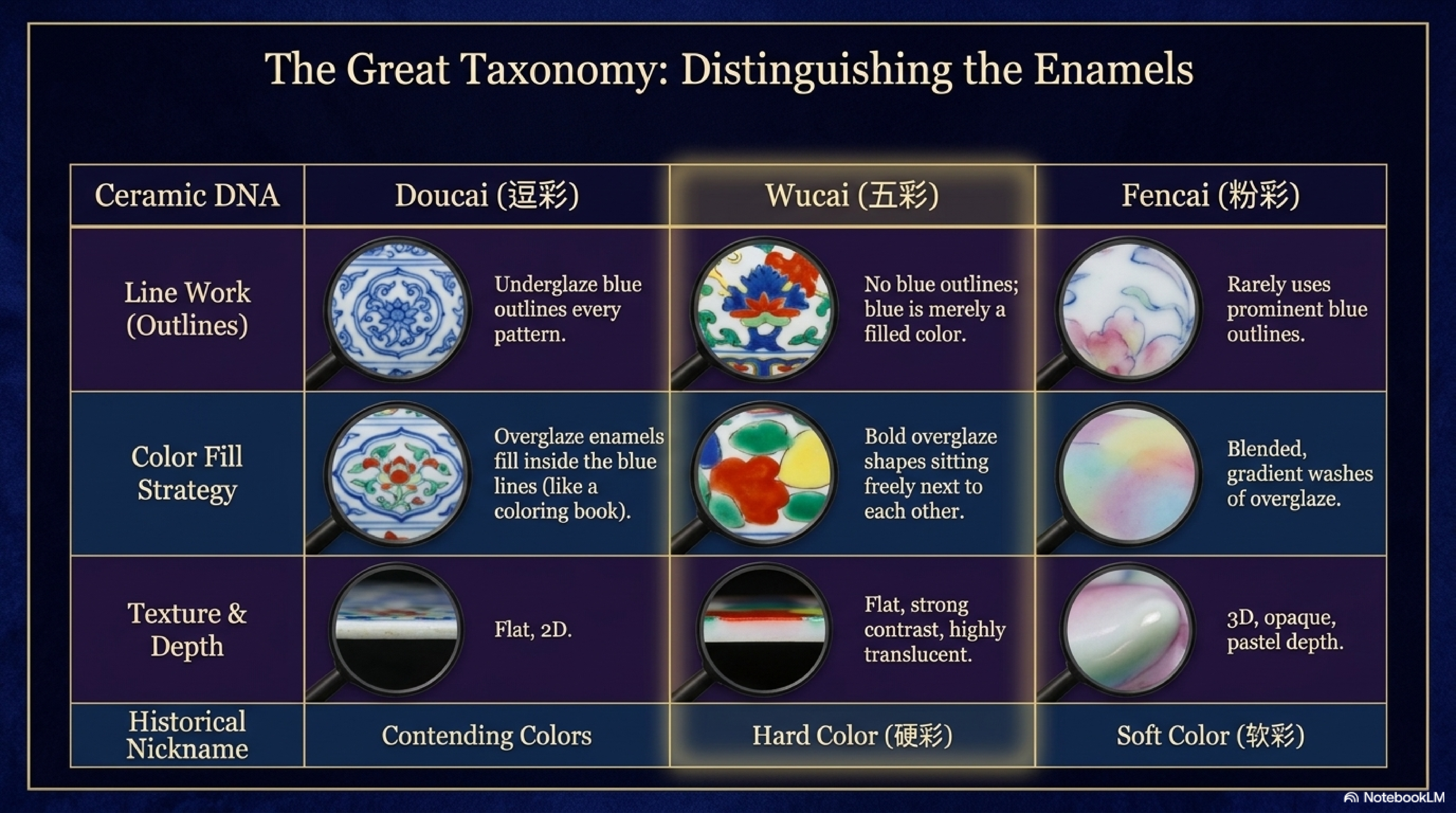
Wucai's development is longer and more complex than any other Jingdezhen tradition. Its roots lie in the Song dynasty's early experiments with overglaze colour on stoneware; its canonical form emerges in the Xuande court; its dominant period is the Jiajing-Wanli era; and its technical culmination arrives under Kangxi with an innovation that fundamentally altered the colour palette available to Chinese ceramics.
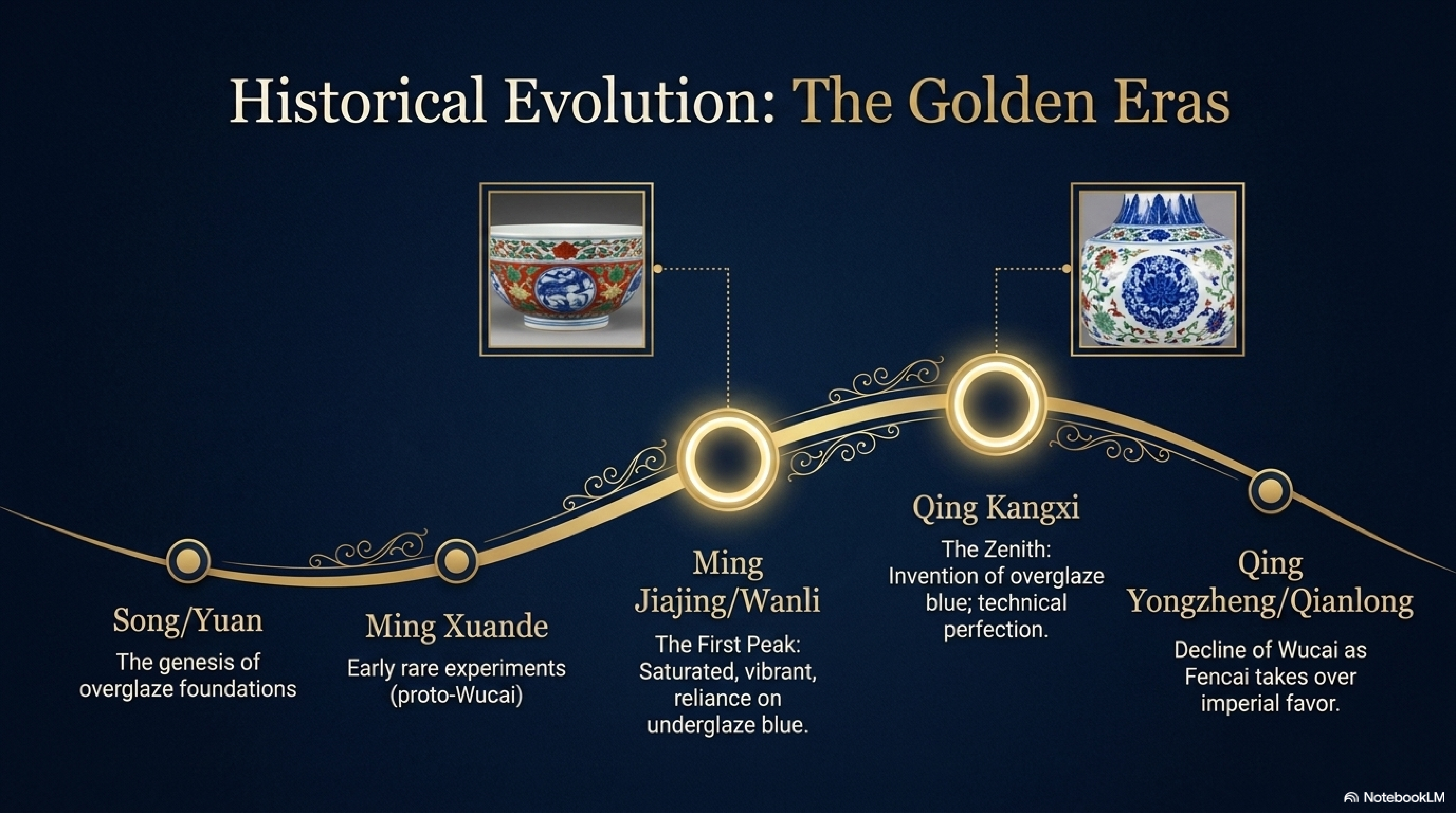
The developmental arc of Wucai. Song-Yuan: early overglaze colour experiments on stoneware establish the technical possibility of post-fire colour decoration. Xuande: the 青花五彩莲池鸳鸯纹碗 (now in the Tibet Museum) establishes the mature conjunction of underglaze cobalt and overglaze multiple enamels — the earliest documented 青花五彩. Jiajing-Wanli: the first great Wucai peak — 大明彩 — dense, bold, export-oriented. Kangxi: the technical summit — 釉上蓝彩 (overglaze blue enamel) invented, gold enamel integrated, the dependence on underglaze cobalt ended.
Song–Yuan
(960–1368)
(960–1368)
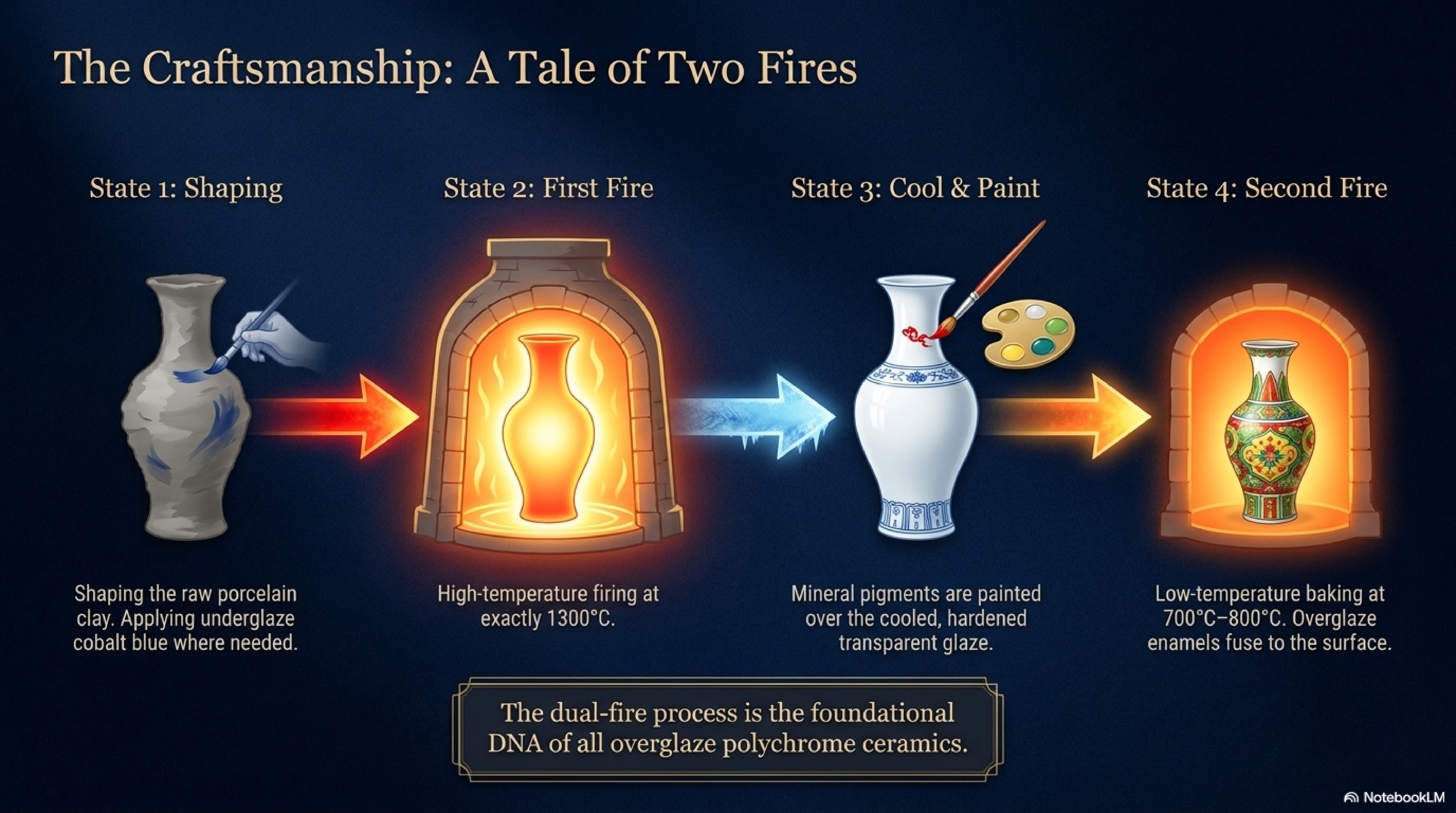
Foundational experiments. Early Chinese potters develop overglaze colour (釉上加彩) on stoneware and porcelain bodies. The technical principle — applying colour to a fired, glazed surface and re-firing at low temperature — is established. Not yet Wucai as a named tradition, but the technical logic is in place.
Ming Xuande
(1426–1435)
(1426–1435)
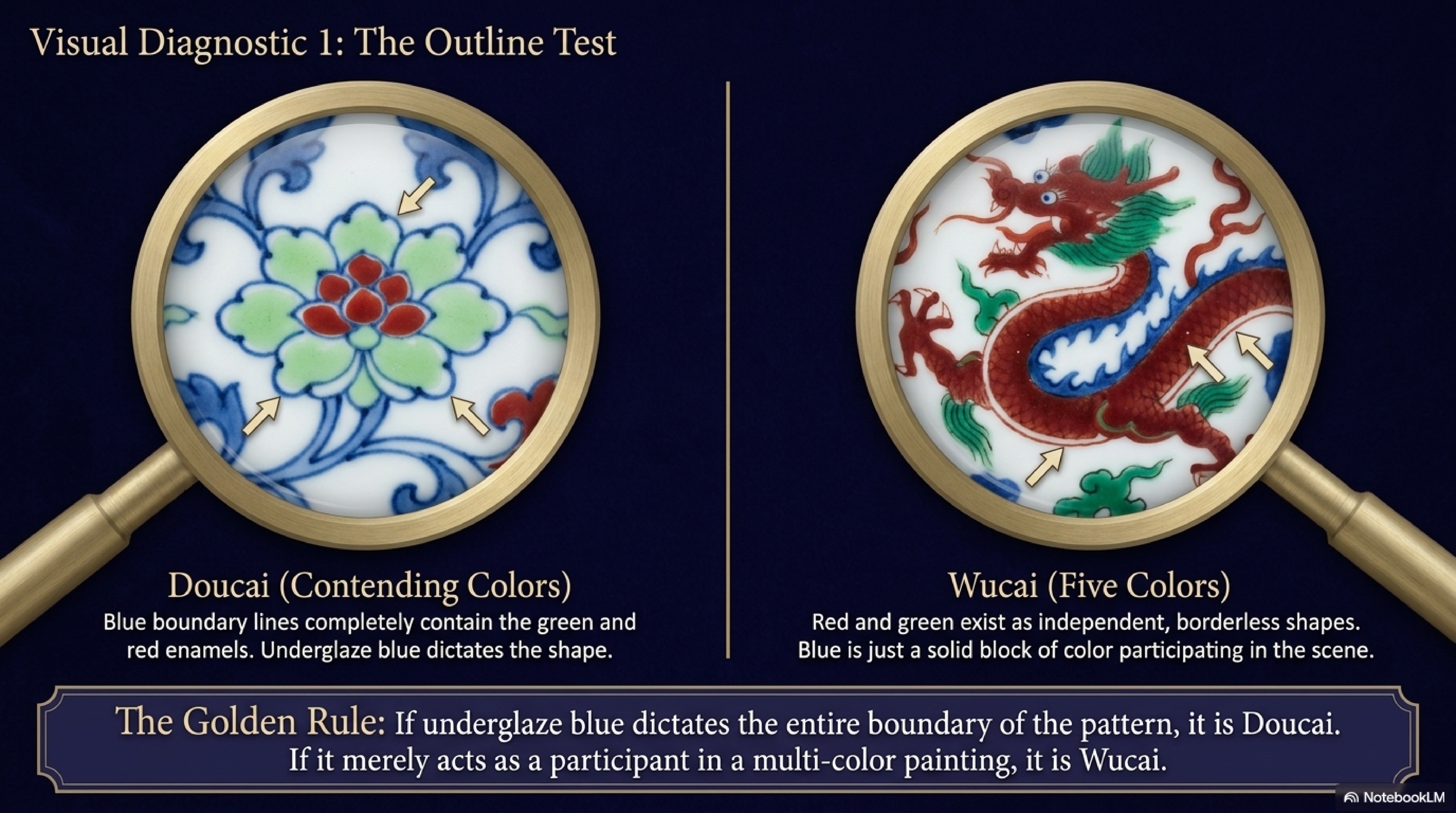
The prototype. The 青花五彩莲池鸳鸯纹碗, discovered in the Tibet Sakya Monastery, establishes the mature 青花五彩 format: underglaze cobalt as one colour field among several, combined with overglaze red, yellow, and green enamels. This is the ancestor of both Wucai and Doucai — the distinction between them would be systematised by later connoisseurship.
Ming Jiajing
(1522–1566)
(1522–1566)
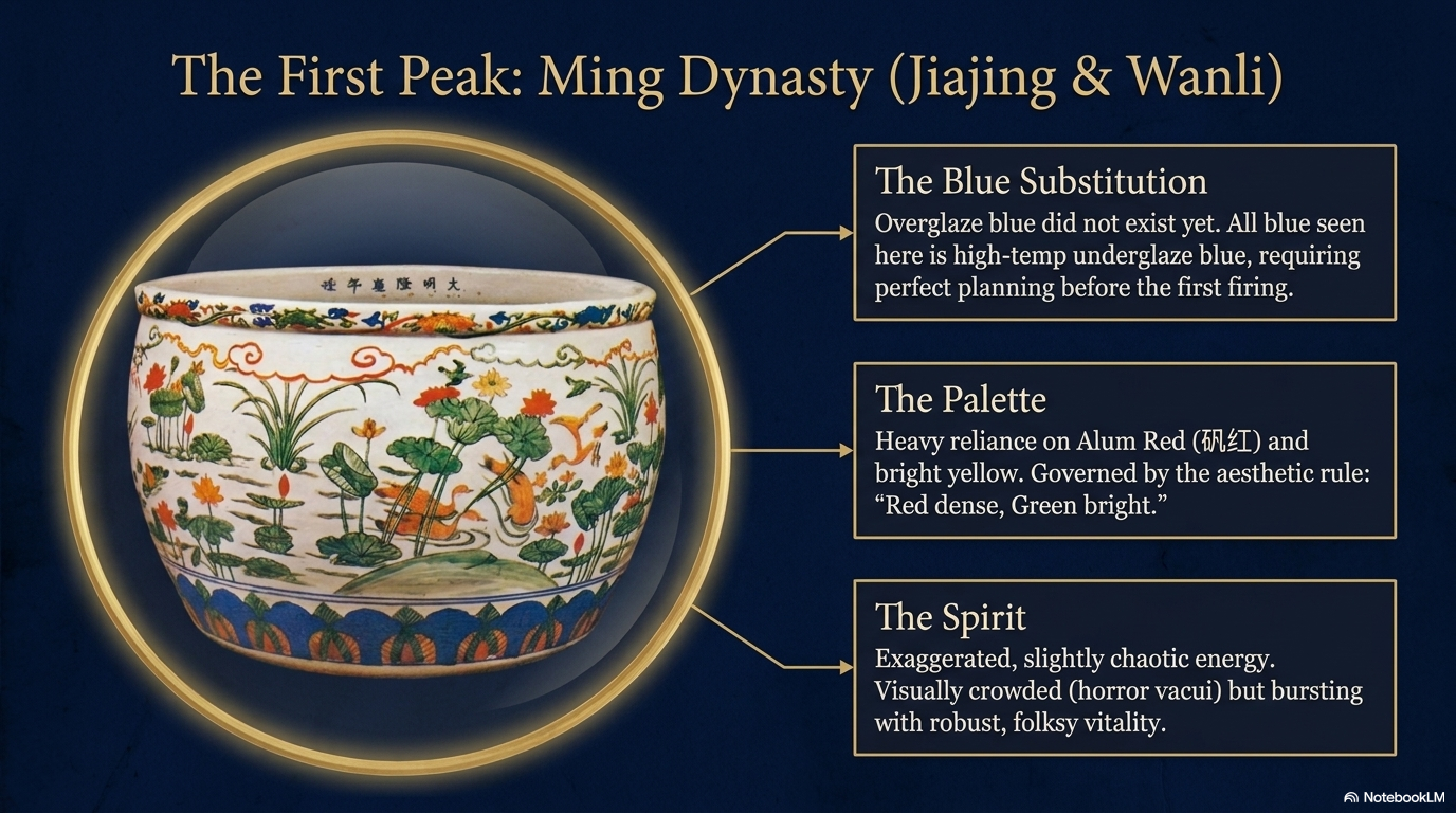
First peak. Wucai reaches its first high-water mark. The Jiajing palette is dominated by 枣皮红 (date-skin red, a deep iron-red) and 孔雀绿 (peacock green). Decorative schemes are bold and mythologically charged — Daoist themes, auspicious creatures, the Eight Trigrams. Brushwork is confident and slightly coarse; the visual effect is forceful.
Ming Wanli
(1573–1620)
(1573–1620)
"大明彩" peak. Wanli Wucai — sometimes called 大明彩 (Great Ming Colour) — pursues maximum decorative density. Compositions cover the entire vessel surface; the colour palette leans toward 红绿对比 (red-green contrast); individual motifs are rendered in dense, full-saturation enamels. Wanli vessels are frequently large and heavy; the approach is cumulative and uncompromising.
Qing Kangxi
(1662–1722)
(1662–1722)
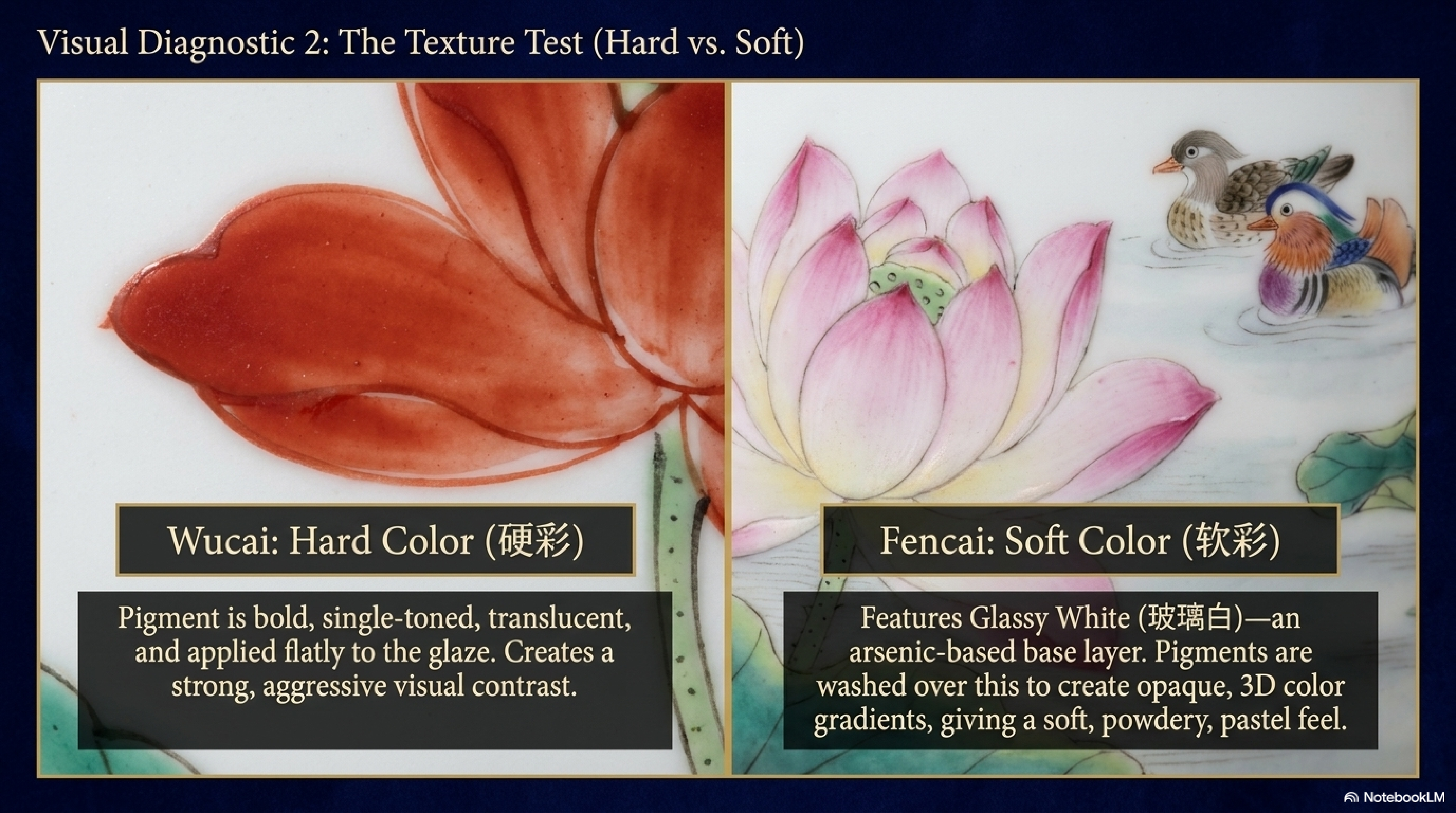
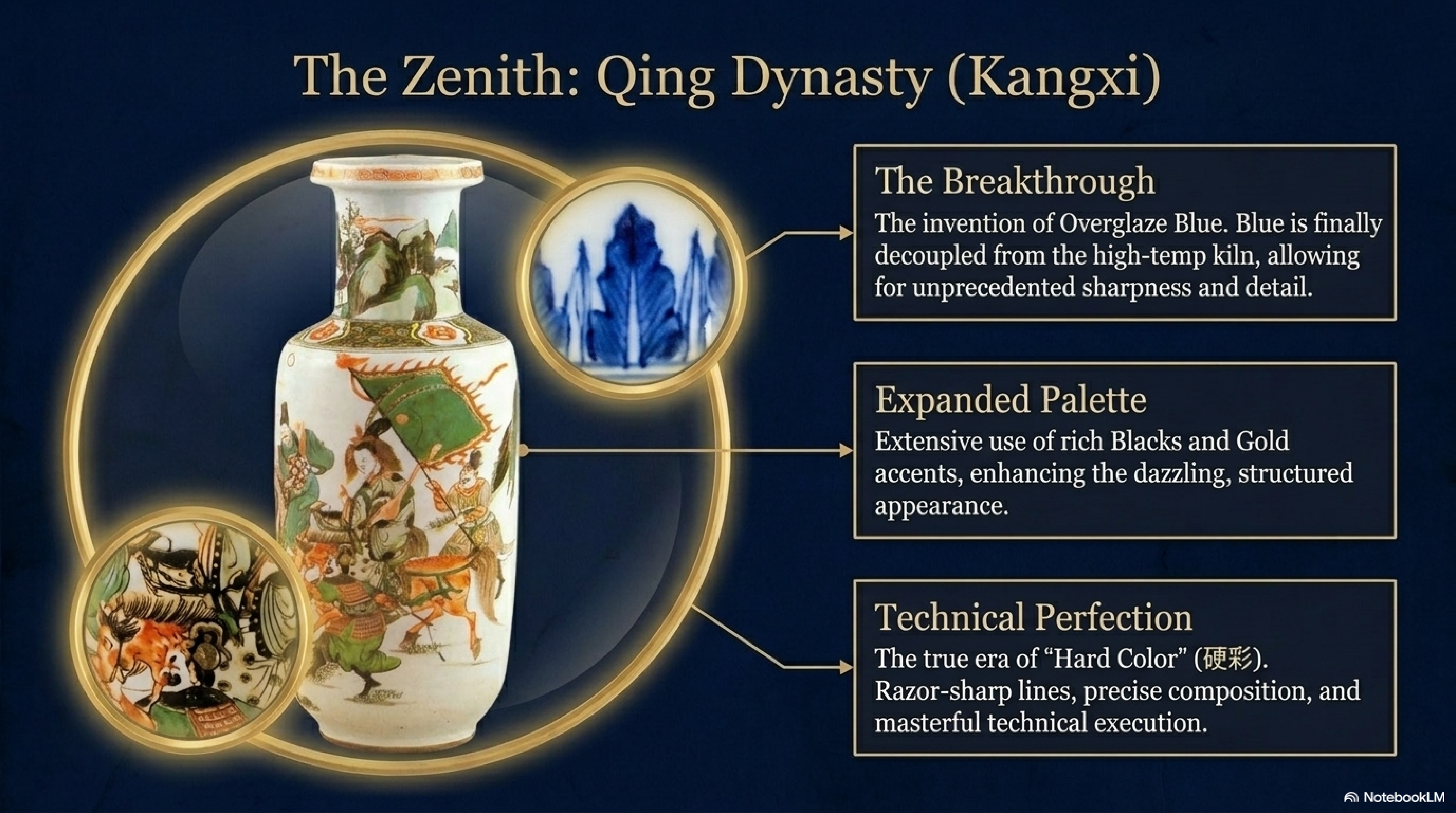
Technical summit — 硬彩. Two innovations define Kangxi Wucai. First: the invention of overglaze blue enamel (釉上蓝彩) — for the first time, cobalt blue could be applied above the glaze rather than beneath it, freeing the painter from the two-firing constraint for blue. Second: gold enamel (金彩) is systematically integrated into Wucai decoration. The Kangxi result — 硬彩 at its technical peak — is a palette of six or more distinct, assertive colours applied with precision and deliberation.
Post-Yongzheng
(after 1735)
(after 1735)
Decline and continuation. As Famille Rose (粉彩) rises to court favour under Yongzheng and Qianlong, Wucai loses its position as the dominant Jingdezhen polychrome. Production continues at reduced scale; the most technically ambitious work shifts to 粉彩 and 斗彩-粉彩 combinations. Late Qing and Republican revivals occur, but the tradition's defining character is firmly fixed in the Ming-Kangxi period.
Wanli Wucai — 大明彩. A large Wanli jar at its most characteristic: the surface is fully covered, every zone assigned a colour, every space occupied by a motif. Red and green dominate — the 红绿对比 that defines the Wanli palette — with yellow as secondary and underglaze cobalt as spatial divider rather than structural outline. The visual effect is deliberately overwhelming: this is not a ceramic tradition that seeks restraint or contemplative quietude. Wanli Wucai was the most aggressively marketed ceramic export of the late Ming dynasty, and its visual language was designed to be legible, desirable, and memorable at commercial scale.