Jingdezhen · Six Great Ceramics · No. 4

Famille Rose
粉彩瓷

玻璃白为底,洗染为法 · The Softest Colour in Chinese Porcelain

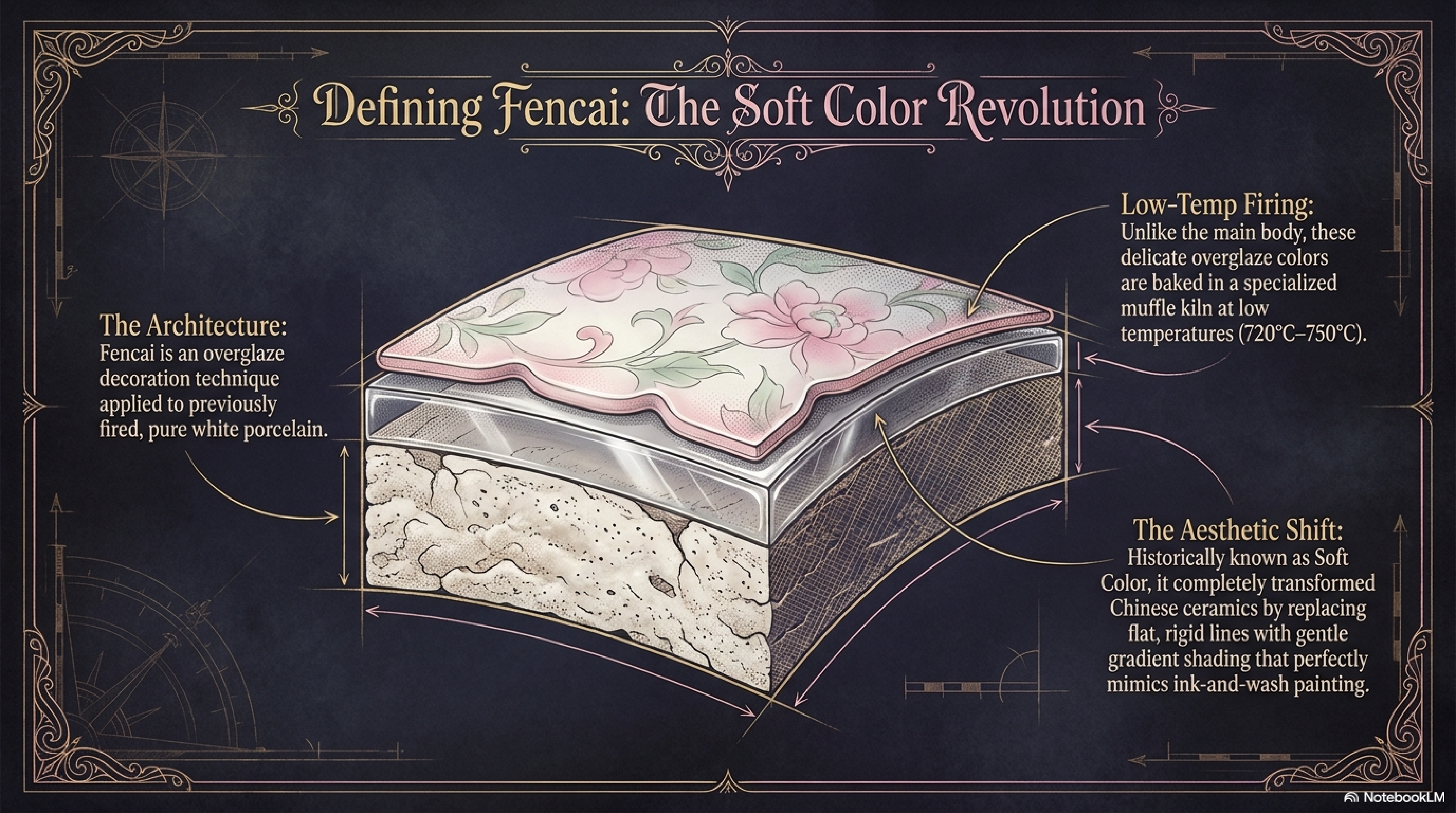
Opaque pink enamels, European-derived technique, Qing court refinement. The tradition that brought Western painterly shading to Chinese ceramics — and produced the summit of the modern auction market.

康熙晚期 Origin Reign
700–850°C Low-Fire Overglaze
玻璃白 Defining Technique
软彩 Alternative Name

The Softest Colour: European Technique Meets Qing Refinement

Famille Rose — 粉彩 (fěncǎi), literally "powder colours," also known as 软彩 ("soft colours") — is the fourth of Jingdezhen's Four Great Ceramics and, by any measure of modern auction-market activity, the most commercially consequential. Its defining technique — applying opaque, arsenate-opacified white enamel (玻璃白) as a foundation layer before overpainted colour, then blending the colour with a soft-bristle brush in the 洗染 (washing-and-shading) technique — derived from Western enamel-painting traditions introduced into China through Jesuit missionaries and European trade contacts in the early 18th century.

The result was a new aesthetic category in Chinese ceramics: for the first time, colour could be modulated tonally on the surface of porcelain — shaded from light to dark, blended from one hue to another, rendered with the pictorial nuance of ink-wash painting or European watercolour. Yongzheng court Famille Rose pieces, with their slender figures, their precise botanical studies, and their almost painfully refined palette, represent one endpoint of this development. Qianlong's exuberant, gold-laden, pattern-saturated pieces represent another. Both belong to 粉彩 — and understanding the tradition requires understanding both.

青花
Blue & White
Cobalt on white. Yuan to Qing. The most globally traded Chinese ceramic.
釉里红
Underglaze Red
Copper on white. "A thousand kilns for one treasure." The rarest high-fire colour.
斗彩
Doucai
Underglaze blue outlines, overglaze enamel fills. Ming Chenghua — the rarest formula.
粉彩
Famille Rose
Opaque pink enamels, 玻璃白 ground. Qing Yongzheng — the auction market's summit. This guide.
五彩
Wucai
Five-colour overglaze. Ming Jiajing / Wanli. Bold, vivid, folk-inflected energy.
颜色釉
Monochrome
Fire, metal oxide, restraint. From Ming sacrificial red to Qing peachbloom. One colour, one fire.

"粉彩色调粉润柔和,画面精美细腻,有别于五彩的强烈对比。"

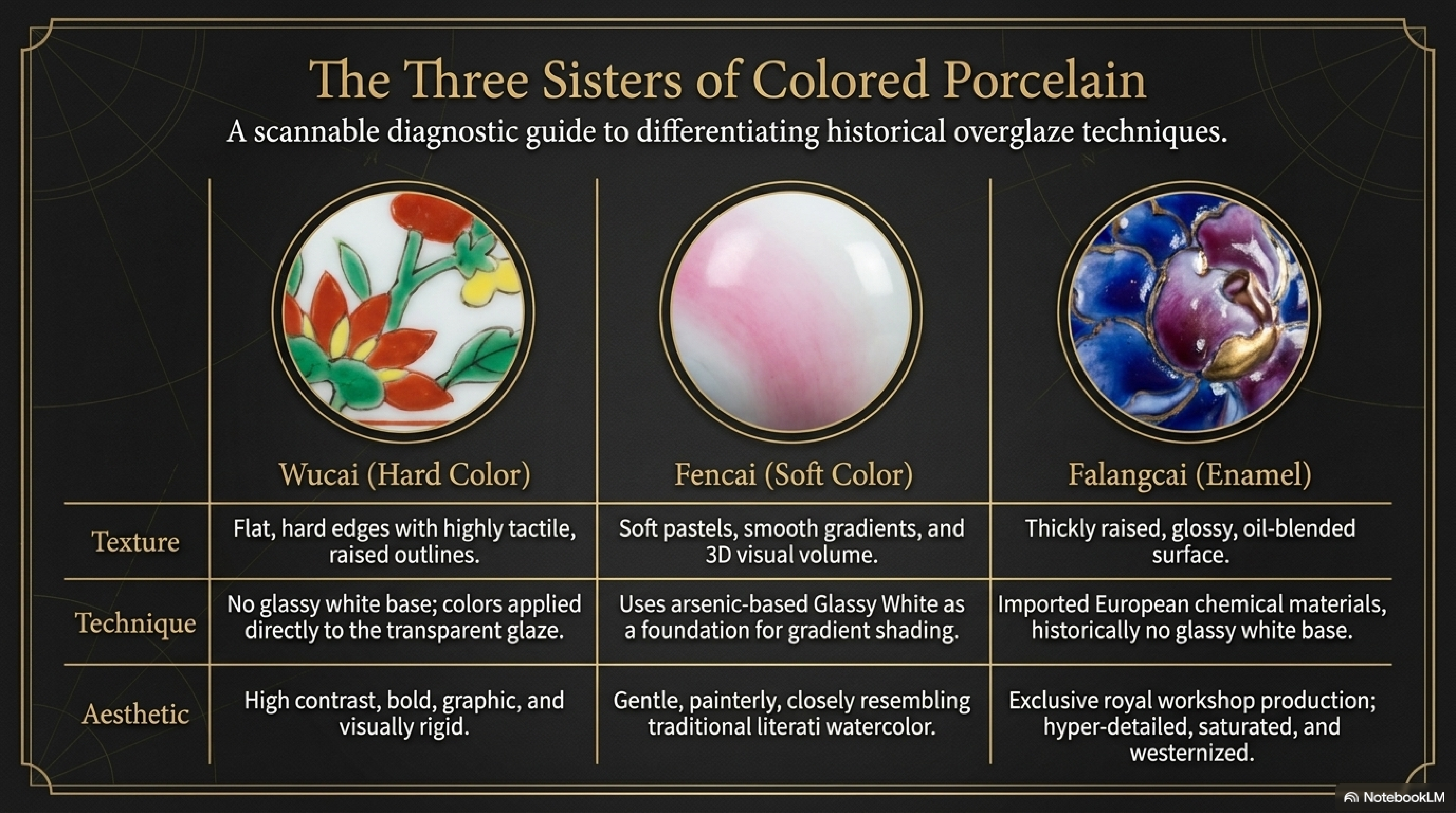
The defining aesthetic distinction of Famille Rose: where Wucai confronts the eye with bold, flat colour contrasts, Famille Rose persuades it with tonal gradation and painterly shading. The 玻璃白 ground makes the difference — it allows each colour to be washed from full saturation to near-transparency in a single brushstroke, a technical capability no earlier Chinese ceramic tradition possessed.

From Kangxi Experiment to Yongzheng Summit

Famille Rose has the most precisely dateable origin of any major Chinese ceramic tradition. Its key technical innovation — the introduction of opaque white enamel (玻璃白) based on arsenate glass — can be traced to the late Kangxi period and the influence of European enamel techniques brought to the Qing court. Its development over the following century defines the arc of Qing imperial taste.

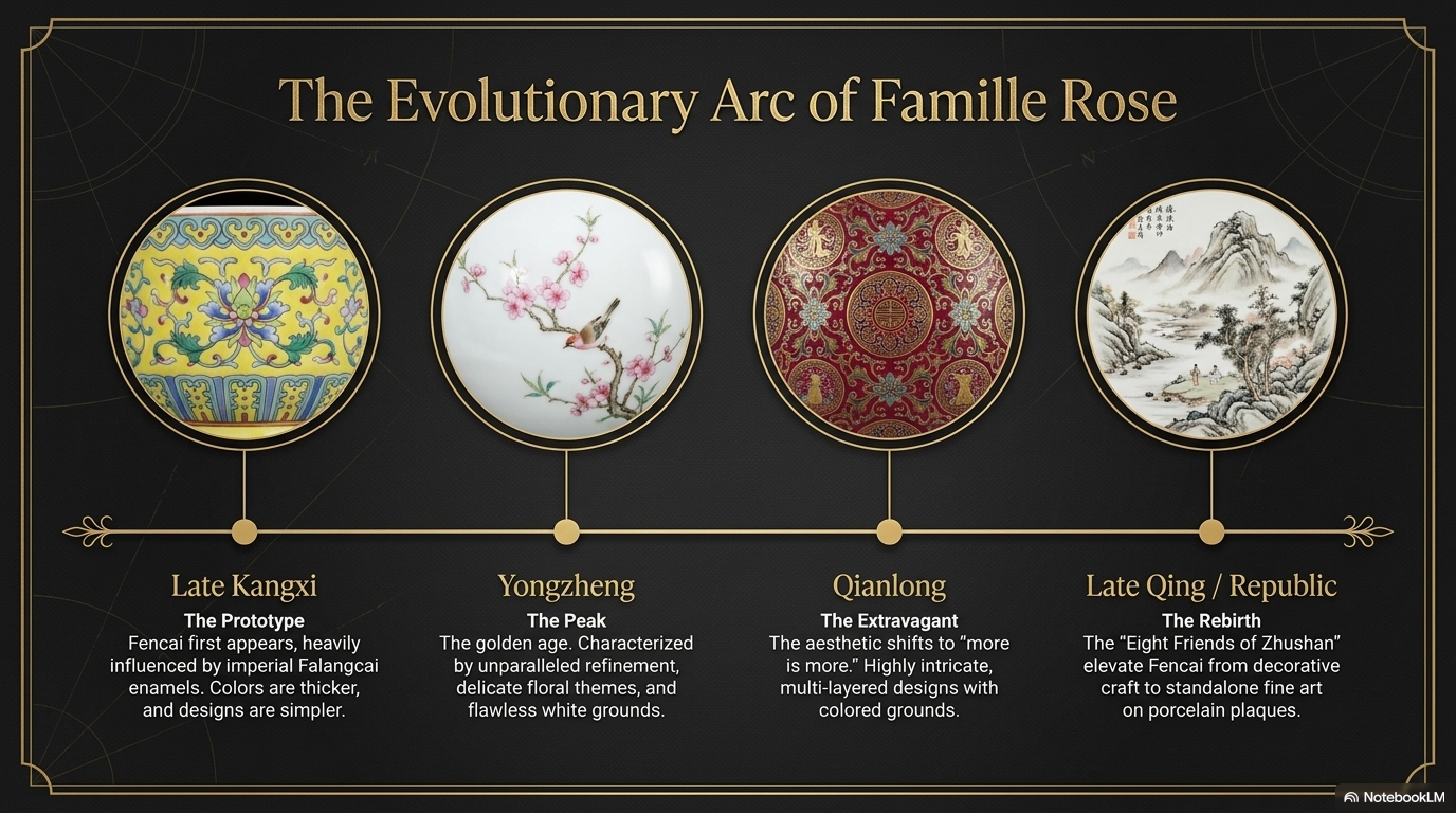
Famille Rose development arc — from late Kangxi experiment through Yongzheng peak to Qianlong elaboration and late Qing literati revival
The developmental arc of Famille Rose. Late Kangxi: first experimental use of 玻璃白 and soft-bristle 洗染 technique. Yongzheng: the canonical pinnacle — pure white ground, slender proportions, botanical precision, the invention of 胭脂红 (carmine / gold-ruby red) from colloidal gold. Qianlong: dense pattern elaboration, 轧道 (sgraffito ground patterns), Western floral motifs (西番莲). Late Qing–Republican: decline of court production, rise of 浅绛彩 and New Famille Rose (珠山八友) — the integration of literati painting conventions into ceramic decoration.
Late Kangxi
c.1700–1722
The seed. Western enamel techniques, introduced through Jesuit missionaries and European trade, inspire Qing court potters to experiment with arsenate-based opaque white enamel. Early pieces show the 洗染 technique in rudimentary form: soft, tonally modulated colour on a limited palette. Technically raw but historically transformative.
Yongzheng
1723–1735
The canonical peak. The definitive Famille Rose aesthetic: pristine white ground (白地), slender vessel proportions, palette of exceptional purity — especially 胭脂红 (carmine, produced from colloidal gold), a colour previously impossible in Chinese ceramics. The 过枝 (crossing-branch) technique — floral compositions that flow from exterior to interior across the rim — first appears in this reign. Considered the Yongzheng hallmark.
Qianlong
1736–1795
Baroque elaboration. Famille Rose aesthetics shift from refinement to complexity. 轧道 (sgraffito ground): dense spiral or floral patterns incised into a coloured enamel ground before overpainting. 色地开光 (coloured-ground medallion panels). Heavy use of gilt. Western floral motifs (西番莲). The Qianlong approach is antithetical to Yongzheng restraint — both are technically superb.
Jiaqing–Daoguang
1796–1850
Gradual decline. Court quality falls. Famille Rose production continues at scale but with less of the Yongzheng precision or the Qianlong ambition. More formulaic decorative schemes. Still recognisably Famille Rose, but the apex is behind.
Late Qing
1851–1911
浅绛彩 transition. A new tradition, 浅绛彩 (qiǎn jiàng cǎi — "shallow-crimson colours"), emerges using iron-red and ink-blue washes in a deliberately literati-painting register. Less technically demanding but artistically distinct from court Famille Rose.
Republican Period
1912–1949
珠山八友 revival. The "Eight Friends of Zhushan" — a group of Jingdezhen painters — produce New Famille Rose pieces fully signed with painter's name, seal, and inscription: a complete integration of Chinese literati painting conventions (poetry, calligraphy, painting, seal) with ceramic decoration. Highly collectible as a distinct category.
Yongzheng Famille Rose — elegant vase showing 胭脂红 carmine, botanical precision, 过枝 crossing-branch technique on pristine white ground
Yongzheng Famille Rose at its peak. The white ground is absolute — no colour bleeds onto it accidentally. The 胭脂红 (carmine) flower petals are shaded from deep saturation at the petal base to near-transparency at the edges: impossible without the 玻璃白 ground and the 洗染 technique. The composition flows through the rim — the 过枝 technique, invented in this reign — as if the blossoming branch cares nothing for the boundary between inside and outside. This is the kind of detail that Yongzheng court supervision enforced. Imperfect pieces were returned; the surviving examples represent the ruthless quality selection of an obsessively detail-conscious emperor.
Opaque White Ground, Soft Brush: The Famille Rose Secret

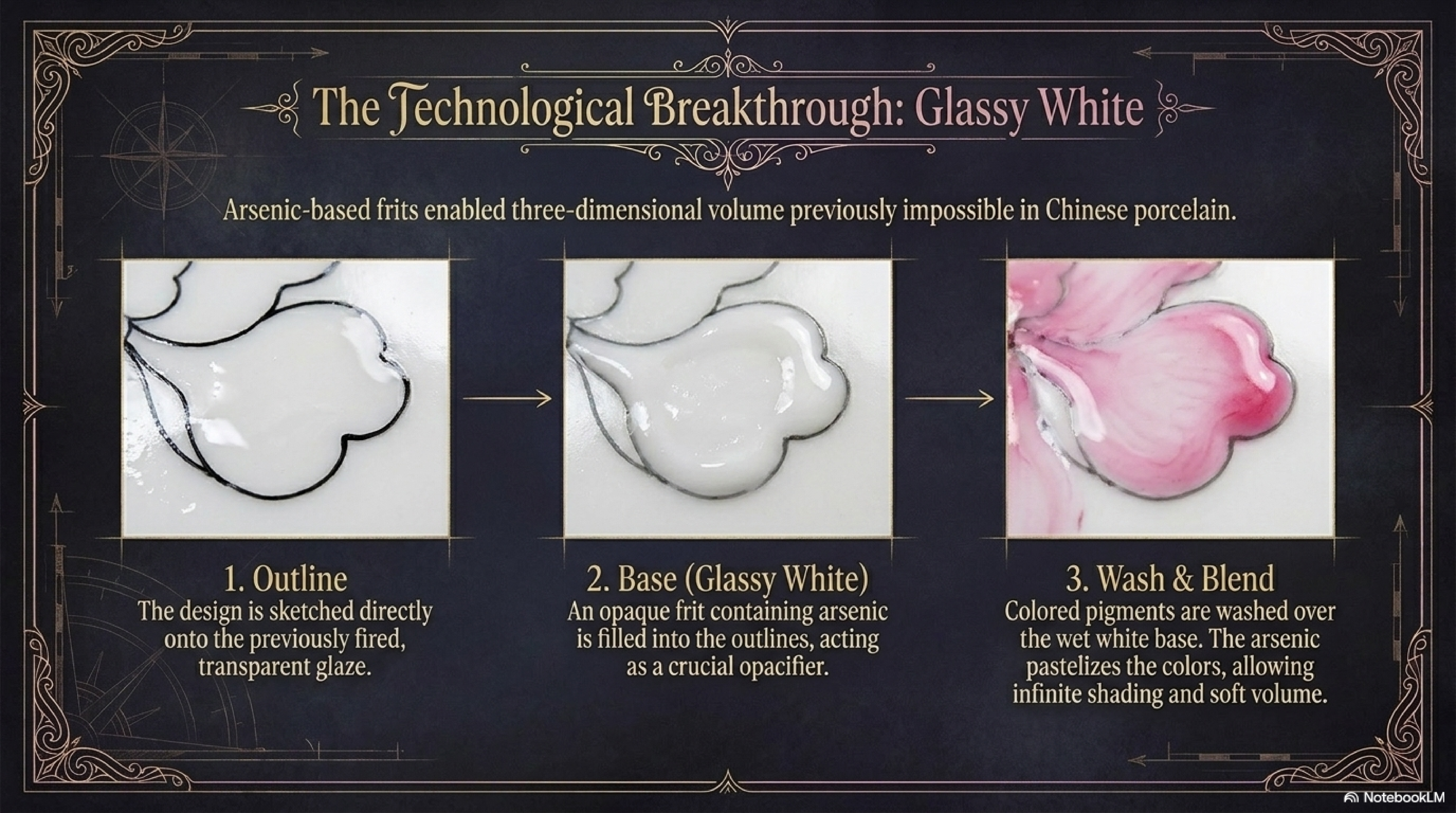
The technological heart of Famille Rose — what differentiates it from all preceding Chinese polychrome traditions — is a single innovation: the use of 玻璃白 (glass white) as an opaque base layer beneath overglaze colour. This is not a glaze; it is a low-fire enamel, opacified with arsenate of lead (氧化砷), that provides an opaque white ground on the fired porcelain surface for subsequent colour application.

Famille Rose technical process — Stage 1: 玻璃白 opaque white applied; Stage 2: colour applied over white; Stage 3: 洗染 soft-brush blending; Stage 4: 700-850°C low-fire kiln
The three-layer technical logic. Layer 1 (玻璃白 ground): opaque arsenate-lead enamel applied to the fired white porcelain surface. Its opacity creates a "canvas" on which subsequent colours behave differently — they remain on the surface rather than sinking into the glaze, and they can be physically moved before firing. Layer 2 (colour application): one to three overglaze enamels applied over the white ground, often in a single stroke. Layer 3 (洗染 blending): before the enamel dries, a clean soft brush disperses the colour outward from the centre of application, creating tonal gradation. The piece then enters the low-fire kiln at 700–850°C. The arsenate chemistry (氧化砷) in the 玻璃白 also produces a subtle optical diffusion effect — light scatters in the opaque layer, giving the finished surface its characteristic "powdery" or "soft" quality.

The 玻璃白 Distinction

The technical distinction between Famille Rose and 珐琅彩 (Falangcai / Imperial Enamel) is subtle but absolute. Both traditions use arsenate-based opaque white. The differences lie in the medium and the production context:

Famille Rose (粉彩): Pigments mixed with water or mild gum (胶水/清水). Applied at Jingdezhen or by court decorators. Production at scale — commercial, tributary, and imperial.

Imperial Enamel (珐琅彩): Pigments mixed with an oil medium (松节油). Applied exclusively at the Imperial Workshops (造办处) in Beijing. Production extremely limited — some entire reigns have fewer than one hundred authenticated surviving pieces.

The 过枝 Technique

The 过枝 (guò zhī, "crossing-branch") composition technique, developed under Yongzheng, is one of Famille Rose's most distinctive visual markers. A flowering branch — prunus, lotus, chrysanthemum — is painted as if it continues from the exterior of the vessel to its interior, crossing the rim boundary without interruption. This requires precise coordination of the composition at both levels simultaneously, and creates an illusion of a three-dimensional stem passing through the porcelain wall. It appears in the finest Yongzheng pieces and becomes rarer and less precisely executed in subsequent reigns.

过枝 crossing-branch technique — floral composition crossing from exterior to interior of Yongzheng bowl, showing three-dimensional visual illusion through the rim
The 过枝 technique. The flowering branch enters from the exterior of the vessel and continues — uninterrupted — on the interior. On a genuine Yongzheng piece, the branch axis, flower angles, and leaf positions on interior and exterior are optically consistent: the composition was conceived as a three-dimensional object viewed from outside, not as two separate paintings on two separate surfaces. This level of compositional planning — requiring the painter to mentally rotate the vessel and resolve the geometry before making a single mark — is one of the strongest markers of authentic Yongzheng court production.

Reading the Period: Palette, Proportion, Base Glaze

Four visual criteria allow preliminary Famille Rose period attribution: the overall decorative density, the palette character (particularly carmine and ground colours), the vessel proportions and figure types, and the base glaze colour. No single criterion is sufficient — attribution requires convergence.

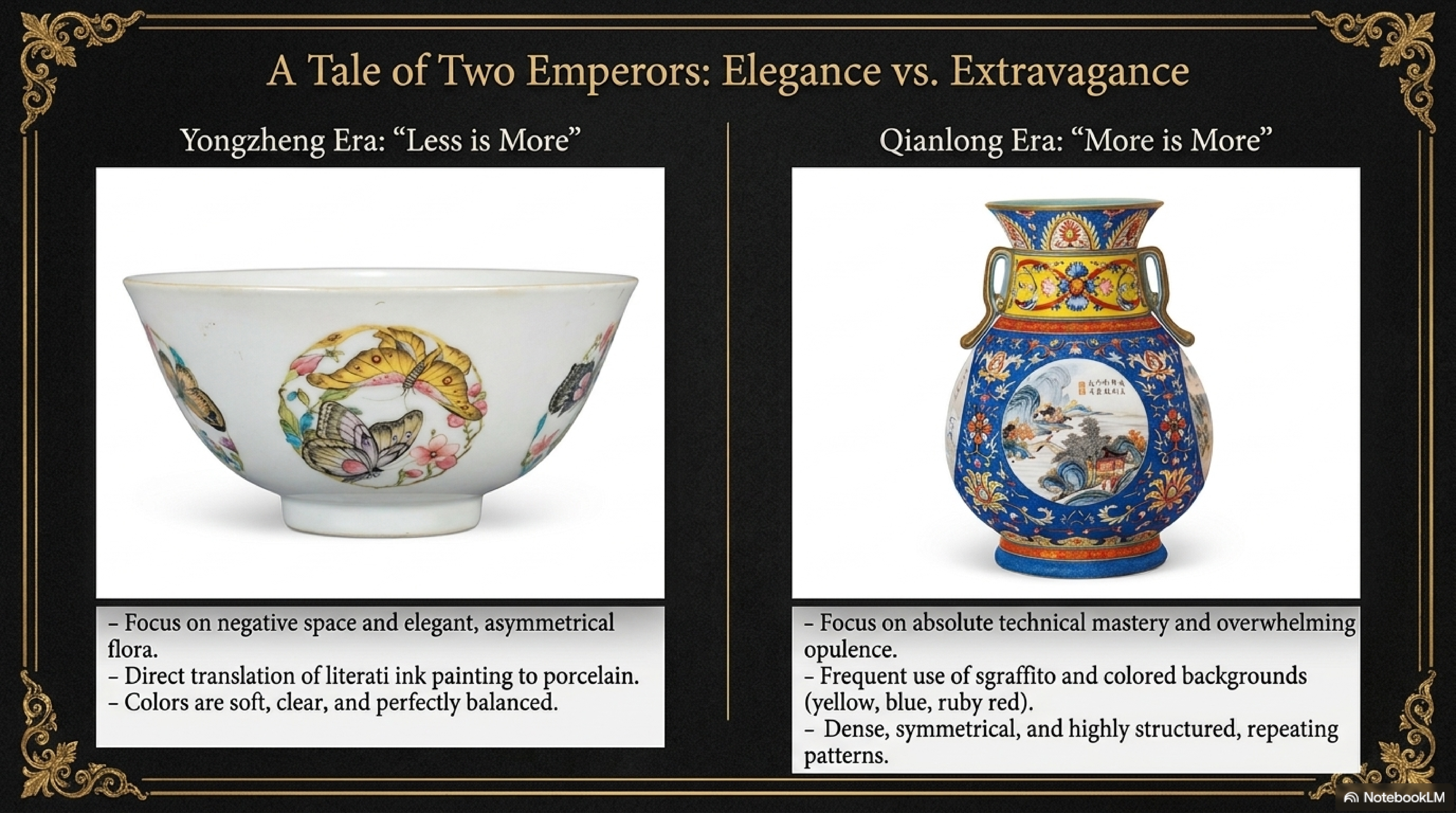
Famille Rose period comparison — Yongzheng restrained botanical on white ground, Qianlong dense sgraffito ground with medallion, late Qing coarser formulaic decoration
Period comparison. Yongzheng (left): sparse, botanical, precise — white ground, single branch composition, extraordinary palette purity. The 胭脂红 is unmistakable. Qianlong (centre): dense, gold-accented, patterned ground with medallion openings — the 轧道 ground technique in full development. Late Qing (right): formulaic auspicious motifs, cruder 洗染 execution, ground colour less pure, reign mark less controlled. The visual distance between Yongzheng and late Qing production is almost as great as between two entirely different traditions.
Yongzheng Style · 雍正风格 Qing Yongzheng 1723–1735

The definitive aesthetic: 精·巧·秀 (precise, refined, elegant). White ground without exception in the finest pieces. Slender proportions, elongated female figures with fine features. 胭脂红 (carmine) of exceptional purity — a reliable period marker when correctly produced. 过枝 compositions on bowls and vases. Reign mark: 大清雍正年制 in regular, vigorous blue-and-white clerical script.

Qianlong Style · 乾隆风格 Qing Qianlong 1736–1795

Dense, elaborate, gold-enriched. 轧道 (sgraffito spiral) on coloured grounds — typically 豆瓣绿 (broad-bean green), 珊瑚红 (coral red), 明黄 (imperial yellow). Medallion-panel compositions (开光) on coloured grounds. Western floral motifs (西番莲, rococo scrollwork). Compositional density and material richness as aesthetic value. Base foot: characteristic 豆瓣绿 (fresh broad-bean green) glaze.

Late Qing Style · 晚清风格 Jiaqing–Guangxu 1796–1908

Declining precision. Auspicious motifs (福·禄·寿, bats, peaches) rendered in increasingly formulaic brushwork. 洗染 technique coarser — tonal transitions less controlled. Palette slightly muddier, especially in the carmine (胭脂红 becomes less pure, tending toward orange-red). Reign marks less consistent. Production scale large; quality variable.

Republican Period · 民国风格 Republic of China 1912–1949

New Famille Rose (新粉彩) and 浅绛彩 — fully signed literati painting in ceramic form. Painter's name, studio seal, inscription, and date all present on the piece itself. The 珠山八友 (Eight Friends of Zhushan) produced individual signed works with specific painters' hands. High quality; distinctly different aesthetic from court production. Increasingly valued by specialists.

Old vs. New: Reading the Famille Rose Surface

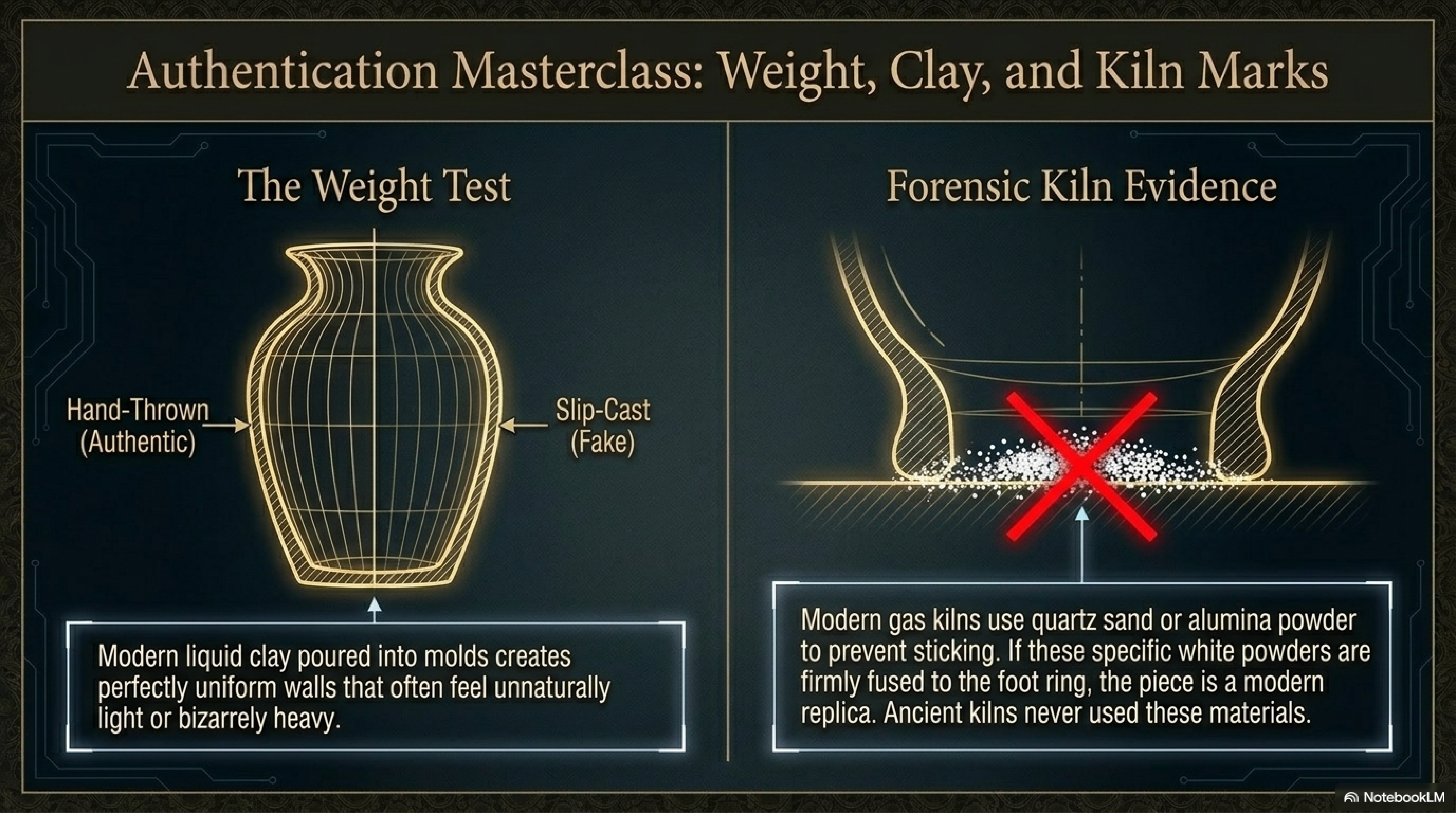
Famille Rose authentication presents a specific technical challenge: its low-fire overglaze enamels are more vulnerable than high-fire underglaze colours to surface alteration, chemical treatment, and skilled reproduction. The key authentication markers work in layers — surface conditions, material chemistry, and structural choices.

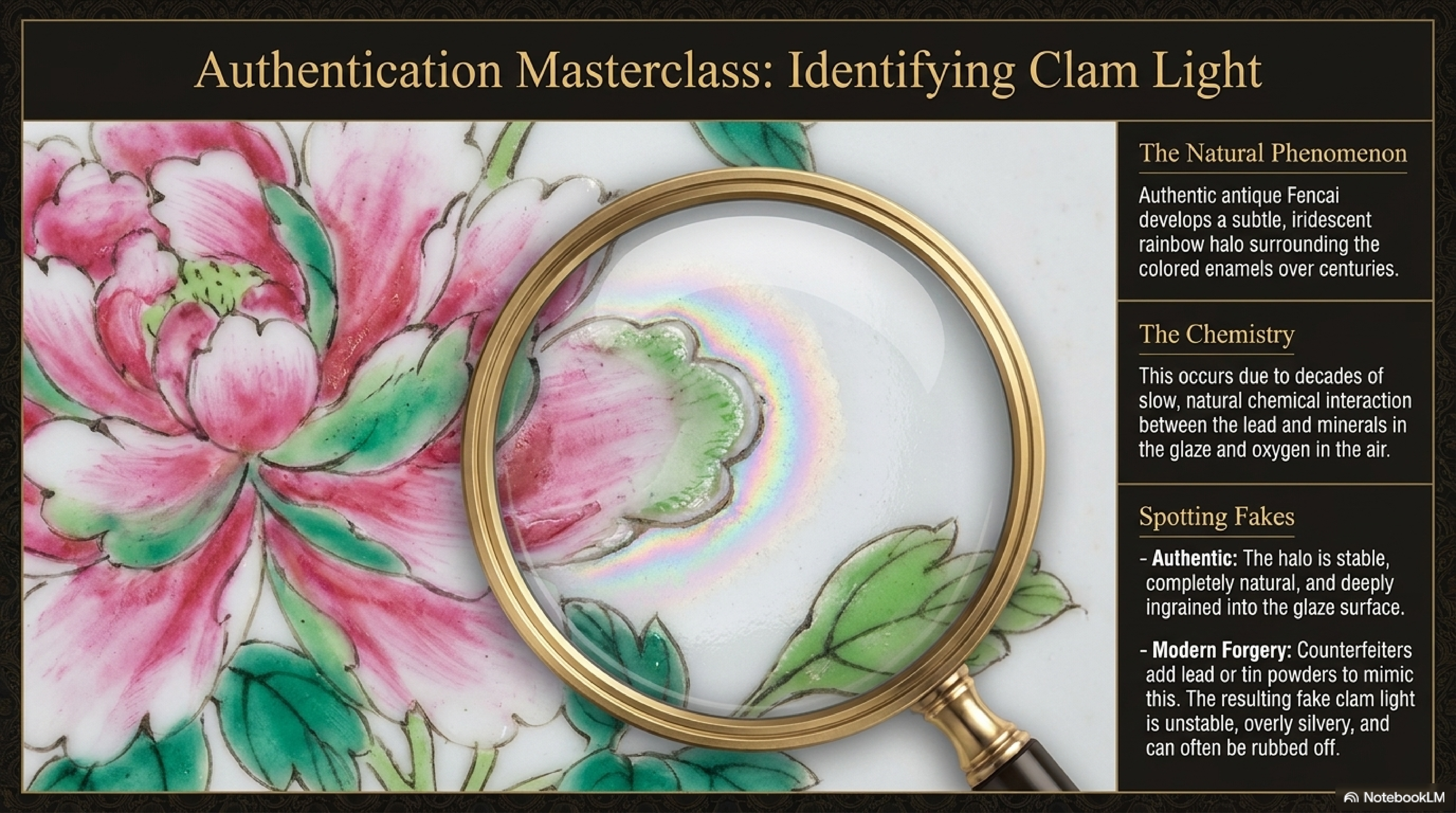
Famille Rose authentication — 蛤蜊光 iridescence on aged enamel, 浮光 fire-flash on new piece, magnified 洗染 quality comparison between genuine and reproduction
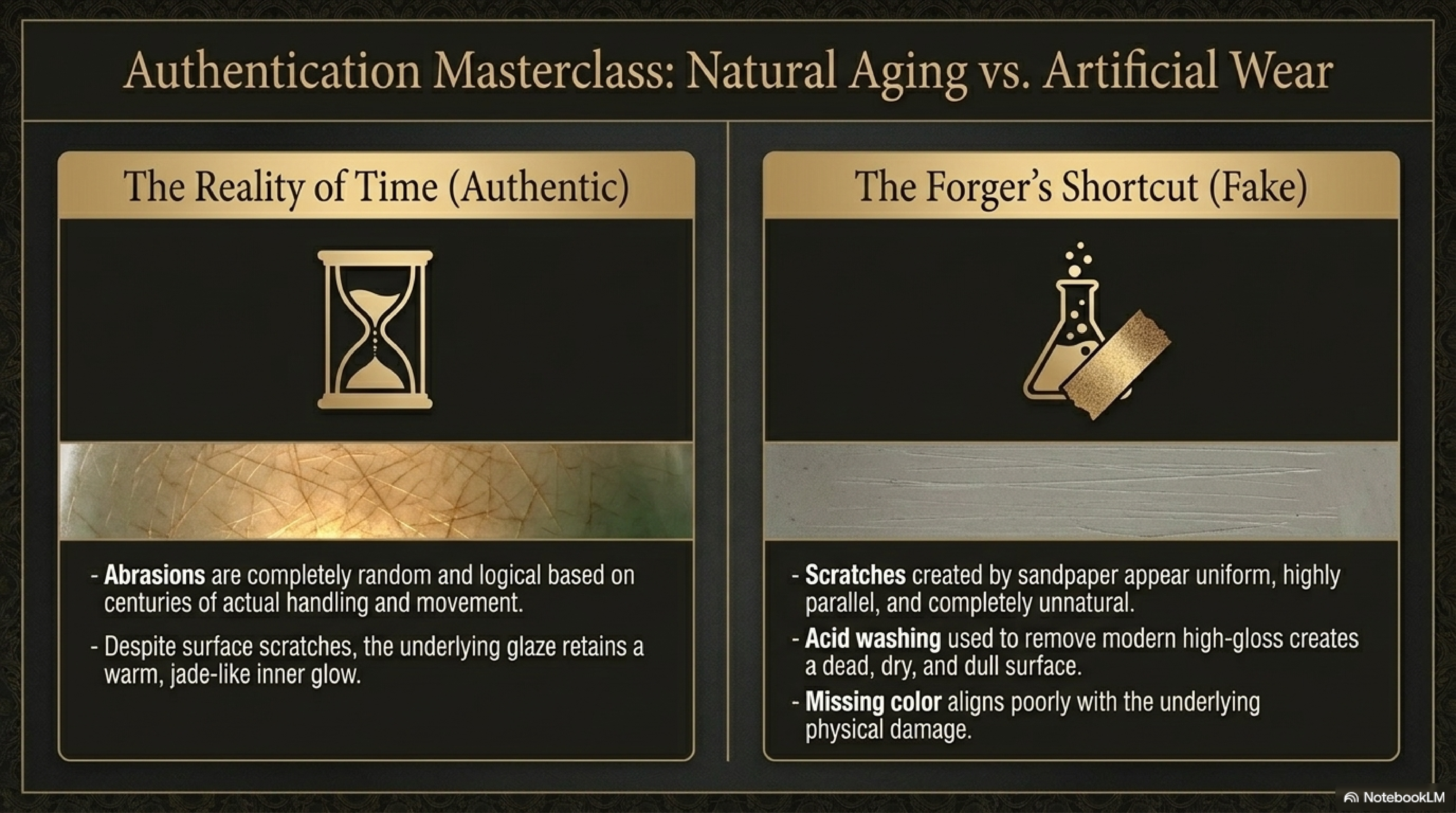
Authentication layers. Layer 1 (surface optical): 蛤蜊光 (clam-shell iridescence) on aged enamel — rainbow shimmer from micro-surface mineral infiltration over centuries. Genuine; cannot be washed off. Compare to the "fire-flash" (浮光/火刺光) of new enamels — an over-bright, slightly harsh surface sheen that fades only very slowly. Layer 2 (磨损/wear marks): genuine Famille Rose pieces show wear at contact points (foot rim, handle, lid edges) that is consistent with actual use — not artificial abrasion (which leaves marks at non-contact points or shows inconsistent depth). Layer 3 (洗染 quality under magnification): genuine 洗染 shows colour gradation that fades smoothly without a visible "edge" — the enamel was moved physically with a brush. Reproduction "洗染" often shows a hard edge at the transition zone, or uniform, spray-tool gradation.

Two Traditions, One Chemistry: Famille Rose and Imperial Enamel

The most important distinction within the Qing overglaze enamel world is between Famille Rose (粉彩) and Imperial Enamel (珐琅彩 / Falangcai). Both use arsenate-opacified glass white; both derive from European enamel technique; both represent the apex of Qing court ceramics. The differences — in production context, medium, and surviving quantity — are absolute.

Famille Rose vs. Imperial Enamel comparison — Fencai bowl showing Jingdezhen-made piece alongside Falangcai piece made at Beijing Imperial Workshops 造办处
The fundamental split. Famille Rose (粉彩): produced at Jingdezhen, in commercial and imperial quantities, for a wide audience — from imperial court to wealthy merchant to export market. Imperial Enamel (珐琅彩): produced exclusively at the Imperial Workshops (造办处) in Beijing, on blank Jingdezhen porcelain bodies sent to the capital, by court painters under direct imperial supervision. Imperial Enamel pieces have no reign marks on the base — instead, they carry two or four-character marks in the enamel itself (often 康熙御制 / 雍正御制). Their surviving population is counted in the dozens per reign; Famille Rose survivors number in the millions.

粉彩 Famille Rose

Production: Jingdezhen kilns (imperial + commercial)
Medium: Pigments mixed with water or gum (胶水/清水)
玻璃白 ground: Yes — applied first, then colour
Scale: Large — imperial, commercial, export
Mark: Underglaze blue reign mark on base
Collector note: Broad market, wide price range

珐琅彩 Imperial Enamel

Production: Beijing Imperial Workshops (造办处) only
Medium: Pigments mixed with oil medium (松节油)
玻璃白 ground: Yes — but oil-mixed, different texture
Scale: Tiny — some reigns produce fewer than 100 pieces
Mark: Enamel-painted mark within decoration; no base mark
Collector note: Rarest category; museum-level acquisition only

"粉彩者,柔而不弱;珐琅彩者,精而近绝。"

Famille Rose is soft but not weak: its painterly range — from delicate botanical studies to dense Qianlong elaboration — spans two centuries and every register of Chinese decorative taste. Imperial Enamel is precise to the point of near-extinction: its rarity is absolute, its court context unambiguous, its visual character unmistakably different from any commercial production. Collecting one is an exercise in breadth; the other, in singular depth.
Republican New Famille Rose — 珠山八友 signed literati painting piece showing fully integrated poem, calligraphy, painting and seal on porcelain
The Republican culmination: 珠山八友 New Famille Rose. By the early 20th century, Famille Rose had absorbed the full vocabulary of Chinese literati painting — poem (诗), calligraphy (书), painting (画), and seal (印) fully integrated on a single ceramic surface. The eight principal painters of the Zhushan group each brought a distinct hand and subject matter: Wang Qi (花鸟), Deng Bishan (鱼藻), Liu Yucen (山水). Their pieces are fully signed works of art in a way that imperial court production — where individual painters were absorbed into an institutional voice — never quite was.

Currently Available · 粉彩在售

Selected Famille Rose pieces available from our eBay store.

Antique Chinese Famille Rose "Wu Shuang Pu" Teacup, Late Qing Dynasty
View on eBay
Antique Chinese Famille Rose "Wu Shuang Pu" Hexagonal Pot, Daoguang of Period
View on eBay
Antique Chinese Famille Rose Wu Shuang Pu Crabapple-shaped Stem Plate, 19th C
View on eBay
Antique Chinese Famille Rose Miniature Butterfly & Flower Teapot, Tongzhi period
View on eBay
Antique Chinese Famille Rose Stem Dish "Wu Shuang Pu" 19th C Xianfeng Period
View on eBay
Antique Chinese Famille Rose WuShuangPu Pot with lid, Daoguang of the period
View on eBay
Chinese Antique Famille Rose WuShuangPu Hexagonal Form Hat Vase, Late Qing
View on eBay
Exquisite Chinese Antique WuShuangPu Eggshell Teacup with Lid & Saucer Late Qing
View on eBay
Exquisite Chinese Antique octagonal-lobed Bowl depicting "Babman Jinbao", 19th C
View on eBay
Exquisite Chinese Cantonese Famille Rose Teacup & Saucer, Yongzheng and of period
View on eBay
A pair of 18thC Chinese Antique Qianlong Period Famille Rose Tea Bowl & Saucer
View on eBay

All pieces ship from the United Kingdom.  ·  View all available pieces →