Jingdezhen · Six Great Ceramics · No. 6

Monochrome Glazes
颜色釉

以简为境,以釉为魂 · The Whole Spectrum in a Single Colour

No brushwork. No outline. No narrative. Only the glaze, the fire,
and the chemistry of metal oxides transformed by heat and atmosphere.

永宣 Three Great Prototypes
5°C Sacrificial Red Tolerance
Fe · Cu · Co Three Colourant Metals
郎不流 Sang-de-Boeuf Maxim

One Colour, One Fire:
The Art of Restraint

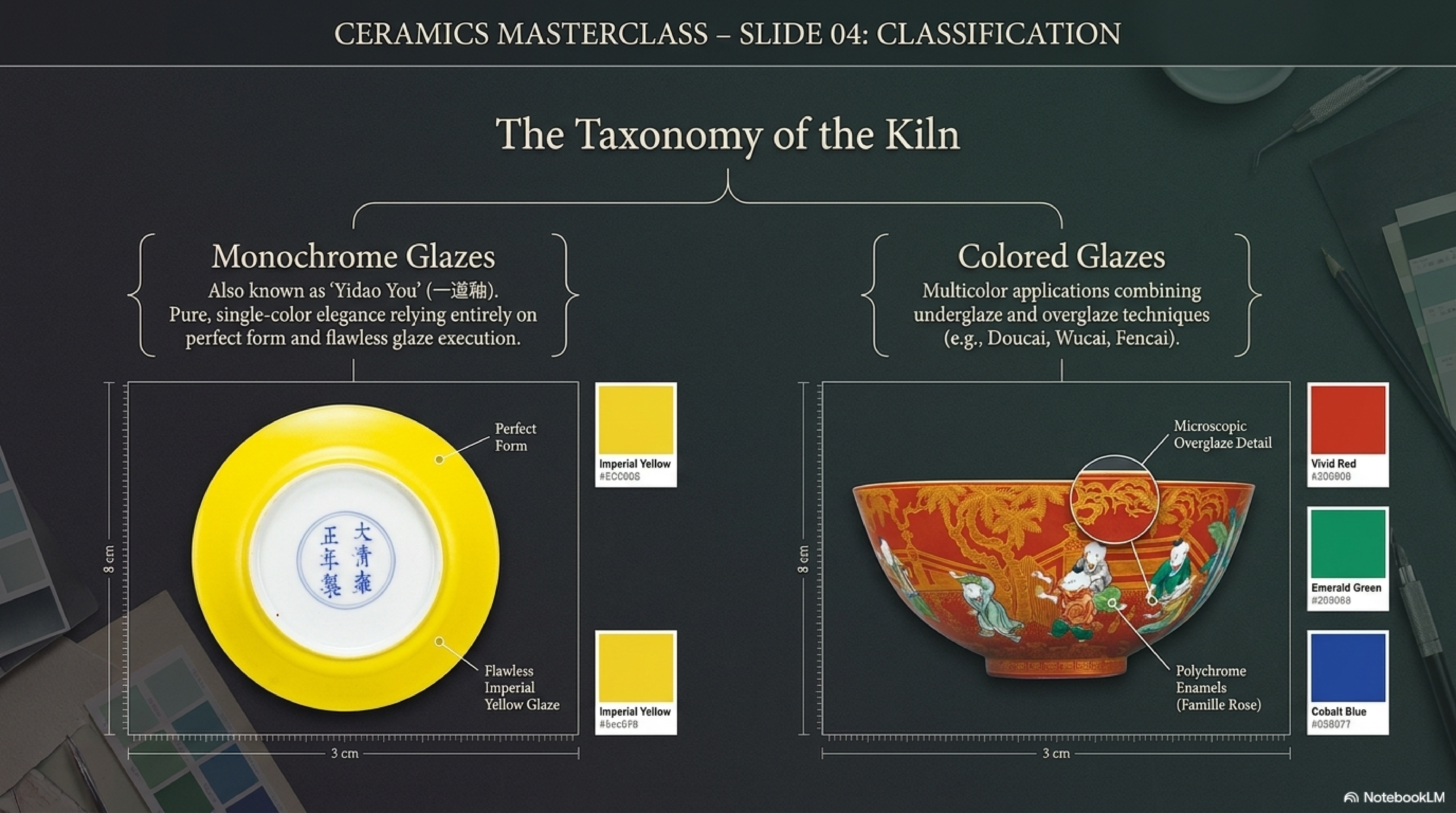
Monochrome glazes — 颜色釉 (yánsè yòu), literally "coloured glazes," also called 一道釉 ("one-glaze") — represent the most distilled aesthetic proposition in Chinese ceramics: no painting, no outline, no narrative image. Only a single, unified field of colour achieved through the interaction of metal oxides, kiln atmosphere, and precisely controlled temperature. To the eye trained on polychrome porcelain, a perfectly fired piece of 祭红 (sacrificial red) or 豇豆红 (peachbloom) may seem simple. To the collector who understands what it takes to produce one, it is the most technically demanding object in the entire Jingdezhen tradition.

Spanning from the Ming court's ritual colour system to the Qing Three Reigns' systematic exploration of every colour the kiln could produce, 颜色釉 constitutes one of Jingdezhen's six great ceramic categories — and the one most directly governed by the aesthetic of 大巧若拙 (great skill appearing artless). Each named colour — 梅子青 (plum green), 豇豆红 (peachbloom), 茶叶末 (tea-dust), 窑变 (flambe) — carries a weight of human association, literary precedent, and material meaning that no single brushstroke could achieve.

青花 Blue & White

Cobalt on white. Yuan to Qing. The most globally traded Chinese ceramic.

釉里红 Underglaze Red

Copper on white. "A thousand kilns for one treasure." The rarest high-fire colour.

斗彩 Doucai

Underglaze blue outlines, overglaze enamel fills. Ming Chenghua — the rarest formula.

粉彩 Famille Rose

Opaque pink enamels from Europe. Qing Yongzheng / Qianlong. The auction market's summit.

五彩 Wucai

Five-colour overglaze. Ming Jiajing / Wanli. Bold, vivid, folk-inflected energy.

颜色釉 Monochrome

Fire, metal oxide, restraint. From Ming sacrificial red to Qing peachbloom. This guide.

"以简为境,以釉为魂。"

— The aesthetic charter of monochrome glazes: simplicity as the destination, glaze as the spirit. Where polychrome traditions add complexity to communicate meaning, 颜色釉 strips everything away and asks whether a single, perfect colour — achieved through exact control of chemistry, temperature, and atmosphere — is enough. In the finest examples, the answer is unambiguous.
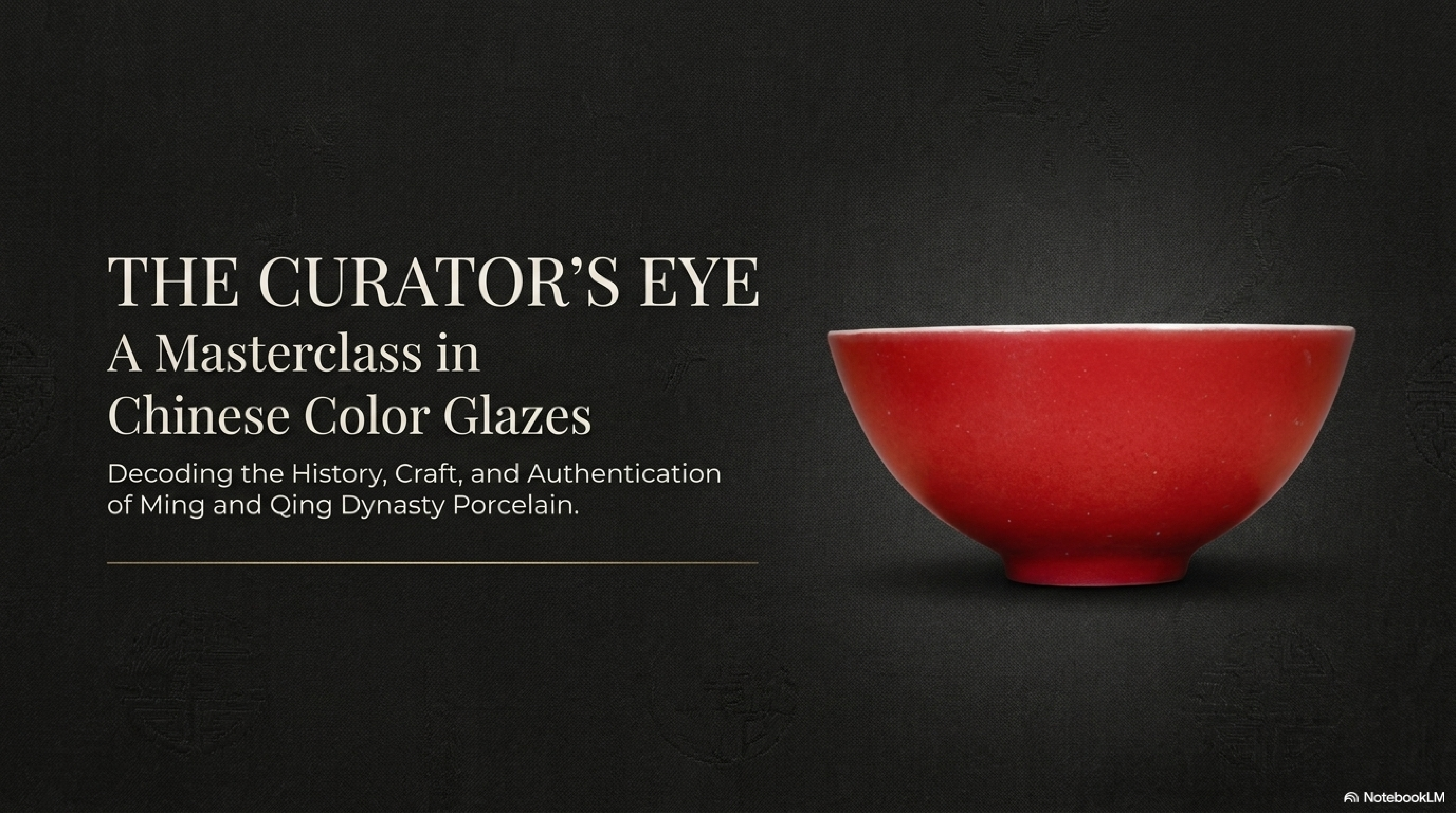
Overview of major Jingdezhen monochrome glazes — 祭红, 郎窑红, 豇豆红, 祭蓝, 甜白, 浇黄, 茶叶末, 窑变 — arranged by colour family

The monochrome spectrum. Each piece represents a distinct chemical formula, firing condition, and historical moment. Top row (red family): 祭红 (deep sacrificial red), 郎窑红 (brilliant sang-de-boeuf), 豇豆红 (soft peachbloom with green moss). Middle (blue and white): 祭蓝 (sapphire sacrificial blue), 甜白 (translucent sweet white). Bottom (other): 浇黄 (imperial poured yellow), 茶叶末 (iron-brown tea-dust), 窑变花釉 (multi-colour flambe). All are the result of the same basic principle — metal oxides in a high-temperature kiln atmosphere — but each achieves a completely different material and aesthetic outcome.
From Ming Court Ritual
to Qing Technical Summit

Monochrome glazes were not invented for aesthetic pleasure — they were systematised for ritual and imperial function. The Ming court's decision to standardise ceramic production for state ceremonies created the conditions for systematic colour exploration that would eventually produce, under the Qing, one of the most varied and technically ambitious glaze traditions in the history of world ceramics.

Ming Xuande three great prototypes — 甜白, 祭红 and 祭蓝 shown together, the canonical foundation of Chinese monochrome glaze tradition

The Xuande three great prototypes (三大名品). The Xuande reign (1426–1435) established the canonical foundation: 甜白 (sweet white — translucent as congealed fat), 鲜红/祭红 (sacrificial red — deep, clotted copper-red), and 祭蓝 (sacrificial blue — a deep sapphire cobalt). These three colours were not chosen arbitrarily: they corresponded to different ritual functions within the Confucian-imperial ceremonial system, and their technical specifications — temperature, clay body, colourant concentrations — were codified as court standards that all subsequent production sought to meet or exceed.

Ming Hongwu (1368–1398)

Ritual foundation. The second year of the Hongwu reign established that all court ritual vessels must be ceramic (凡祭器皆用瓷). This decree made Jingdezhen the mandatory supplier of the imperial colour system — creating institutional demand for precisely specified monochromes that would drive technical development for the next three centuries.

Ming Yongle–Xuande (1403–1435)

The three great prototypes. 甜白 (sweet white), 祭红 (sacrificial red), and 祭蓝 (sacrificial blue) are codified in their canonical forms. Yongle 甜白 is distinguished by an almost porcelain-smooth glaze surface without the orange-peel texture (橘皮纹) that appears in Xuande examples. Both reigns represent the Ming technical summit for these three types.

Ming Chenghua–Zhengde (1465–1521)

New colours emerge. The Hongzhi reign (1488–1505) produces the most celebrated Ming yellow glaze — 浇黄 (poured yellow, also called 娇黄), a low-fire lead-fluxed glaze of exceptional uniformity and warmth, universally acknowledged as the Ming era's most accomplished yellow. The Zhengde reign is noted for vivid 孔雀绿 (peacock green), a copper-green low-fire glaze of distinctive brilliance.

Qing Kangxi (1662–1722)

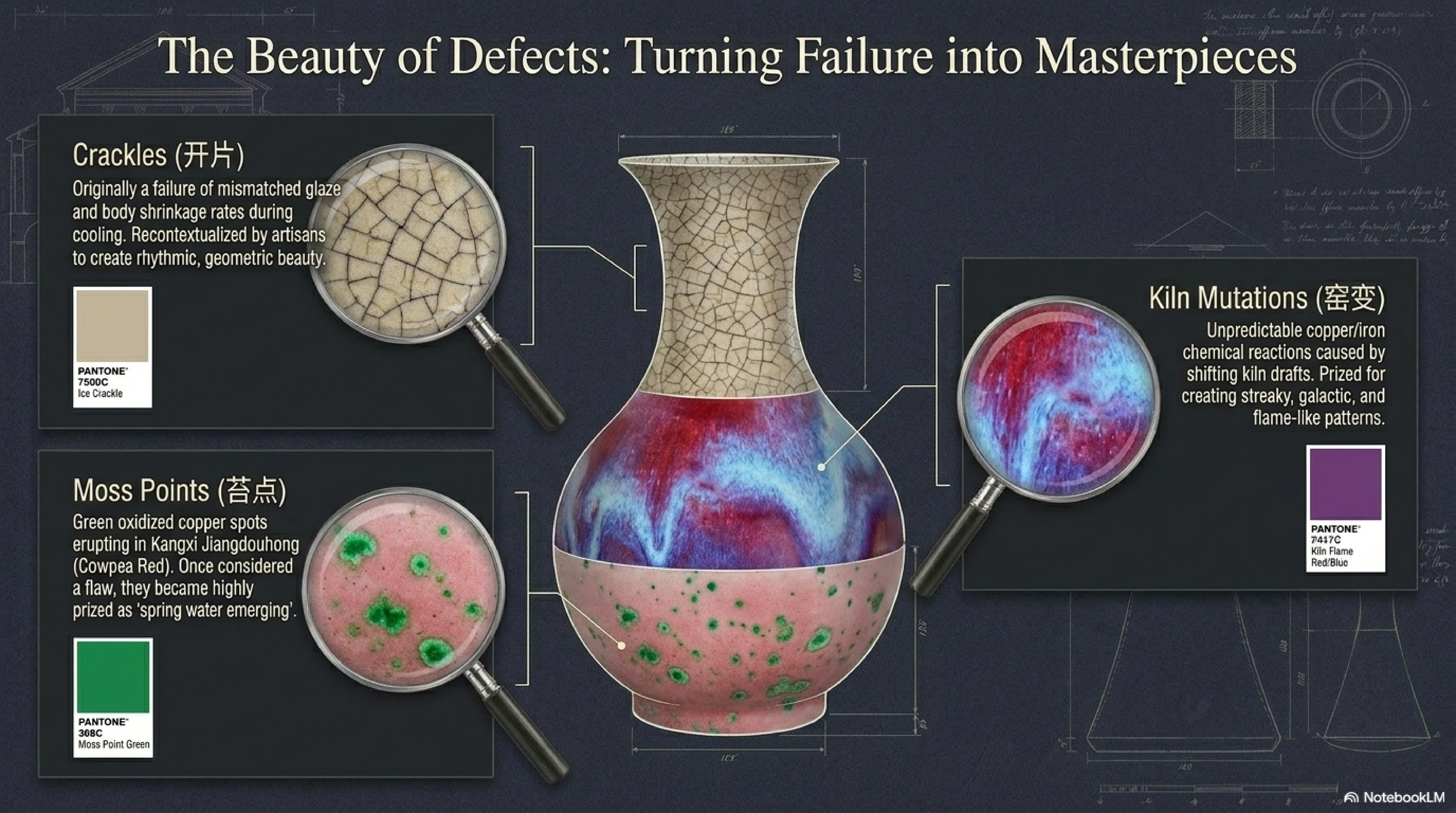
Red revival and new inventions. Kangxi revives the difficult copper-red tradition, producing three historically important new types: 郎窑红 (sang-de-boeuf — brilliant, flowing, assertive), 豇豆红 (peachbloom — soft, pink-variegated, restricted to small scholar's vessels), and 乌金釉 (mirror black — jet black with a mirror-like surface). The reign also sees the introduction of 洒蓝 (sprinkled blue) — a mottled blue-white from the blow-glaze (吹釉) technique.

Qing Yongzheng (1723–1735)

The connoisseur's pinnacle. Yongzheng pursues a programme of systematic historical reconstruction — commissioning near-perfect reproductions of Song dynasty 汝, 官, 哥, 钧, 定 glazes — while simultaneously producing new colour types of extraordinary delicacy: 胭脂水 (rouge red, from colloidal gold), 柠檬黄 (lemon yellow), and 粉青 (pale celadon) of unprecedented refinement. The Yongzheng programme is the only moment in Chinese ceramic history when court production simultaneously surpassed and equalled a tradition six centuries older.

Qing Qianlong (1736–1795)

Exuberant complexity. Qianlong production favours 茶叶末釉 (tea-dust glaze — iron-brown with crystalline green spots, also called 厂官釉) and the dramatically unpredictable 窑变花釉 (flambe glaze — red, blue, and purple flowing together from uncontrolled kiln-atmosphere changes). The Qianlong court embraced visual complexity and material richness even in its monochrome tradition.

Republican Period (1912–1949)

Transition and revival. Court patronage ceases; Jingdezhen production shifts to commercial reproduction of Qing Three Reigns types. Quality is variable — some Republican-period 郎窑红 and 豇豆红 pieces are technically accomplished; most represent a simplified version of Kangxi chemistry. The period also sees some experimentation with modern-influenced decorative monochromes.

Qing Three Reigns monochrome comparison — Kangxi 郎窑红 and 豇豆红, Yongzheng 胭脂水 and reconstructed 汝釉, Qianlong 茶叶末 and 窑变花釉

The Qing Three Reigns monochrome achievement. Kangxi (top): 郎窑红 — copper-red of maximum vibrancy, flowing to the foot but not beyond it (郎不流), the result of precise kiln-cooling control. 豇豆红 — soft, blushpink with characteristic green 苔点 (moss spots) from localised copper oxidation; restricted by court decree to a small set of scholar's desk vessel forms. Yongzheng (centre): 胭脂水 (rouge red from colloidal gold) and a reconstructed 汝釉 of a quality that baffled subsequent scholars. Qianlong (bottom): 茶叶末 (iron-brown with green crystalline dispersion) and 窑变花釉 (red, purple, blue flowing together — no two pieces identical). The three reigns together represent the most sustained and systematic exploration of monochrome glaze chemistry in Chinese ceramic history.

Metal, Atmosphere, Temperature:
The Chemistry of Colour

Every 颜色釉 colour results from the interaction of three variables — the colourant metal oxide in the glaze formula, the kiln atmosphere (oxidising or reducing), and the peak firing temperature. Change any one of these and the colour changes fundamentally. This is why monochrome glaze production is at once the most systematic and the most unpredictable of all Chinese ceramic techniques: the chemistry is knowable; the kiln is not fully controllable.

Metal oxide colour chart — iron (Fe), copper (Cu), cobalt (Co) shown in oxidising and reducing atmospheres with resulting glaze colours

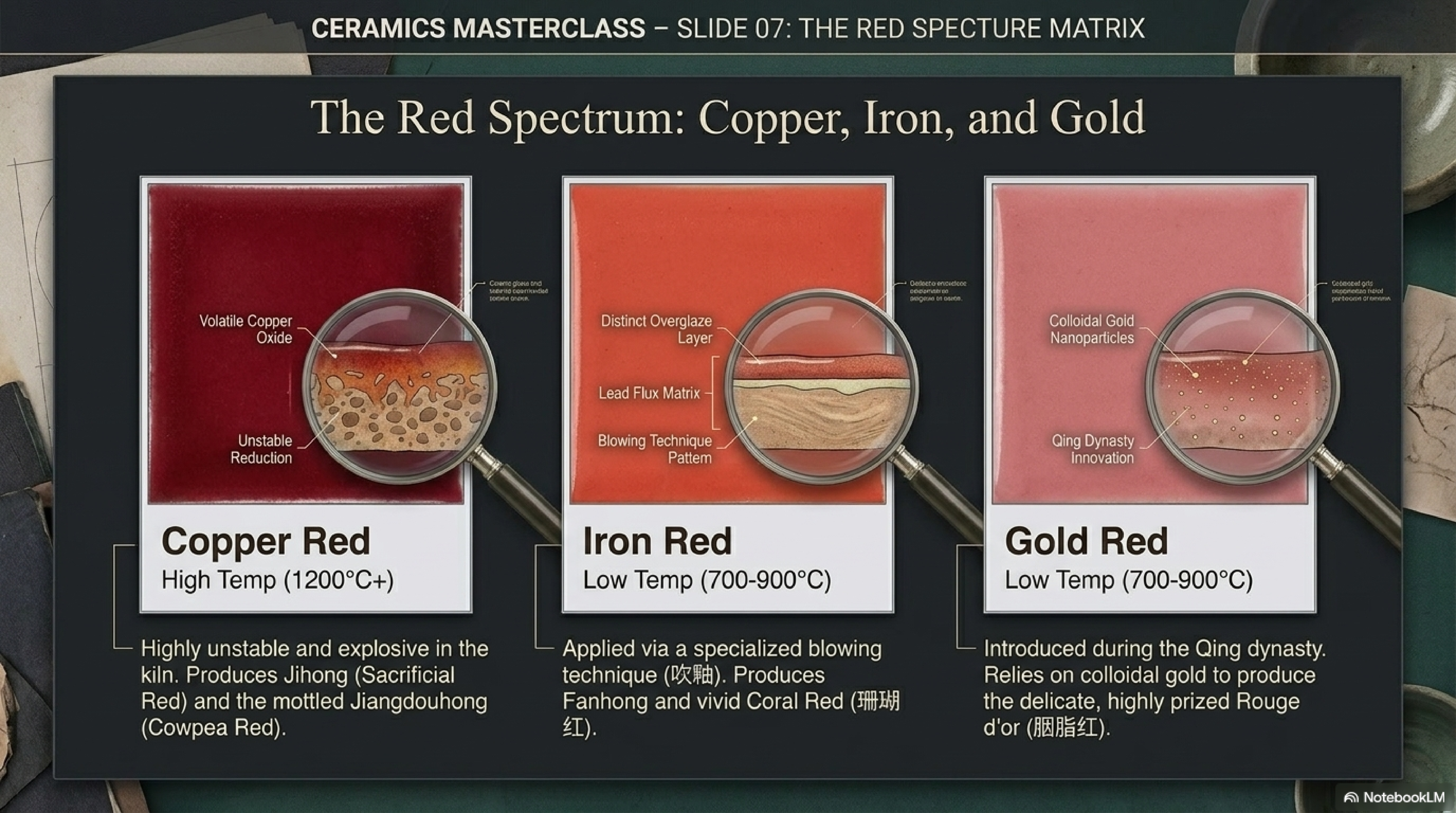
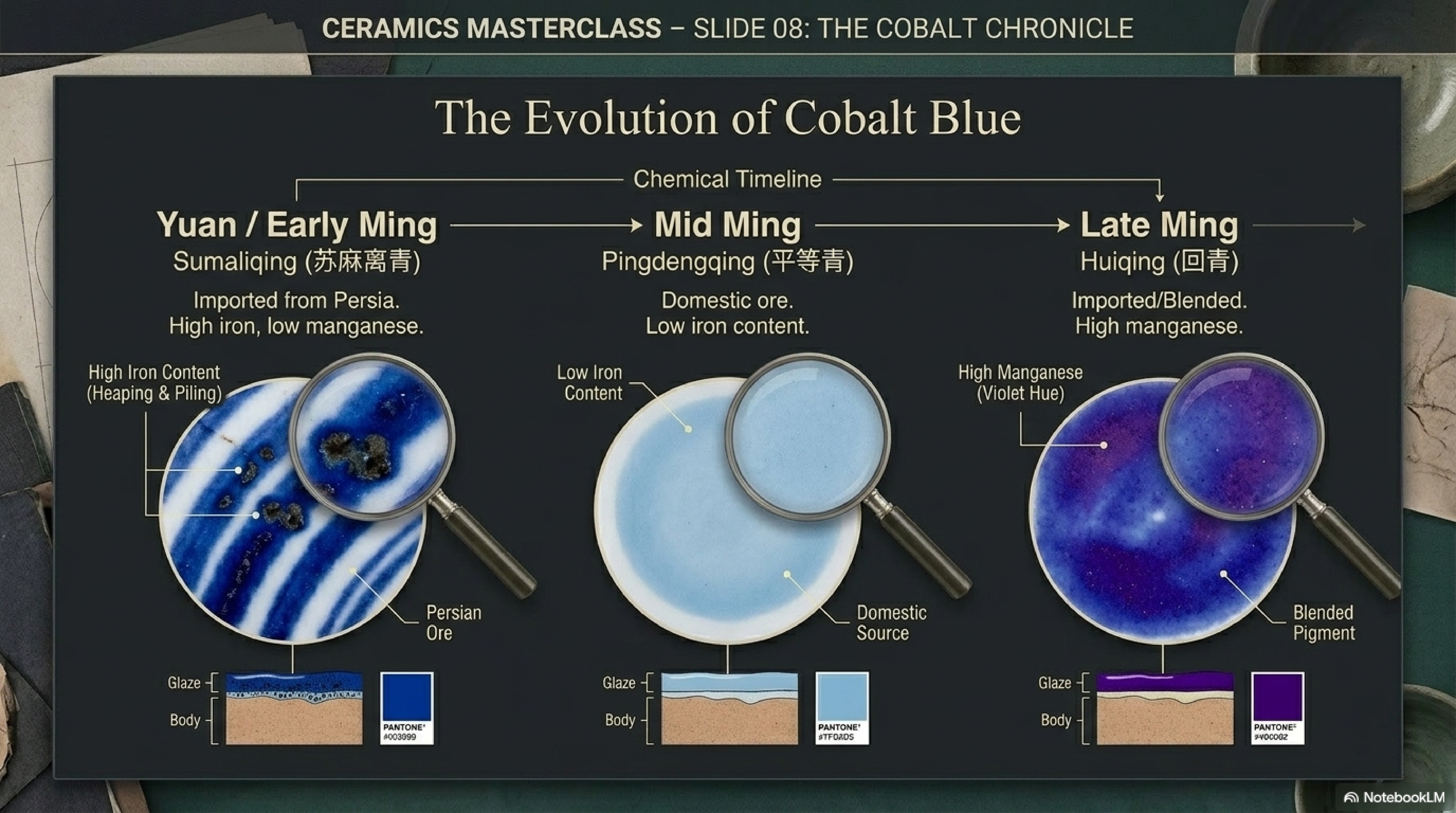
The colourant triad. Three metal oxides produce the majority of Chinese monochrome glaze colours — and each behaves entirely differently depending on kiln atmosphere. Iron (Fe): in a reducing atmosphere (oxygen-depleted), produces blue-grey to celadon; in an oxidising atmosphere, produces yellow, amber, or iron-brown. Copper (Cu): in reduction, produces red (祭红, 郎窑红, 豇豆红); in oxidation, produces green (孔雀绿, 苹果绿). Cobalt (Co): produces blue in both atmospheres, making it the most technically stable colourant — its blue character does not depend on atmosphere control. This explains why cobalt blue (祭蓝) was historically more reliable to produce than copper red (祭红): the same colour results regardless of kiln conditions.

High-Fire vs. Low-Fire Glazes

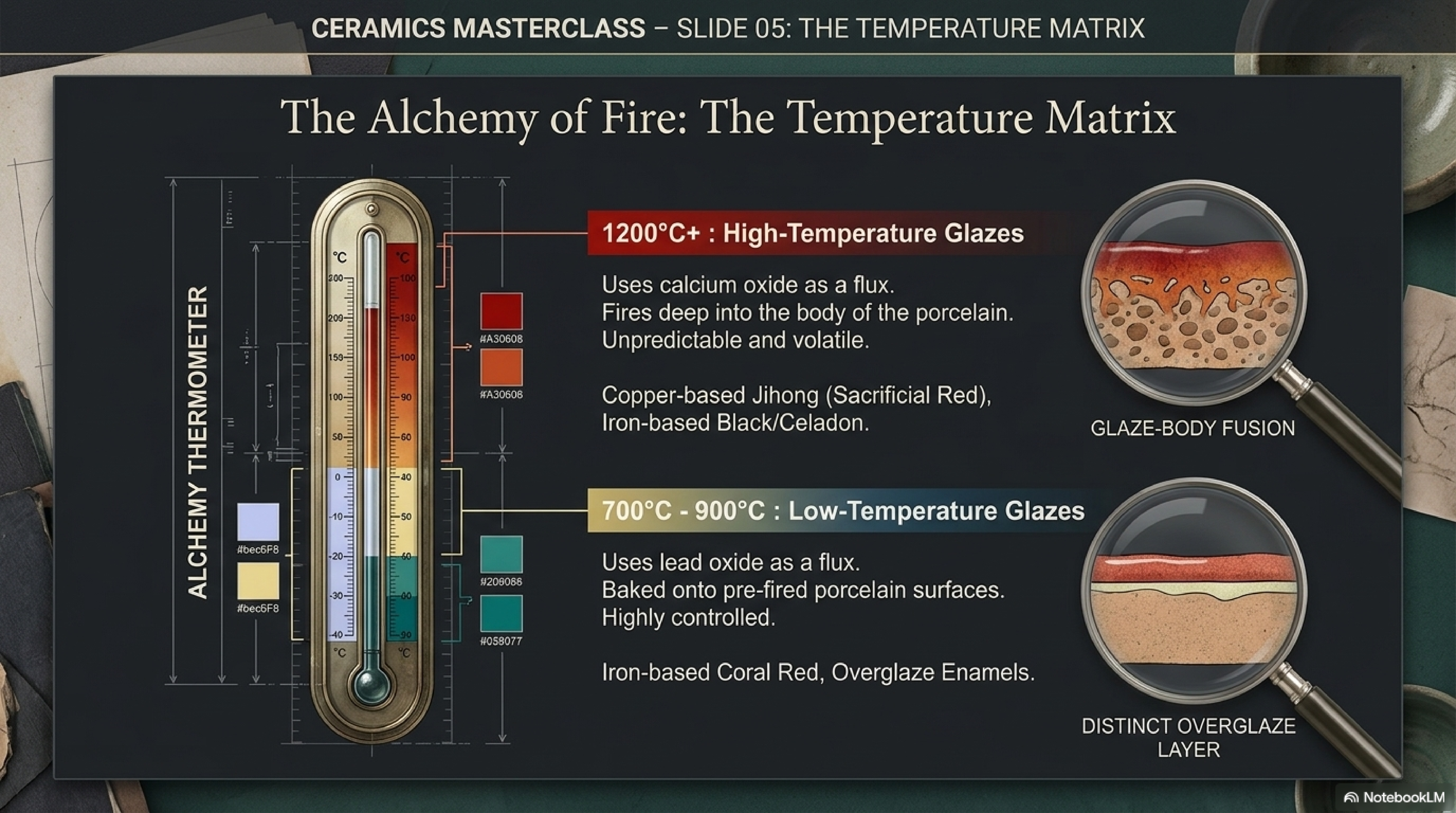
Monochrome glazes divide into two fundamental technical categories based on firing temperature:

High-Fire Glazes (高温釉, >1200°C)

Applied to the unfired body and fired once at full temperature. Examples: 青釉 (celadon), 祭蓝 (sacrificial blue), 郎窑红 (sang-de-boeuf), 甜白 (sweet white). These glazes are fully integrated with the porcelain body — the glaze and clay mature together. Temperature control is critical: 祭红 tolerates a variation of only approximately 5°C before the copper-red colour fails — grey from under-firing, brown-black from over-firing.

Low-Fire Glazes (低温釉, 700–900°C)

Applied to a pre-fired body and re-fired at low temperature with a lead or other flux. Examples: 浇黄 (imperial yellow), 孔雀绿 (peacock green), 胭脂红 (rouge red). The lead flux melts at low temperature, fusing the colour to the glazed surface without re-vitrifying the porcelain. Lower technical risk per firing, but the lead content (and in some cases arsenic) defines specific working and preservation conditions.

The Blow-Glaze Technique (吹釉法)

One of the Qing period's most important technical innovations for monochrome production was the systematic adoption of the 吹釉法 (blow-glaze technique) — applying liquid glaze by blowing it through a bamboo tube fitted with a gauze membrane at one end. The technique produces a uniformly thin, even glaze layer without the dipping or pouring marks visible on earlier pieces. It was also the key to achieving the special surface effects of 洒蓝 (sprinkled blue, where uneven application creates a mottled blue-white pattern) and the subtle colour variegation of 豇豆红 (where the thin, multiple-layer application produces the characteristic pink-to-red-to-green surface transitions).

吹釉法 blow-glaze technique — bamboo tube with gauze membrane, multiple thin layers, resulting in even glaze distribution and special surface effects

The 吹釉法 technique. A bamboo tube, fitted at one end with a gauze membrane, is used to blow liquid glaze suspension onto the vessel body in multiple thin layers. Each layer is allowed to dry before the next application. The result: a glaze of exceptional uniformity, without the drip marks or pooling associated with dipping (蘸釉) or pouring (浇釉). For 豇豆红, multiple thin layers are applied in sequence, each contributing a slightly different concentration of copper — the cumulative chemistry produces the characteristic soft variation from pink through red to green moss spots (苔点) that defines the glaze. For 洒蓝, an interrupted blowing technique produces intentional spatial variation in coverage, creating the mottled blue-white pattern.

The Named Colours:
A Collector's Glossary

Chinese monochrome glaze nomenclature is one of the most poetic in world ceramics — each name encodes a visual, literary, and sometimes ritual meaning that calibrates the collector's expectations before the object is even seen. The following are the canonical types every serious collector must know, organised by colour family.

Red Family (红釉)

Red glaze family — 祭红 deep sacrificial red, 郎窑红 brilliant sang-de-boeuf, 豇豆红 soft peachbloom with green moss spots, shown side by side

The copper-red family. Three fundamentally different characters from the same colourant (copper in reduction) — differentiated by copper concentration, glaze thickness, firing temperature, and cooling rate. 祭红 (far left): dense, clotted, ceremonially weighty — the colour of blood-dark ritual. 郎窑红 (centre): brilliant, translucent at the upper vessel, flowing to the foot but stopping precisely at the boundary (the 郎不流 effect) — a colour of maximum vibrancy and technical confidence. 豇豆红 (right): soft, pink, intimate — restricted to small scholar's vessels, always showing the characteristic green 苔点 from localised copper re-oxidation during cooling. Same metal, entirely different results.

Sacrificial Red · 祭红 / 霁红 Ming Xuande · High-fire copper reduction

The ritual red of the Imperial Altar of the Sun (朝日坛). Deep, dense, slightly matte — a colour of contained weight rather than brilliance. Copper in reduction at approximately 1280–1300°C. Temperature tolerance of approximately 5°C: slight under-firing produces grey; slight over-firing produces brown-black. The technical difficulty of 祭红 is not in its formula but in the precision its firing demands. Xuande examples remain the standard against which all subsequent production is judged.

Sang-de-Boeuf · 郎窑红 Qing Kangxi · Named for Governor Lang Tingji

Named after Lang Tingji (郎廷极), the Jiangxi governor who oversaw Jingdezhen kilns during the Kangxi revival. Brilliant, translucent, internally luminous — a red of maximum chromatic intensity. The defining characteristic: the glaze flows during firing but stops at the foot rim without running over — 郎不流 (Lang does not flow). The foot interior often shows a 米汤色 (gruel-white) or 苹果青 (apple-green) secondary colour from cooling atmosphere changes.

Peachbloom · 豇豆红 Qing Kangxi · Scholar's desk vessels only

The most intimate of Chinese monochromes. Soft pink-to-red, always showing green 苔点 (moss spots) from localised copper re-oxidation during kiln cooling — never uniform, always slightly different from piece to piece. Restricted by court decree to eight specific small vessel forms (八大码) used on the scholar's desk: water dropper, brush washer, seal paste box, and related forms. No large vessel was produced in 豇豆红 during the Kangxi period.

Rouge Red · 胭脂水 Qing Yongzheng · Low-fire, colloidal gold

A low-fire pink-red produced from colloidal gold (金红) — the same chemistry as 粉彩 carmine (胭脂红). Applied over an already-fired glaze surface and re-fired at 700–850°C. The result is a warm, cool-toned pink of extraordinary delicacy — quite unlike the warmth of copper-based reds. Yongzheng examples are the canonical standard. The colour is extremely difficult to date without mark examination because later reproductions are technically close.

Blue and White Family (蓝釉 / 白釉)

Blue and white monochrome — 祭蓝 deep sapphire cobalt, 洒蓝 mottled sprinkled blue-white, 甜白 translucent sweet white

Blue and white monochromes. 祭蓝 (left): deep, saturated cobalt blue — the ritual colour of the Imperial Altar of Heaven (天坛). Unlike copper-based reds, cobalt fires blue in both oxidising and reducing atmospheres, making 祭蓝 technically more reliable than 祭红. Its surface in the finest Ming and Qing examples has a quality often described as "宝石蓝" — the depth and lustre of a sapphire. 洒蓝 (centre): the mottled blue-white from interrupted 吹釉 application — each blue zone is a cluster of cobalt-loaded glaze droplets, surrounded by uncoated white areas. 甜白 (right): Yongle-period sweet white — translucent as rendered fat, the whitest body Jingdezhen produced before the modern era.

Sacrificial Blue · 祭蓝 / 霁蓝 Ming Xuande · High-fire cobalt

The ritual colour of the Altar of Heaven (天坛). Cobalt oxide in a high-fire transparent glaze base — stable across a wide temperature range, making it technically far more forgiving than 祭红. The finest examples: a deep, even, internally luminous blue sometimes compared to a sapphire (宝石蓝). The glaze surface has a slight orange-peel texture (橘皮纹) in Xuande examples — absent in the smoother Yongle standard.

Sprinkled Blue · 洒蓝 Qing Kangxi · Blow-glaze mottled technique

Produced by the interrupted application of cobalt-loaded glaze through the bamboo blow-pipe — the glaze lands in uneven clusters, leaving white ground exposed between zones. The result: a mottled blue-white surface unlike any painted decoration. Often used as a ground for overglaze gilded decoration — 洒蓝描金 (sprinkled blue with gold) is one of the most characteristic Kangxi decorative combinations.

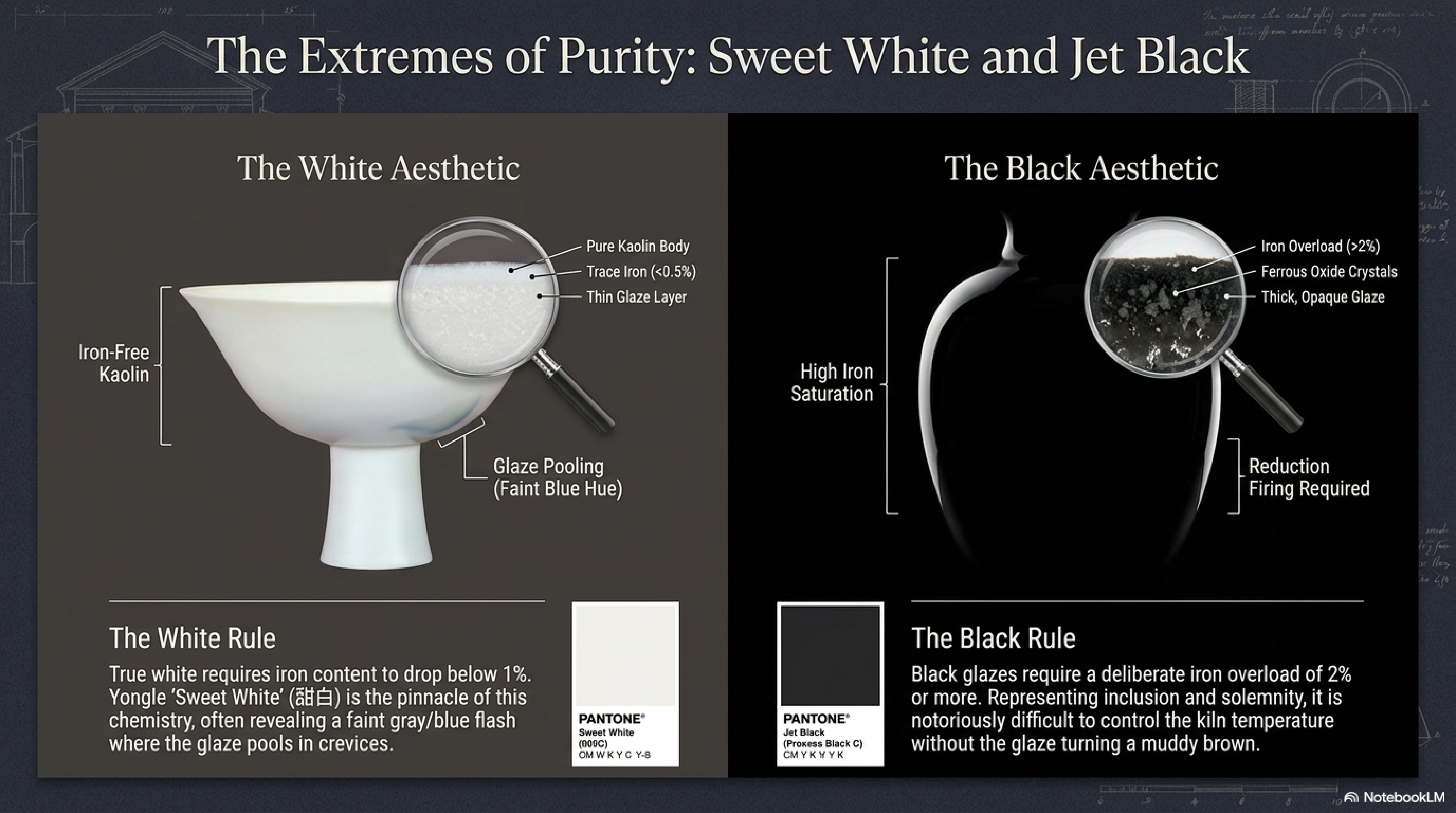
Sweet White · 甜白 Ming Yongle · Pure white, translucent

The whitest and most translucent glaze produced at Jingdezhen before the 20th century. Described as 白如凝脂 (white as congealed fat) — a comparison to rendered animal fat that emphasises warmth and depth rather than cold brightness. Yongle 甜白 has a virtually smooth glaze surface; Xuande examples develop the subtle 橘皮纹. Highly prized as a ground for incised 暗花 (hidden decoration) visible only in transmitted or raking light.

Mirror Black · 乌金釉 Qing Kangxi · High manganese-iron

A jet-black, mirror-surfaced glaze from high concentrations of iron and manganese in a high-fire base. The surface has the reflective quality of lacquer — 漆黑如墨 (black as ink-lacquer). Often used as a ground for overglaze gilded decoration. Kangxi examples show a deep, settled black; later reproductions tend toward a greyer, less saturated tone. The mirror quality is the key authentication marker: it should reflect clearly without milkiness.

Yellow and Green Family (黄釉 / 绿釉)

Yellow and green glazes — 浇黄 imperial poured yellow, 孔雀绿 peacock green, comparing Ming Hongzhi and Zhengde canonical examples

Imperial yellow and court green. 浇黄 (left): Hongzhi yellow — a low-fire lead-fluxed iron-yellow of exceptional warmth and uniformity. Its smooth, even coverage without brushmarks or drip traces is the result of the 浇 (pouring) application technique: the glaze is poured over the vessel surface and allowed to settle before firing. Possession of yellow-glazed vessels was restricted to the imperial family and specifically graded: Empress used fully yellow pieces; Consorts used pieces with yellow exterior and white interior; lower ranks used yellow in combination with other colours. 孔雀绿 (right): Zhengde peacock green — a copper-green of vivid, slightly blue-green character, applied as a low-fire overglaze.

Complex Glazes (复合釉)

Complex monochrome glazes — 茶叶末 tea-dust iron-brown with green crystalline dispersion, 窑变花釉 flambe multi-colour flowing glaze

Complex monochromes: 茶叶末 and 窑变. 茶叶末 (tea-dust glaze, left): an iron-saturated high-fire glaze that separates during cooling into a brown-black matrix with dispersed green crystalline spots — the visual effect of dry tea leaves scattered on dark earth. Also called 厂官釉 (factory official glaze) from its administrative association. The finest examples are Yongzheng; Qianlong production is slightly coarser. 窑变花釉 (flambe, right): a deliberate exploitation of kiln-atmosphere unpredictability — red, blue, purple, and grey flowing together in patterns that cannot be pre-designed. Each piece is unique. The Qianlong court embraced this deliberate surrender to kiln chance as an aesthetic statement in itself.

Tea-Dust · 茶叶末 / 厂官釉 Qing Yongzheng–Qianlong · Iron crystalline

A high-fire iron-saturated glaze that phase-separates on cooling: the iron-rich matrix produces a dark brown-black ground while dispersed areas of lower iron concentration crystallise to green. The visual result — brown ground with green crystalline flecks — resembles dry tea leaves on dark earth. 茶叶末 was a Yongzheng-period favourite, appreciated for its literati quietness. Qianlong examples are technically similar but slightly coarser in crystal dispersion.

Flambe · 窑变花釉 Qing Qianlong · Uncontrolled kiln atmosphere

A glaze that deliberately harnesses the unpredictability of kiln-atmosphere changes during firing. Red, blue, purple, and grey flow together in patterns determined entirely by local atmosphere fluctuations within the kiln — no two pieces are identical. The Qianlong court's enthusiasm for 窑变 represents an interesting philosophical reversal: rather than controlling the kiln to produce a specified colour, the potter designs a glaze formula whose outcome is intentionally variable, and accepts whatever the kiln produces. Each 窑变 piece is, in a precise sense, unique.

Reading the Period:
Surface, Foot, Translucency

Dating monochrome glazes requires attention to three physical properties: the glaze surface character (texture, sheen, orange-peel), the foot rim treatment and body colour, and the transmitted-light body tone. No single criterion is sufficient — reliable attribution requires convergence across all three.

Period comparison of monochrome glaze surface — Yongle smooth surface, Xuande orange-peel texture, Kangxi hard-bright surface, late Qing thin over-refined surface

Surface character by period. Yongle (top left): glaze surface is smooth, polished, without orange-peel texture — described as 莹润光净 (lustrous and smooth). Xuande (top right): the glaze surface develops a fine, regular orange-peel texture (橘皮纹) — a physical marker of the Xuande glaze formula's different viscosity at firing temperature. This textural distinction is one of the most reliable surface-level criteria for separating Yongle from Xuande. Kangxi (bottom left): glaze surface is described as 硬亮青 (hard and bright blue-white) — firmer and more uniformly reflective than Ming surfaces. Late Qing (bottom right): the surface tends toward thinness — the glaze layer is thinner, the colour slightly less saturated, the overall surface less "settled."

Ming Period · 明代 Hongwu through Wanli

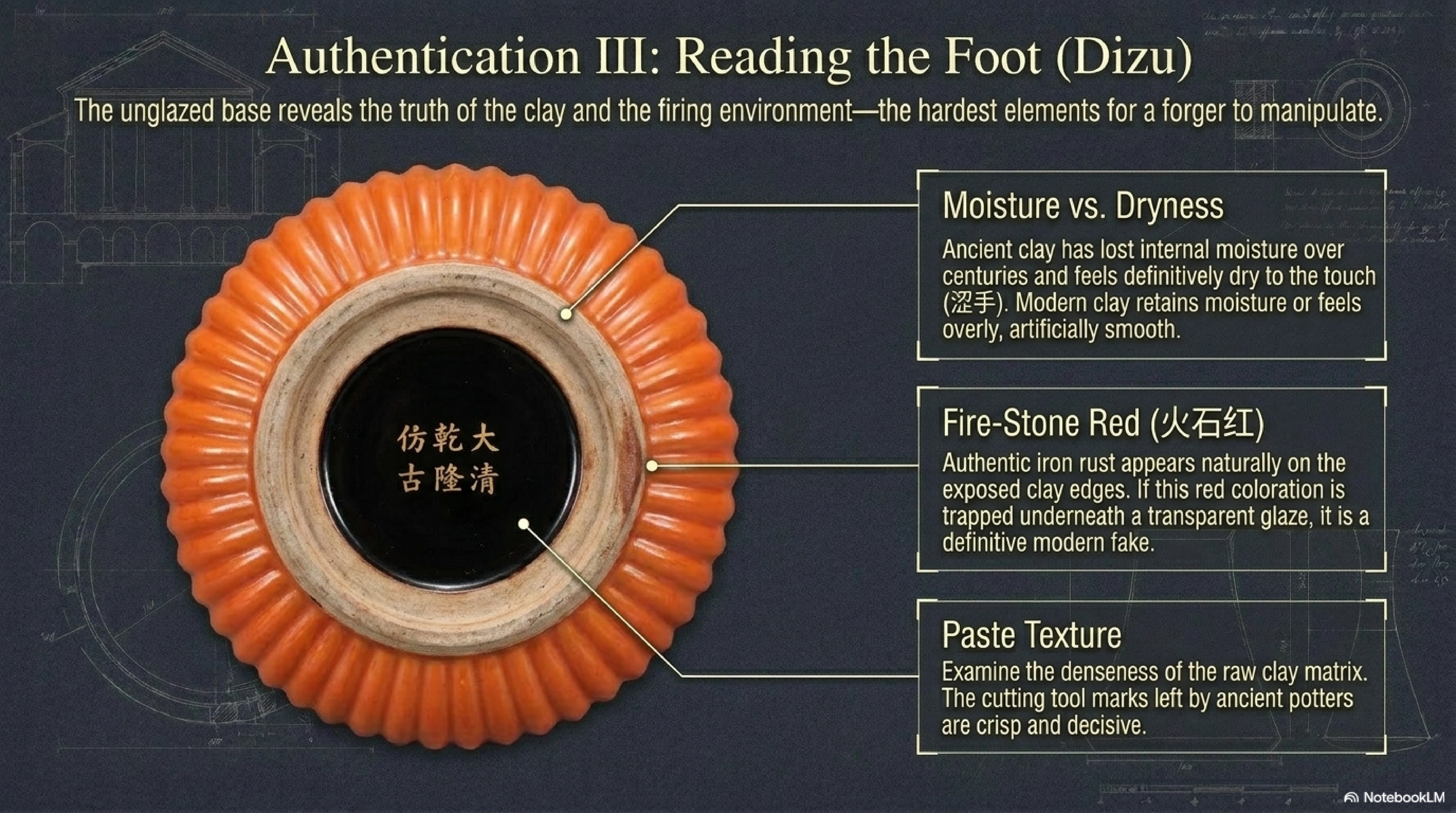
Body in transmitted light shows a warm pinkish-ivory (肉红色) — the natural iron content of Ming-period Jingdezhen clay. Foot rim frequently shows 火石红 (fire stone red — an orange-iron oxidation ring at the glaze-clay boundary). Exterior foot often has radial tool marks (跳刀痕) from the trimming process. Glaze surface slightly thicker and more settled than Qing equivalents.

Kangxi Period · 康熙 Qing Kangxi 1662–1722

Glaze surface character: 硬亮青 (hard-bright blue-white) — a firmer, more uniformly reflective surface than Ming. Body in transmitted light: cooler, slightly blue-white. Foot rim: more precisely trimmed than Ming, with the characteristic Kangxi "slanted foot" (斜削足) on some vessel forms. 郎窑红 specifically: foot shows 米汤色 (gruel-white) or 苹果青 (apple-green) secondary colour on foot interior.

Yongzheng Period · 雍正 Qing Yongzheng 1723–1735

The most precisely potted and trimmed of all Qing periods — foot rim execution is described as the most refined in Chinese ceramic history (修足最为精雅). Round vessels are perfectly regular and even. Glaze surface: slightly softer than Kangxi, with a more "settled" quality. Body: very white, with minimal iron. Reconstructed Song glazes (仿汝, 仿官): technically very close to Song originals but with a slight regularity of form that reveals Qing workshop discipline.

Late Qing / Republican · 晚清民国 After Jiaqing · post-1796

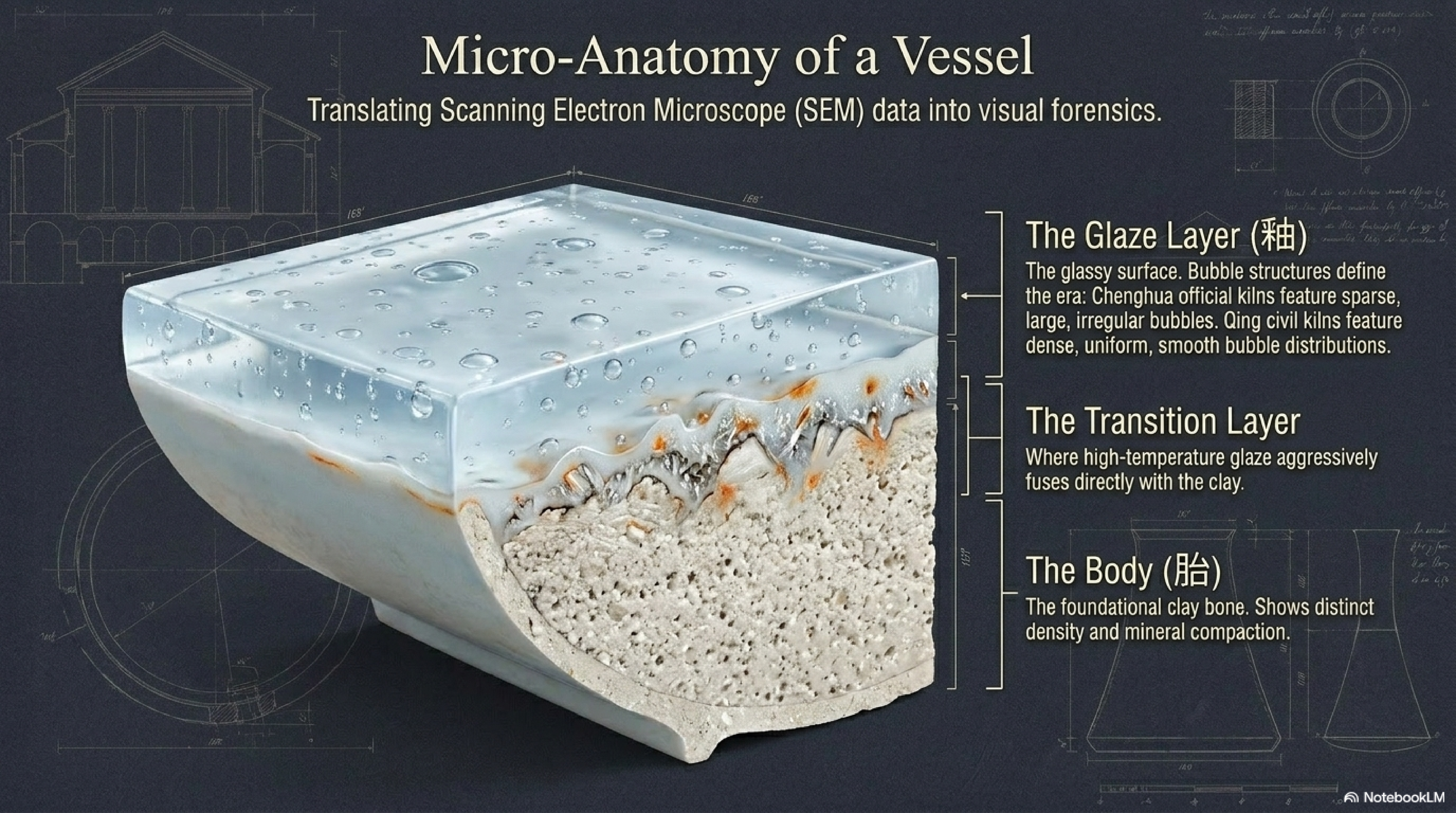
Glaze surface: thinner, slightly less saturated — colour tends toward 欠莹润 (less lustrous). Body: refined, often too white and too dense — modern clay with lower iron content, transmitting a cold blue-white light rather than the warm pinkish-ivory of Ming and early Qing. Foot rim: often shows stone-quartz sand (石英砂) or alumina powder adhering to the base — a marker of modern gas-kiln firing absent in authentic early production.

Foot rim comparison — Ming foot with fire stone red and radial tool marks, Kangxi slanted foot with secondary colour on interior, Yongzheng precisely trimmed even foot

Foot rim as diagnostic evidence. Ming (left): the foot rim exposes raw clay showing natural 火石红 (fire stone red) — the orange-iron oxidation that develops at the glaze-clay boundary over firing and time. Radial 跳刀痕 (trimming tool marks) are visible on the exterior foot surface. Kangxi 郎窑红 (centre): the foot interior shows 苹果青 (apple-green) — a secondary colour from atmosphere changes at the cooler lower kiln zone during the late firing stage. Yongzheng (right): the foot rim is trimmed to a precision and evenness that no earlier or later Chinese production matches — the cutting is even, the angle consistent, the exposed clay body pure white. Each of these features, in the right combination, is a reliable period marker.

Old vs. New:
Reading the Monochrome Surface

Monochrome glazes present a specific authentication challenge: without brushwork or painted decoration to examine for vitality and hesitation, the collector must read the object's physical character entirely through glaze surface, body quality, and aging evidence. The markers are few but decisive.

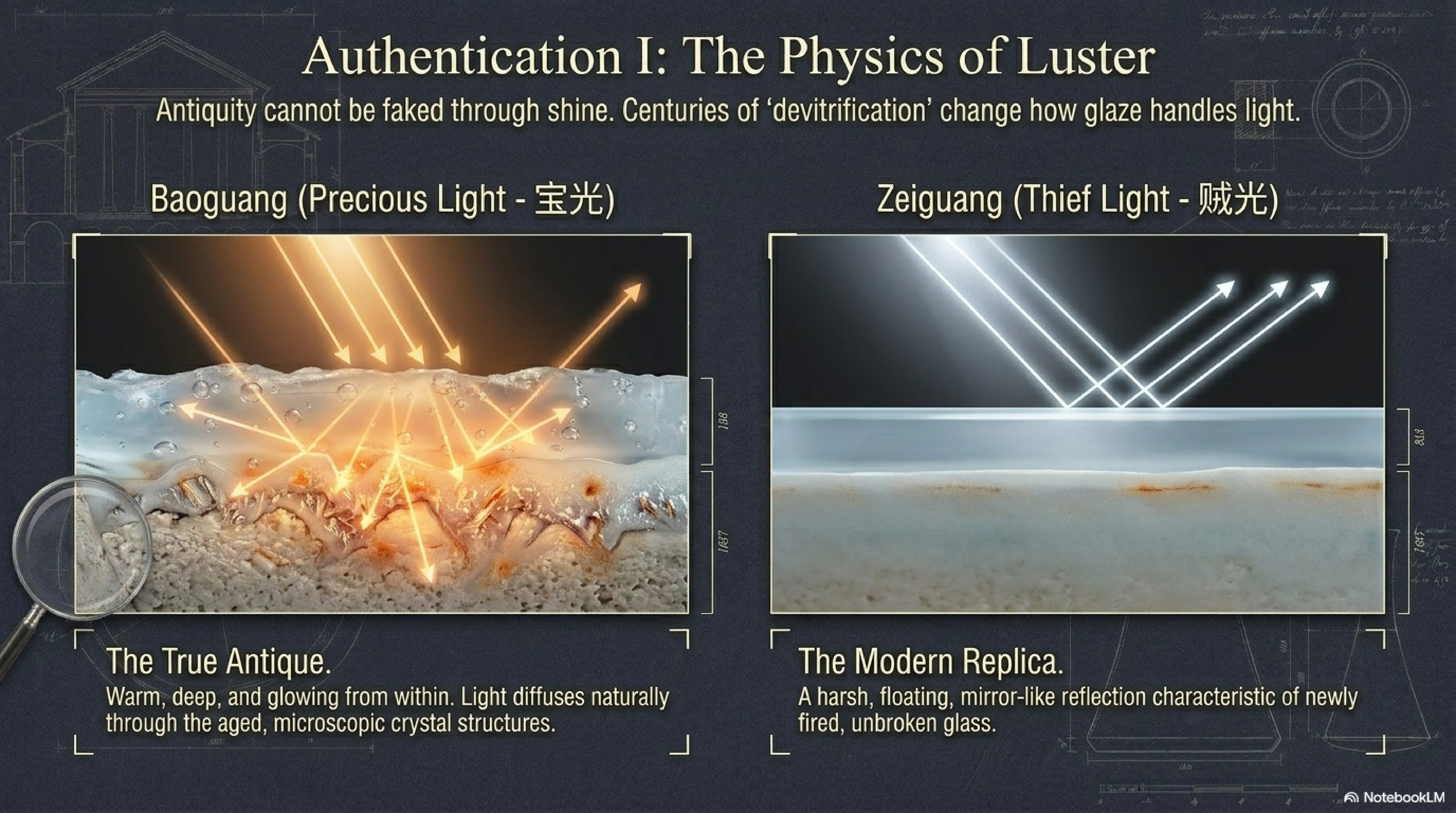
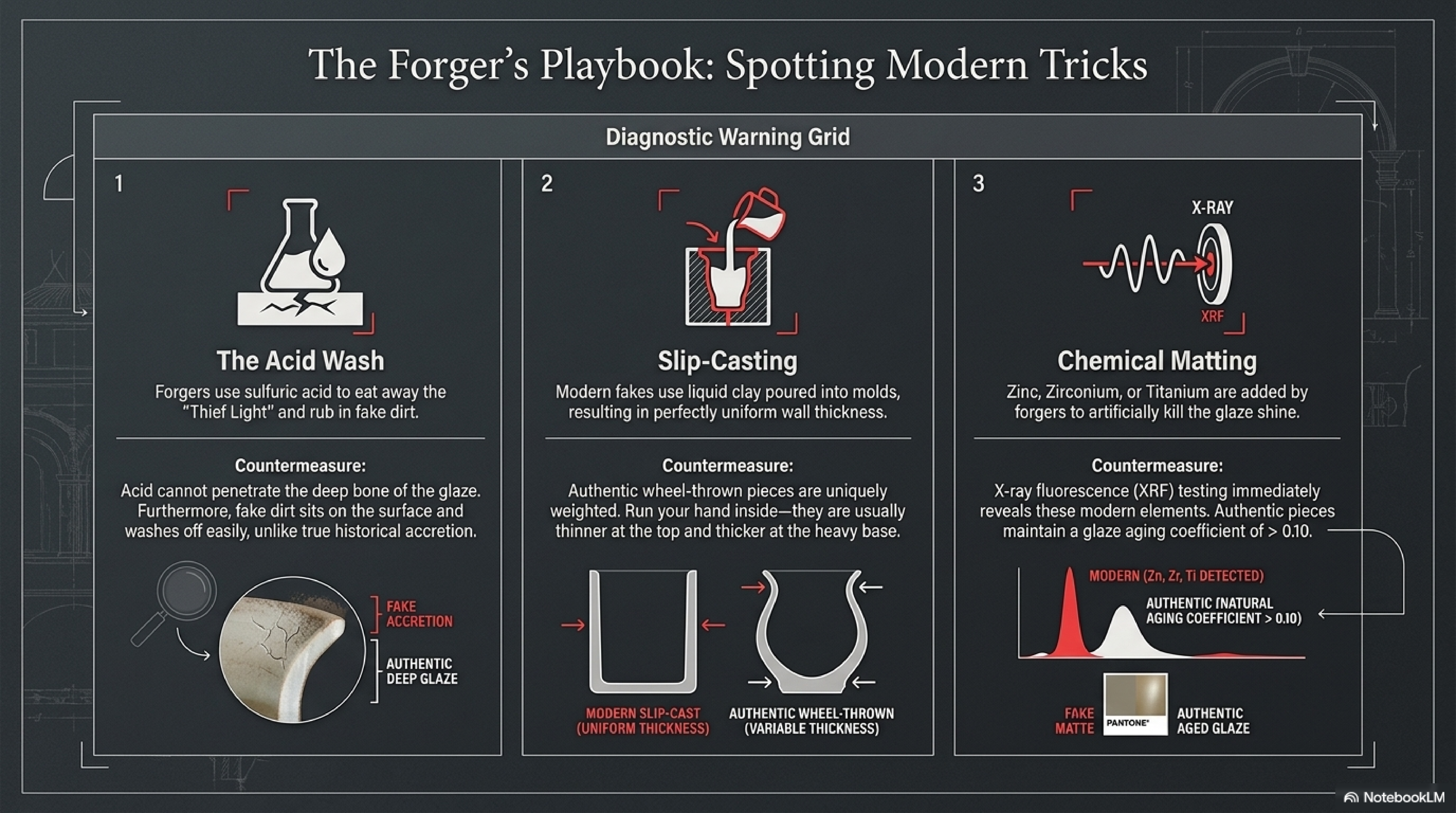
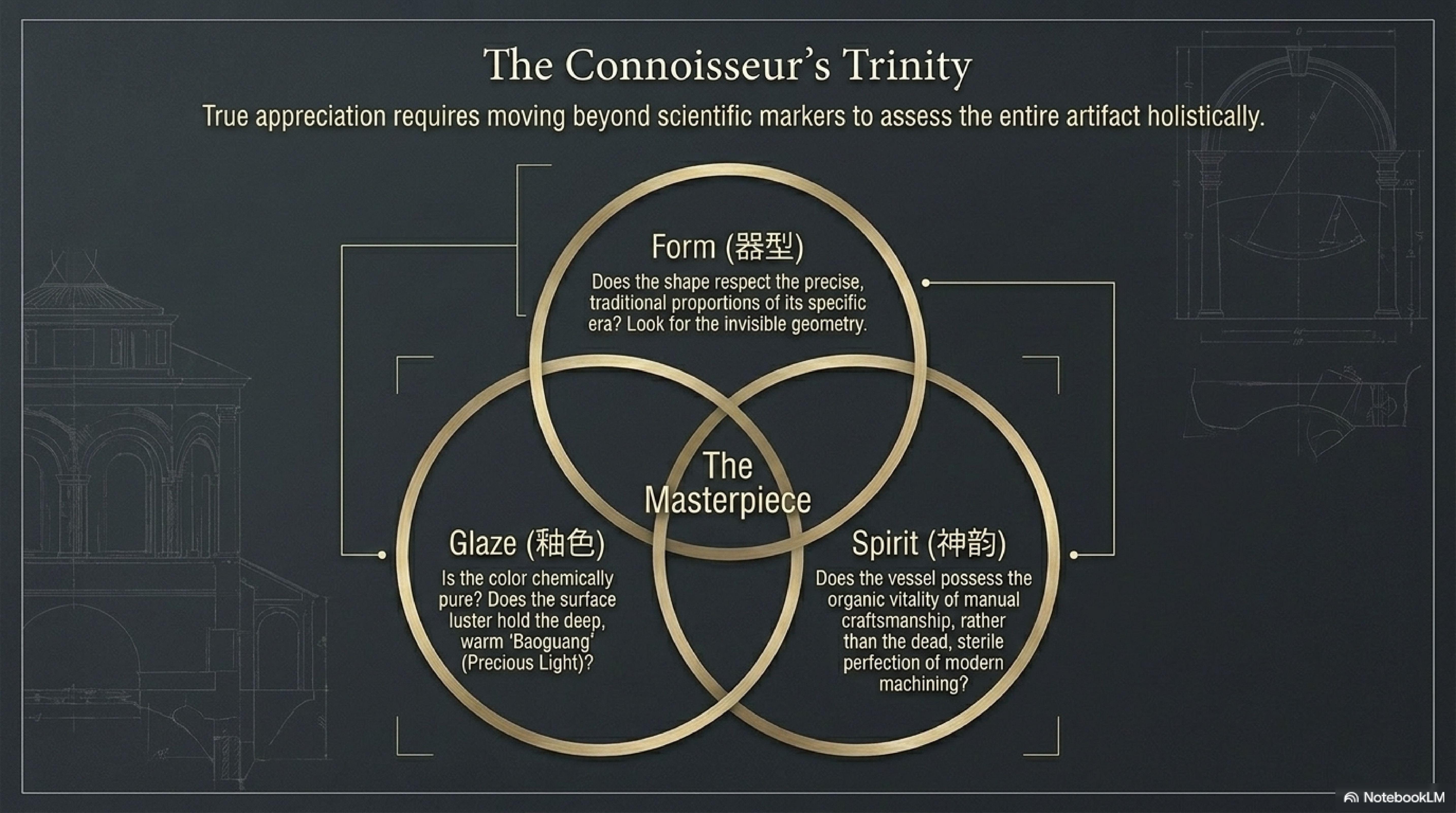
Monochrome authentication — 宝光 internal luminosity of genuine aged glaze versus 浮光 harsh surface brightness of new production, shown under consistent lighting

宝光 vs. 浮光 — the central optical test. Genuine old monochrome (left): the glaze surface has 宝光 — a warm, internally luminous quality, as if the light comes from within the glaze layer rather than reflecting off its surface. This is a real optical phenomenon: centuries of micro-surface weathering create a slight diffusion layer at the outermost glaze surface that scatters incident light inward before it reflects outward, producing the characteristic "soft" quality. New production (right): the glaze surface has 浮光 or 火刺光 — a harsh, surface-reflective brightness from the highly polished, undisturbed outer glaze surface of recently fired ceramics. The distinction is consistent under controlled lighting and is one of the most reliable authentication indicators.

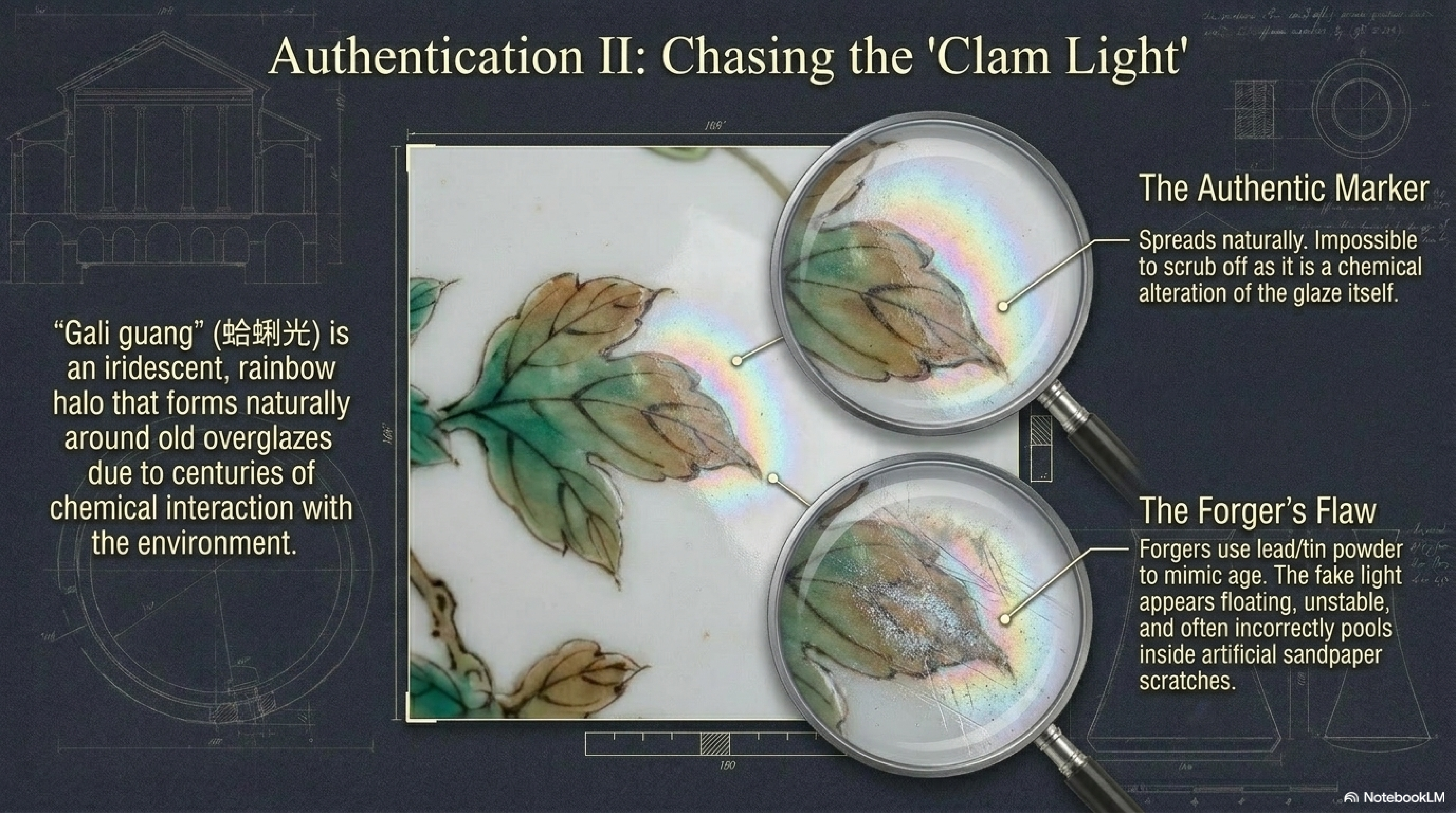
Authentication detail — 蛤蜊光 iridescence on old 祭蓝 glaze surface, fire stone red at foot rim, hand-throw spiral marks on interior

Authentication evidence in detail. Top left: 蛤蜊光 on an old 祭蓝 surface — the rainbow shimmer is visible across the glaze field, strongest at oblique angles and in the thinly-glazed areas near the foot. Top right: genuine 火石红 on a Ming foot rim — the orange-iron zone fades naturally inward from the glaze boundary, with irregular distribution reflecting the actual fired-clay chemistry. Bottom: interior of a hand-thrown vessel showing natural spiral 旋纹 — the subtle ridges from finger pressure during throwing, slightly irregular in spacing and depth. These three markers together, on the same piece, constitute strong combined evidence for early Ming attribution.

"缺陷,是自然告诉我们它参与了创作。"

— The "defect aesthetics" (缺陷美学) of Chinese monochrome glazes: the green 苔点 in 豇豆红 (spots of copper re-oxidation during cooling), the unpredictable colour flows of 窑变 (kiln transformation), the crackling of 哥窑-style glazes — none of these were originally intended as decorative features. They are traces of the kiln's own participation in the making. Chinese connoisseurship elevated these traces to defining virtues, recognising in them what the craftsman's hand alone cannot produce: evidence that nature itself co-authored the object.
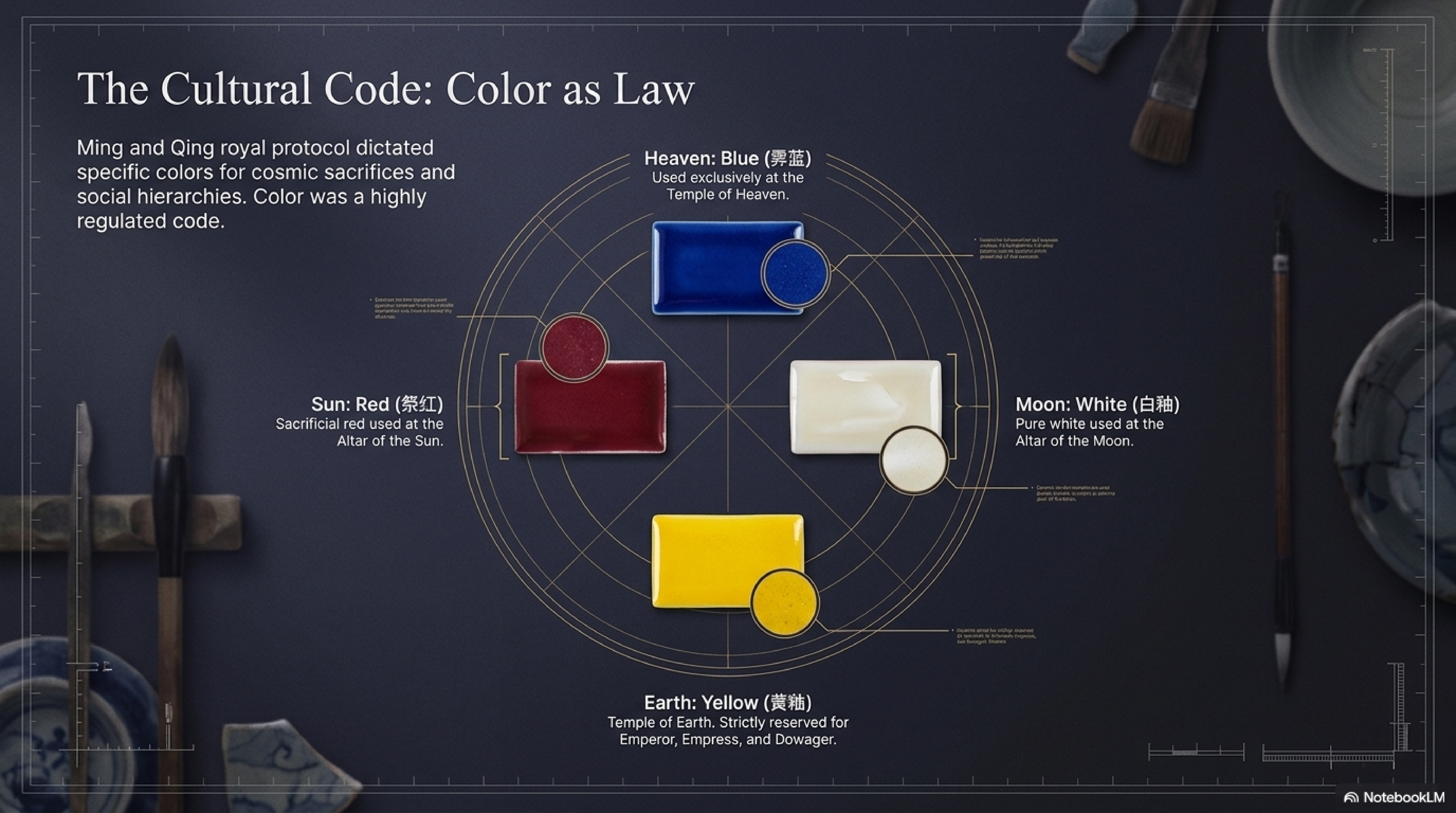
Ritual colour system — Jingdezhen monochrome glaze colour-to-ceremony correspondence: 祭蓝 for 天坛, 黄釉 for 地坛, 祭红 for 朝日坛, 月白 for 夕月坛

The imperial ritual colour system. The Confucian-imperial state ceremony framework assigned specific colours to specific altars and ritual functions, and Jingdezhen's monochrome production was systematically organised to supply them. The Altar of Heaven (天坛) required 祭蓝 (sacrificial blue) — the colour of the sky. The Altar of Earth (地坛) required 黄釉 (yellow) — the colour of earth. The Altar of the Sun (朝日坛) required 祭红 (sacrificial red) — the colour of fire and the rising sun. The Altar of the Moon (夕月坛) required 月白 (moon white or pale blue-white) — the colour of moonlight. This colour system, enforced for over four centuries, drove the technical standardisation of monochrome glaze production at Jingdezhen and explains why particular colours — especially 祭红 and 祭蓝 — received such sustained court investment in their technical refinement.

Currently Available · 颜色釉在售

Selected monochrome glaze pieces available from our eBay store.

Antique Chinese robin's egg-glazed vase with four seasons' floral design, 19th C
View on eBay
Antique Chinese Ge type celadon bowl with magnificent crazing, 18th C or earlier
View on eBay
Antique Chinese slip-decorated brown-glazed tripod incense burner, Wanli, 16th C
View on eBay
Antique Chinese slip-decorated brown water jar with two star motifs Wanli 16th C
View on eBay
Exquisite Antique Chinese Qingbai Censer Ming Xuande Mark, Kangxi and of period
View on eBay

All pieces ship from the United Kingdom.  ·  View all available pieces →