Eight Great Kiln Systems · Crown of Northern Celadon

Yaozhou Ware
耀州窑

北方青瓷之冠 · The Blade That Carved Light

A thousand years of kiln fire on the Loess Plateau.
Olive-green glazes and slanted-blade relief that no tradition has matched.

618 Tang Dynasty Origins
十里 Kiln Field Extent
1300°C Peak Firing Temp
巧如范金 Clever as Cast Bronze

The Crown of Northern Celadon:
Where Blade Meets Clay

In the canon of Chinese ceramics, the south gave the world jade-green perfection in Longquan. The north answered with something entirely different: a celadon so deeply carved, so physically assertive in its relief, that it seemed less like a glazed surface and more like a landscape. Yaozhou ware is the undisputed peak of northern celadon — distinguished not by the milky opacity of its glaze but by the masculine, blade-hewn energy of its decoration.

For a thousand years, the kilns of Huangbao Town (黄堡镇) in Tongchuan, Shaanxi fired a tradition that would earn the highest praise Song connoisseurs could offer: "巧如范金、精比琢玉" — clever as cast bronze, precise as carved jade. At its Northern Song peak, the "ten-li kiln field" (十里窑场) supplied tribute ware to the imperial court while simultaneously feeding a vast commercial export market across northern China.

Longquan

Celadon jade-green. Powder Blue & Plum Green. The southern summit of the celadon tradition.

耀 Yaozhou

Olive green. Slanted-blade relief carving. The northern crown. The subject of this guide.

Jian

Black iron glaze. Hare's fur & oil drop. Born for the Song tea ceremony.

Cizhou

White ground, black painting. China's greatest folk kiln tradition.

Hutian

Shadow blue yingqing. White as jade, thin as paper. Jingdezhen's foundation.

"巧如范金,精比琢玉。"

— Song Dynasty praise for Yaozhou celadon: "Clever as cast bronze, precise as carved jade." The supreme compliment for a northern kiln that turned the act of carving unfired clay into an art form rivalling metalwork and lapidary.

A Thousand-Year Arc:
From Tang Sancai to Northern Song Peak

Yaozhou ware takes its name from ancient Yaozhou prefecture — today's Tongchuan City (铜川市) in Shaanxi Province, where the principal kilns clustered in Huangbao Town (黄堡镇) along the Qishui River valley. The site lay within the coal-bearing geology of the Loess Plateau — a geographical accident that would define the kiln's entire technical character.
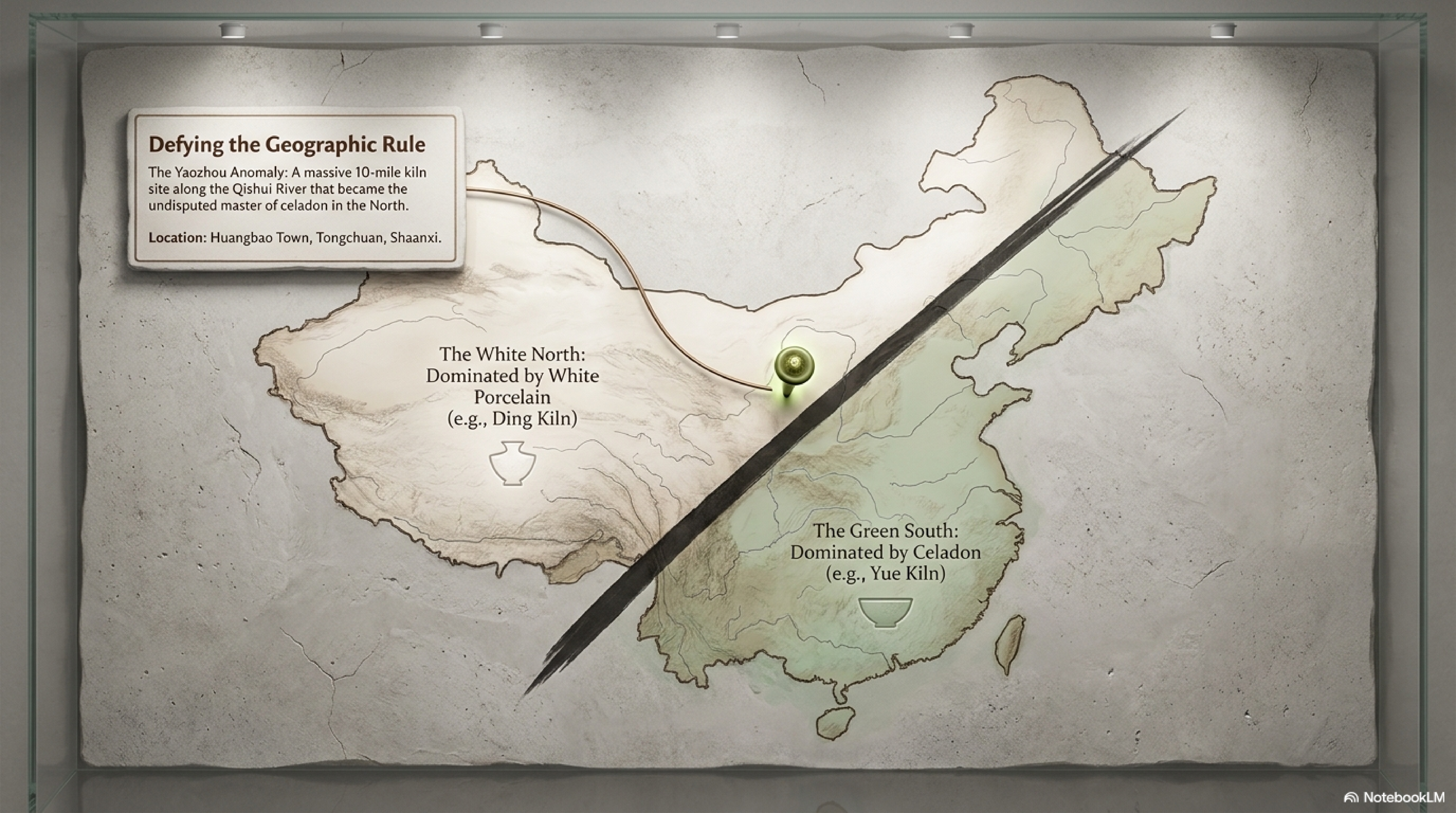
Geographic map of Yaozhou kiln production zone — Huangbao Town, Tongchuan, Shaanxi, showing the Qishui River valley coal-bearing geology and distribution of kiln sites

The production heartland. Huangbao Town sits within a coal-bearing basin on the Loess Plateau — a geological coincidence that made Yaozhou the first major kiln in Chinese history to systematically use coal as fuel. The local clay (grey-white, fine-grained during the Northern Song) combined with access to coal and iron-rich glaze minerals to create the kiln's defining combination of hard body, deep glaze, and extreme carving precision.

The Dynasty-by-Dynasty Arc

Tang (618–907)

Remarkable variety. Black glaze, white ware, and brilliant sancai lead-glazed earthenware. The kiln already demonstrates technical range, though celadon is not yet dominant.

Five Dynasties (907–960)

The sky-blue moment. Under the influence of Yue ware from the south, Yaozhou developed a refined "sky-blue glaze" (天青釉) — thin, precise, and elegant. This tradition is believed to have influenced the development of Ru ware's iconic sky-blue in the subsequent Northern Song period.

Northern Song (960–1127)

The golden age. The kiln establishes its definitive character: deep olive-green glaze, coal-fired reduction atmosphere, and the full development of slanted-blade carved decoration. Imperial tribute ware produced. Scale: the "ten-li kiln field."

Jin (1115–1234)

A shift in colour. Production continues but the glaze gradually warms from olive-green toward ginger-yellow (姜黄). Carving remains bold; quality is maintained. The Jin period represents the beginning of the long colour drift.

Yuan–Ming

Decline. Glaze increasingly yellowed; carving quality diminishes as the northern ceramic economy shifts. Production gradually contracts, ultimately yielding dominance to Jingdezhen's blue-and-white tradition.
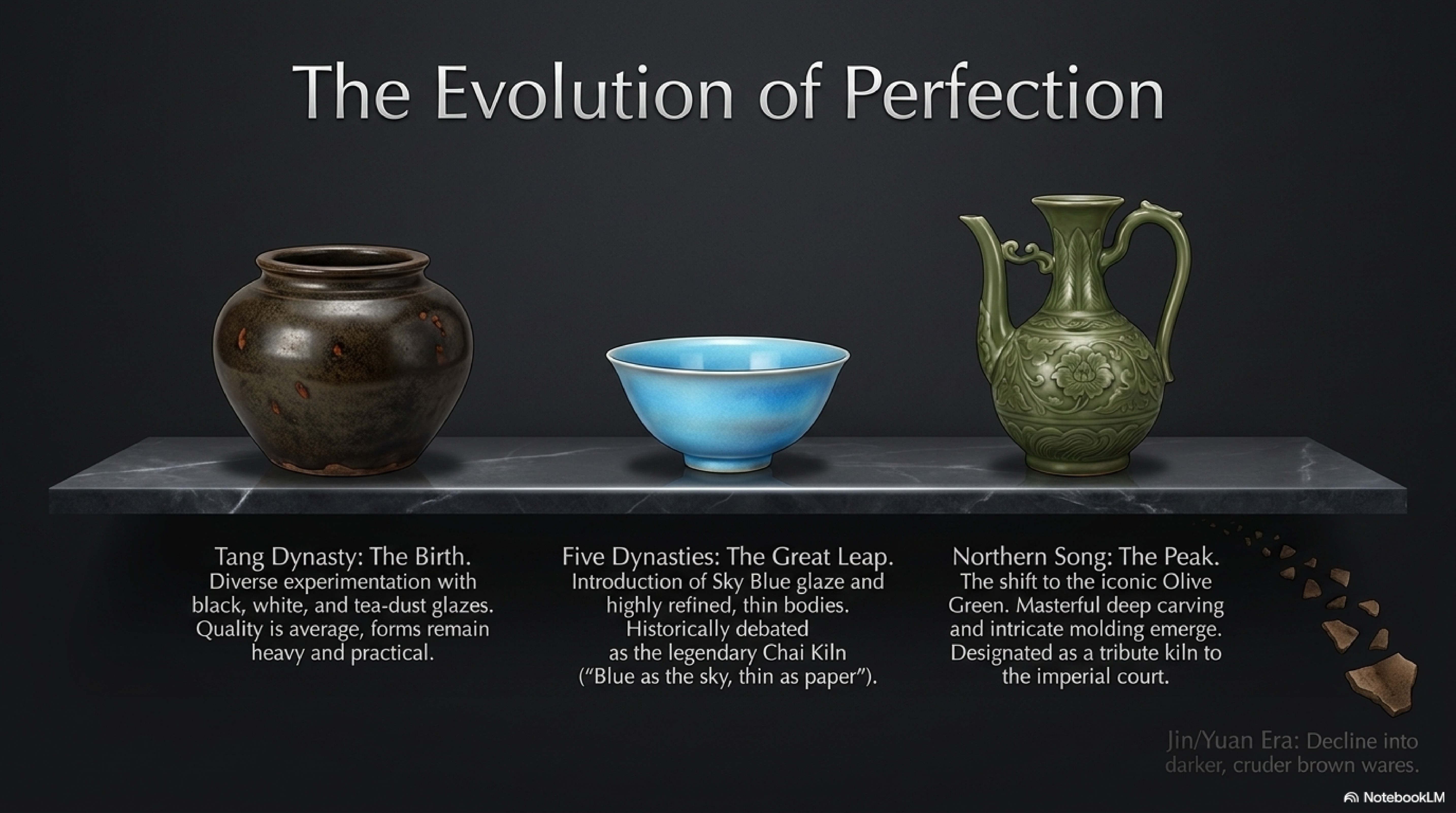
Yaozhou ware evolution across Tang, Five Dynasties, Northern Song, and Jin dynasties — glaze color shift from sky blue to olive green to ginger yellow

A millennium of colour drift. Tang: polychrome sancai and black glaze variety. Five Dynasties: sky-blue celadon, thin and precise — closest to Yue ware influence. Northern Song: the peak — olive green, deep-carved, coal-fired, hard and luminous. Jin: the colour begins its drift toward ginger-yellow as glazing practice changes. The olive-green of the Northern Song summit is the canonical Yaozhou tone; pieces outside this window require careful dating.
Coal, Clay & the
Slanted Blade

Yaozhou's technical identity rests on two pillars: the pioneering use of coal as kiln fuel, and the invention of slanted-blade relief carving (偏刀刻花) — a technique so demanding and so distinctive that it remains the kiln's most reliable authentication marker a thousand years later.

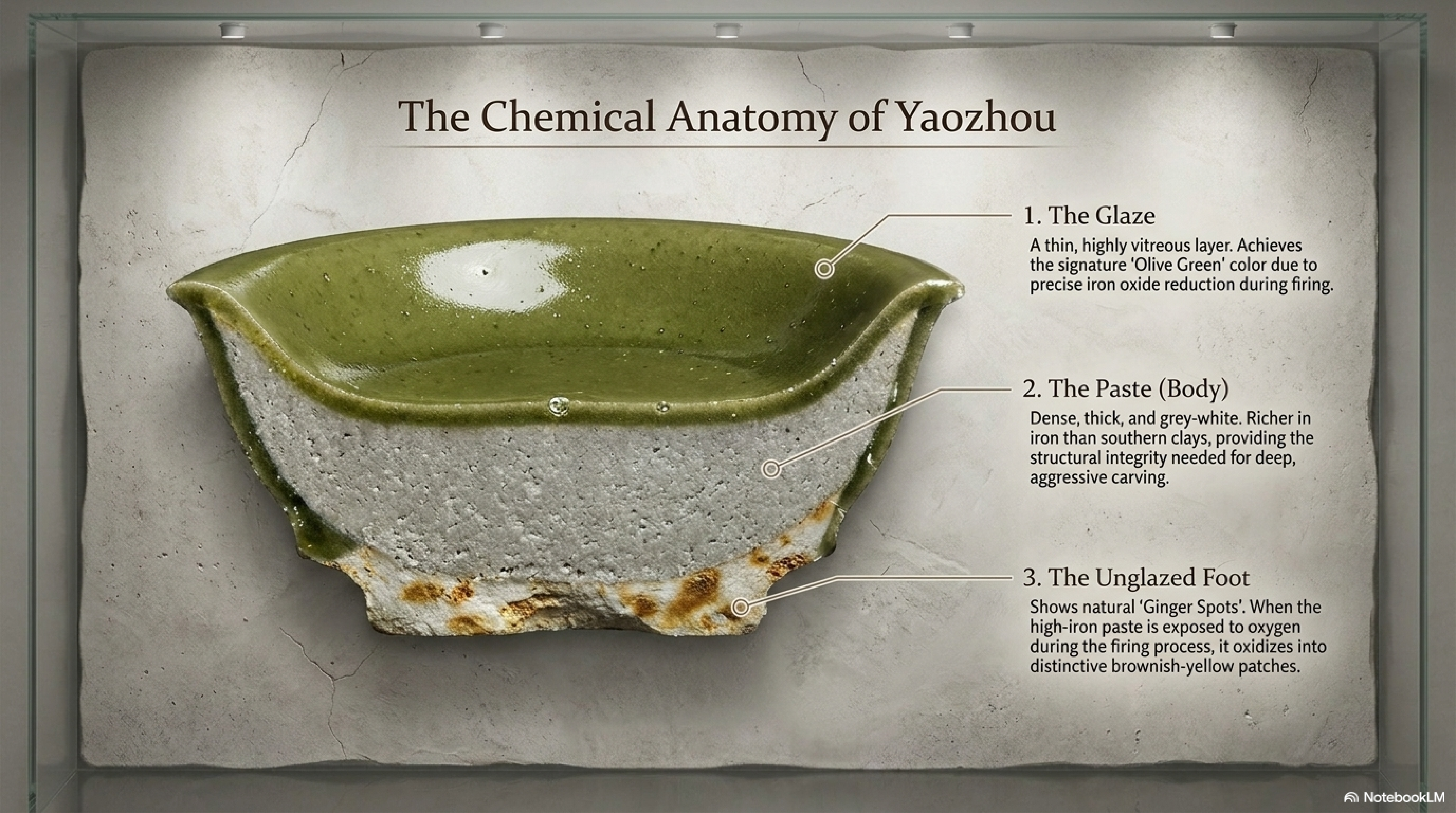
Yaozhou glaze chemistry and clay body composition — iron-coloured celadon glaze formula, grey-white Northern Song clay body with Al₂O₃ and Fe₂O₃ analysis

The material foundation. Yaozhou's Northern Song clay (胎土) is grey-white and notably fine-grained — a clean, dense body whose high firing temperature produces a hard, sonorous result. The glaze is iron-coloured celadon (铁着色青釉): the characteristic olive-green emerges from the interaction of iron, reduction atmosphere, and temperature. The deep olive colour (橄榄青) represents the peak firing window; deviation produces yellow or grey.

China's First Coal Kiln

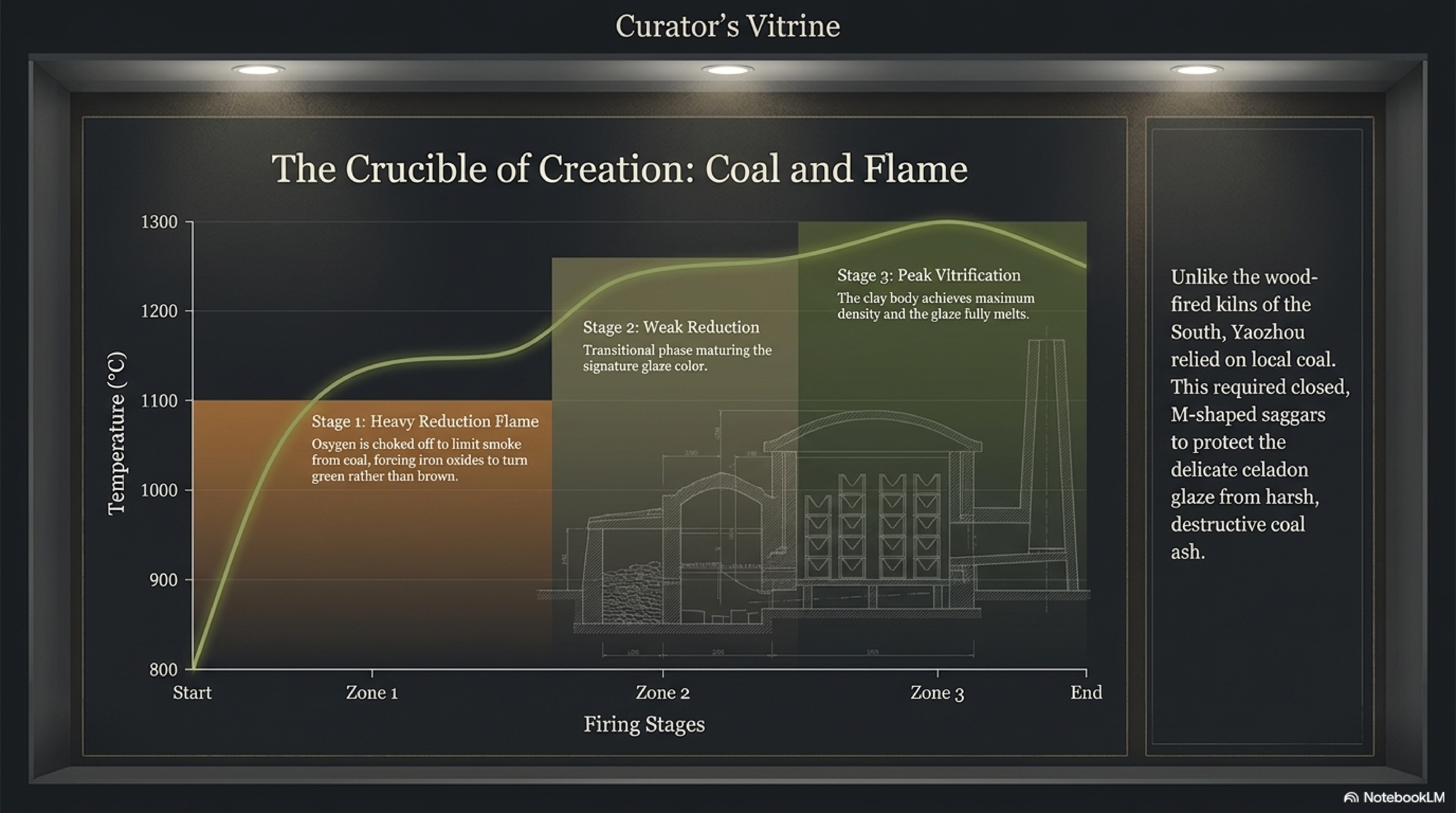
Yaozhou was among the earliest major kilns in Chinese history to use coal as primary fuel — a technological leap with profound consequences. Coal burns at a more stable, higher temperature than wood, enabling consistent reduction atmospheres and the extreme 1260–1300°C firing temperatures that harden Yaozhou's body to its characteristic iron-like density.

Yaozhou coal-fired kiln diagram — cross-section showing coal combustion, reduction atmosphere management, and 1260-1300°C firing temperature zone

The coal advantage. Unlike wood-fired dragon kilns (which require constant stoking and produce fluctuating temperatures), coal-fired kilns generate a more stable, intense heat. At 1260–1300°C, the iron-rich clay body vitrifies to near-stoneware density, producing the characteristic metallic ring when struck. The controlled reduction atmosphere is responsible for both the olive-green glaze colour and the dense micro-bubble structure that distinguishes authentic Song Yaozhou from modern electric-kiln imitations.

The Slanted Blade: "刀刀见泥"

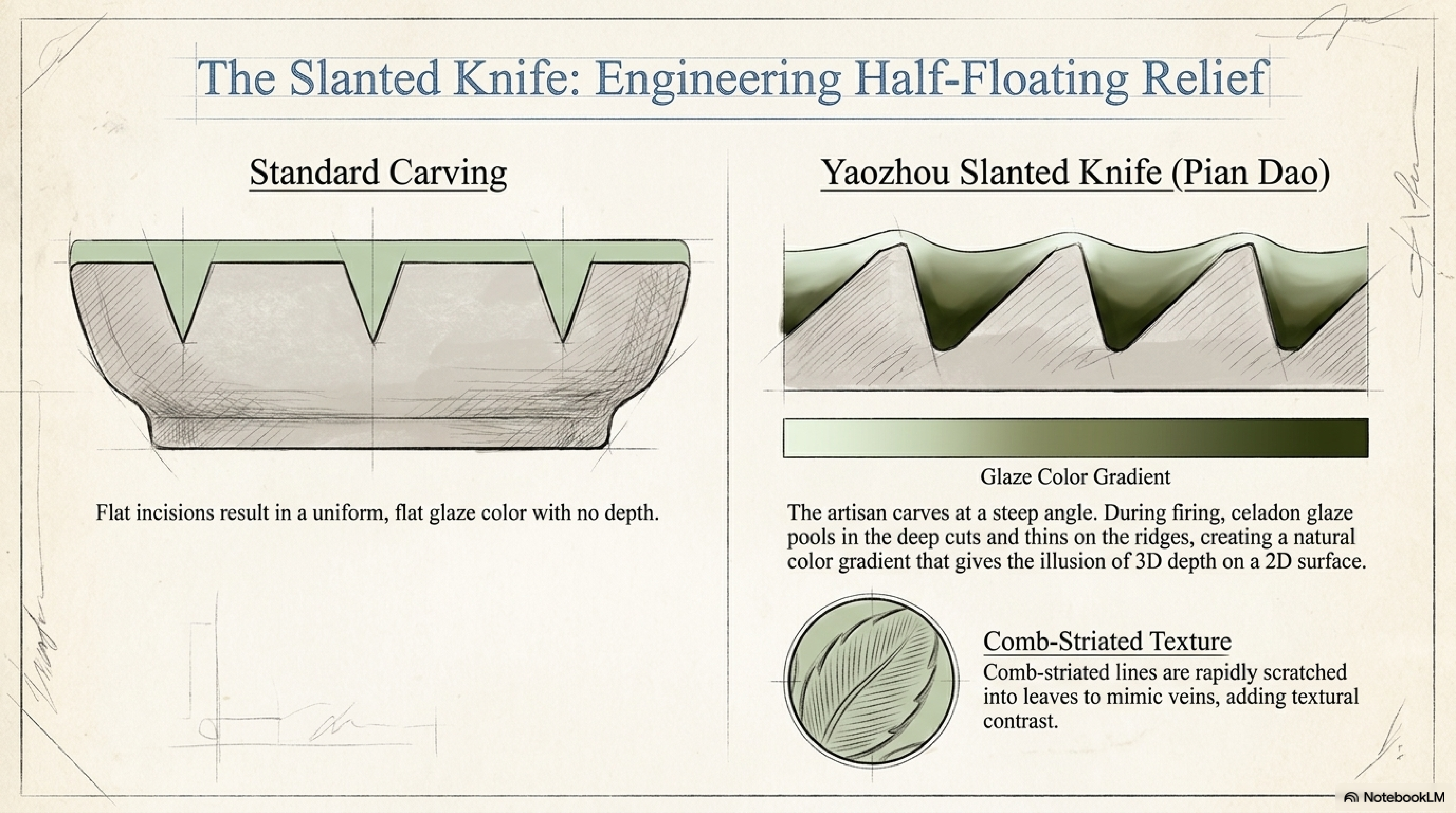
The defining technique of Yaozhou ware is the 偏刀刻花 (slanted-blade relief carving) — called "刀刀见泥" (every blade cut reveals clay) by later connoisseurs. Executed on half-dry clay bodies, the blade is held at an angle rather than perpendicular, creating cuts with a bevelled cross-section: one wall steep, one wall sloped. When glaze pools in the deeper incised channel, it creates a visible gradient from dark to light that gives the decoration its extraordinary dimensionality.

Yaozhou slanted-blade carving technique —偏刀刻花 cross-section diagram showing angled blade position, bevelled cut profile, and how pooled glaze creates relief contrast

The slanted blade in cross-section. The key is the blade angle: held obliquely rather than perpendicular, each cut creates an asymmetric profile — a steep inner wall and a gently sloped outer wall. When glaze is applied, it pools in the deep channel (dark) and thins on the raised ridge (pale). This contrast produces the low-relief sculptural effect that distinguishes Yaozhou carving from any other ceramic tradition. The lines must be bold and decisive: hesitation produces the "dead," tentative strokes of a forgery.

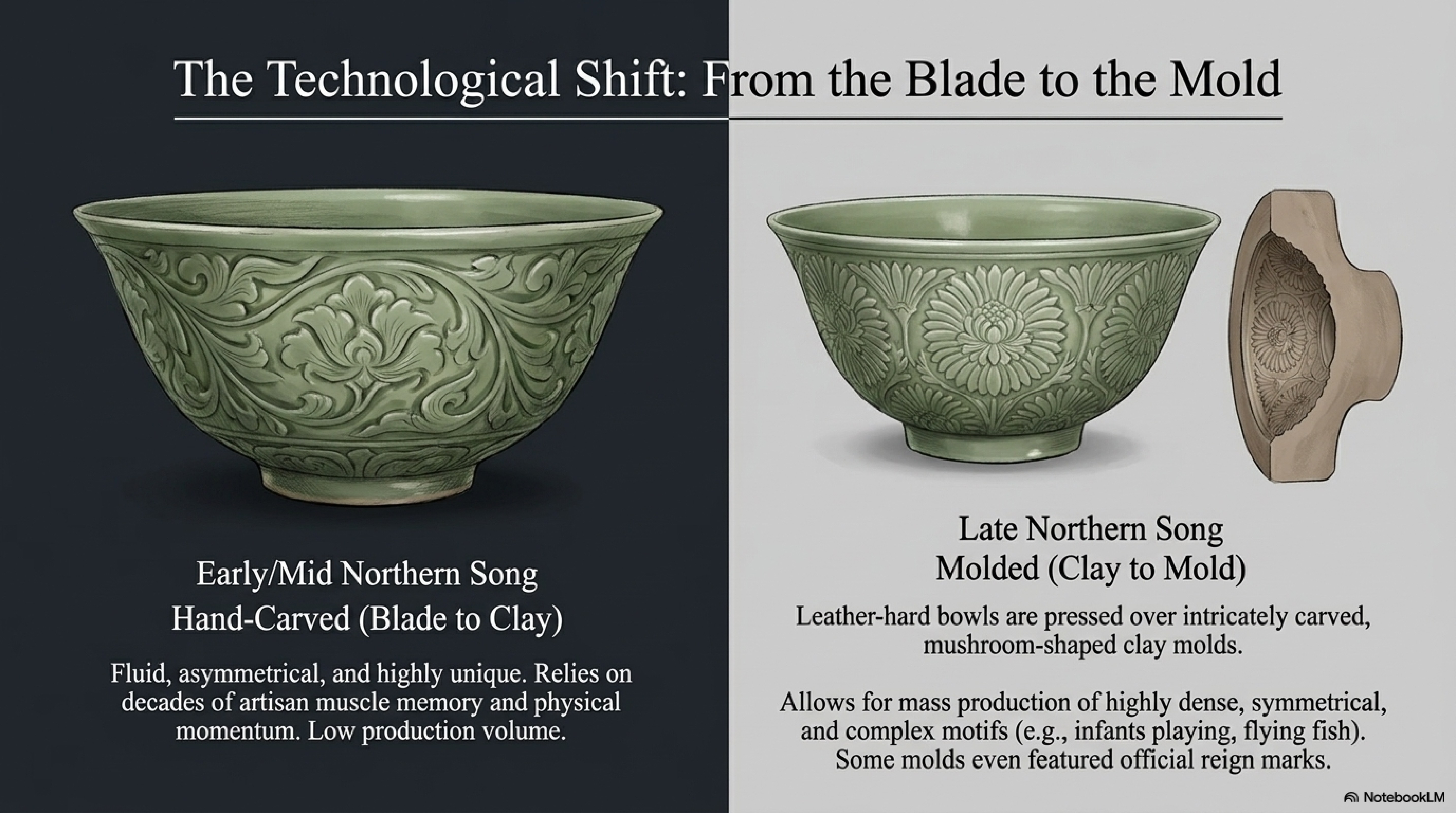
Yaozhou blade-to-mold transition — slanted-blade incised prototype transformed into pressed mold for efficient repeated production of relief-decorated bowls and dishes

From blade to mold. Once a carved master design was perfected, it was pressed into a clay mold to enable repeated production. This two-stage process (free carving → mold-pressing) allowed the kiln to supply both individual artistic pieces and high-volume commercial output. The mold-pressed wares retain the bevelled relief profile of the original carving — distinguishable from purely mold-pressed imitations by the slight variation and aliveness of each individual piece.

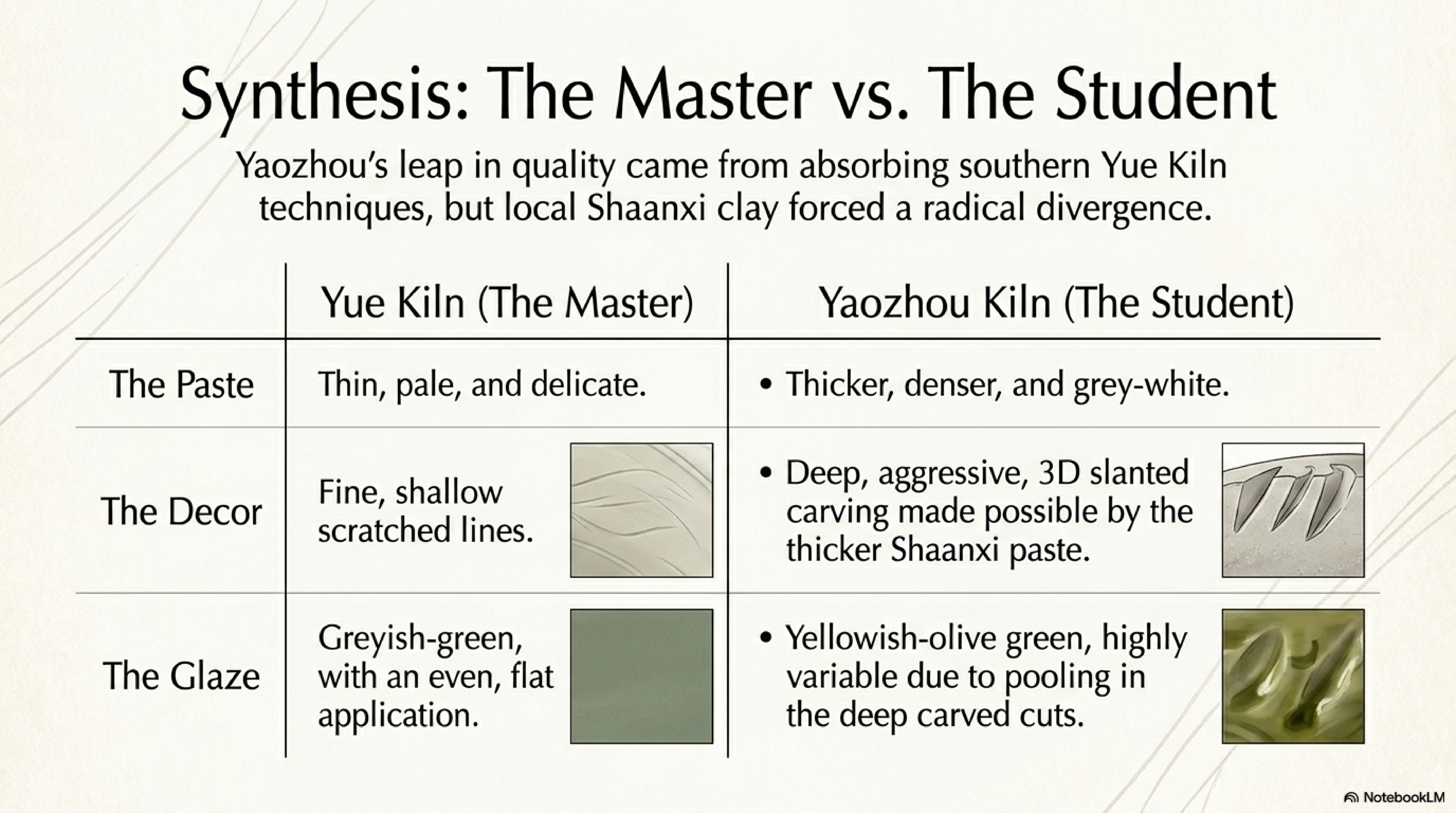
Yaozhou versus Yue ware comparison — Northern Song Yaozhou deep carving and olive green versus Southern Yue celadon thin glaze and pale green, distinguishing two traditions

Yaozhou versus Yue. Both traditions produced iron-coloured celadon, but their character is fundamentally opposed. Yue (left): thin glaze, pale grey-green, carved lines shallow and linear — elegant, restrained. Yaozhou (right): thick, intensely olive glaze, carving bold and deeply bevelled — physical and assertive. The easiest way to distinguish them is dimensional: Yaozhou relief feels sculptural; Yue feels drawn. Confusion between the two is almost always a result of ignoring this physical weight difference.

From Imperial Tribute
to the Ingenious Pot

Yaozhou produced the full range of Song-period ceramic life — daily vessels, architectural ware, ritual objects — with a decorative vocabulary that is immediately recognisable. The motifs are drawn from nature and domestic life, executed with a confidence and physical freedom that defines northern ceramic aesthetics.

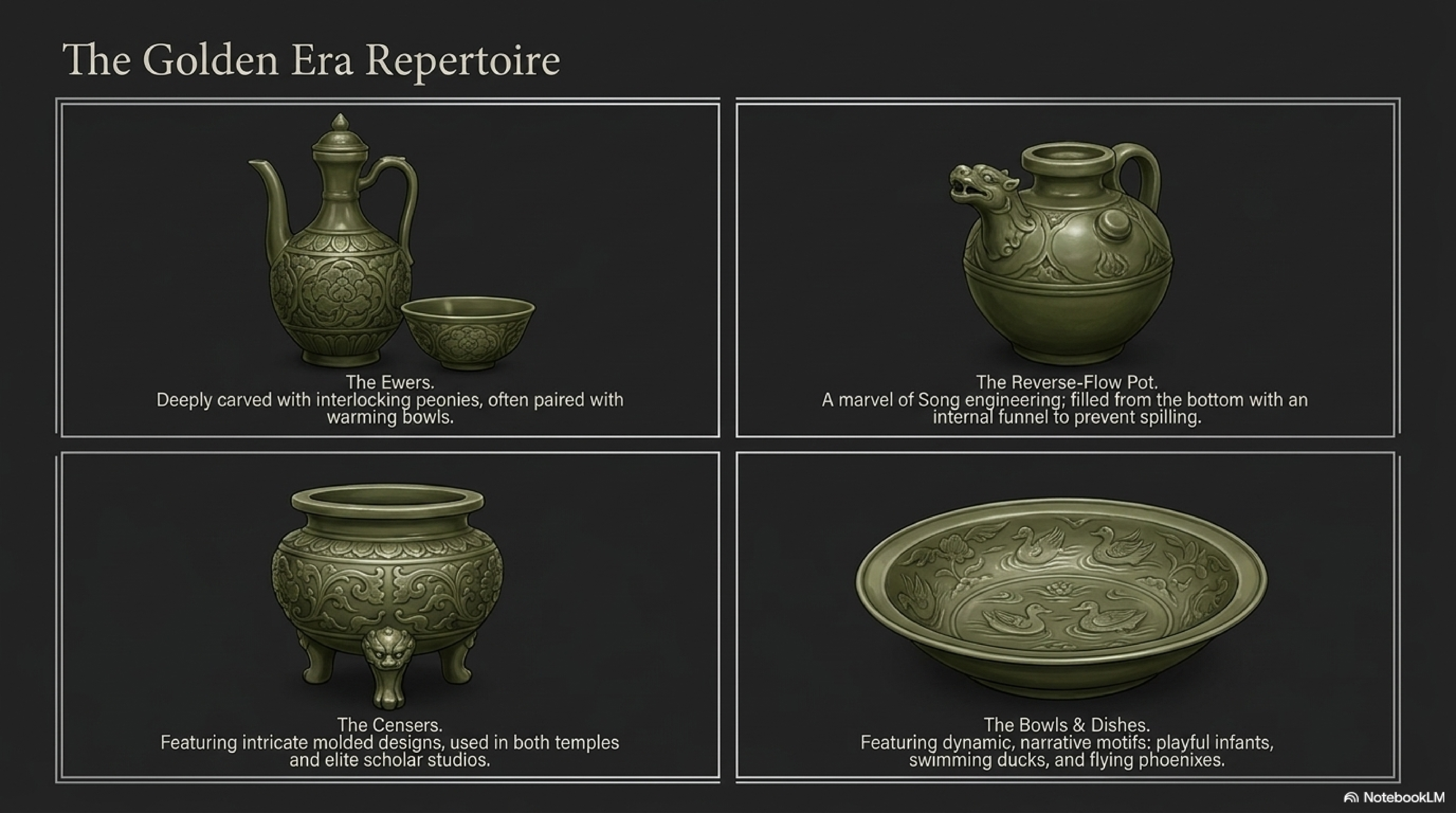
Yaozhou ware repertoire — bowls, meiping vases, ewers, incense burners, and the famous reverse-flow pot (倒流壶), all with slanted-blade carved decoration

The full repertoire. Daily ware dominated production: bowls, dishes, washers, bottles, ewers, and incense burners in every size. Decorative motifs — peony, lotus, fish, phoenix, children at play — were executed in slanted-blade relief across the full range of forms. Most famous is the 倒流壶 (reverse-flow ewer): filled from a hole in the base, it operates on a siphon principle, demonstrating the kiln's simultaneous mastery of engineering and aesthetics.

Carved Bowls & Dishes 刻花碗·盏

The workhorses of production. Interior carved with peony (牡丹), lotus (莲花), or fish (游鱼) motifs in bold slanted-blade relief. The bevelled carving catches pooled glaze to create a dark-to-light gradient that reads as three-dimensional from any angle.

Meiping & Vases 梅瓶·尊

Tall vessels with continuous carved narrative bands — phoenix in flight (飞凤), peony scroll, or children at play (婴戏) circling the body. The cylindrical surface amplifies the relief effect, making the carving appear to spin with the form.

Reverse-Flow Ewer 倒流壶

Yaozhou's most famous object. Filled through a hole in the base (which uses an internal tube to prevent spillage), poured from the spout. The siphon principle is concealed within the carved body — an engineering puzzle dressed as a ceramic masterpiece.

Decorative Vocabulary

Peony (牡丹) — the imperial flower, bold and generous. Lotus (莲花) — Buddhist purity, elegant and spare. Children at play (婴戏) — domestic joy, energetic and irreverent. Fish (游鱼) — fluid, sinuous, always in motion. Phoenix (飞凤) — mythic power, feathers carved with individual blade strokes. Each motif is executed with a single-breath confidence that authenticates the hand.

Stacking & Foot Treatment

Early Yaozhou used support pins (支钉) for stacking, leaving small spur marks. By mid-Northern Song, the kiln shifted to kiln setters (垫饼), scraping the foot rim of glaze to prevent adhesion. This produced the characteristic unglazed foot exposing the grey body — later covered with the thin "sesame paste glaze" (芝麻酱釉) that is a key authentication marker.

Five Diagnostic Markers:
Reading a Yaozhou Piece

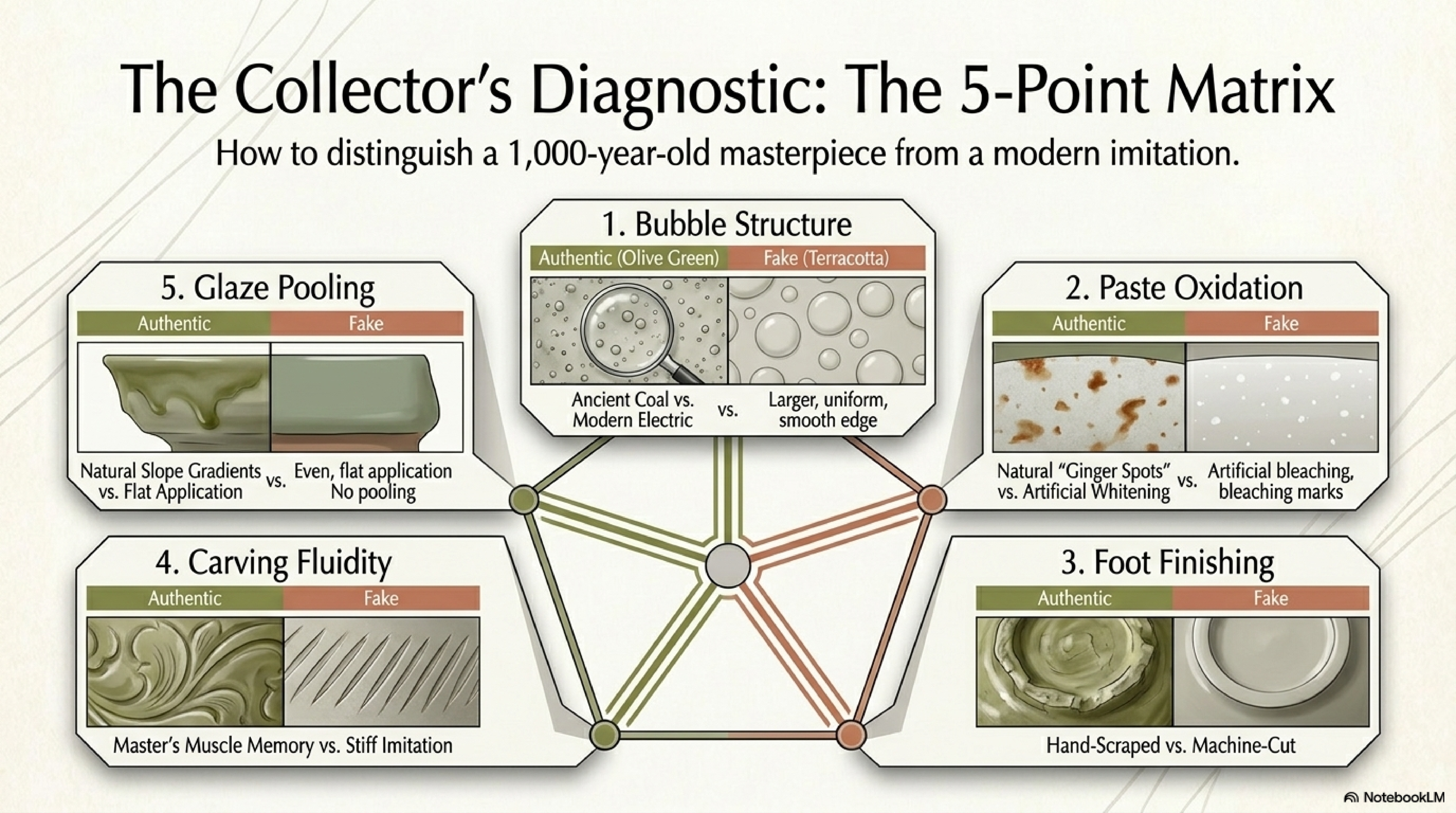
Yaozhou is extensively forged, primarily because the slanted-blade carving technique is visually spectacular and comparatively well-known. The forgeries divide into two categories: modern electric-kiln pieces that get the colour wrong, and skilled imitations that approximate the carving but cannot replicate the coal-fired micro-bubble structure. Authentication requires reading five physical markers in combination.

Yaozhou authentication — five-point diagnostic guide showing glaze bubbles, carving quality, foot treatment, colour tone, and sound test

The five-point diagnostic system. From top: (1) Glaze colour — authentic Northern Song pieces display a specific olive-green (橄榄青), neither too grey nor too yellow. (2) Micro-bubble density — coal reduction produces a particular internal bubble structure invisible to the naked eye but detectable under magnification. (3) Carving quality — boldness and bevelled depth. (4) Foot treatment — sesame paste glaze on the unglazed rim. (5) Sound — the iron-hard body rings clearly when struck.

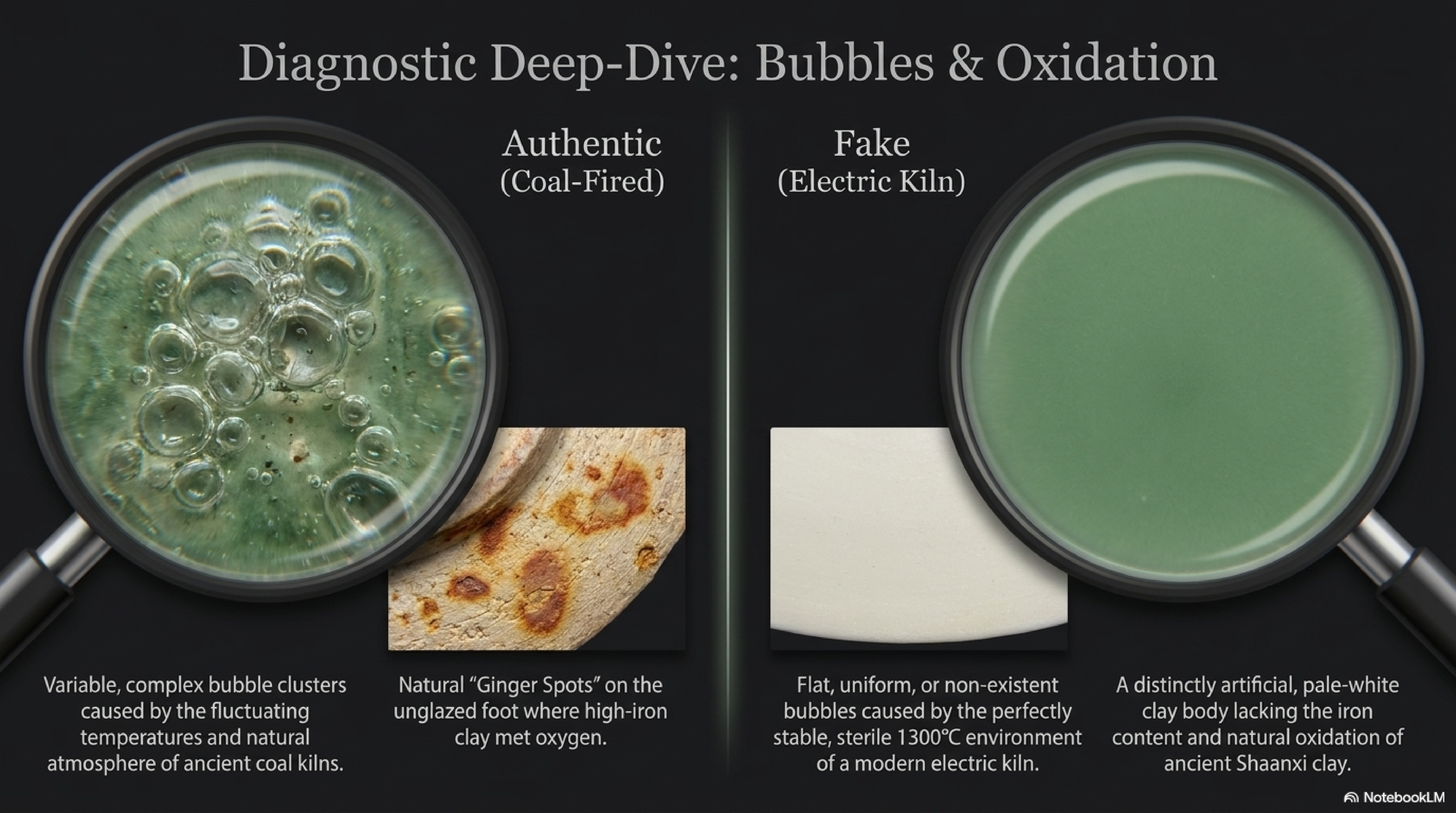
Yaozhou glaze micro-bubble structure — authentic coal-fired dense bubble cluster versus modern electric-kiln sparse or absent bubbles, magnified cross-section comparison

The bubble test. Under magnification, authentic Northern Song Yaozhou glaze contains a dense, irregularly distributed cluster of micro-bubbles — a physical consequence of the reduction atmosphere in coal-fired kilns. Modern electric-kiln reproductions fire in oxidising atmospheres and either lack this bubble density entirely or produce a fundamentally different (more uniform, larger) bubble pattern. This is one of the most reliable scientific authentication markers, though it requires a loupe or microscope.

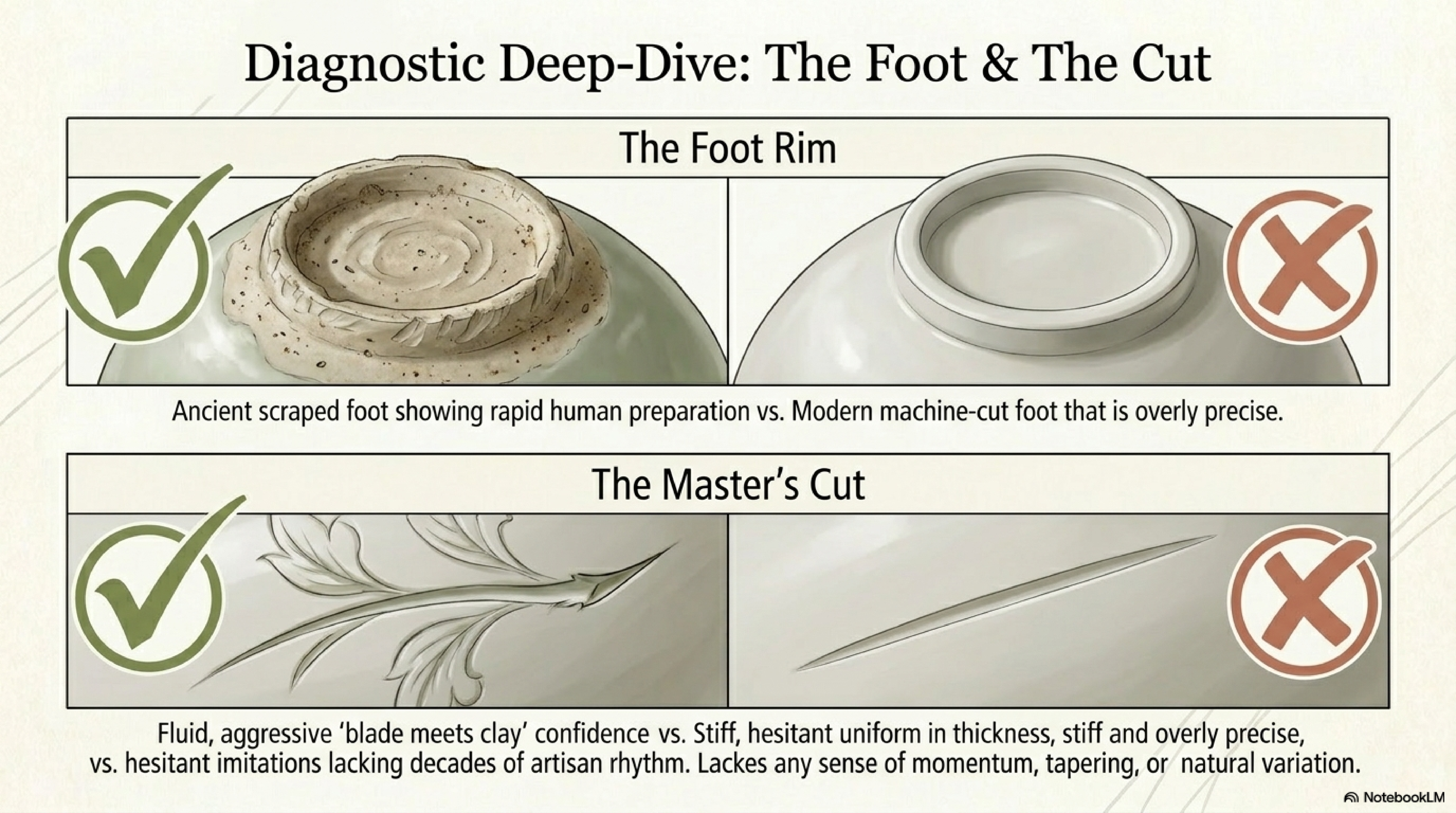
Yaozhou foot treatment — authentic sesame paste glaze (芝麻酱釉) on unglazed foot rim, and carving sharpness comparison between authentic and forgery

Foot and carving tells. Left: the unglazed foot of authentic Northern Song Yaozhou typically carries a thin, irregularly distributed layer of brownish "sesame paste glaze" (芝麻酱釉) — iron-rich residue from the clay reacting in the kiln environment. This is non-uniform and natural, not deliberately painted. Right: carving comparison — authentic lines (top) are decisive and bevelled; forgery lines (bottom) are hesitant, with rounded rather than sharp shoulders, and lack the pooled-glaze gradient in the channel.

The Five-Point Checklist

The Northern Crown:
Influence & Inheritance

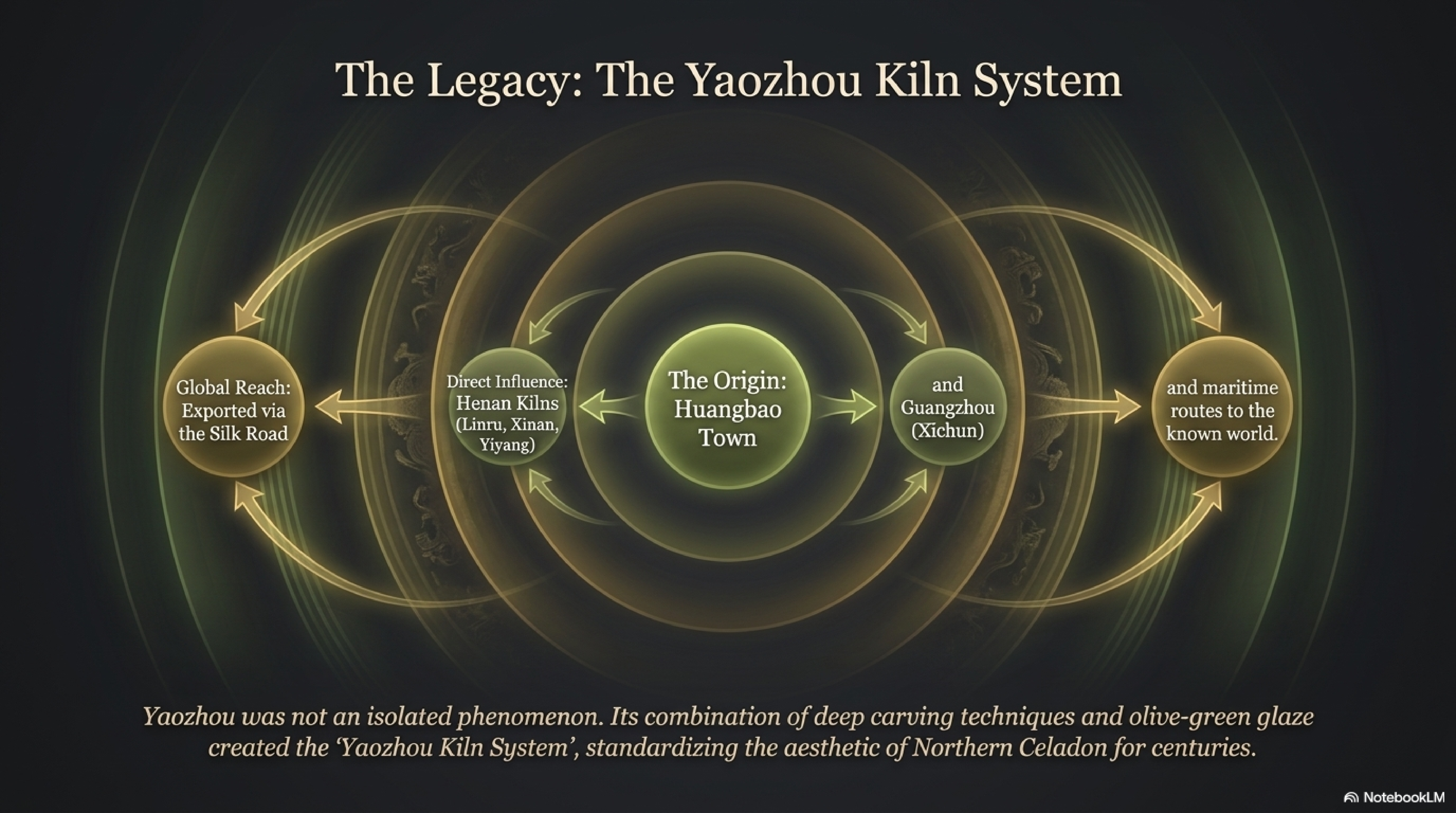
Yaozhou's legacy extends far beyond Shaanxi. At its height, the kiln's influence radiated across northern China, inspiring imitation kilns from Henan to Guangdong. Its technical innovations — coal-firing, bevelled carving, and high-temperature reduction — became the template for an entire regional ceramic tradition that persisted for centuries after the original kilns fell silent.

Yaozhou influence network — satellite kiln systems across northern China that adopted slanted-blade carving and coal-fired reduction techniques from Huangbao Town

The influence network. The Yaozhou style — olive celadon with slanted-blade relief — spawned satellite kilns across a vast geographic arc: Linru in Henan, Yaozhou-type kilns in Hebei, and imitation production reaching as far south as Guangdong. The "Yaozhou system" (耀州窑系) designates this entire tradition of regional imitation, making Huangbao Town the northern counterpart to Longquan's role as the defining southern celadon tradition.

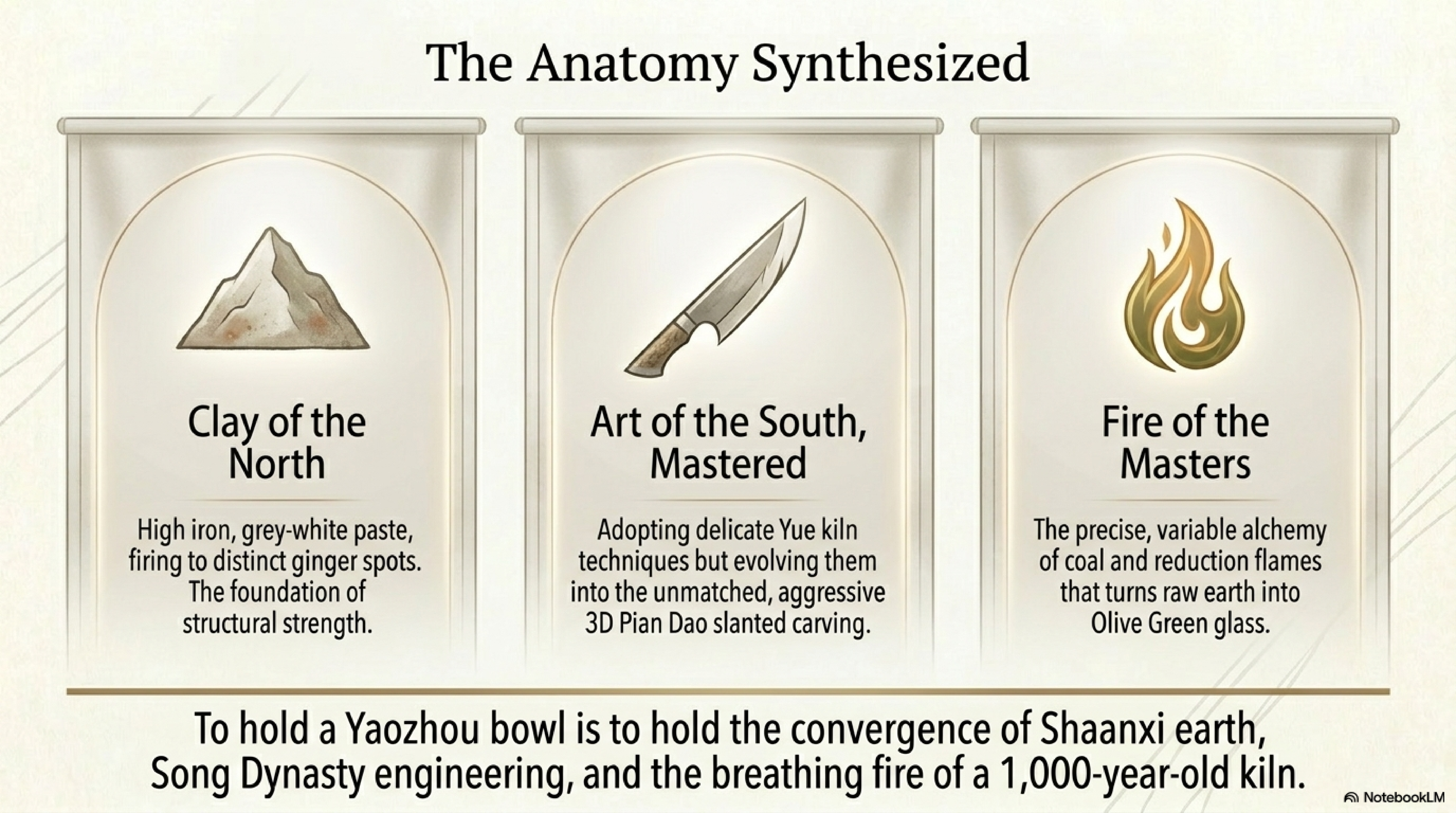
Yaozhou synthesised anatomy — complete visual guide to glaze, body, carving, foot, and dating indicators for Northern Song Yaozhou celadon

The Yaozhou synthesis. The complete diagnostic picture: olive-green glaze (橄榄青) pooling in carved channels; grey-white fine body with iron-hard density from coal-fired reduction; bold slanted-blade relief with pronounced bevelled depth gradient; unglazed foot with sesame paste iron deposit. Together these markers form an irreducible fingerprint — the physical record of a kiln tradition that, for two centuries of the Northern Song, produced the finest carved celadon anywhere in the world.

"The north gave the world a different answer to the question of beauty — not the mute luminosity of jade, but the assertive geometry of the blade."

— On the Yaozhou tradition: where Longquan sought to dissolve the surface in milky opacity, Yaozhou asserted it — carving the clay with the same confidence a sculptor brings to stone. Two traditions, one achievement: the pinnacle of celadon in opposite directions.