Eight Great Kiln Systems · Crown of the Folk Kilns

Cizhou Ware
磁州窑

南有景德,北有彭城 · The North's Living Ceramic

A thousand years of folk art in fired clay. Black brush on white slip —
China's most prolific and most human ceramic tradition.

Northern Dynasties Est. Origins
化妆土 White Slip Technique
瓷枕 Signature Form
白地黑花 Defining Style

The People's Kiln: A Living Dictionary of Northern Life

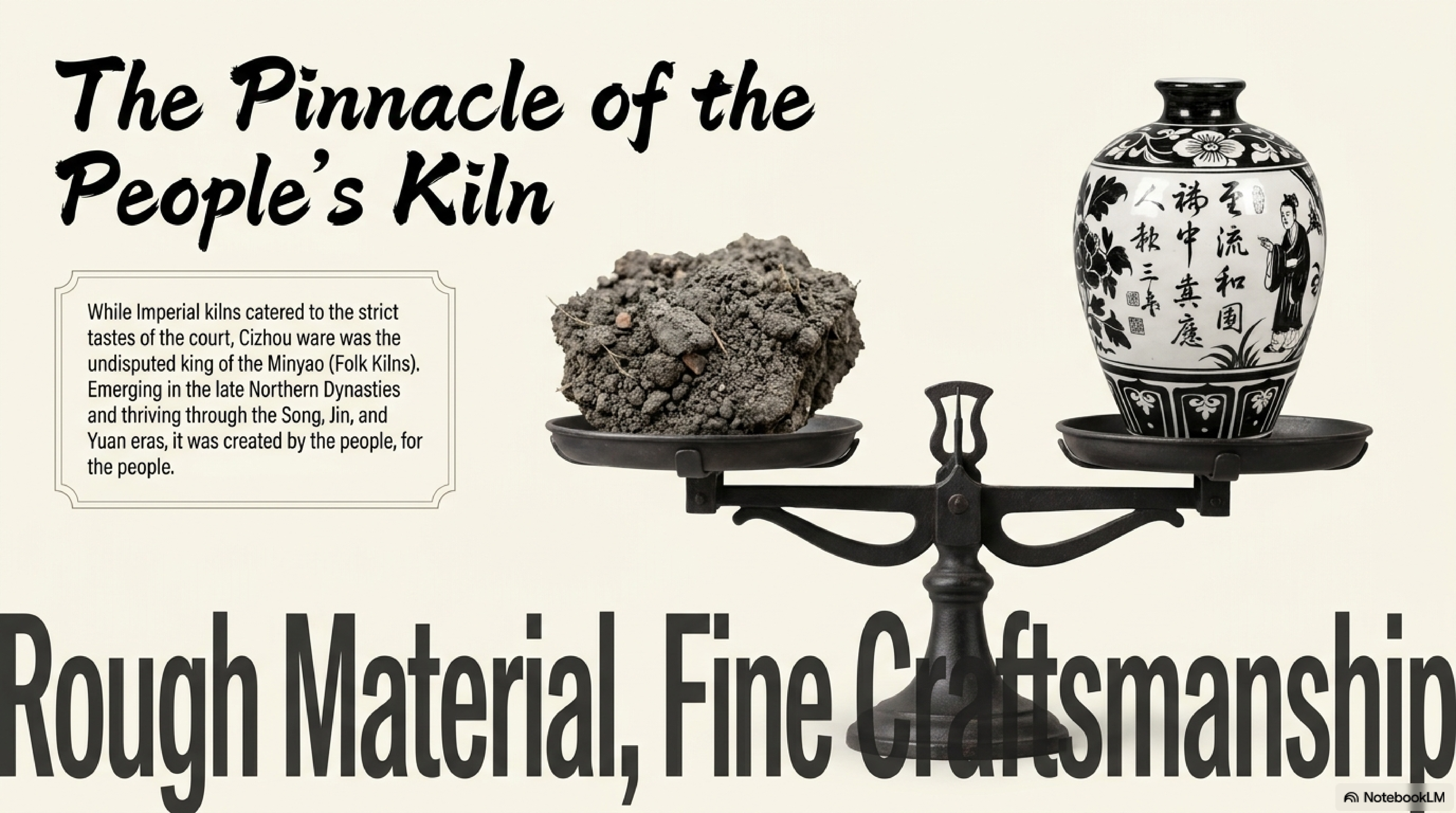
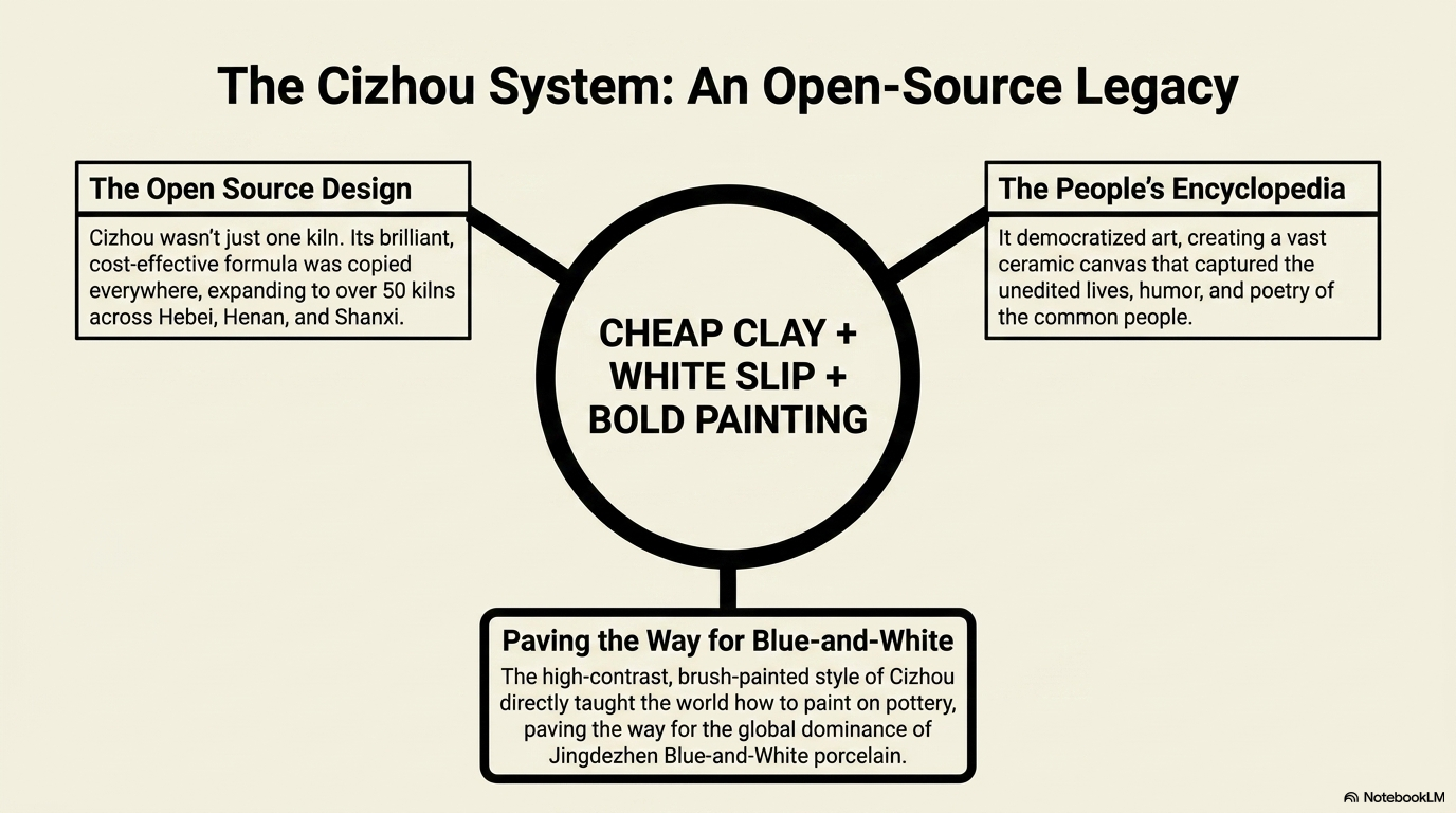
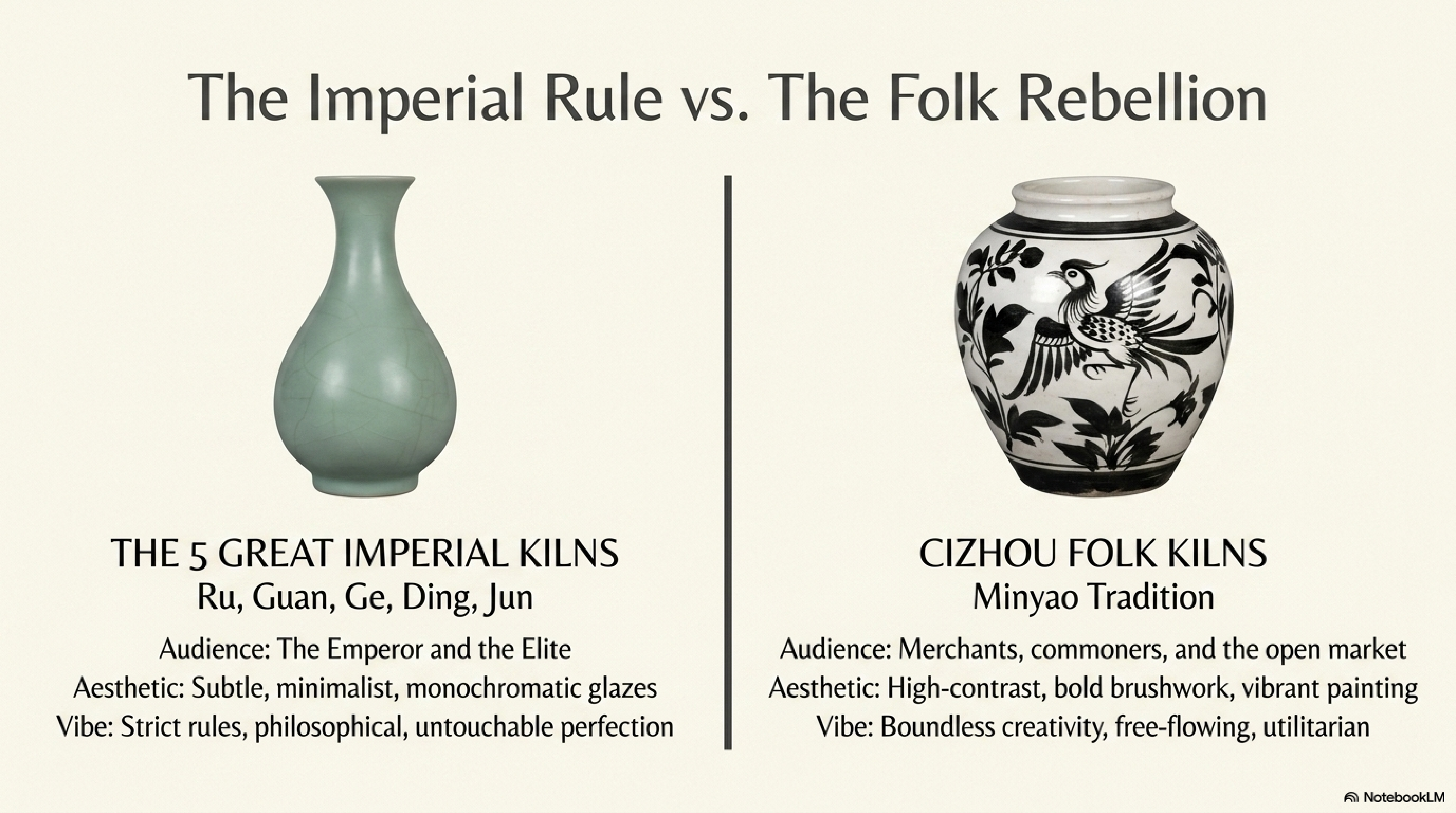
Among all Chinese ceramic traditions, Cizhou stands alone as the voice of the ordinary. Where the Five Great Kilns spoke in the language of the court and the monastery — of austere perfection, imperial tribute, ritual contemplation — Cizhou ware spoke in the language of the street market, the farmhouse kitchen, and the village festival. It recorded what people actually ate, dreamed, played, and quoted. It painted Su Shi's poems on pillows and drew children flying kites on jars. It is, in the words of later collectors, a "民俗词典" — a dictionary of folk custom in fired clay.

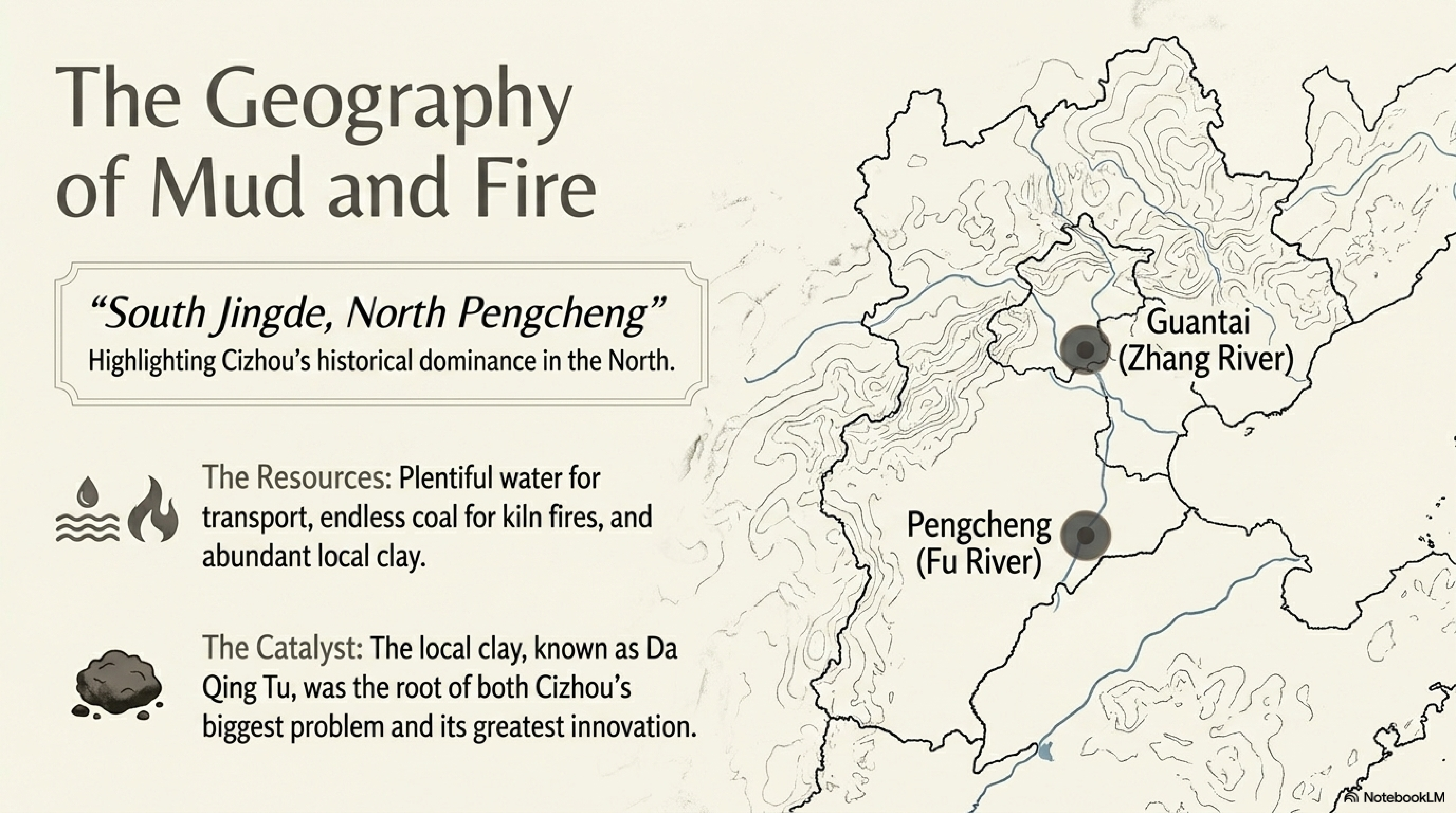
The kiln's historical claim: "南有景德,北有彭城" — South: Jingdezhen; North: Pengcheng. This was not hyperbole. At its Song-Jin-Yuan peak, the Cizhou kiln system was the largest folk ceramic production complex in northern China, a tradition so deeply rooted that it never stopped firing — production continues in some form to the present day.

Longquan

Celadon jade-green. Powder Blue & Plum Green. 1,600 years of southern mastery.

耀 Yaozhou

Olive green. Deep blade-carved relief. Northern celadon's undisputed peak.

Jian

Black iron glaze. Hare's fur & oil drop. Born for the Song tea ceremony.

Cizhou

White ground, black painting. China's greatest folk kiln tradition. The subject of this guide.

Hutian

Shadow blue yingqing. White as jade, thin as paper. Jingdezhen's foundation.

"南有景德,北有彭城。"

— The historical saying that defined Cizhou's place in China's ceramic geography: where Jingdezhen served the south with fine white porcelain and blue-and-white, Pengcheng served the north with a different kind of perfection — coarser, bolder, more human, and more enduring.

Handan's Kilns: The Great Folk Tradition of the North

The Cizhou kiln system is centred on Cixian County (磁县), Handan City, Hebei Province, with two principal production centres: Guantai Town (观台镇) — the historical heartland and site of earliest high-quality production — and Pengcheng Town (彭城镇), which grew to a larger scale, achieved later dominance, and remains active to this day. The tradition encompasses kiln sites spread across Hebei and across the wider north, making Cizhou not a single kiln but a vast regional system.

Guantai (观台窑) — The Heartland

The historical core of Cizhou production. Earliest high-quality wares. The site where the defining black-on-white painting tradition reached its first maturity during the Northern Song. Guantai output is associated with the finest Song-period decorative vocabulary.

Pengcheng (彭城窑) — The Living Kiln

Larger in scale, later in dominance. Pengcheng became the dominant Cizhou production centre from the Jin Dynasty onward and remains active today — making it the only kiln centre in the Eight Great Kiln Systems with unbroken production to the modern era.

Production Timeline

Geographic distribution of Cizhou kiln sites across Hebei and northern China — the Cizhou system spans multiple provinces

The geographic reach of the Cizhou kiln system. Unlike a single-site tradition, Cizhou represents a vast regional complex extending across Hebei and into neighbouring northern provinces. Core production at Guantai and Pengcheng in Cixian County, Handan — but kiln influence and imitation sites spread throughout the northern plains, wherever the same folk aesthetic and material conditions prevailed.
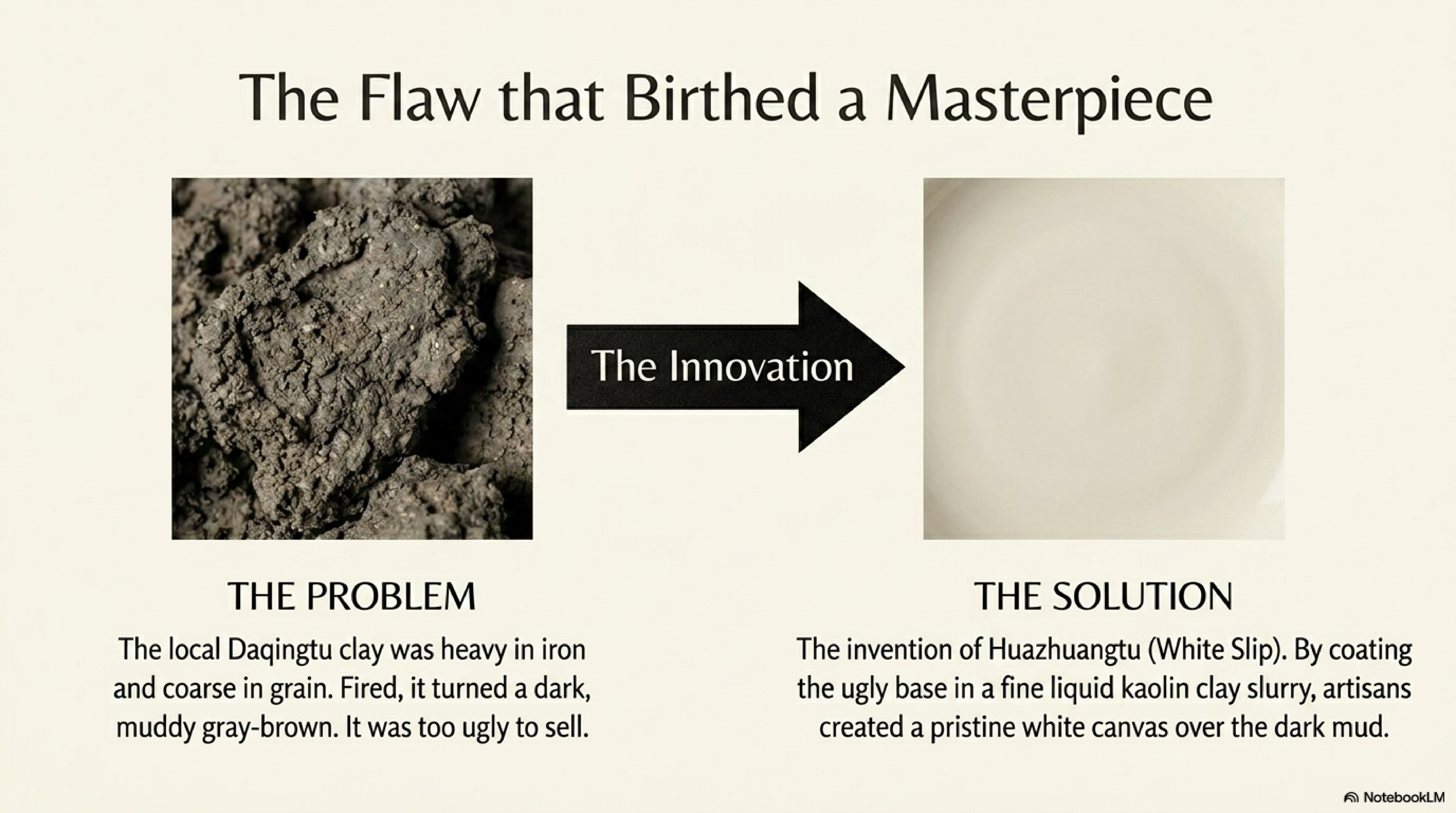
The raw material foundation of Cizhou ware — 大青土 (Grey-Blue Earth), the local high-iron clay that fires to a grey-yellow body

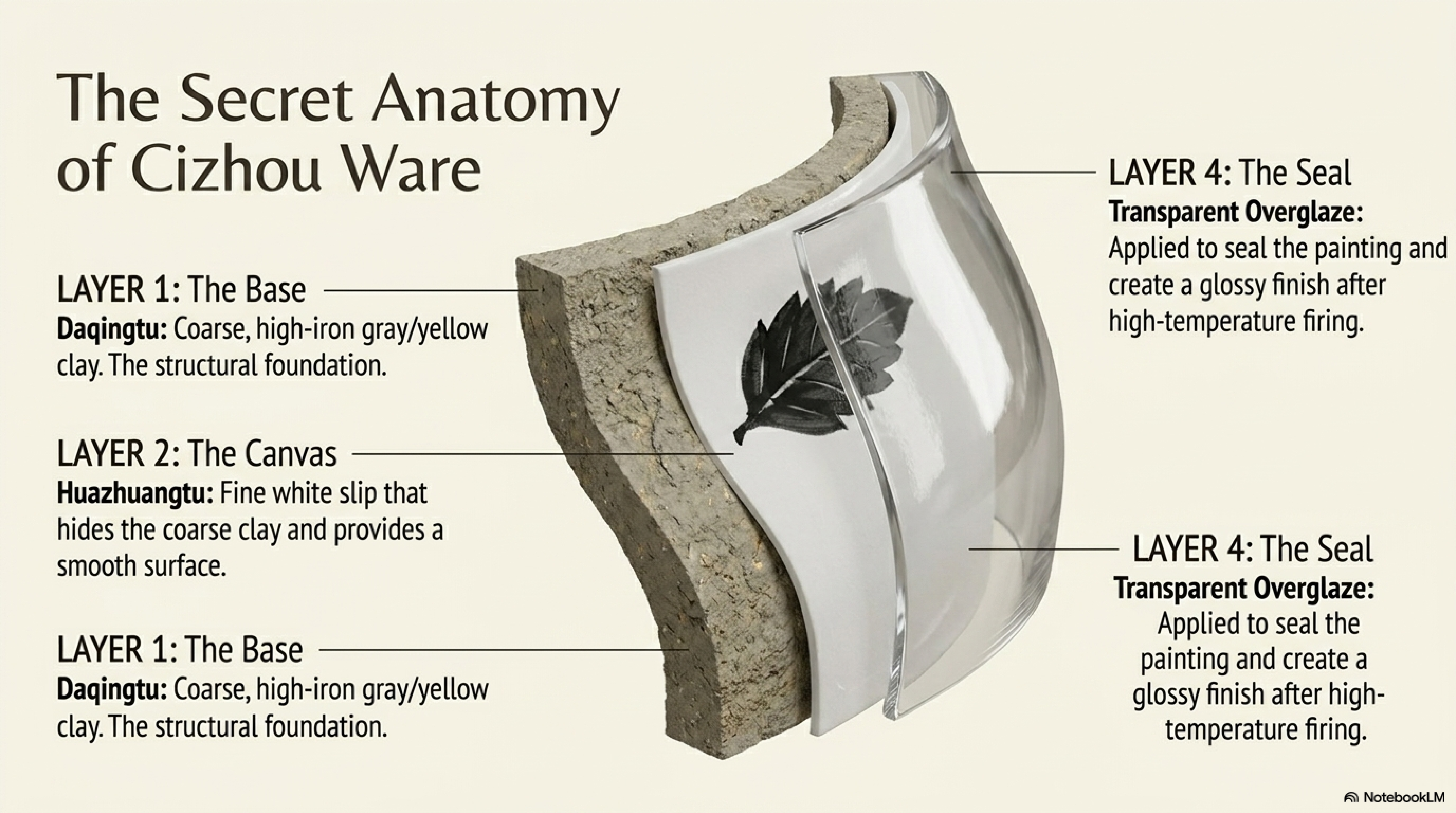
The material foundation: 大青土 (Grey-Blue Earth). The local clay of the Handan region is iron-rich, coarse-grained, and fires to a characteristic grey-yellow body — strong and durable, but wholly unsuitable as a decorative surface. This geological fact drove the most important Cizhou invention: the 化妆土 (white slip) coating that transformed coarse northern clay into a canvas for the boldest brush painting in Chinese ceramic history.
The Genius of the White Coat: Slip, Brush, and Fire

Cizhou's local clay — 大青土 (Grey-Blue Earth) — is iron-rich, coarse, and fires to a grey-yellow colour. Ideal for structural integrity; terrible as a decorative surface. The solution, arrived at over generations of northern kilns experimentation, was one of the most elegant workarounds in all of ceramic history.

化妆土 — The White Coat

Artisans developed a brilliantly simple technique: coating the rough body with a thin layer of fine white kaolin slip before decorating. This "cosmetic earth" (化妆土, literally "cosmetic / make-up earth") transformed the coarse grey substrate into a smooth white canvas. All subsequent painted, carved, and incised decoration was applied to this white coat — not to the clay body itself.

白地黑花 — The Black-on-White Process

The defining Cizhou technique produced the characteristic black-on-white contrast that looks, to modern eyes, uncannily like ink wash painting on paper. The process proceeds in five steps, and admits no revision at any stage:

The Cizhou painter and the calligrapher shared the same fundamental discipline: one unretractable brushstroke. The speed, confidence, and physical commitment of the stroke determined the quality of the work. There was no correcting, no over-painting, no second chance.

The white slip (化妆土) coating technique — application method and function as decorative ground

The 化妆土 (white slip) coating technique. The slip is applied to the leather-hard body by dipping or pouring, creating a uniform white surface that completely conceals the grey-yellow substrate. The thickness and evenness of this coat directly determines the quality of the painting ground — too thin and the grey body bleeds through; too thick and it cracks on drying. Genuine Song-period application achieves a natural, organic integration between slip and body that forgeries consistently fail to replicate.

The black pigment brush painting process — the 'three brushstroke' (三笔划) standard for Cizhou authenticity

The "three-stroke" (三笔划) standard. Cizhou's decorative painters were folk artisans working at production pace — a standard peony motif was executed in three to five decisive strokes, a fish in two. The standard identifies the minimum number of brush movements required to complete each canonical motif. Authentic strokes are fast, tapered, and physically committed: they enter with pressure and exit cleanly. Forgery brushwork is slow and hesitant — the painter imitates rather than does, and the hesitation shows.

Cizhou firing technique — reduction atmosphere in a wood-fuelled dragon kiln

The firing. Cizhou wares were fired in wood-fuelled kilns under a reduction atmosphere — limited oxygen causes the iron in the pigment to reduce to a dark, near-black state while the iron-free slip whitens. The single high-temperature firing fuses the glaze, locks the painting, and completes the transformation from grey clay and brown iron pigment into the bold black-on-white contrast that defines the Cizhou aesthetic.

Beyond Black and White: Five Faces of Cizhou

Though black-on-white painting defines Cizhou for most collectors, the kiln tradition encompasses a remarkable range of decorative technologies spanning nearly a thousand years. Many were borrowed from other traditions and reinvented with Cizhou's characteristic folk directness.

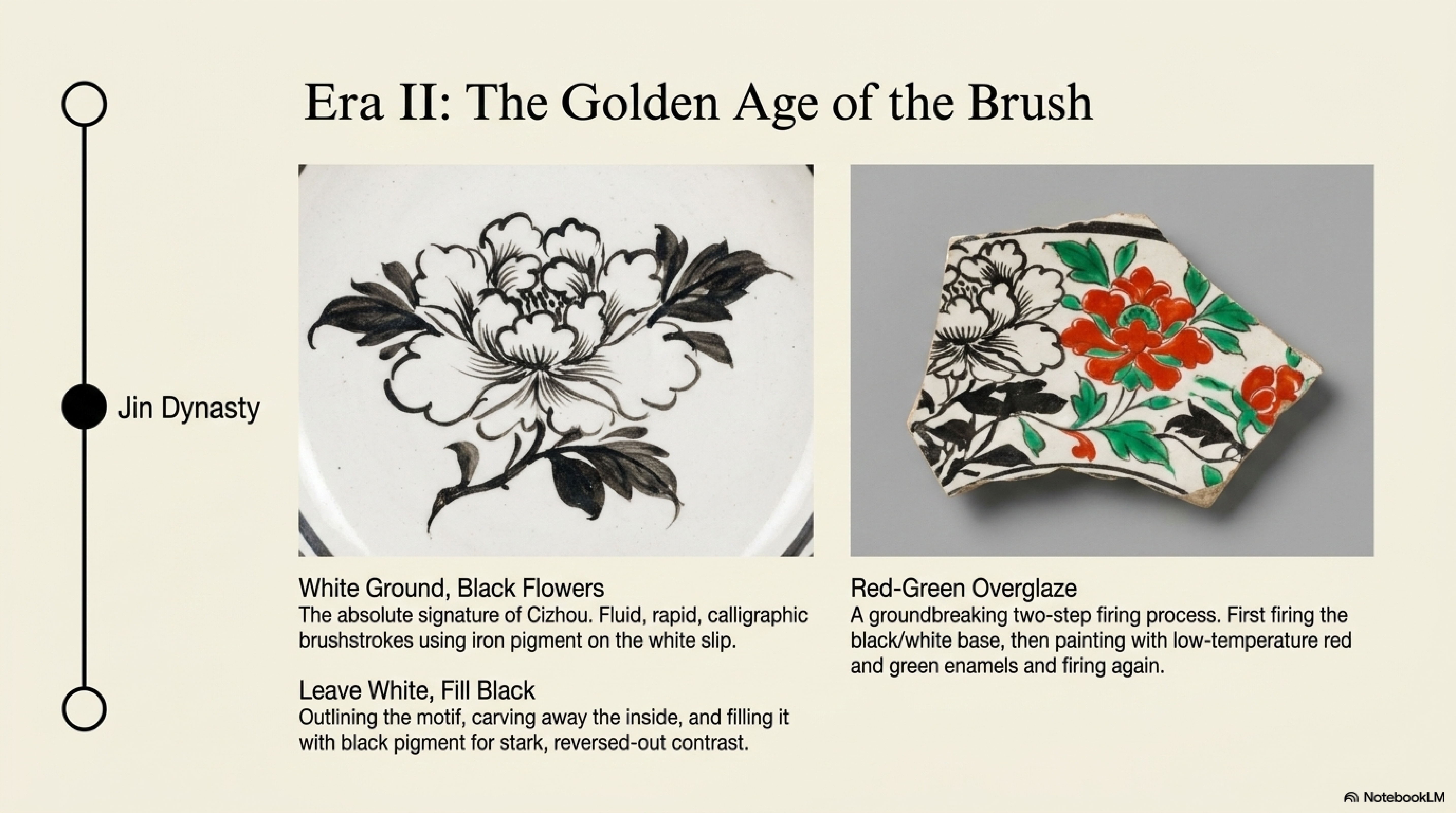
Black-on-White Painting 白地黑花 · The Defining Voice

Iron-brown brushwork on white slip, one transparent glaze, single high-temperature firing. The most direct expression of northern folk aesthetics — bold, unretractable, spontaneous. Motifs: children at play, peonies, fish, poetry, proverbs, workshop marks.

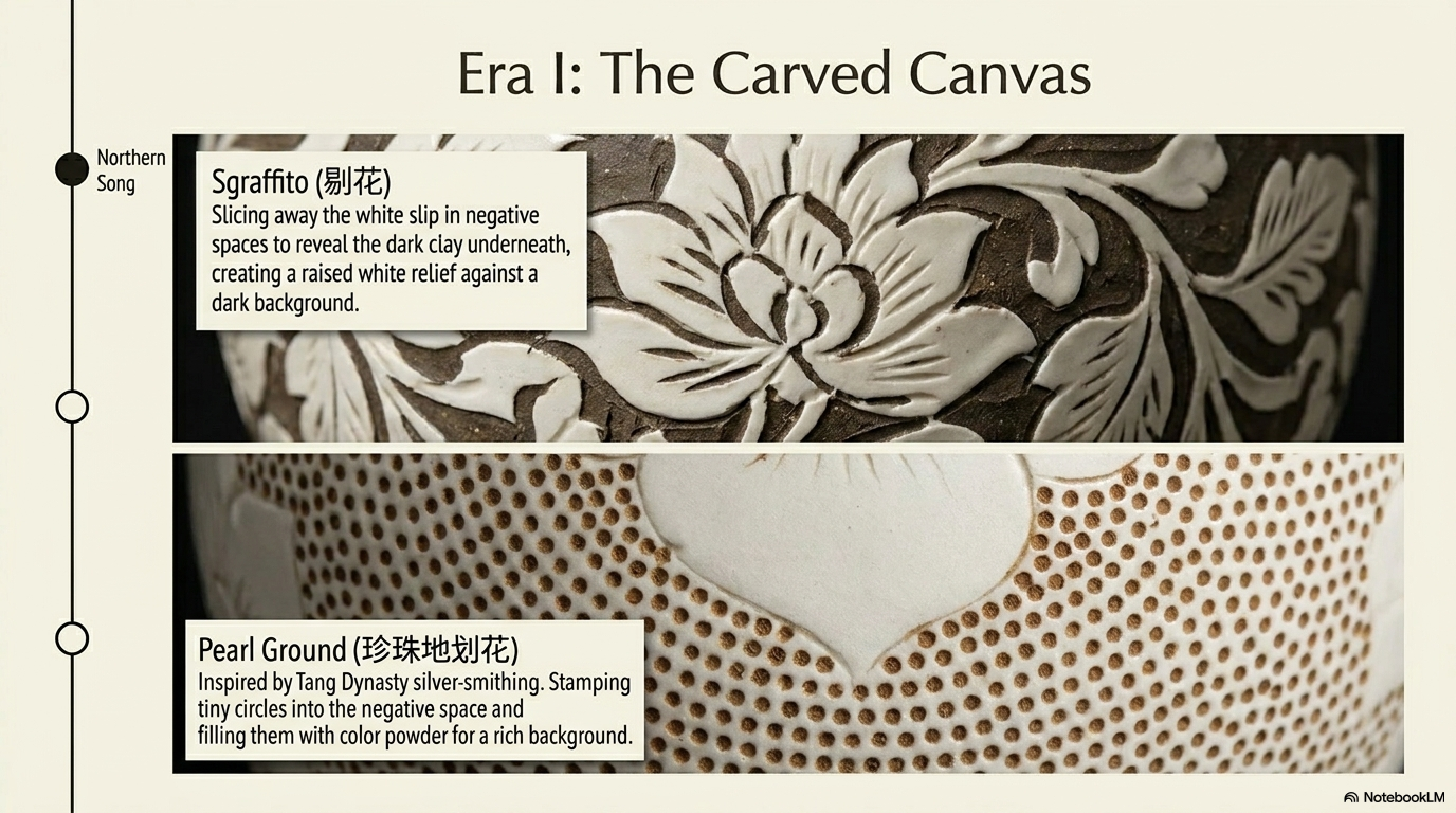
Carved and Sgrafitto 刻划花 · 剔花 · The Sculptural Voice

Sgrafitto (剔花) removes the white slip between motifs to reveal the grey body beneath, creating bold dark-ground/white-motif contrast with strong relief depth. Incised carving (刻划花) traces lines through the slip to expose the dark ground beneath the motif.

Red and Green Overglaze 红绿彩 · The Colourful Voice

Beginning in the Jin Dynasty: red, green, and yellow low-temperature enamel pigments applied over a fired white surface, then re-fired at low temperature. Produces vivid, jewel-like colour. The direct ancestor of later polychrome Chinese porcelain traditions.

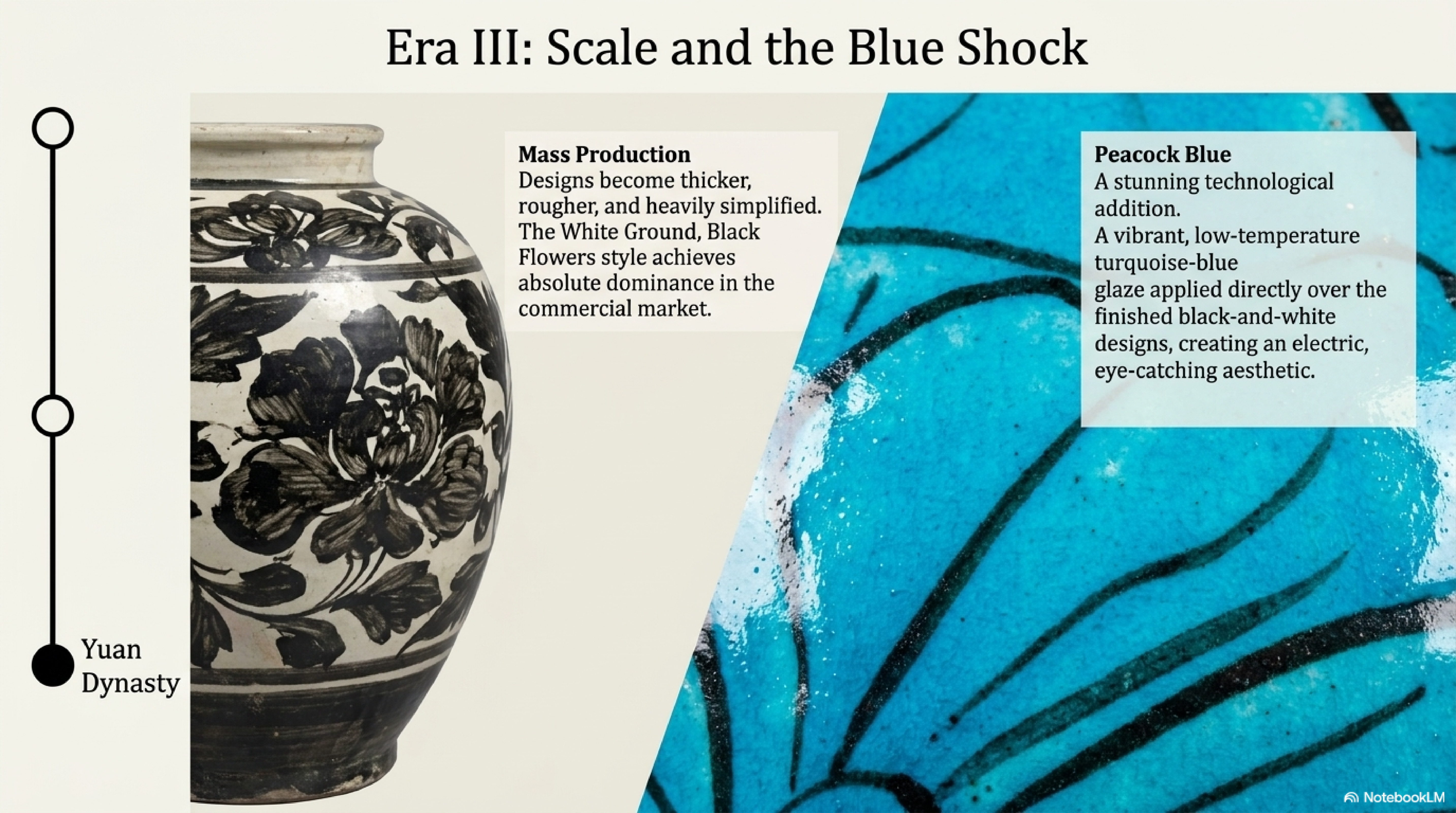
Peacock Blue Glaze 孔雀蓝釉 · The Exotic Voice

Yuan Dynasty: a vivid turquoise-to-sky-blue low-temperature glaze applied over a black-painted white-slip ground. The colour comes from copper under an alkaline flux. Shows strong Central Asian and Islamic glazing influence.

Pearl Ground 珍珠地划花 · The Jewelled Voice

Inspired by Tang gold and silver work: the background is stamped with a dense field of tiny circular dots, against which the carved motif stands in clear white relief. Technically laborious; associated with the Northern Song peak.

Comparison of the five Cizhou decorative types — black-on-white, sgrafitto, red-green overglaze, peacock blue, and pearl ground

The five faces of Cizhou compared. Black-on-white painting (白地黑花) dominates in quantity and defines the tradition's popular identity. Sgrafitto (剔花) and incised carving (刻划花) represent the sculptural tradition — technically demanding and visually powerful. Red-green overglaze (红绿彩) introduces colour and marks the bridge to later Chinese polychrome wares. Peacock blue (孔雀蓝釉) reflects the Yuan Dynasty's cosmopolitan exchange with Central Asian ceramic culture. Pearl ground (珍珠地划花) is the most laborious and associated with Song peak production.

The ceramic pillow (瓷枕) — Cizhou's signature form, displaying the full decorative range

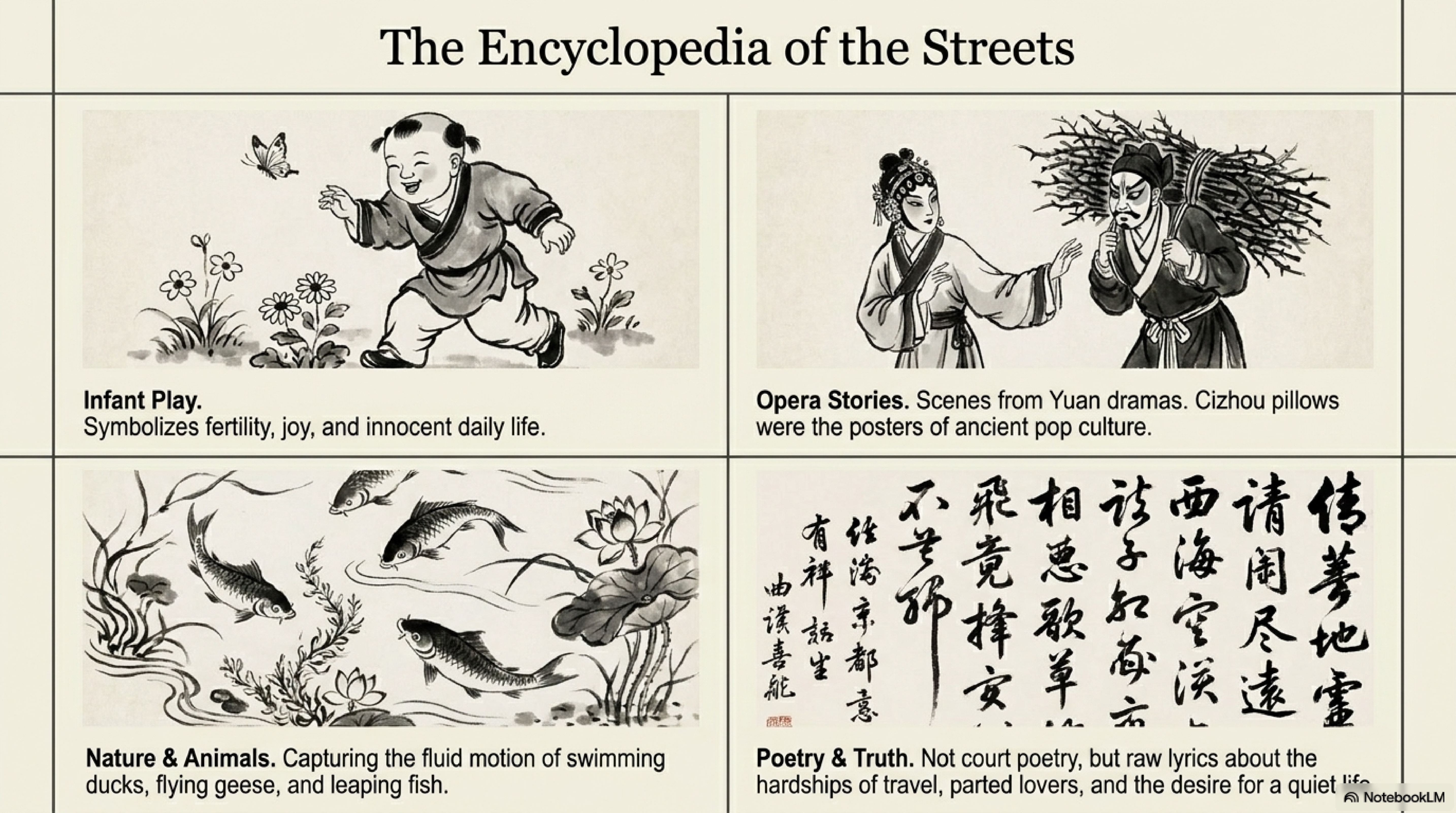
The 瓷枕 (ceramic pillow) — Cizhou's most celebrated form. Used as an actual sleeping pillow in northern Chinese households, the ceramic pillow provided a large, flat decorative surface that Cizhou painters exploited to the full: narrative scenes, children's games, peony scrolls, inscribed poetry, and proverbs. The pillow surface displays the complete Cizhou decorative vocabulary across all five type traditions. It is the form most associated with the kiln's folk literary character — Su Shi's 赤壁赋 inscribed in running script on a pillow is among the most humanly immediate objects in all of Chinese ceramics.

Motifs, Forms, and Workshop Marks

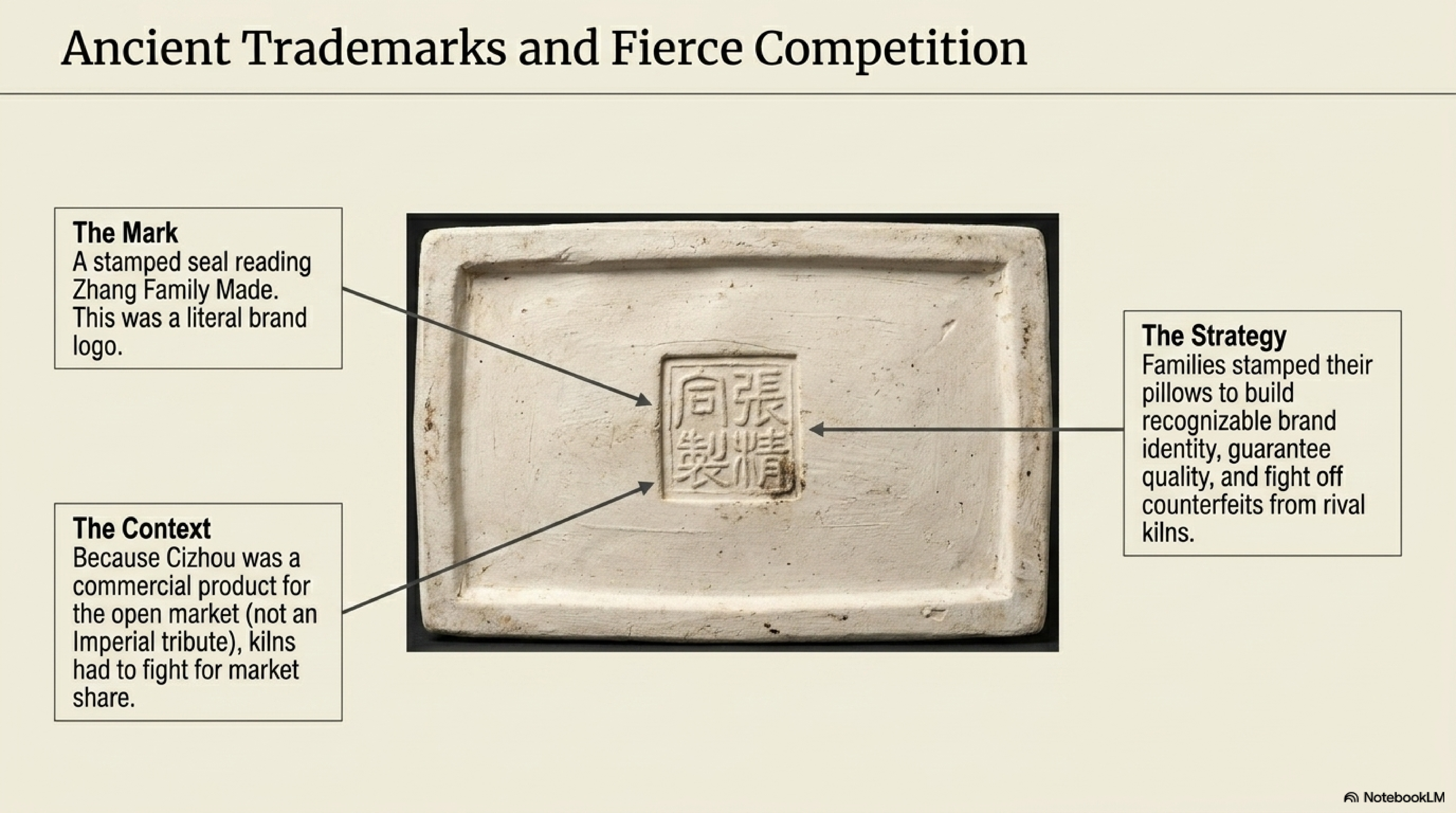
The Cizhou decorative vocabulary is a direct record of northern Song-Jin-Yuan daily life. Key motifs include 婴戏 (children at play — flying kites, fishing, chasing butterflies; the most beloved Cizhou subject), 牡丹 (peony), fish, birds, and inscribed poetry and proverbs. Workshop marks — "张家造" (Made by the Zhang Workshop), "王寿朋造" — survive on Song-period pieces and constitute evidence of brand consciousness a millennium before the concept was formalised. Beyond the pillow, Cizhou produced bottles, jars, bowls, and ewers for everyday household use across the northern Chinese population.

Reading the Folk Hand: Five Authentication Markers

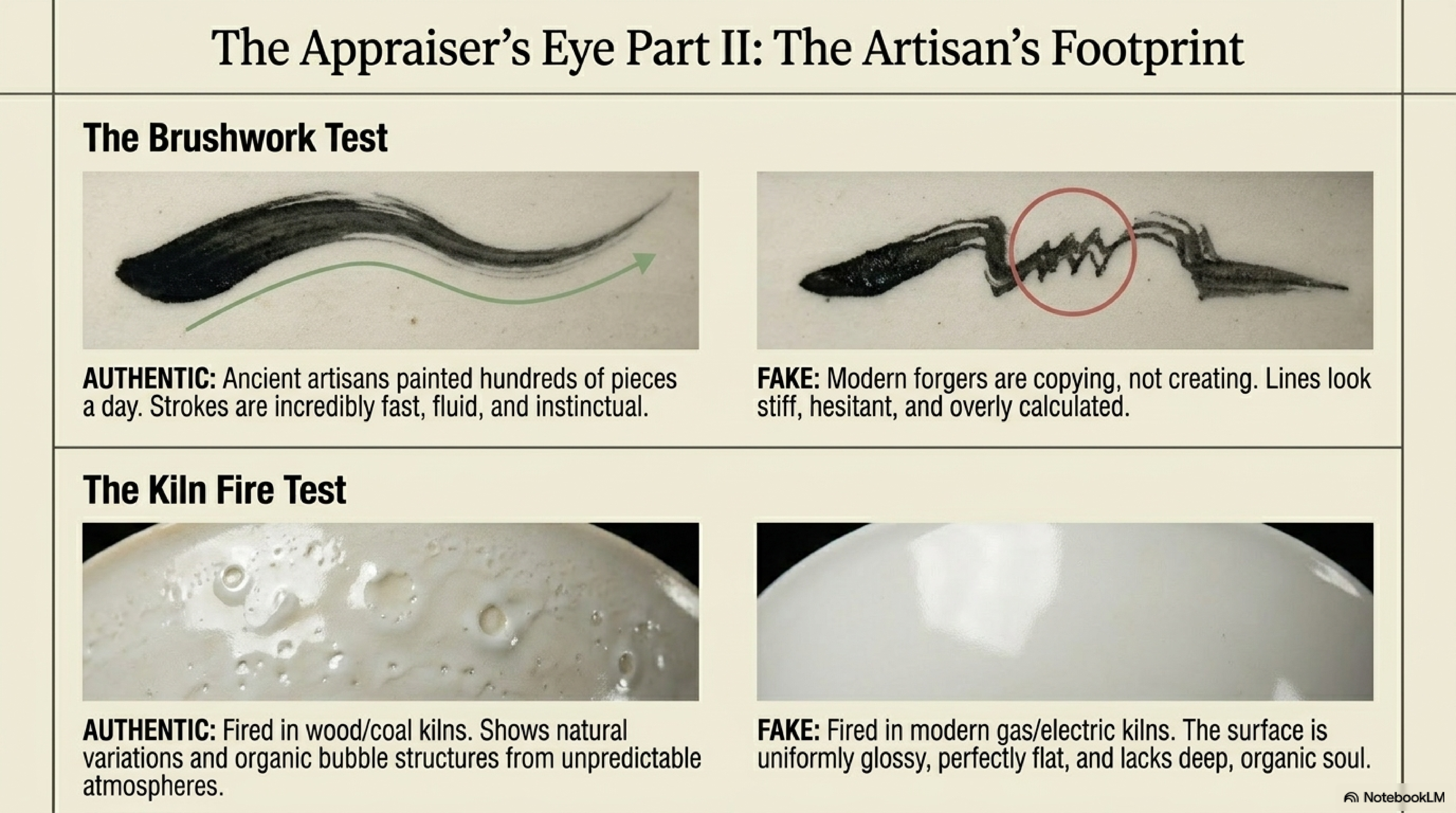
Cizhou's accessibility — no rare imperial connection, no exotic materials — makes it widely copied. The authentication challenge is not rarity but reading the difference between an artisan working at speed with complete confidence and a forger working slowly under pressure. Every physical marker reflects this underlying difference in mental state.

White slip (化妆土) integration — authentic organic bonding versus forgery uniformity

White slip integration: the first diagnostic. Genuine 化妆土 bonds with the body over centuries, sometimes developing natural hairline cracking or slight localised peeling at the edges — the integration looks organic, as though the slip were part of the surface rather than applied to it. Forgery slip is too uniform and too perfect: no natural variation, no aging, no organic transition at the edges. Under raking light, authentic slip shows micro-surface variation; forgery slip appears flat and even.

Brushstroke quality on authentic Cizhou black-on-white painting — confident, abbreviated, and alive versus hesitant forgery work

Brushstroke quality: the second and most revealing diagnostic. Authentic Cizhou brushwork is fast and abbreviated — a peony executed in three decisive strokes, a fish in two. The stroke enters with pressure, tapers naturally, and exits cleanly. Under magnification, the entry point shows confident ink loading; the exit is clean and dry. Forgery brushwork is slow: rounded stroke ends, tentative entry points, lines that lose confidence mid-stroke. The forger is imitating a motion rather than performing it.

Body and foot authentication on Cizhou ware — coarse grey clay body and iron-oxidised foot rim versus forgery refinement

Body and foot diagnostics. The authentic Cizhou body is coarse, grey-yellow, and structurally dense — a northern folk clay, not a refined porcelain clay. Where the body is exposed at the foot rim, the iron in the local 大青土 oxidises during the cooling phase, producing patchy brown-black discolouration that is irregular, natural, and unrepeatable. A foot rim that is too even, too black, or too smooth indicates either artificial darkening or a refined modern clay body — in either case, not genuine Cizhou.

The Unbroken Thread: China's Longest Folk Tradition

Cizhou is unique among the Eight Great Kiln Systems: it never stopped. While Jian ware collapsed with the decline of 斗茶, while Yaozhou yielded to the Mongol disruption, while the Five Great Kilns became historical relics — Cizhou continued. Pengcheng Town still fires today.

But Cizhou didn't just survive — it transmitted. Its white-slip painting technique directly influenced the development of blue-and-white porcelain at Jingdezhen. Its red-green overglaze enamels (红绿彩) were the direct precursors of Jingdezhen's polychrome wares. The Song children painted on Cizhou pillows became the motif ancestors of Ming porcelain decoration. The folk vocabulary of Cizhou — its peony scrolls, its playing children, its fish and birds — runs through the entire subsequent history of Chinese decorative ceramics like a root system beneath the surface.

Cizhou's influence on later Chinese ceramic decorative traditions — the transmission of white-slip painting and red-green overglaze to Jingdezhen

The transmission legacy. The white-slip painting technique of Cizhou provided the technical and aesthetic template for Jingdezhen's development of cobalt blue-and-white painting on a white ground — the same fundamental approach, translated into a different material. Cizhou's 红绿彩 (red-green overglaze enamel) wares of the Jin Dynasty were the direct precursors of the 五彩 (wucai) polychrome tradition. The decorative motifs of Cizhou — children, peonies, narrative scenes — were the iconographic foundation that Ming decorators inherited, rationalised, and refined.

The unbroken living tradition at Pengcheng Town — Cizhou production continues to the present day

The living tradition at Pengcheng Town (彭城镇). Of all the kilns in the Eight Great Kiln Systems, only Cizhou's Pengcheng centre has maintained unbroken production from the Song Dynasty to the present. Modern Pengcheng potters work in a tradition whose fundamental techniques — 大青土 body, 化妆土 coating, iron-pigment brush painting — have remained structurally unchanged for a thousand years. This is not revival or reconstruction; it is continuity. Cizhou is the only ancient Chinese kiln tradition that never required rediscovery.

"It painted what people actually lived."

— On Cizhou as the ceramic record of ordinary Song-Jin-Yuan life: where the Five Great Kilns preserved the aspirations of a civilisation, Cizhou preserved its daily reality — the games children played, the poems they memorised, the good-luck phrases they believed in. No tradition is a more honest mirror of who the northern Chinese actually were.