Eight Great Kiln Systems · The Foundation of Jingdezhen

Hutian Ware
湖田窑

影青 · Shadow Blue — The Jade That Porcelain Became

Seven hundred years of kiln fire outside Jingdezhen. The qingbai celadon that earned the name "false jade" — and laid the foundation for all that followed.

700+ Years of Production
Five Dynasties Est. Origins
影青 Yingqing Celadon
饶玉 Rao Jade Epithet

False Jade, Real Wonder:
The Yingqing Tradition

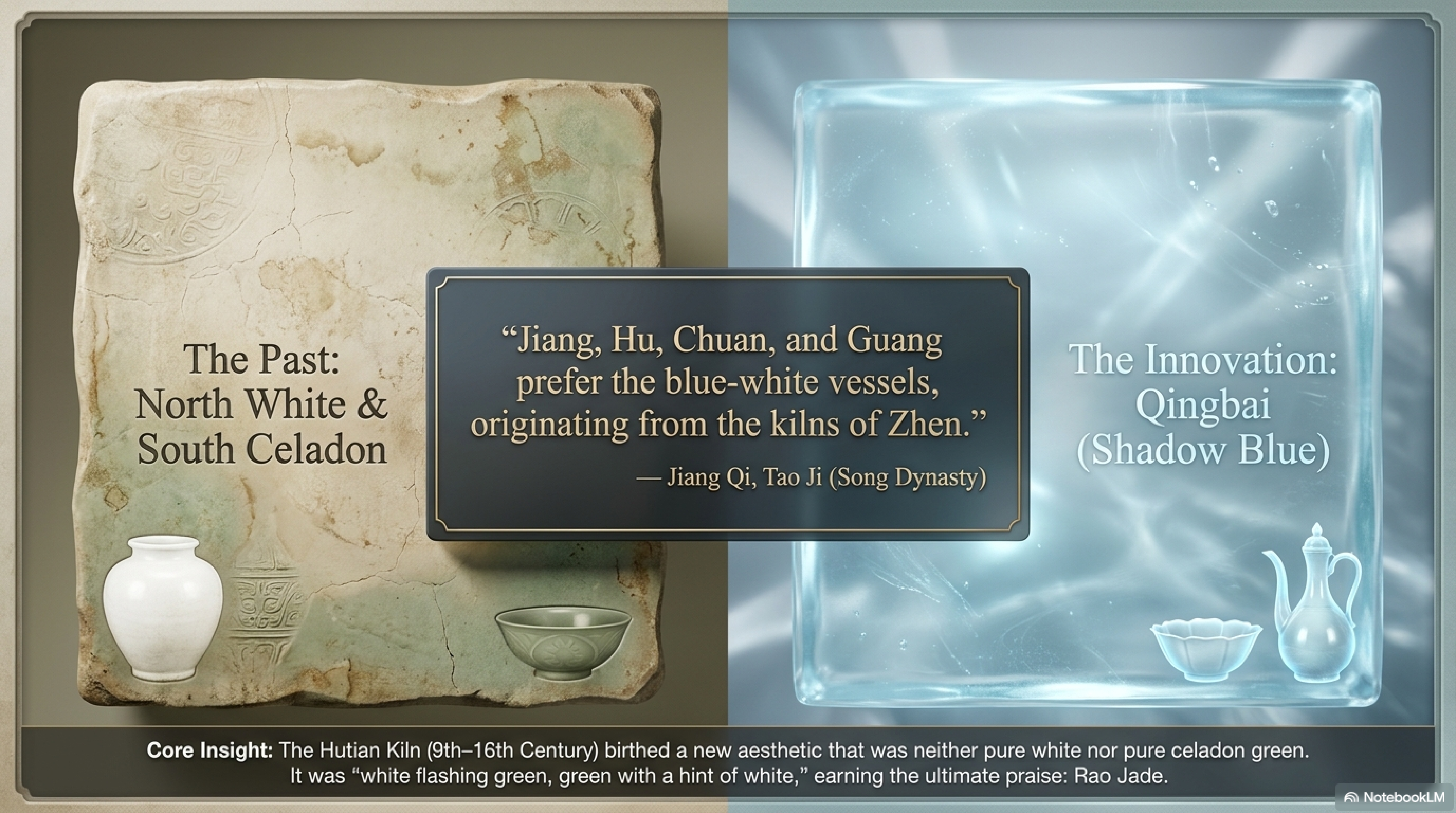
Before blue-and-white porcelain made Jingdezhen the ceramic capital of the world, there was Hutian. For seven centuries, the kilns of Hutian Village — located just four kilometres southeast of modern Jingdezhen — produced a celadon so fine that its contemporaries called it "假玉器" (false jade) and "饶玉" (Rao jade, after Raozhou prefecture). These were not insults. In Song China, the highest ceramic aspiration was to approach the appearance and feeling of nephrite jade — and Hutian's qingbai (青白瓷), also known as yingqing (影青, "shadow blue"), came closer than any other porcelain tradition.

The praise: "白如玉、明如镜、薄如纸、声如磬" — white as jade, bright as mirror, thin as paper, rings like a stone chime. This fourfold standard defined the aesthetic summit of Hutian production at its Northern Song peak.

Hutian represents the technical foundation of Jingdezhen: the clay processing, glaze chemistry, throwing techniques, kiln management, and decorative sensibility all developed here fed directly into the later blue-and-white tradition that would make Jingdezhen globally famous.

Longquan

Celadon jade-green. Powder Blue & Plum Green. 1,600 years. UNESCO heritage.

耀 Yaozhou

Olive green. Deep blade-carved relief. Northern celadon's undisputed peak.

Jian

Black iron glaze. Hare's fur & oil drop. Born for the Song tea ceremony.

Cizhou

White ground, black painting. China's greatest folk kiln tradition.

Hutian

Shadow blue yingqing. White as jade, thin as paper. Jingdezhen's foundation. The subject of this guide.

"白如玉,明如镜,薄如纸,声如磬。"

— The Song Dynasty's fourfold standard of Hutian excellence: white as jade, bright as a mirror, thin as paper, ringing like a stone chime. Four tests — visual, tactile, material, acoustic — that collectively describe the achievement of a ceramic tradition pursuing physical perfection.

The Village Four Kilometres from History:
Hutian and Jingdezhen

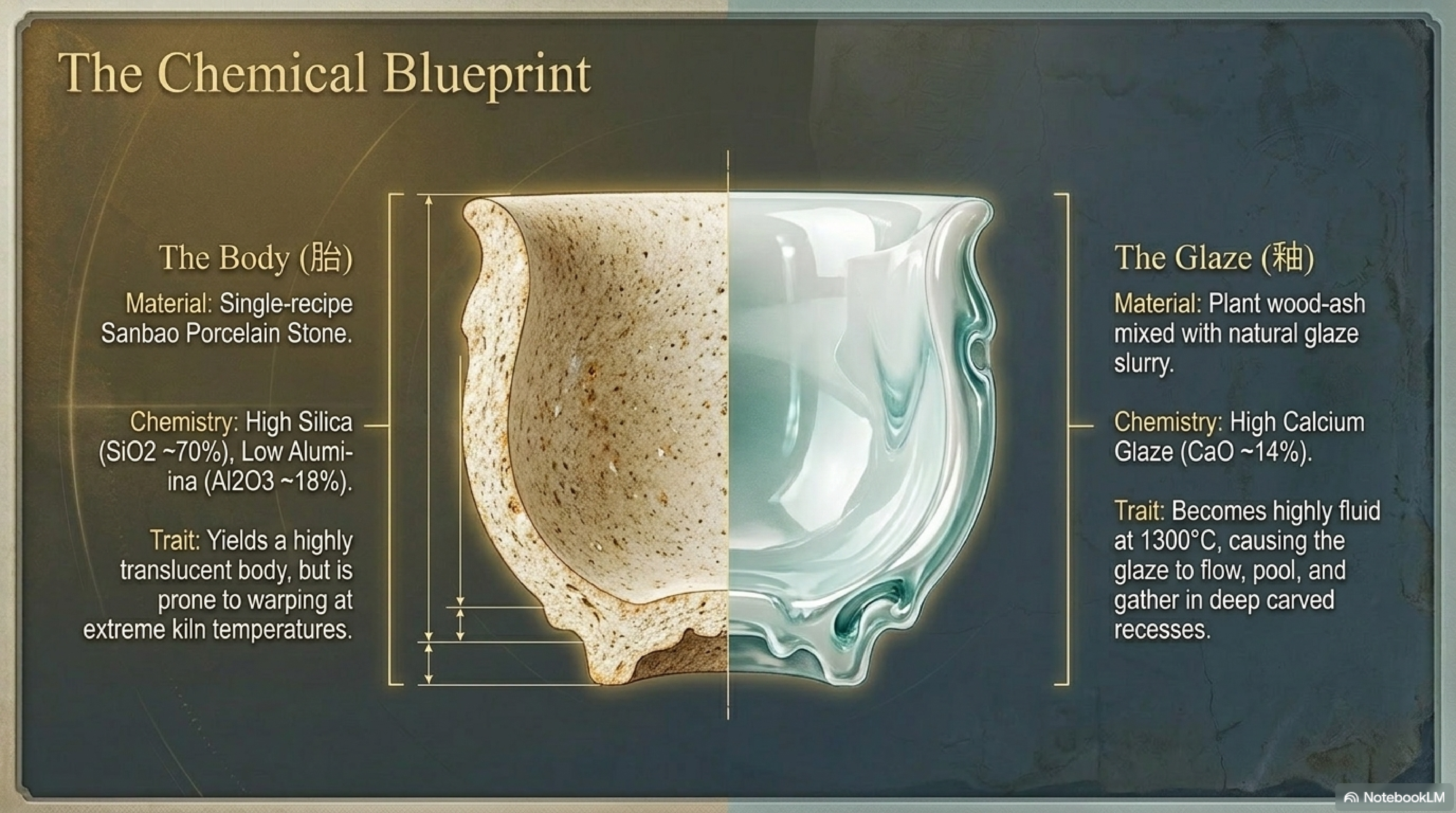
Hutian Village (湖田村), Jingcheng Town (竟成镇), is located approximately 4km southeast of central Jingdezhen City, Jiangxi Province. The village sits within the Jingdezhen ceramic geological zone — with direct access to the Sanbaoshanmine (三宝山) porcelain stone (瓷石) that would define the body chemistry of the entire tradition. Pre-Yuan, the body was made from a single mineral (porcelain stone only, no kaolin addition) — a "high-silica, low-alumina" (高硅低铝) body unique to this region.
Geographic map showing Hutian Village's position within the Jingdezhen ceramic zone, 4km southeast of central Jingdezhen City, Jiangxi Province

Hutian Village within the Jingdezhen ceramic geographical zone. Located four kilometres southeast of the city centre, Hutian sat at the intersection of geological advantage — access to Sanbaoshanmine porcelain stone — and commercial centrality. Its seven centuries of continuous operation established Jingdezhen as a ceramic centre before blue-and-white made it globally famous.
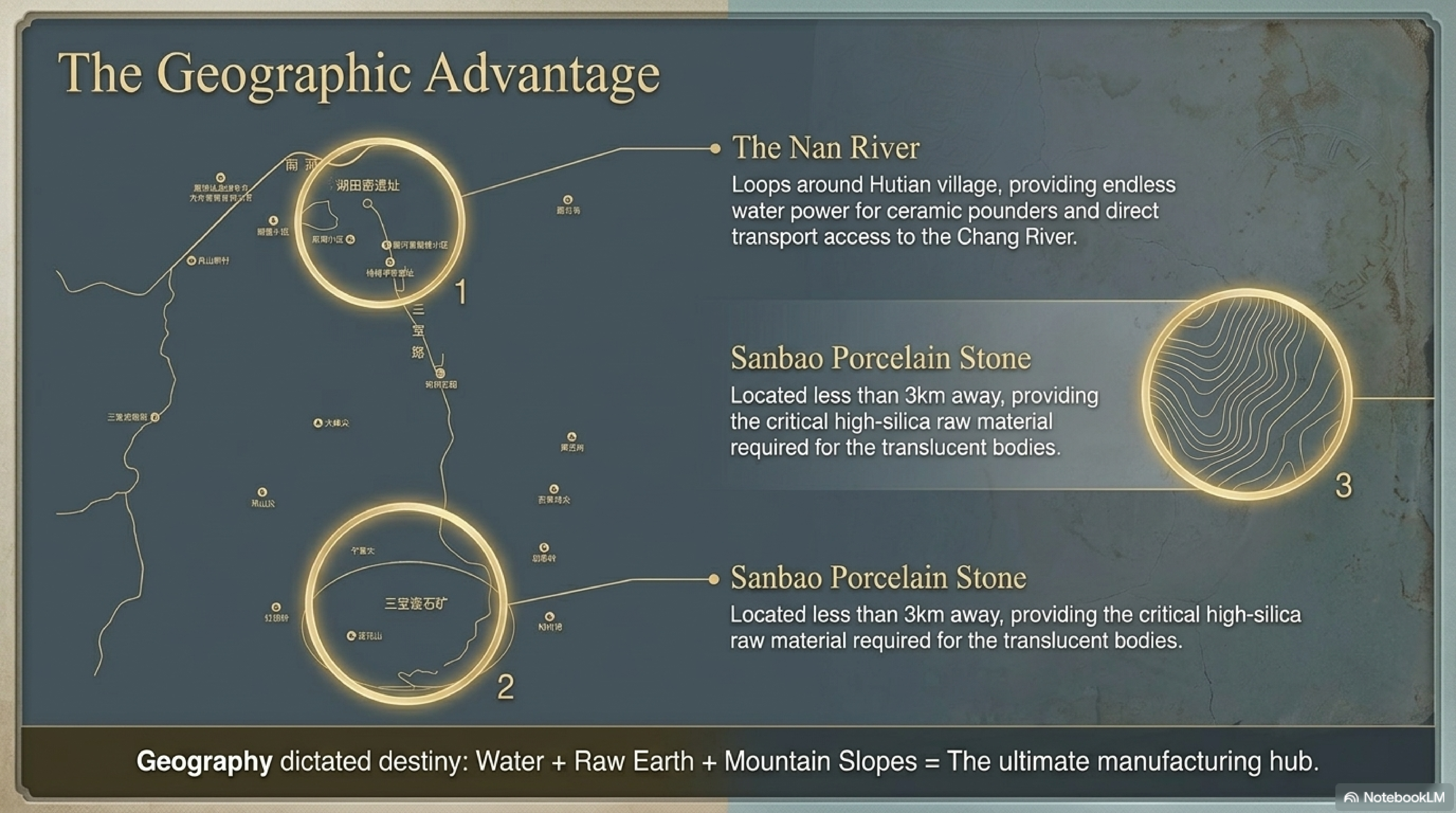
Sanbaoshanmine porcelain stone samples showing the single-mineral body chemistry of pre-Yuan Hutian — high-silica low-alumina composition

The Sanbaoshanmine (三宝山) porcelain stone — the geological foundation of Hutian ware. Before the Yuan dynasty, Hutian bodies were made from this single mineral source, producing the high-silica, low-alumina (高硅低铝) body that gives yingqing its characteristic translucency. The introduction of kaolin in the Yuan period built directly on this established base material knowledge.

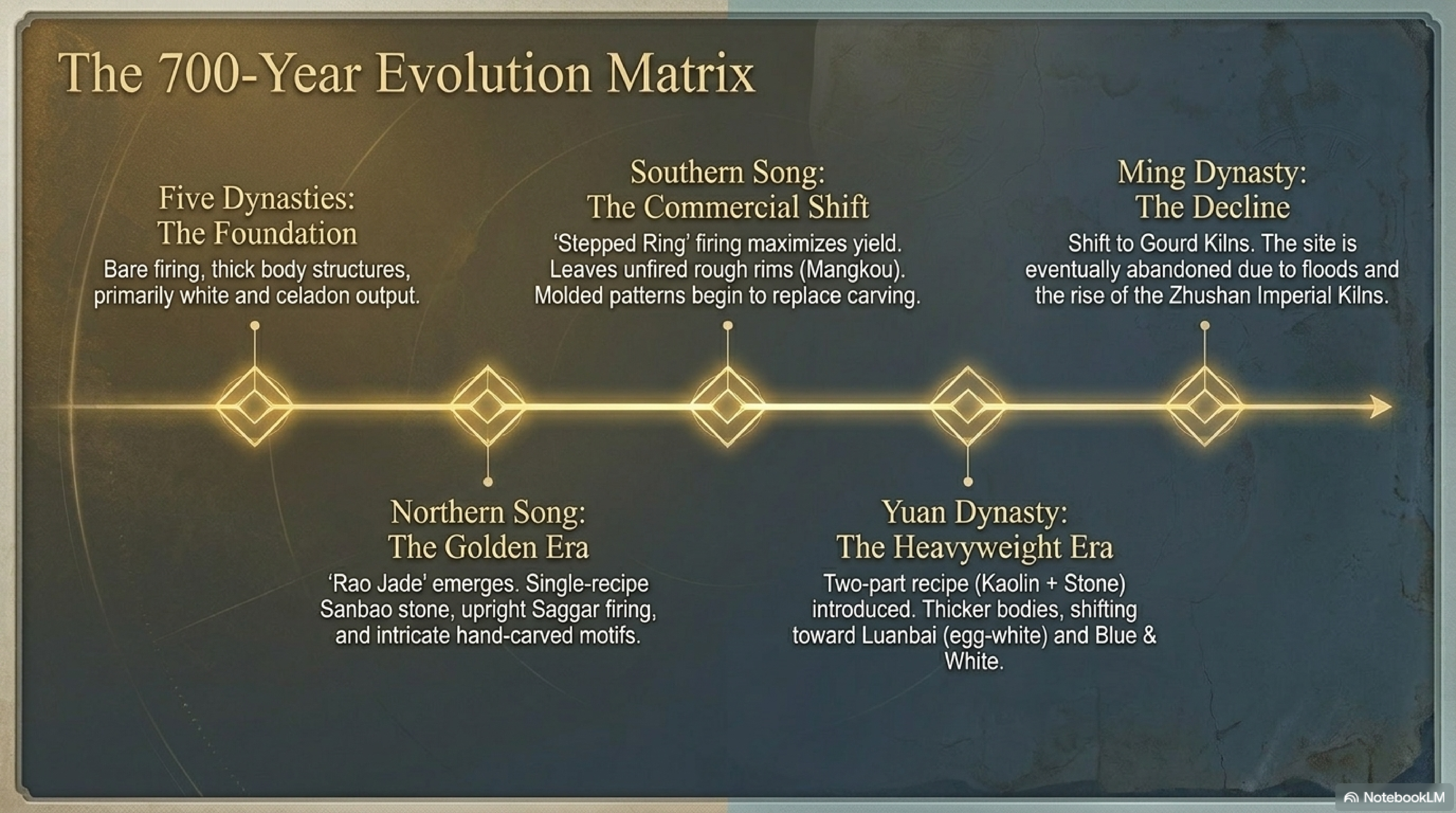
The Timeline

Thin as Paper: Rotary Trimming,
High Calcium, and the Art of Translucency

The body (胎体): Before Yuan, a single-mineral body derived from Sanbaoshanmine porcelain stone — no kaolin. This produced a "high-silica, low-alumina" body that is more translucent than kaolin-added bodies but slightly less stable at extreme temperatures. The result is the characteristic translucency of yingqing: held to light, a thin piece shows the carved interior decoration through the wall.

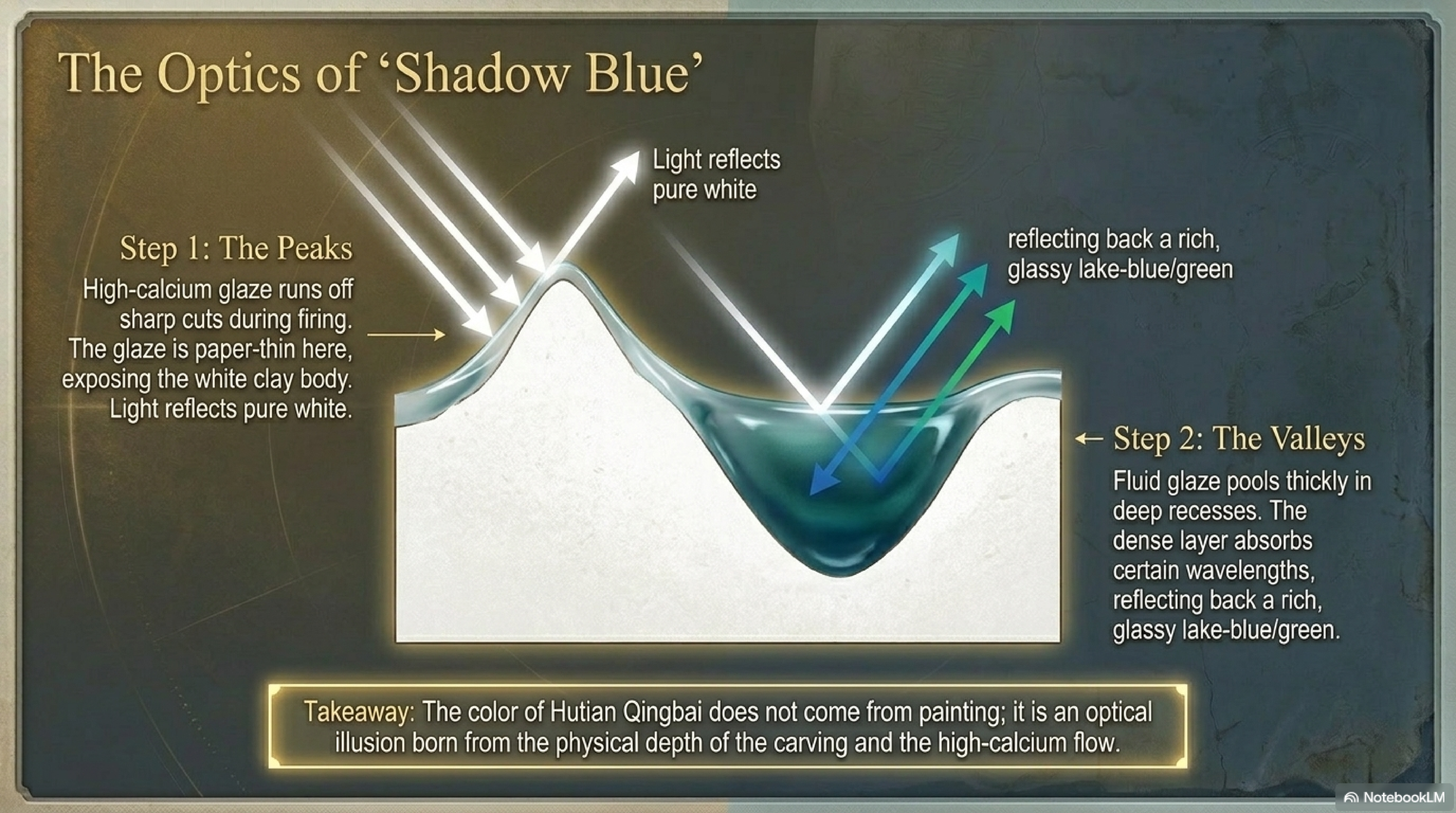
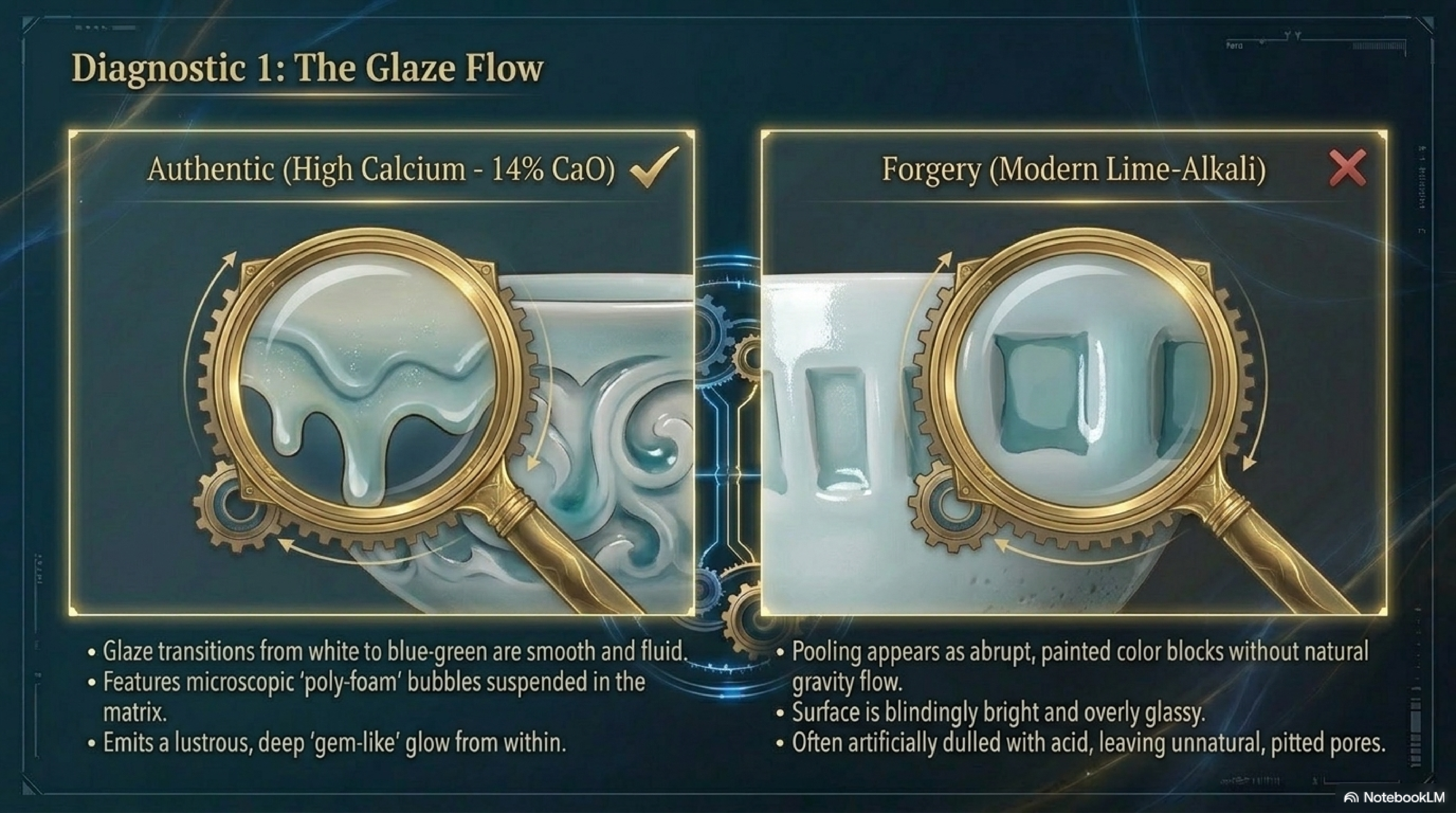
The glaze (釉料): A high-calcium (高钙) lime glaze, with CaO content approximately 14% — significantly higher than later Jingdezhen glazes. High calcium makes the glaze very fluid at high temperature, causing it to pool in carved channels and produce the characteristic pooled-glaze-deepens-to-blue-green effect. Where the glaze is thin, it appears white; where thick, it deepens to a haunting blue-green.

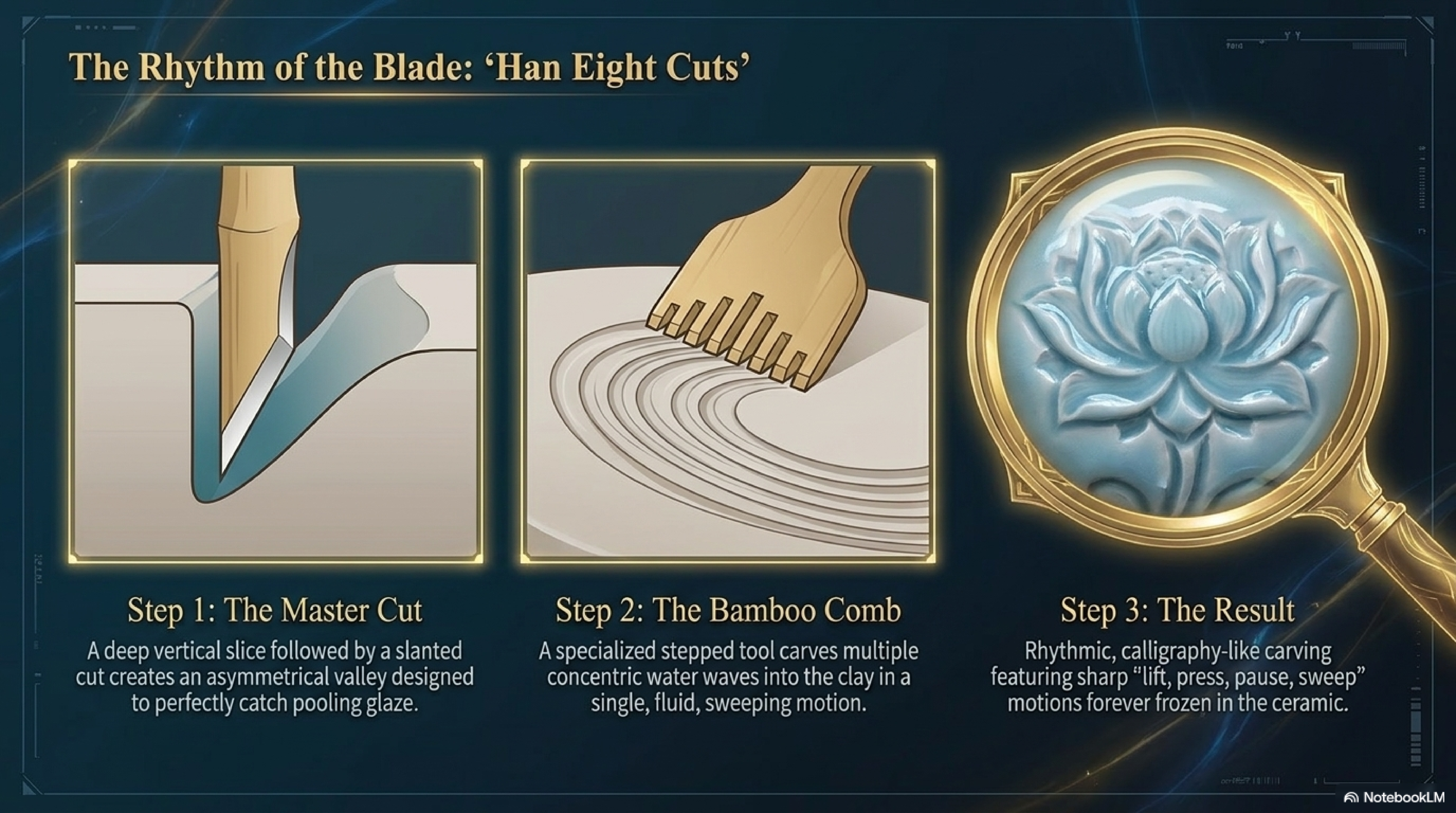
The defining technique — rotary trimming (旋坯): After throwing and partial drying, the body is inverted on the wheel and trimmed with a sharp iron blade. Hutian potters pushed this to an extreme: some large conical bowls (斗笠碗) have walls trimmed to less than 2mm — thinner than heavy writing paper. This requires extraordinary throwing precision and body consistency.

Rotary trimming (旋坯) technique demonstrated on a conical Hutian bowl, showing wall thickness under 2mm achieved by inverting the leather-hard body on the wheel

The rotary trimming (旋坯) technique — the central craft achievement of Hutian production. The leather-hard vessel is inverted on the wheel and trimmed with an iron blade until the wall approaches 2mm or less. This level of thinness requires extraordinary precision at the throwing stage: any variation in wall thickness causes the trimming blade to break through. The finest Northern Song conical bowls (斗笠碗) are thinner than writing paper.

High-calcium glaze pooling effect — where glaze is thin it appears white, where it pools in carved channels it deepens to blue-green, making the interior carving visible as colour contrast

The high-calcium glaze in action. The approximately 14% CaO content makes the glaze highly fluid at peak temperature — it flows and pools in the carved channels, deepening to blue-green where accumulated, remaining pale white where thin. This is not incidental: Hutian decorators carved knowing exactly where the glaze would pool, using chemistry as a second decorative medium.

Firing Evolution and the Stacking Revolution

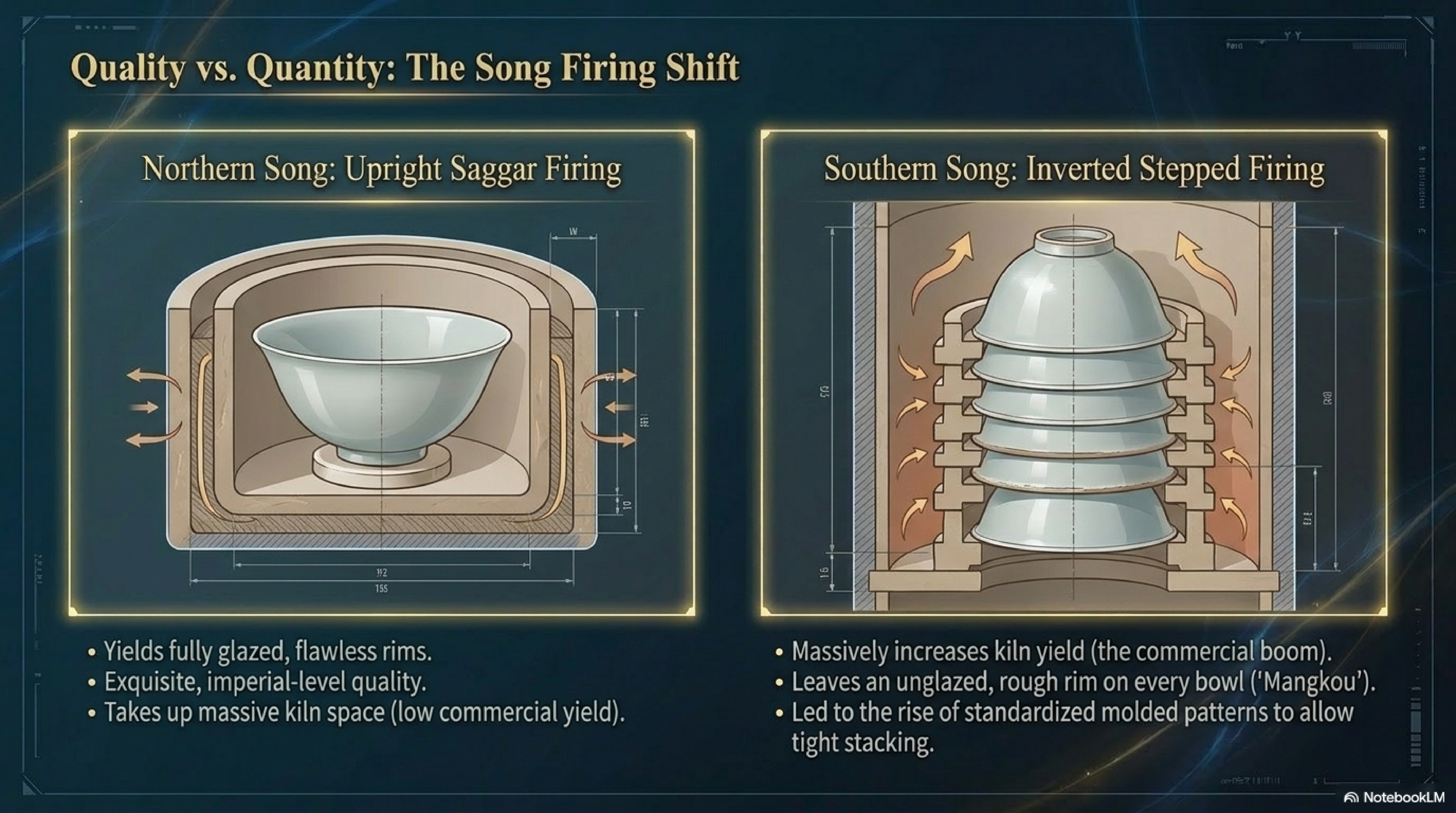
The evolution of Hutian's firing technology across seven centuries is directly legible in the objects' rims. Each stacking method left a permanent physical mark — making these marks the most reliable dating tool for Hutian pieces:

Four stacking methods compared — support pin scars (Five Dynasties), saggar upright (Early Song), inverted ring with芒口 (Southern Song), and涩圈 unglazed ring (Yuan) — each method's telltale mark on the finished piece

The four stacking methods and their telltale marks. These marks are the most reliable dating tool for Hutian pieces — more reliable than stylistic analysis, because firing technology changed at known historical moments. A piece with an unglazed芒口 rim cannot predate the Southern Song adoption of inverted stacking from Ding ware; a piece with涩圈 marks cannot predate the Yuan bulk production era.

Shadow Blue:
The Yingqing Vocabulary

Hutian ware is almost entirely defined by a single ceramic type — qingbai/yingqing — but within that tradition, the decorative vocabulary and functional range are remarkably broad.

Yingqing Bowls and Dishes 影青碗盘 · The Core Production

The staple of Hutian production. Conical bowls (斗笠碗) trimmed to paper thinness; flat dishes with interior carved or incised decoration. The yingqing glaze pools in the carved channels, intensifying to blue-green — making the decoration visible as a colour contrast as well as a surface relief.

Wine and Tea Sets 注碗执壶 · The Ritual Ensemble

Complete wine and tea service sets: warming bowls (注碗), ewers (执壶), incense burners, and covered jars. The translucency of the body means candlelight or firelight passes through thin walls — the serving set becomes luminous in use.

Sculptural Ware 瓷塑 · The Spiritual Range

Figurines, incense burners in vessel form, and Buddhist sculpture. The same rotary-trimming precision applied to vessel walls was used to produce extremely fine, thin-shelled figurines whose translucency gives them an almost ghostly appearance.

Decorative Motifs

Incised and carved decoration: babies at play (娃娃纹), lotus (莲纹), water waves (水波纹), peony, fish. The carving is always positioned where the pooled glaze will deepen the channels to blue-green — making the decoration emerge from within the surface rather than standing on it.

The 芒口 (Unglazed Rim)

The unglazed rim produced by the inverted stacking method (Southern Song and later) was not considered a defect. Song aristocratic buyers often mounted these rims in gold or silver (金扣, silver-rim setting), transforming the technical artifact of production into an aesthetic feature.

Hutian decorative vocabulary — incised babies at play (娃娃纹), lotus (莲纹), and water waves (水波纹) with glaze pooling deepening the carved channels to blue-green

The full Hutian decorative vocabulary. Incised babies at play (娃娃纹) — a signature Northern Song Hutian motif; lotus (莲纹) and water waves (水波纹) — the most common decorative registers. In every case the carving is designed to work with the glaze chemistry: channels become reservoirs for pooled blue-green glaze, making the decoration as much chromatic as sculptural.

芒口 (unglazed rim) examples from Southern Song and Yuan Hutian pieces, with gold-rim (金扣) and silver-rim mounted examples showing aristocratic transformation of the production mark into aesthetic feature

The 芒口 (unglazed rim) and its aristocratic reception. The rim was left unglazed by the inverted stacking process — a production necessity that Song connoisseurs transformed into an aesthetic opportunity, mounting the bare rim in gold (金扣) or silver. Several museum examples retain their original metal mounts, showing that the "flaw" of inverted firing was aesthetically integrated rather than concealed.

Four Looks:
Reading a Hutian Piece

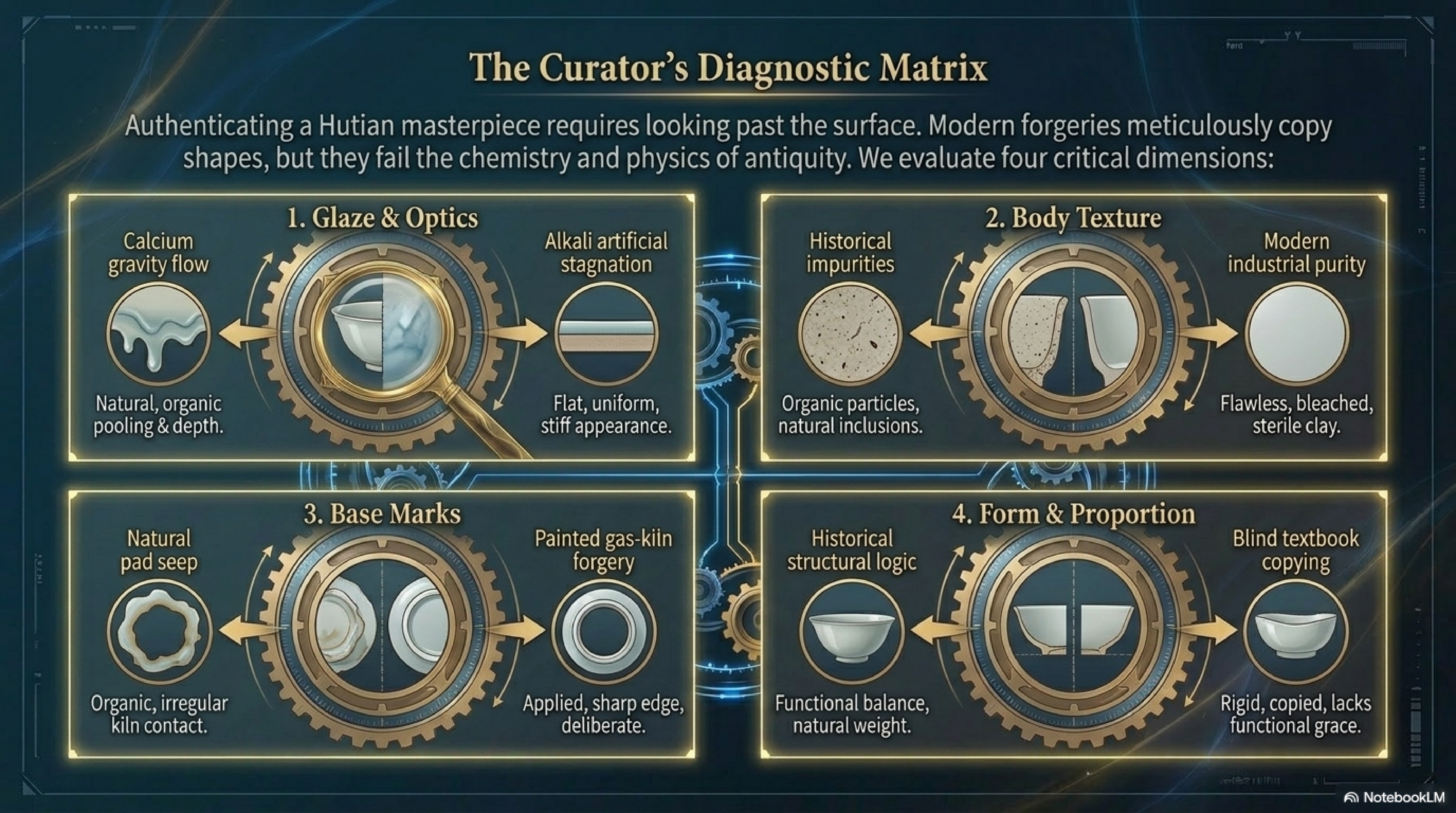
Hutian yingqing is a relatively accessible collecting area — less expensive than the Five Great Kilns — and accordingly widely reproduced. The forgeries range from crude modern production to sophisticated pieces that approximate the body and glaze chemistry. The four-look system addresses the most common forgery tells.

Brown pinhole (棕眼) identification — close-up showing pinholes penetrating through the glaze to the body, with radiating mineral infiltration stains characteristic of genuine Song Hutian yingqing

Brown pinholes (棕眼) under magnification. Authentic Hutian glaze shows tiny pinholes where gas bubbles escaped during firing — some penetrate all the way to the body, creating micro-channels through which burial minerals later infiltrate, producing small radiating stain patterns. This combination (pinhole + radiating mineral stain) is a natural aging marker absent in modern reproductions.

Glaze quality comparison — genuine Song Hutian yingqing jade-like warmth and mellow translucency versus modern reproduction's hard glassy surface

Glaze quality (釉质) comparison. Genuine Song Hutian yingqing (left): mellow, jade-like warmth — simultaneously translucent and soft, it looks wet without being glassy. Modern imitation (right): harder, brighter, more glassy surface from kaolin-modified bodies and low-calcium glazes — the difference between a jade bead and a glass marble is precisely the difference between these two surfaces.

Body texture and foot mark authentication — genuine Hutian foot with natural ochre kiln-setter mark fading into surrounding clay, versus forgery with artificially concentrated treatment

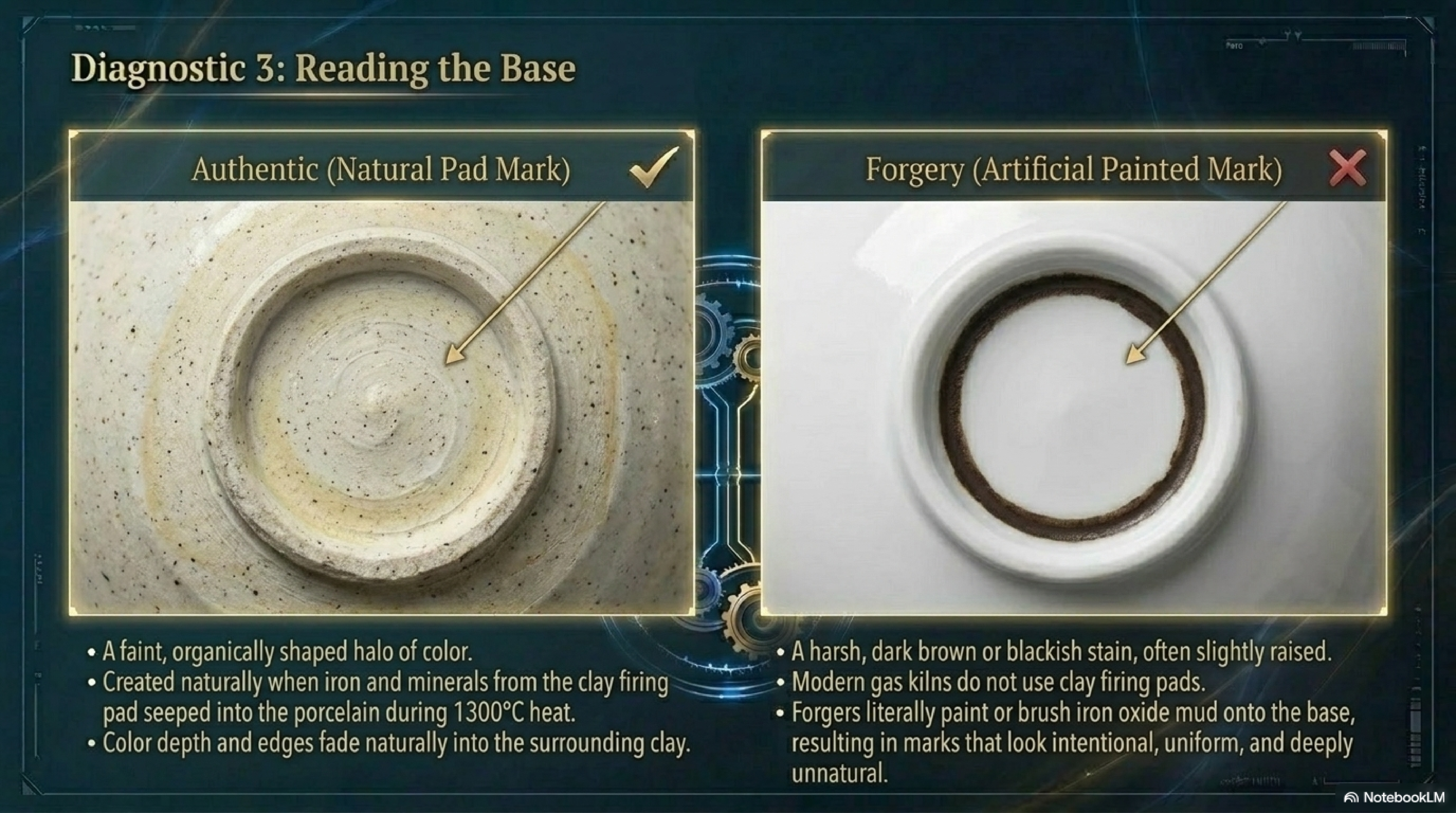
Body texture and foot mark authentication. The foot of a genuine upright-fired Hutian piece (left): natural ochre setter mark, irregular in colour and depth, fading organically into the surrounding clay. The body surface shows the slightly granular texture of hand-processed Sanbaoshanmine porcelain stone. Forgery foot (right): the chemical treatment produces too-even a colour band with unnaturally clean edges — the absence of organic variation is itself diagnostic.

The Foundation Stone:
How Hutian Built Jingdezhen

Hutian's most important legacy is not the yingqing pieces themselves — beautiful as they are — but the technical and cultural infrastructure it built for Jingdezhen's later dominance. The kiln's seven centuries of continuous operation established Jingdezhen as a ceramic centre, trained generations of potters, and refined the porcelain stone processing techniques that would eventually support blue-and-white production.

The kaolin introduction: When Yuan-period potters began adding kaolin to the traditional Sanbaoshanmine porcelain stone body, they were building on centuries of Hutian understanding of how that base material behaved. The two-material body (二元配方) that enabled Jingdezhen's blue-and-white revolution was a direct evolution of Hutian's single-material foundation.

Export: Hutian yingqing was exported extensively from the Song period — to Japan, Korea, Southeast Asia, and the Middle East. Some of the finest pieces reached the Ottoman imperial treasury (Topkapi Palace collection), where they were mounted in gold and silver alongside the greatest Longquan and Jingdezhen pieces.

Export reach of Hutian yingqing — distribution map showing Song and Yuan period trade routes to Japan, Korea, Southeast Asia and the Middle East, with Topkapi Palace collection presence

The export reach of Hutian yingqing. Song and Yuan period trade routes carried Hutian pieces across the Maritime Silk Road to Japan, Korea, Southeast Asia, and the Middle East. The Topkapi Palace collection in Istanbul holds mounted examples — gold and silver settings applied by Ottoman craftsmen to pieces they considered worthy of the imperial treasury, alongside the greatest Longquan and later Jingdezhen wares.

Technical lineage from Hutian yingqing to Jingdezhen blue-and-white — the single-mineral porcelain stone body evolving through Yuan kaolin addition to the two-material (二元配方) body that enabled cobalt blue painting

The technical lineage. Hutian's single-mineral porcelain stone body → Yuan kaolin addition → the two-material body (二元配方) that enabled Jingdezhen's blue-and-white revolution. The transition was not a rupture but a refinement: Yuan potters building on seven centuries of accumulated knowledge of the Sanbaoshanmine base material, adding kaolin to increase alumina content and firing stability, and opening the door to the cobalt-blue decorated porcelain that would make Jingdezhen the ceramic capital of the world.

"It is not the most celebrated, but it is the most necessary — the clay from which Jingdezhen's legend grew."

— On Hutian's role: not the most dramatic ceramic tradition (Jian's yohen holds that title), not the most expensive (Ru ware), not the longest-lived (Cizhou), but the most structurally important — the kiln whose accumulated technical knowledge became the foundation of all that Jingdezhen would later achieve.