龙泉青瓷 · The Pinnacle of Green
1,600 years of unbroken kiln fire. The only ceramic tradition
designated a UNESCO Intangible Cultural Heritage of Humanity.
In the entire history of Chinese ceramics, no kiln has come closer to replicating the appearance of jade in fired clay than Longquan. For sixteen centuries, from the Three Kingdoms period to the Qing Dynasty, the kilns of Longquan City in Zhejiang Province pursued a single obsessive goal: to create a glaze so thick, so milky, and so luminous that it would be indistinguishable from carved nephrite — the most revered material in Chinese culture.
They came closer than anyone thought possible. The finest Southern Song Longquan celadons achieve a jade-like warmth and opacity that no other ceramic tradition has matched before or since. Their secret was not a single invention but a convergence of three breakthroughs: a unique local clay body, a revolutionary shift from calcium to calcium-alkali glazes, and a multi-layer glazing technique requiring biscuit firing before each application.
Celadon jade-green. Powder Blue & Plum Green. 1,600 years. The subject of this guide.
Olive green. Deep blade-carved relief. Northern celadon's undisputed peak.
Black iron glaze. Hare's fur & oil drop. Born for the Song tea ceremony.
White ground, black painting. China's greatest folk kiln tradition.
Shadow blue yingqing. White as jade, thin as paper. Jingdezhen's foundation.
"类玉类冰,如脂如膏。"
— Song Dynasty connoisseur literature describing the finest Longquan celadon: "Like jade, like ice — as smooth as fat, as lustrous as cream." The highest compliment in Chinese ceramic aesthetics.Longquan ware takes its name from Longquan City (龙泉市) in southwest Zhejiang Province, where kiln activity began around the Three Kingdoms and Eastern Jin periods (3rd–4th century CE). The production zone extended along the Oujiang River valley, encompassing Qingyuan, Yuhe, and Lishui — a mountainous region whose geology would determine everything.
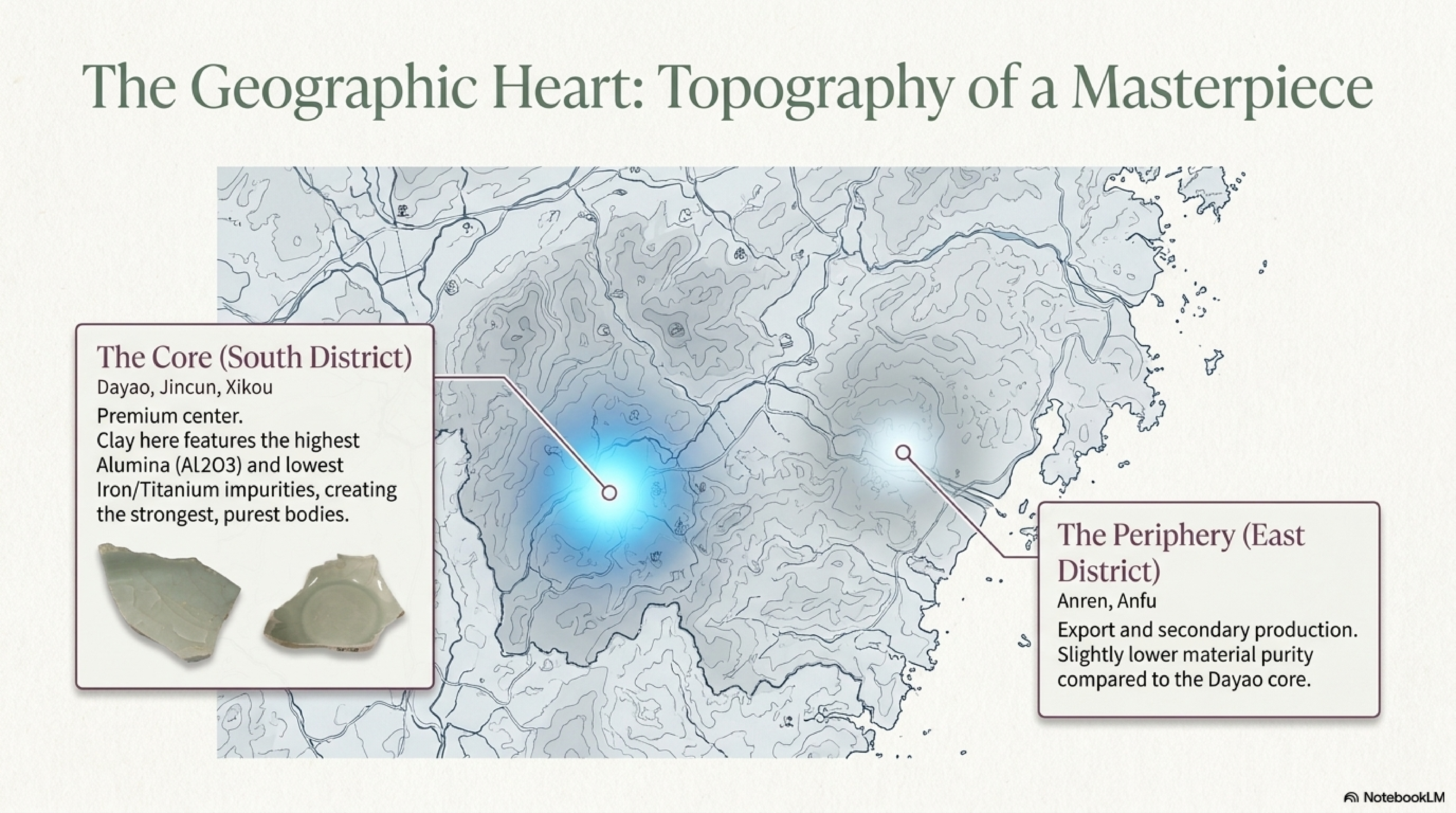
The two production districts of Longquan celadon. The South District — centred on Dayao, Jincun, and Xikou — commands the premium tier: highest alumina content, lowest iron and titanium impurities, finest body purity. The East District (Anren, Anfu) served export and secondary production. Within the South District, Dayao wares represent the absolute summit of quality.
Centred on Dayao, Jincun, and Xikou villages. Local clay has the highest alumina (Al₂O₃) content and the lowest iron and titanium impurities of any celadon-producing region in China. This geological advantage is the foundation of Longquan's unparalleled body purity and glaze clarity.
Centred on Anren and Anfu, adjacent to the Jinshuitan reservoir. Slightly lower material purity compared to the Dayao core. Primarily served export markets and secondary production throughout the Southern Song and Yuan periods.
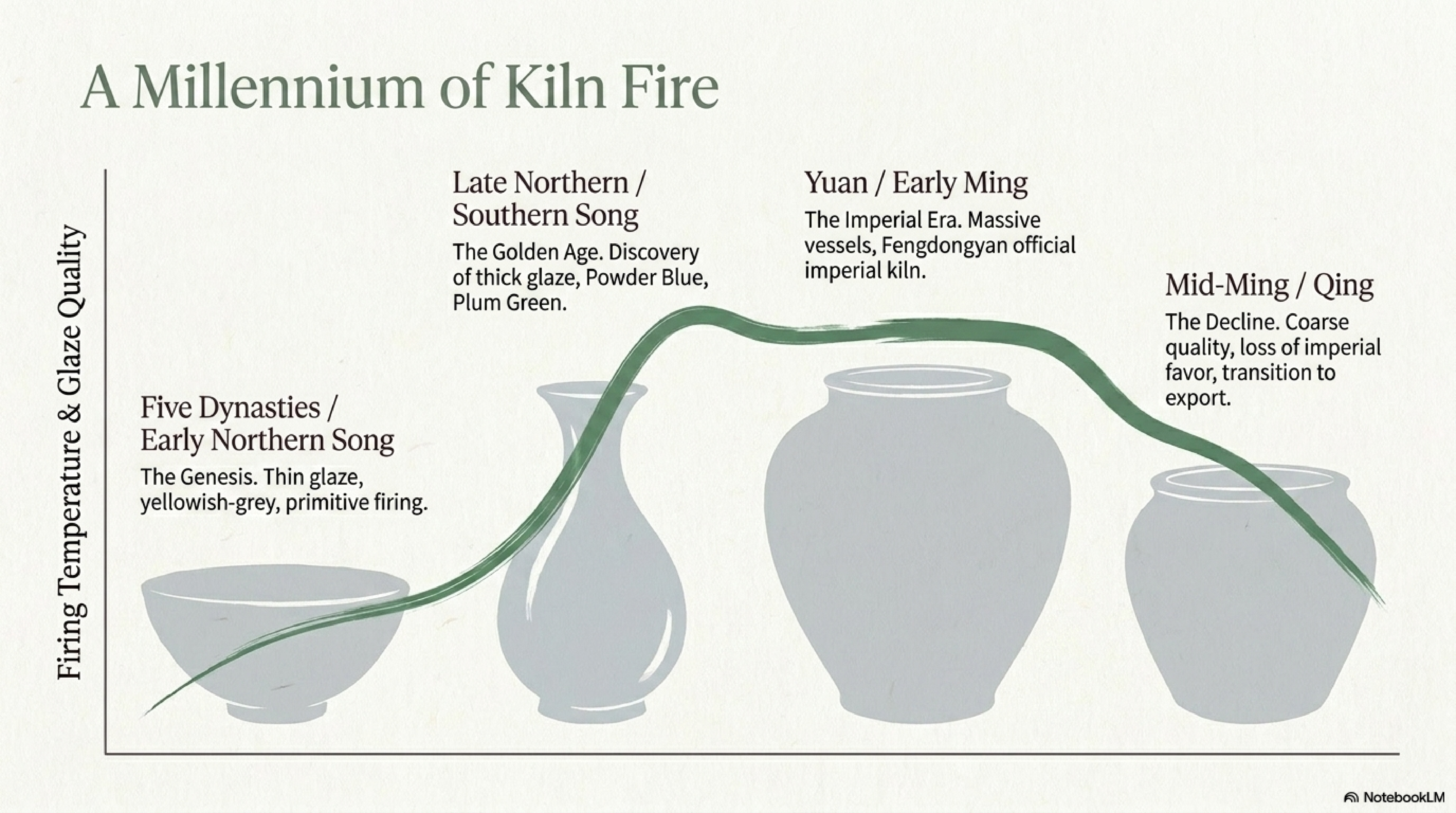
A millennium of kiln fire. Five Dynasties / Early Northern Song: thin, yellowish-grey glaze, primitive firing — the genesis. Late Northern Song / Southern Song: discovery of thick glaze, Powder Blue, and Plum Green — the golden age. Yuan / Early Ming: the imperial era, massive vessels, Fengdongyan official kiln. Mid-Ming / Qing: exhaustion of premium raw materials, loss of imperial favour, transition to export quality.
Longquan's arc across fifteen centuries is one of gradual refinement, a golden age of barely a century, and then a long, slow twilight. The kiln did not collapse — it persisted, exporting to the world — but it never again achieved the jade-like depth of the Southern Song peak.
The jade-like quality of Song Longquan celadon is not a mystery — it is a precisely engineered outcome. Every element of the production process, from clay selection to firing atmosphere, was optimised over generations to achieve one goal: a glaze so thick and so light-diffusing that it would lose all transparency and glow like polished stone.
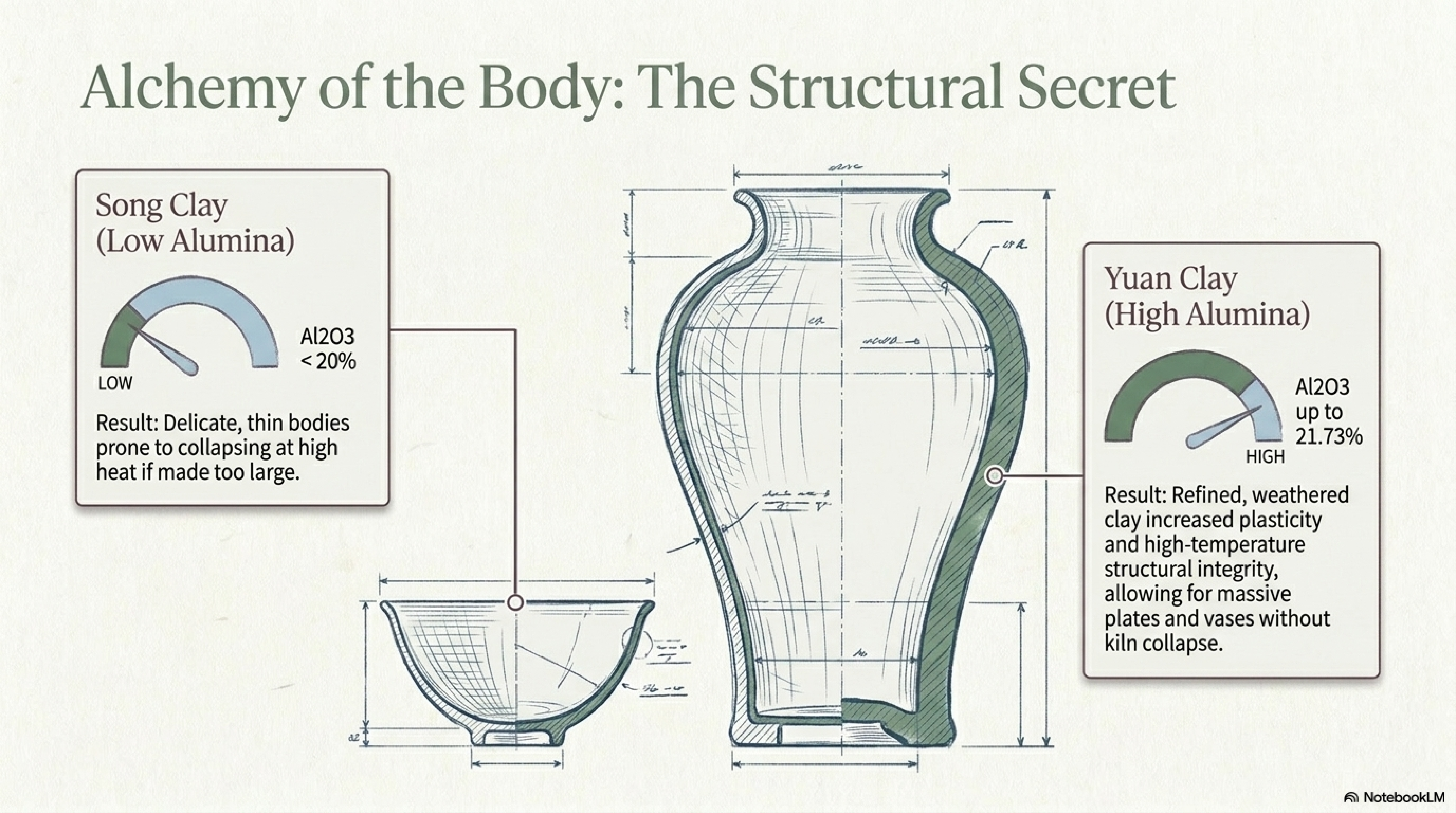
The body evolution. Song-period clay (low alumina, Al₂O₃ < 20%) yielded delicate, thin bodies — but collapsed at high temperatures if made too large. During the Yuan dynasty, access to more refined, weathered clay with up to 21.73% Al₂O₃ increased structural integrity, allowing the massive plates and vases that define Yuan Longquan without kiln collapse.
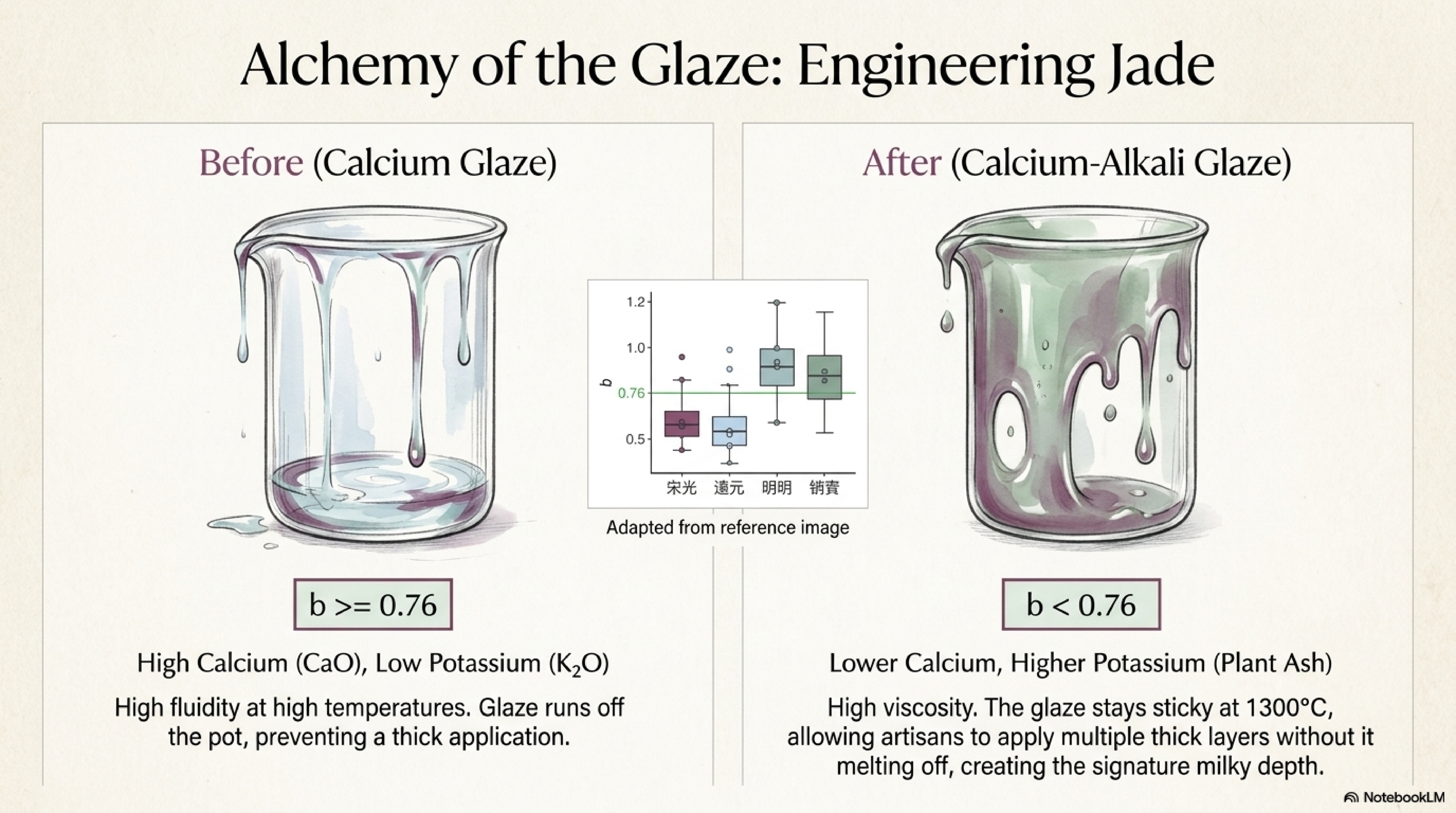
The single most important technical event in Longquan history was the shift from calcium (lime) glaze to calcium-alkali (plant ash) glaze during the Southern Song. This change, invisible to the naked eye, determined everything about the finished surface.
The chemistry of thickness. Early calcium glaze (high CaO, low K₂O) becomes highly fluid at 1300°C — it runs off the pot, preventing thick application. The Southern Song calcium-alkali glaze (lower calcium, higher potassium from plant ash) stays viscous at peak temperature, allowing artisans to dip the biscuit-fired body 3–4 times, building a glaze layer so thick it diffuses light internally — the source of the milky, jade-like opacity.
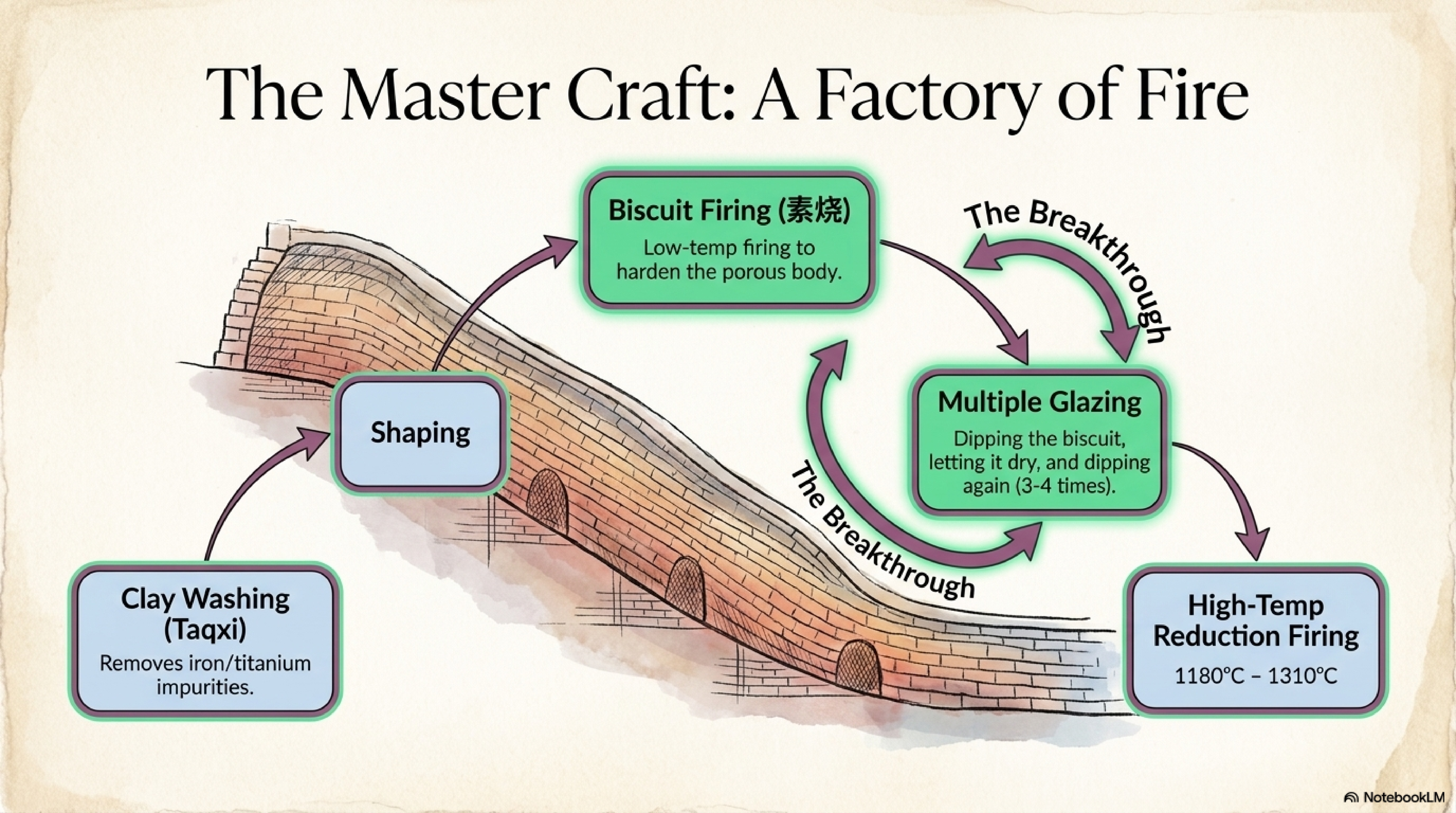
The production cycle. After shaping, the clay body undergoes taqxi (clay washing) to remove iron and titanium impurities. Biscuit firing at low temperature hardens the porous body to maximise glaze absorption. The biscuit is then dipped in glaze, dried, and dipped again — 3 to 4 times — before the final high-temperature reduction firing at 1180–1310°C in a wood-fuelled dragon kiln.
Longquan celadon divides into two distinct body traditions — white body and black body — producing three defining glaze types. Each reflects a different balance of raw materials, firing temperature, and aesthetic intention. Mastering this taxonomy is the foundation of all Longquan collecting.
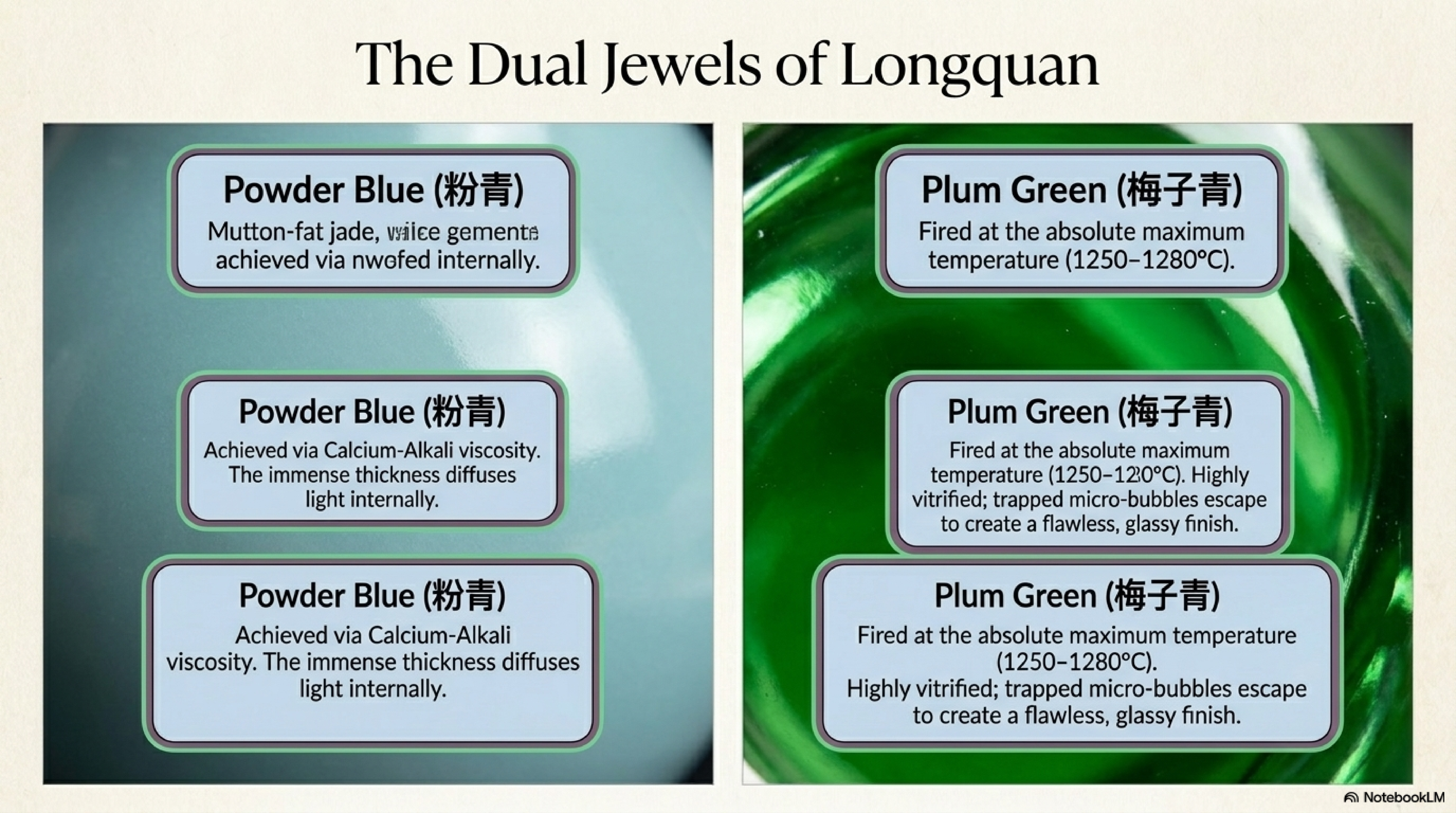
The two crowns of Longquan. Powder Blue (粉青, left): achieved through calcium-alkali viscosity — the immense glaze thickness diffuses light internally, producing a milky, jade-like opacity resembling mutton-fat nephrite. Plum Green (梅子青, right): fired at the absolute maximum temperature (1250–1280°C), the glaze fully vitrifies, trapping micro-bubbles to escape, yielding a crystalline, glassy surface of deep emerald intensity comparable to fine jadeite.
The most celebrated Longquan glaze. Fired at 1250–1260°C, the thick calcium-alkali layer becomes milky and translucent, diffusing light internally. Colour: pale jade green with a warm, muted depth. Texture: soft, cloud-like. The archetypal "jade of the kiln."
Fired at the absolute maximum temperature. The glaze fully vitrifies, achieving a translucent, glassy depth of deep emerald green comparable to jadeite. Harder and more brilliant than Powder Blue. The rarest and most technically demanding Longquan glaze.
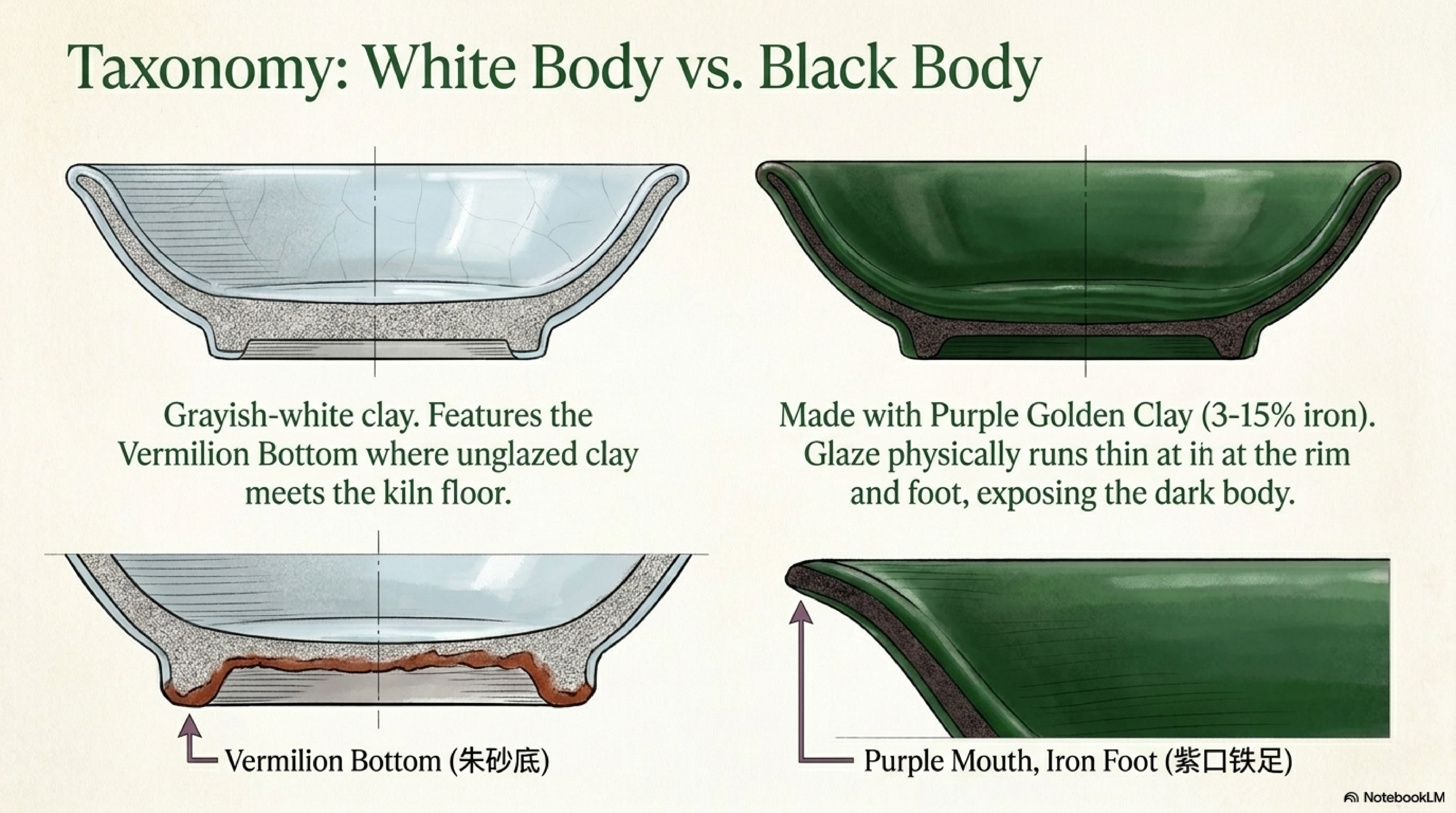
Made with Purple Golden Clay (紫金土) containing 3–15% iron. Glaze physically thins at the rim (Purple Mouth, 紫口) and foot (Iron Foot, 铁足), exposing the dark clay. Created to emulate the aesthetic of Northern Song Ru and Southern Song Guan ware.
The body taxonomy. White body (left): grayish-white clay with the characteristic Vermilion Bottom (朱砂底) — a rust-red oxidation ring where the unglazed foot meets oxygen during firing. Black body (right): made with Purple Golden Clay (紫金土), 3–15% iron. The glaze physically runs thin at the rim and foot, revealing the dark iron-rich clay beneath — producing the Purple Mouth (紫口) and Iron Foot (铁足) that mark the highest Longquan imitation of imperial Guan ware.
Longquan is one of the most extensively faked traditions in Chinese ceramics. The combination of widespread name recognition, relatively broad price range (unlike Ru or Guan), and technically reproducible glaze makes it a prime target for modern forgeries. Authentication requires reading a convergence of physical markers — no single feature is definitive alone.
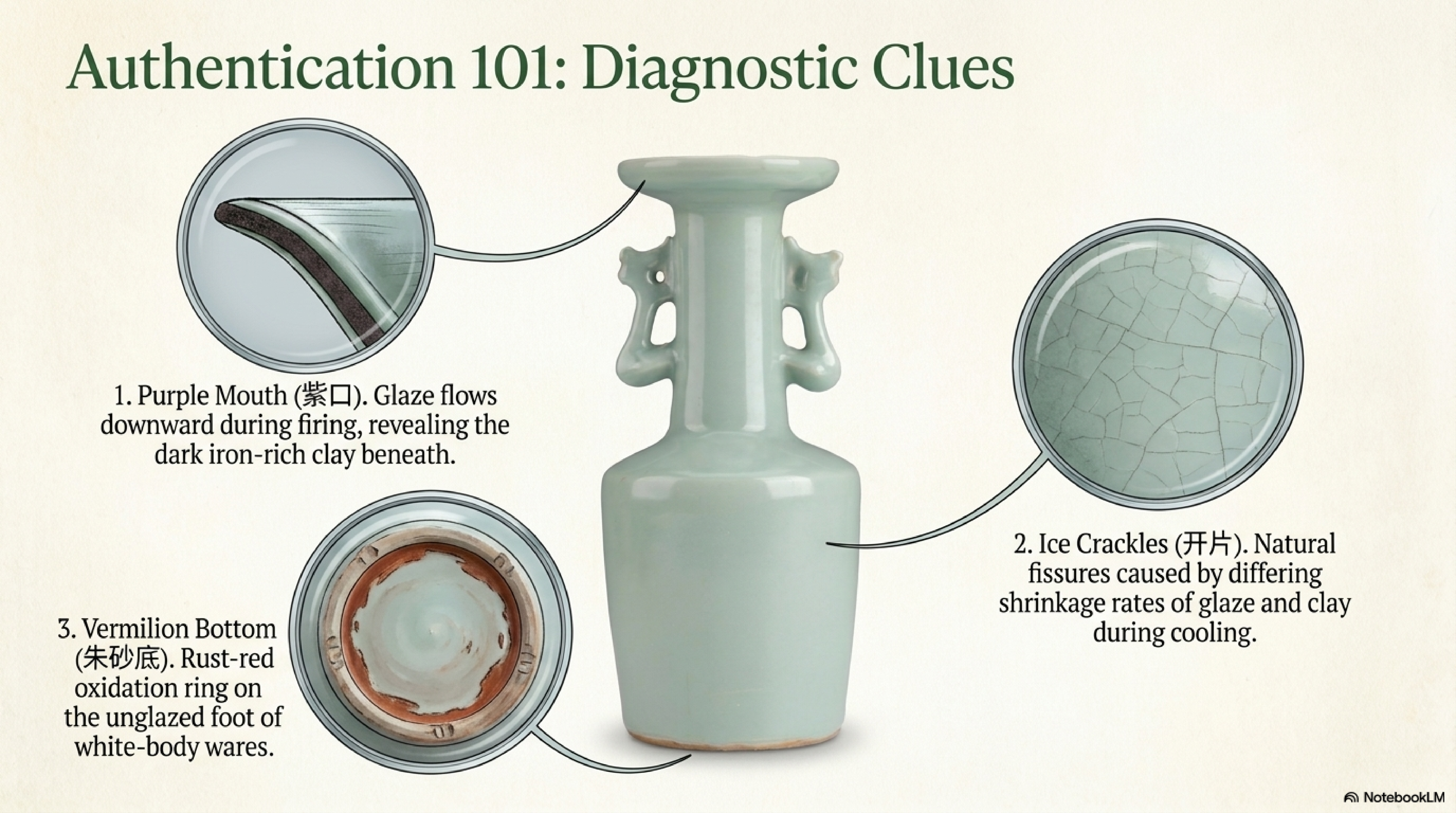
The three primary diagnostic markers on a white-body Longquan vase. 1. Purple Mouth (紫口): glaze flows downward during firing, thinning at the rim and revealing the dark iron-rich clay beneath. 2. Ice Crackles (开片): natural fissures caused by differing shrinkage rates of glaze and clay body during cooling — not all pieces crack, but when present, the pattern should be natural and irregular. 3. Vermilion Bottom (朱砂底): the rust-red oxidation ring on the unglazed foot of white-body pieces — the iron in the local clay oxidises in the kiln's cooling phase.
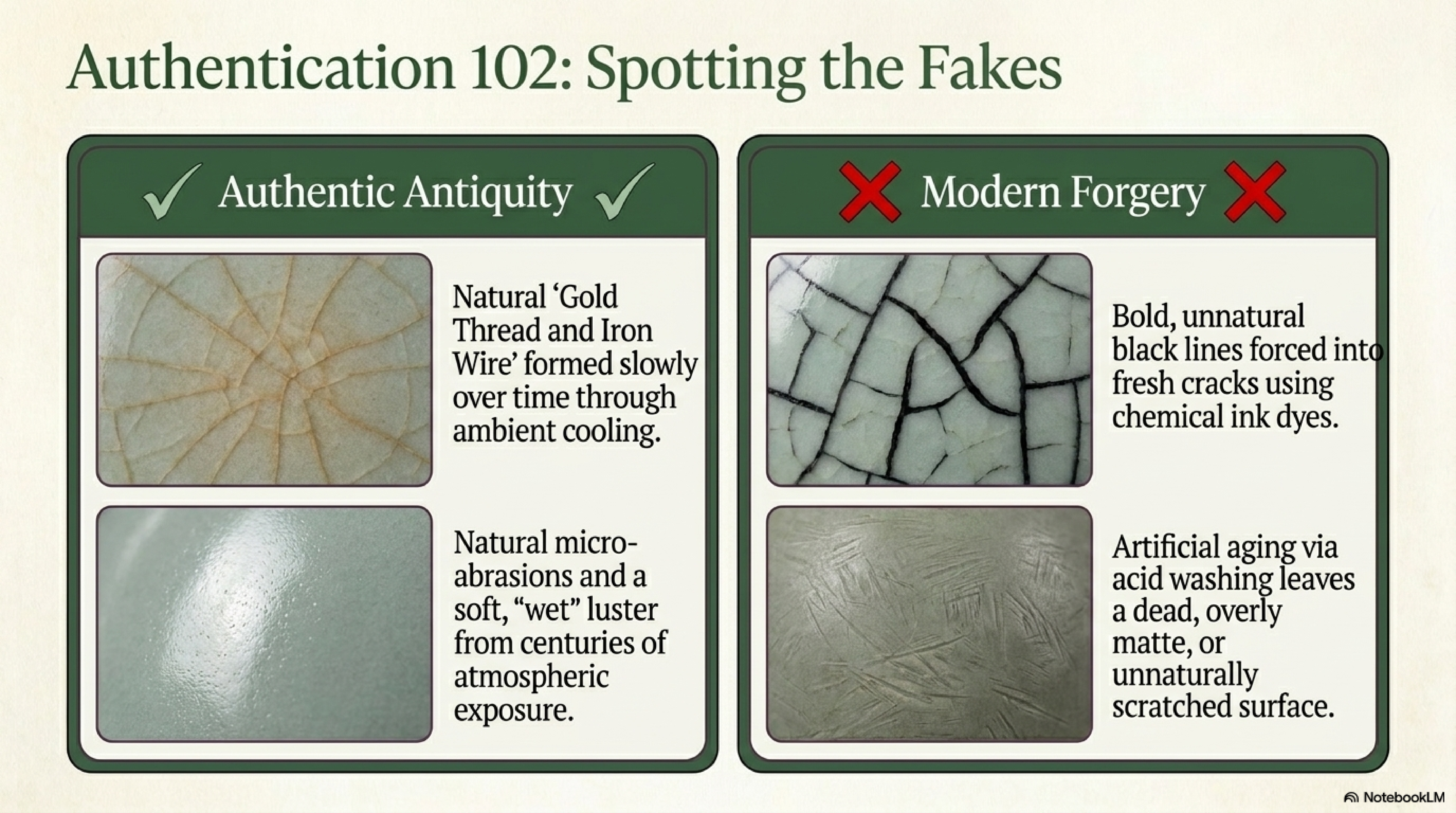
The forgery tells. Authentic: natural gold-and-iron-thread crackle formed slowly by ambient cooling over centuries; soft "wet" surface luster from atmospheric exposure. Forgery: bold, unnatural black lines forced into fresh cracks using chemical ink dyes; artificially aged surfaces via acid washing leave the piece dead, overly matte, or unnaturally scratched — the antithesis of the luminous depth that defines genuine Song and Yuan Longquan.
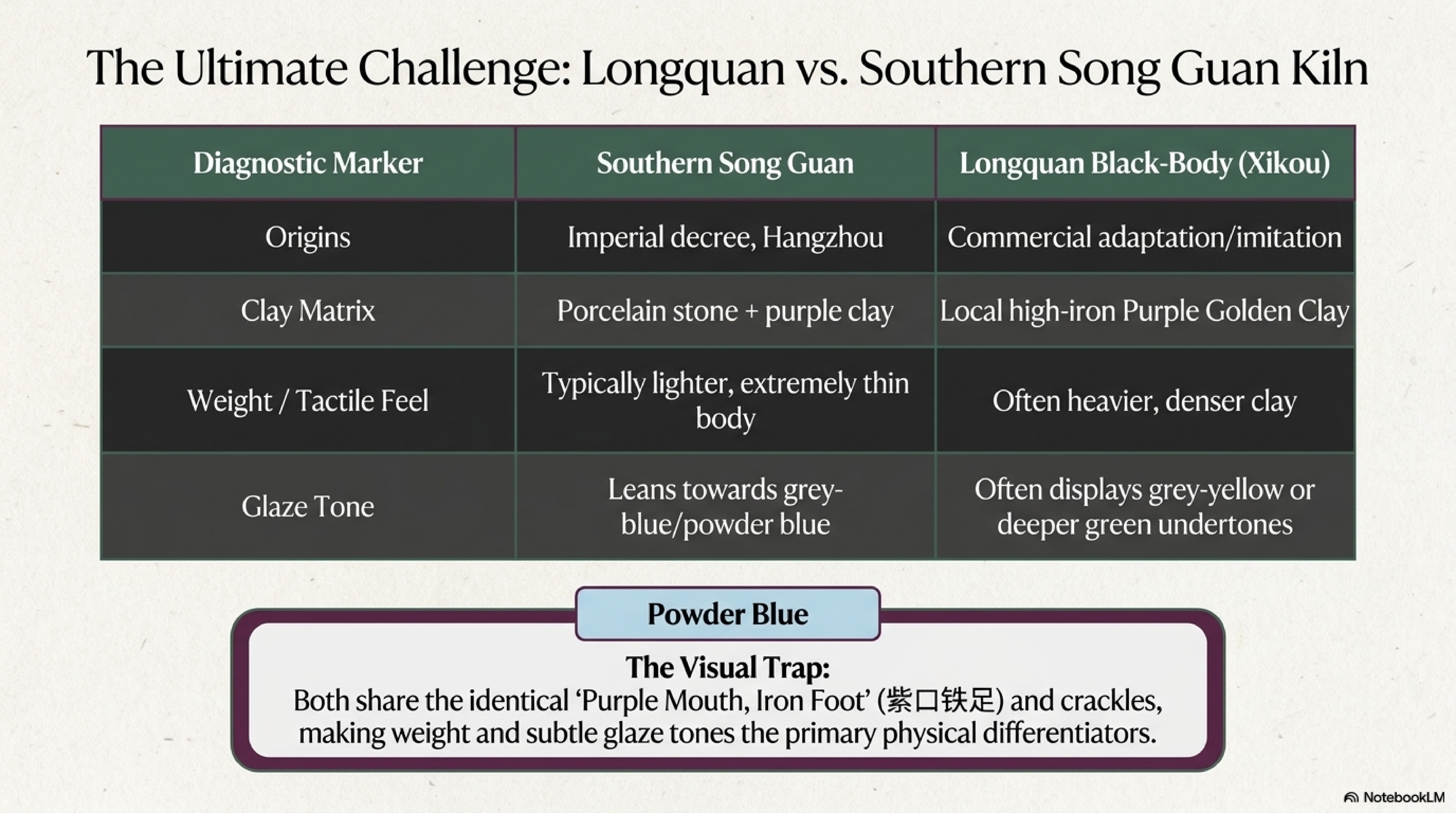
The critical comparison: Longquan Black Body (Xikou) versus Southern Song Guan Kiln. Both share the identical Purple Mouth, Iron Foot, and crackle aesthetic — making weight and subtle glaze tone the primary physical differentiators. Guan ware is typically lighter with an extremely thin body; Longquan Xikou is heavier with denser local clay. Glaze tone: Guan leans toward grey-blue or powder blue; Longquan Xikou often displays grey-yellow or deeper green undertones.
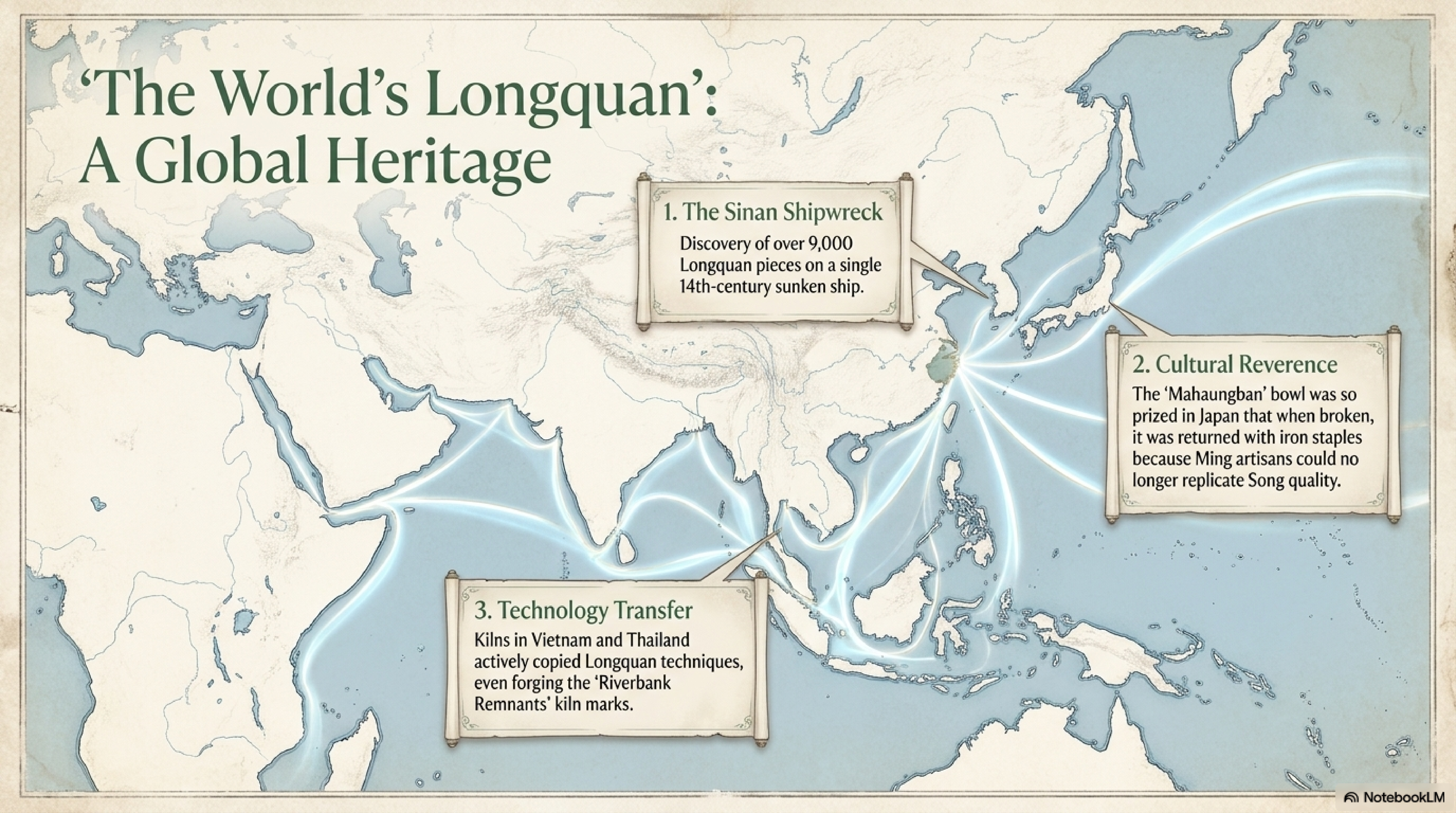
No other Chinese ceramic tradition was exported so widely or for so long. From the Southern Song through the Ming dynasty, Longquan celadon was the primary prestige ceramic of the Maritime Silk Road — shipped in vast quantities to Japan, Korea, Southeast Asia, the Middle East, East Africa, and Europe. It was not merely traded. It was actively imitated, revered, and in some cases worshipped.
The world's Longquan. 1. The Sinan Shipwreck: a single 14th-century sunken ship discovered off the Korean coast yielded over 9,000 Longquan pieces — the largest single archaeological haul of Chinese ceramics ever recovered. 2. Cultural reverence: a Longquan bowl broken in Japan was returned to China with iron staples — because Yongle-period artisans could no longer replicate Song quality. 3. Technology transfer: kilns in Vietnam and Thailand actively copied Longquan techniques, even forging the 'Riverbank Remnants' kiln marks.
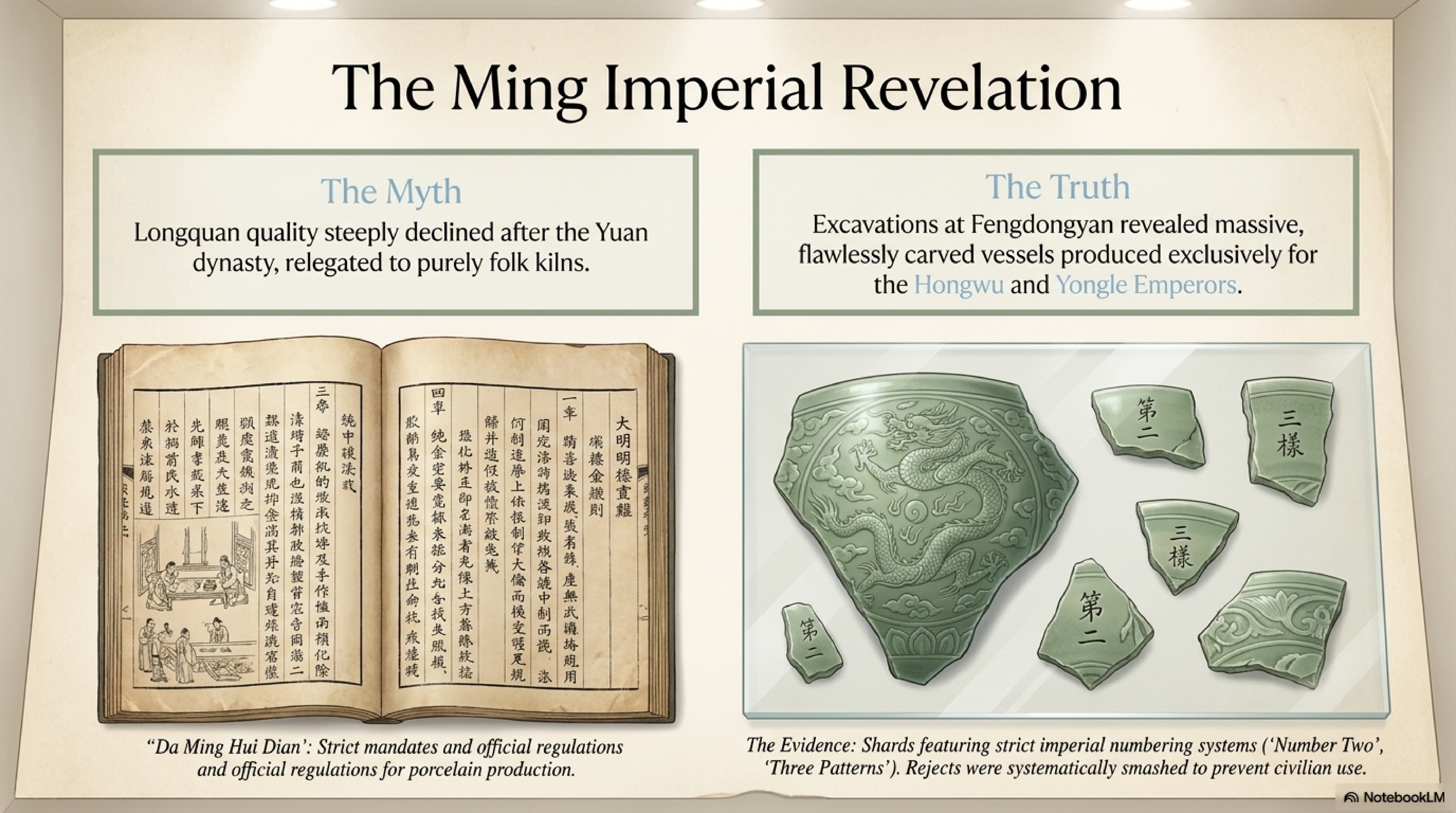
The Ming imperial revelation. The conventional narrative — that Longquan quality collapsed after the Yuan — was overturned by excavations at the Fengdongyan official kiln site. Massive, flawlessly carved vessels were produced exclusively for the Hongwu and Yongle emperors. Shards feature strict imperial numbering systems ('Number Two', 'Three Patterns'); rejects were systematically smashed to prevent civilian use. Ming Longquan was not inferior — it was simply different in scale and intent.
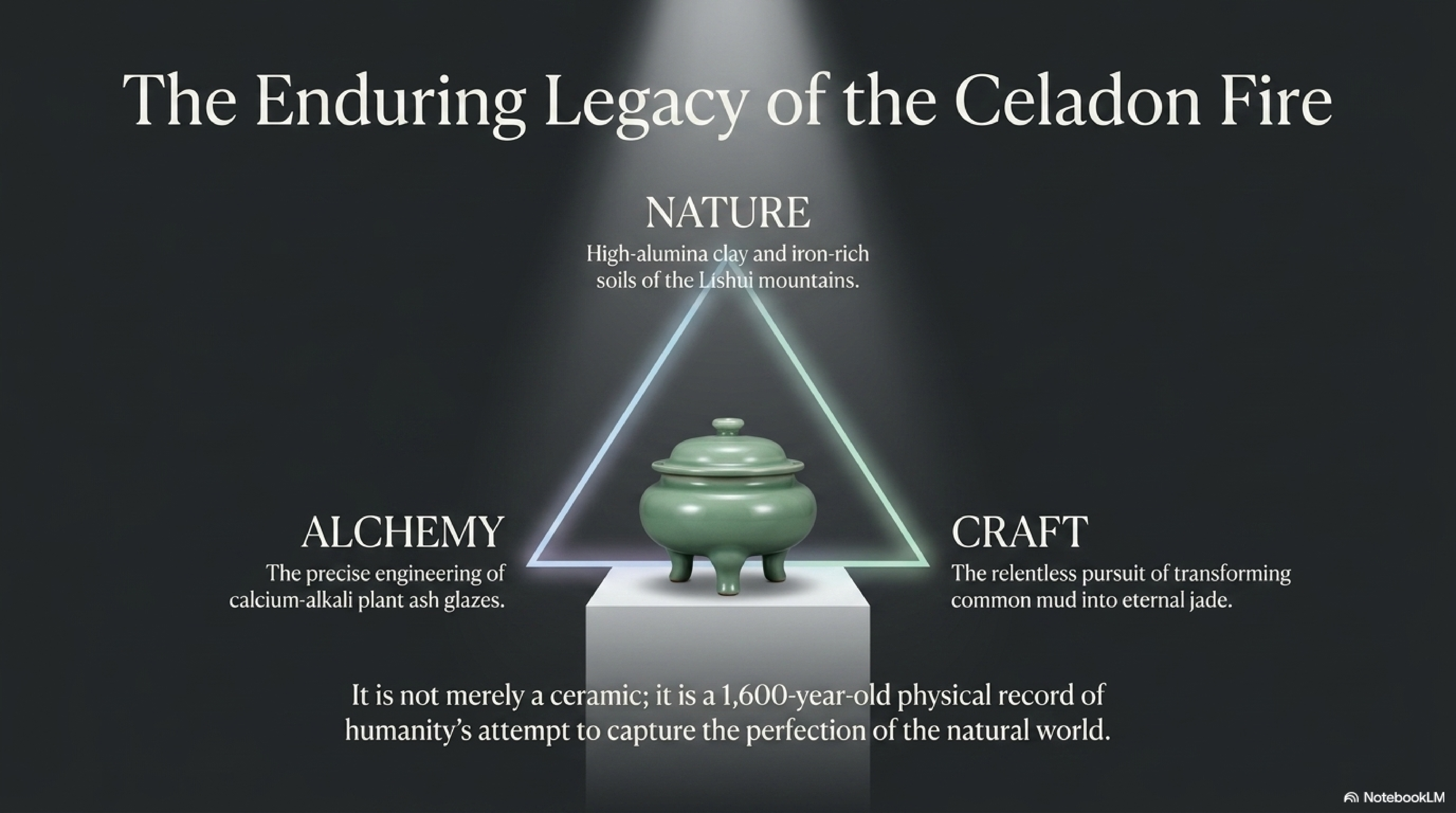
"It is not merely a ceramic; it is a 1,600-year-old physical record of humanity's attempt to capture the perfection of the natural world."
— The Longquan masterclass: on the convergence of Nature (high-alumina clay of the Lishui mountains), Alchemy (calcium-alkali glaze engineering), and Craft (the relentless pursuit of transforming mud into eternal jade).
The legacy triangle. Nature: the high-alumina clay and iron-rich mountain soils of the Lishui mountains — a geological gift that no other region could replicate. Alchemy: the precise engineering of calcium-alkali plant ash glazes, perfected across two centuries of Southern Song experimentation. Craft: the relentless pursuit, kiln by kiln, generation by generation, of transforming common mountain mud into something indistinguishable from eternal jade.