Eight Great Kiln Systems · The Creative Folk Kiln of the South

Jizhou Ware
吉州窑

工匠八方来,器成天下走 · Art Born from Everywhere

Six centuries on the Gan River. The kiln that put leaves, paper-cuts, and tortoiseshell into fired clay — and changed what ceramic decoration could be.

600+ Years of Production
30,000 Workers at Peak
木叶天目 World-Unique Technique
吉安 Jiangxi, Song Dynasty

The Inventive Southerner: Folk Art Transformed

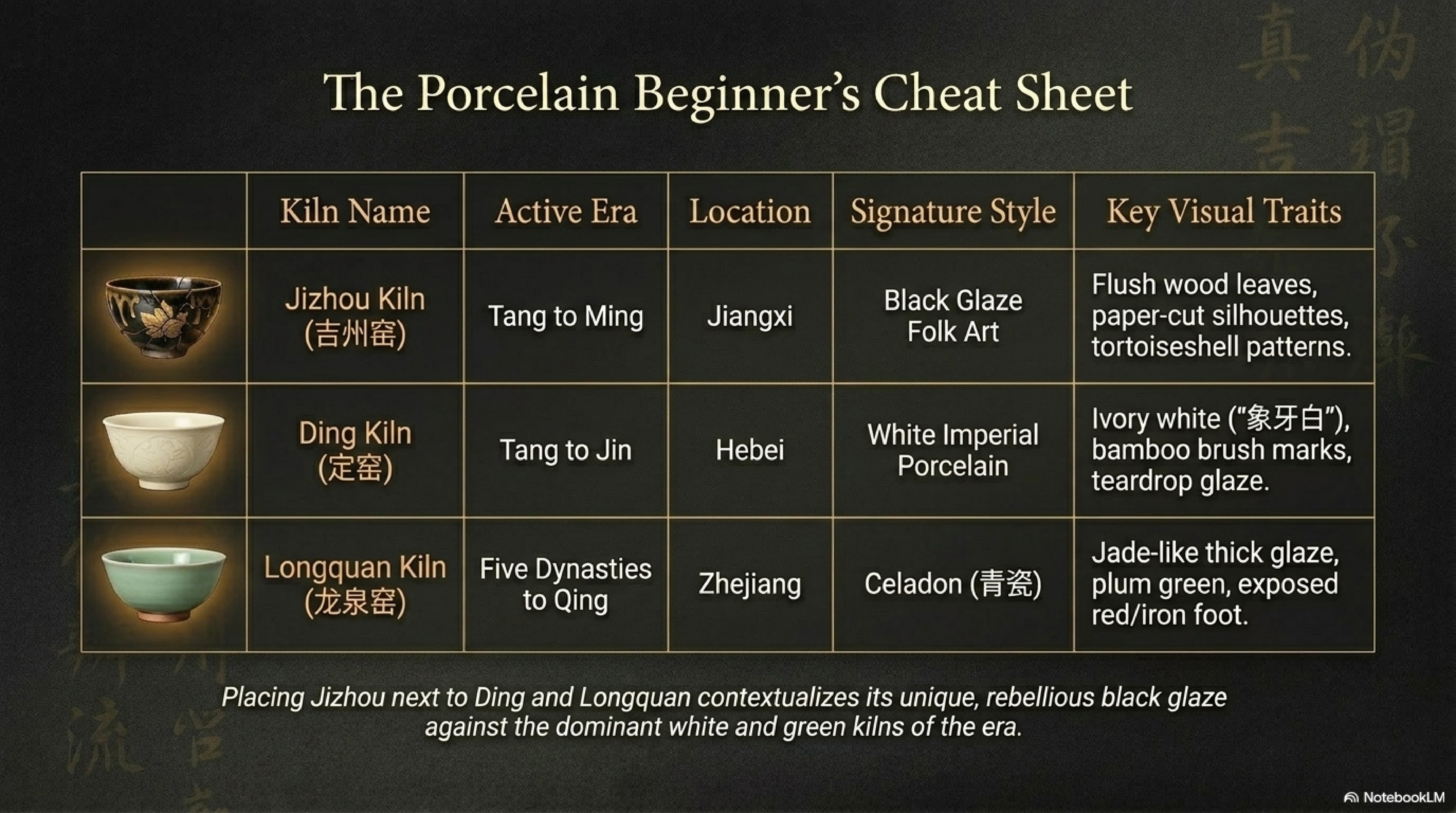
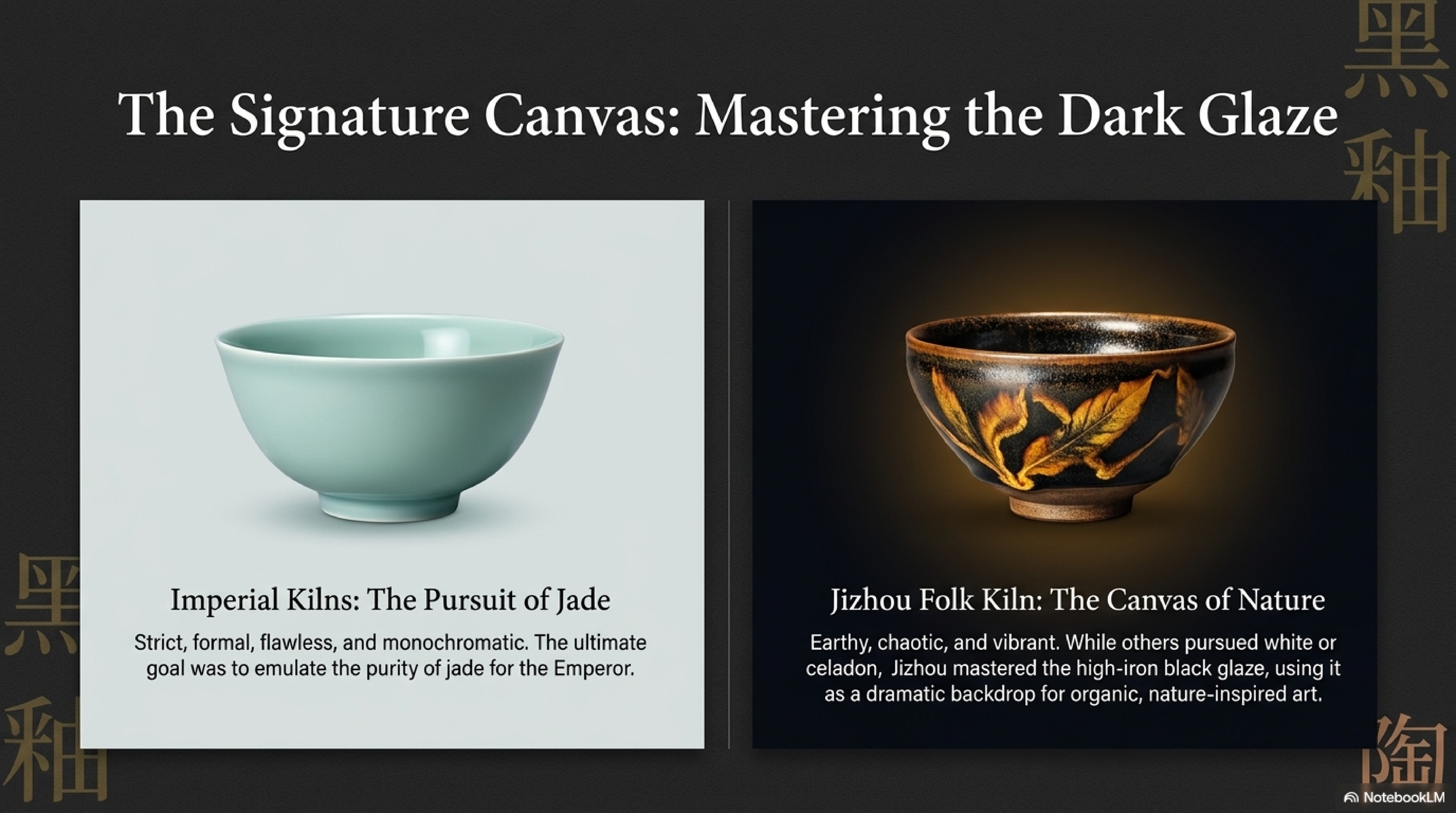
In the landscape of Song ceramics, Jizhou occupies an unusual position — it was neither the most technically refined (that was Hutian), nor the most aesthetically severe (that was Jian), nor the most commercially dominant (that was Cizhou). What Jizhou was, uniquely and definitively, was the most inventive. The kilns of Yonghe Town (永和镇) in Ji'an, Jiangxi synthesised techniques from Ding ware, Cizhou, and Jian ware, then pushed beyond all of them into territory no other kiln attempted: firing real leaves and paper-cuts directly onto ceramic surfaces to leave their ghostly imprint in glaze.

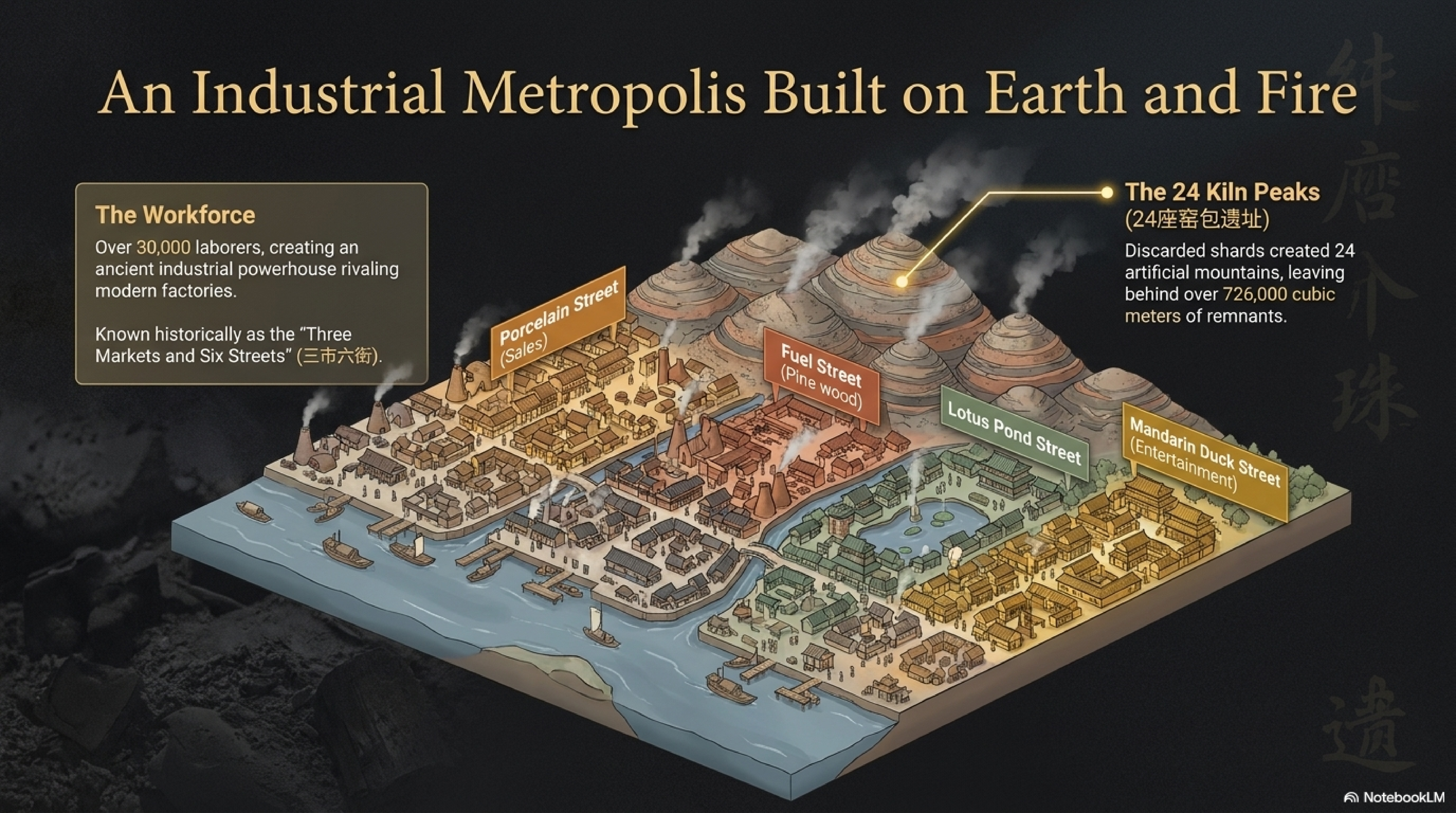
"工匠八方来,器成天下走" — artisans from every direction came to Jizhou; its wares went everywhere under heaven. At its peak, the kiln quarter of Yonghe was one of the largest ceramic production complexes in the world: over 30,000 workers, three market streets, six commercial avenues.

Jizhou

Folk innovation. Leaf temmoku, paper-cut resist, tortoiseshell glaze. The subject of this guide.

耀 Yaozhou

Olive green. Deep blade-carved relief. Northern celadon's undisputed peak.

Jian

Black iron glaze. Hare's fur & oil drop. Born for the Song tea ceremony.

Cizhou

White ground, black painting. China's greatest folk kiln tradition.

Hutian

Shadow blue yingqing. White as jade, thin as paper. Jingdezhen's foundation.

"工匠八方来,器成天下走。"

— The phrase that defines Jizhou's position in Song ceramic geography: a confluence point where techniques from the north (Ding, Cizhou) and south (Jian) met a specifically Jiangxi folk artistic sensibility to produce something the world had never seen.

The Gan River Kilns: Six Hundred Years on the Water

Jizhou ware takes its name from Ji'an City (吉安市) in Jiangxi Province, where the kilns were concentrated in Yonghe Town (永和镇) — also known as 永和窑 (Yonghe Kiln). The kilns sit on the bank of the Gan River (赣江), a strategic position that made transport of raw materials in and finished goods out exceptionally efficient.
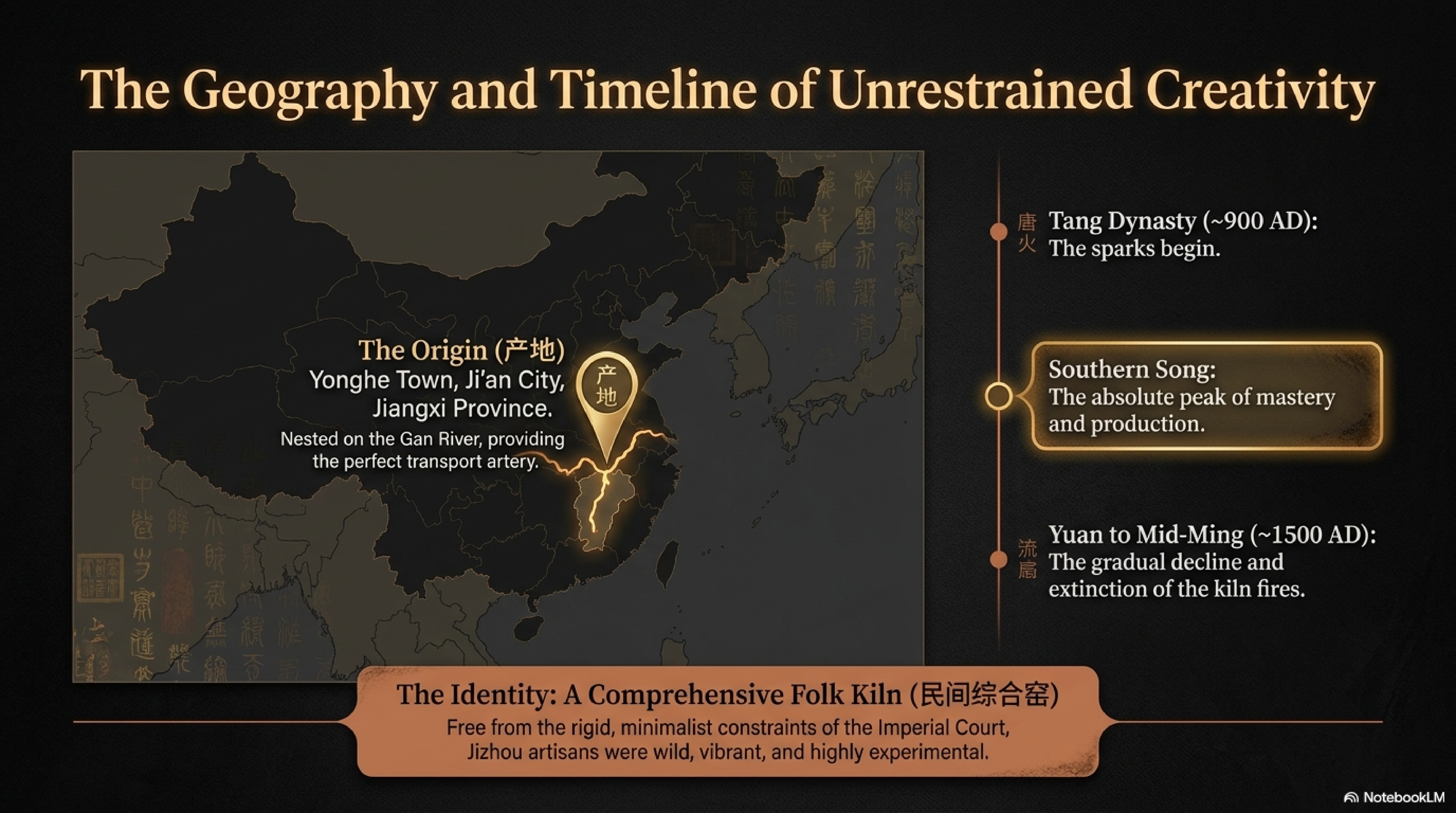
Geographic position of the Jizhou kilns in Yonghe Town on the Gan River, Jiangxi Province — showing proximity to the Jiganglin clay source (鸡冈岭) on the opposite bank

The Gan River position. The Jizhou kilns occupy the western bank of the Gan River at Yonghe Town — a location chosen not for aesthetics but for logistics. The 鸡冈岭 (Jiganglin) clay source on the opposite bank provided both ceramic clay and abundant forest fuel, while the river enabled a commercial scale of production and distribution that no landlocked competitor could match.

The Timeline

Scale at Peak

Peak workforce 30,000+, three market streets, six commercial avenues — one of the largest ceramic production complexes in Song-era China. The kiln quarter of Yonghe Town was effectively a ceramic city unto itself.

The Synthesis Tradition

The kiln synthesised Northern techniques (Ding-style white ware, Cizhou-style painted decoration, Jian-style black glaze) with a distinctly southern folk artistic sensibility, creating a tradition more innovative than any of its individual source traditions.
The Art of the Unexpected: Leaves, Paper, and Fire

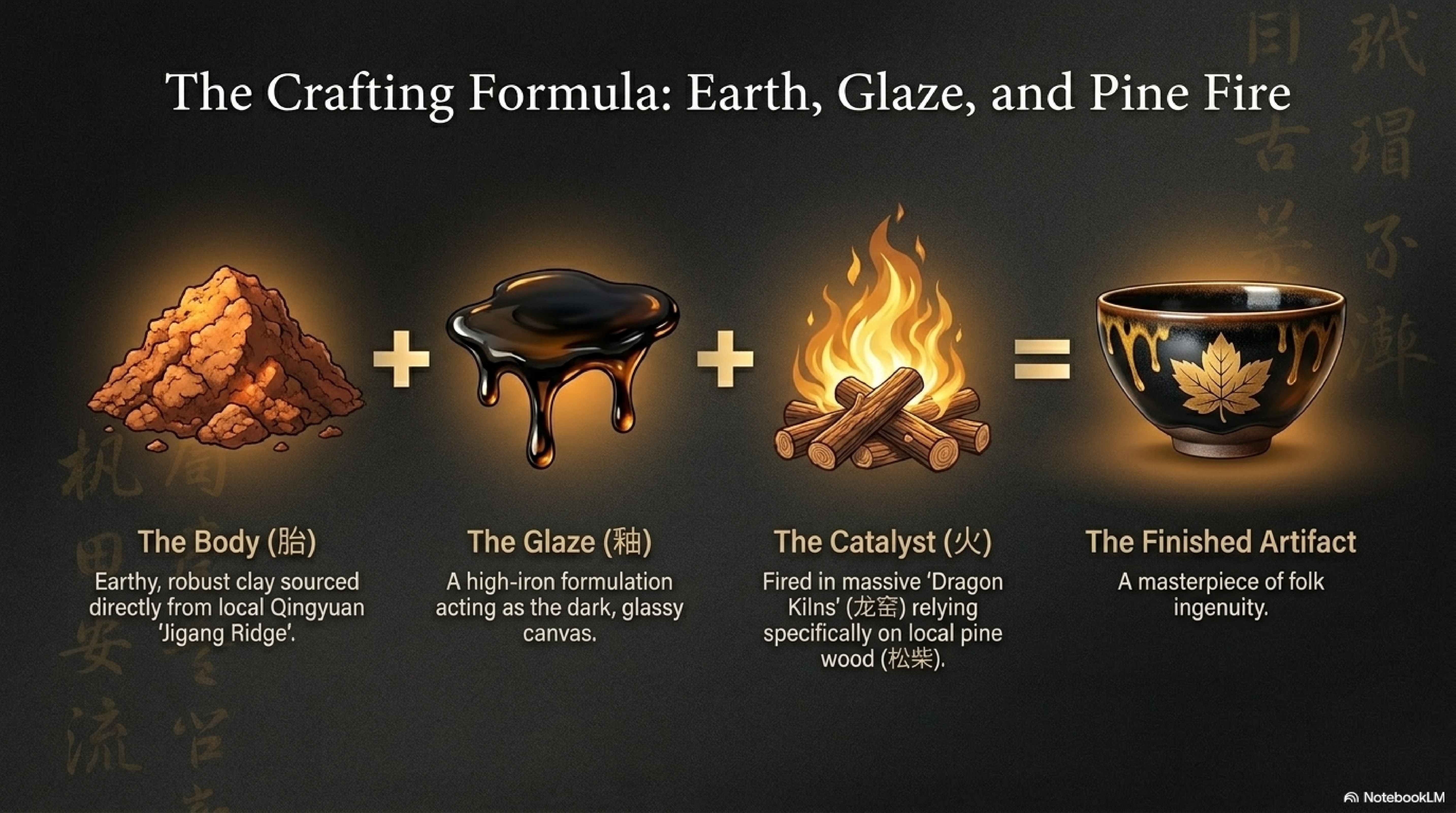
Jizhou's central craft identity is not a single technique but a disposition: the willingness to take materials and processes from daily folk life — a fallen leaf, a paper-cut made for the New Year — and transform them into ceramic decoration through the alchemy of kiln fire.

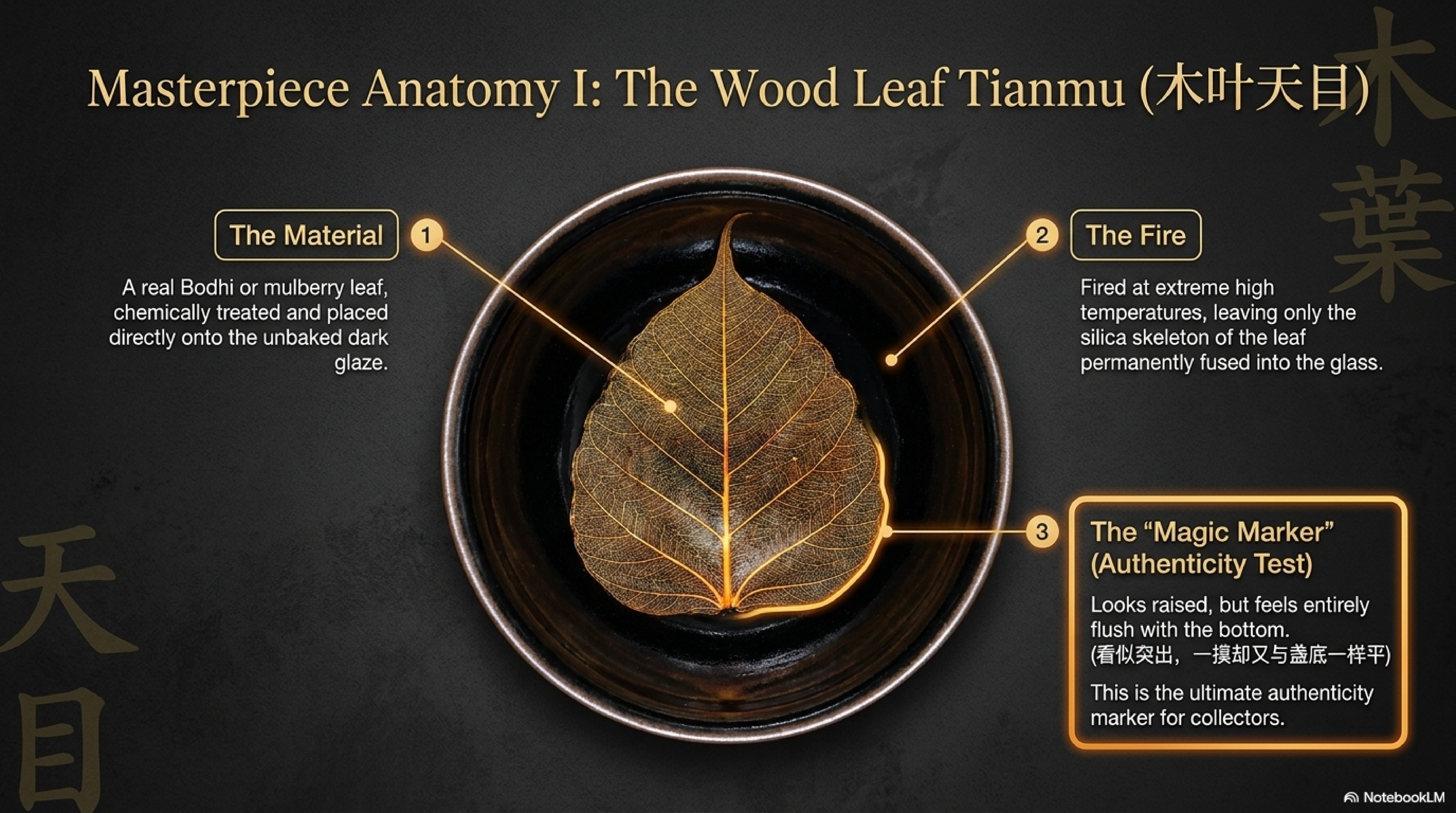
The leaf-pattern temmoku (木叶天目) technique — a real tree leaf pressed onto black-glazed unfired clay before kiln firing at 1300°C

The leaf-pattern technique (木叶天目). A real tree leaf — most commonly from the mulberry or bodhi — is selected, pressed flat, and laid directly onto the unfired black-glazed surface of a bowl. The piece enters the dragon kiln. What emerges is not an imitation of a leaf but the mineral memory of one.

The Leaf Process (木叶天目)

A real tree leaf is pressed flat onto the surface of a black-glazed, unfired bowl. The piece enters the kiln. At 1300°C, the leaf's organic matter burns away completely — but the leaf's silica-rich cellular structure leaves a mineral residue that bonds with the glaze, permanently imprinting the leaf's exact vein network, including capillaries invisible to the naked eye. The finished piece: a black bowl with a golden-brown leaf whose tracery is finer than any brush could draw.

The result can never be exactly repeated — each leaf is unique, and its interaction with the kiln atmosphere determines the final colour (ranging from amber to silver).

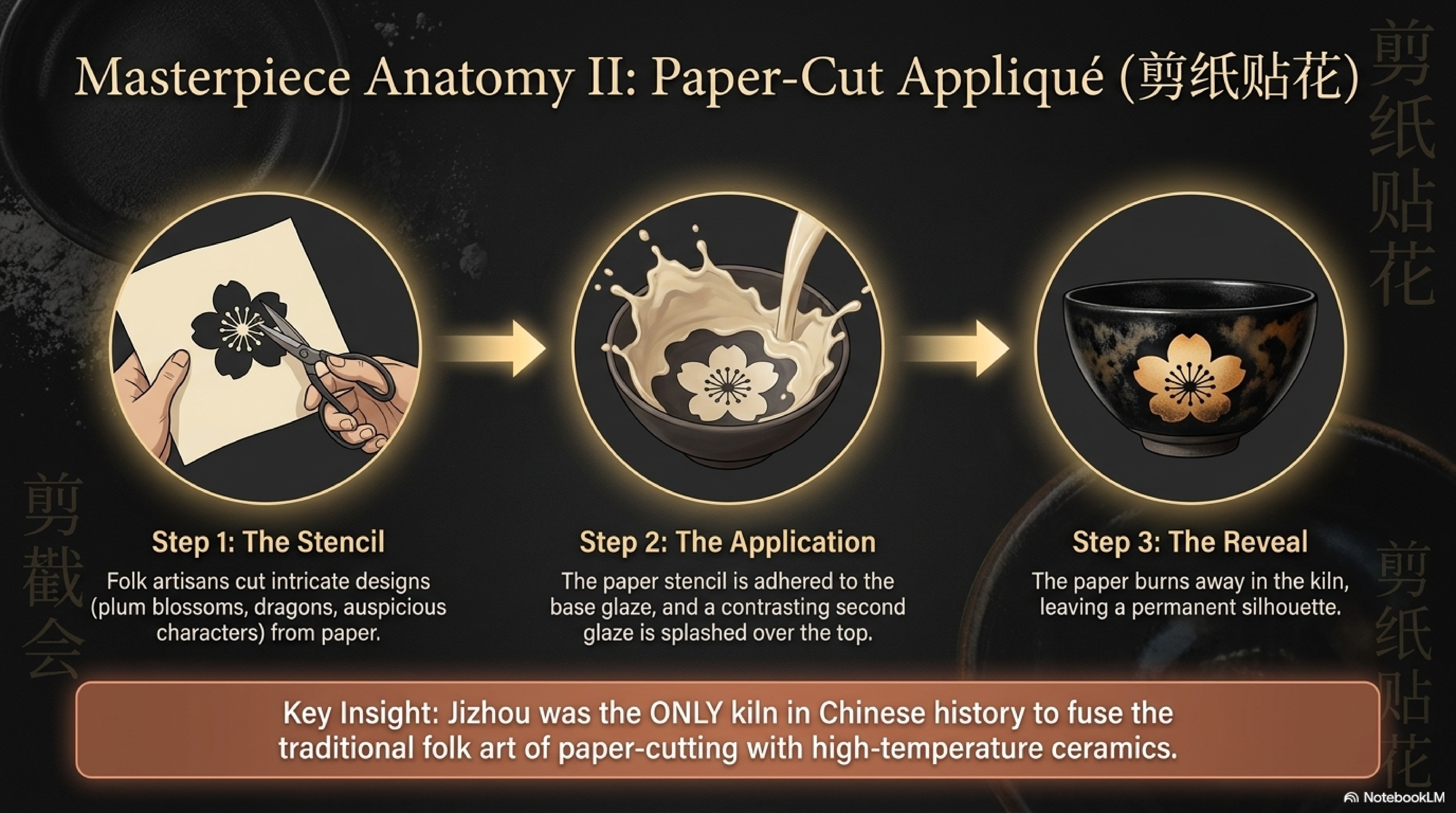
Paper-cut resist decoration (剪纸贴花) — traditional Chinese paper-cut art adapted as a glaze resist on Jizhou ceramics

Paper-cut resist (剪纸贴花). A technique borrowed directly from the folk art of the New Year: the cut paper silhouette is pressed onto the unfired glazed surface, acting as a resist barrier. When the paper is removed before firing, the uncovered area shows the body colour against the glazed ground — white phoenix on black, or black bird on amber tortoiseshell.

Paper-Cut Resist (剪纸贴花)

Chinese paper-cut art (剪纸) — normally made for windows and festivals — is adapted as a glaze resist. The cut paper is pressed onto the unfired glazed surface; glaze is applied over it. When the paper is removed, the uncovered area shows the body colour against the glazed ground. After firing, the paper's silhouette remains in the glaze surface — white bird on a black ground, or white phoenix on amber tortoiseshell.

Tortoiseshell Glaze (玳瑁釉)

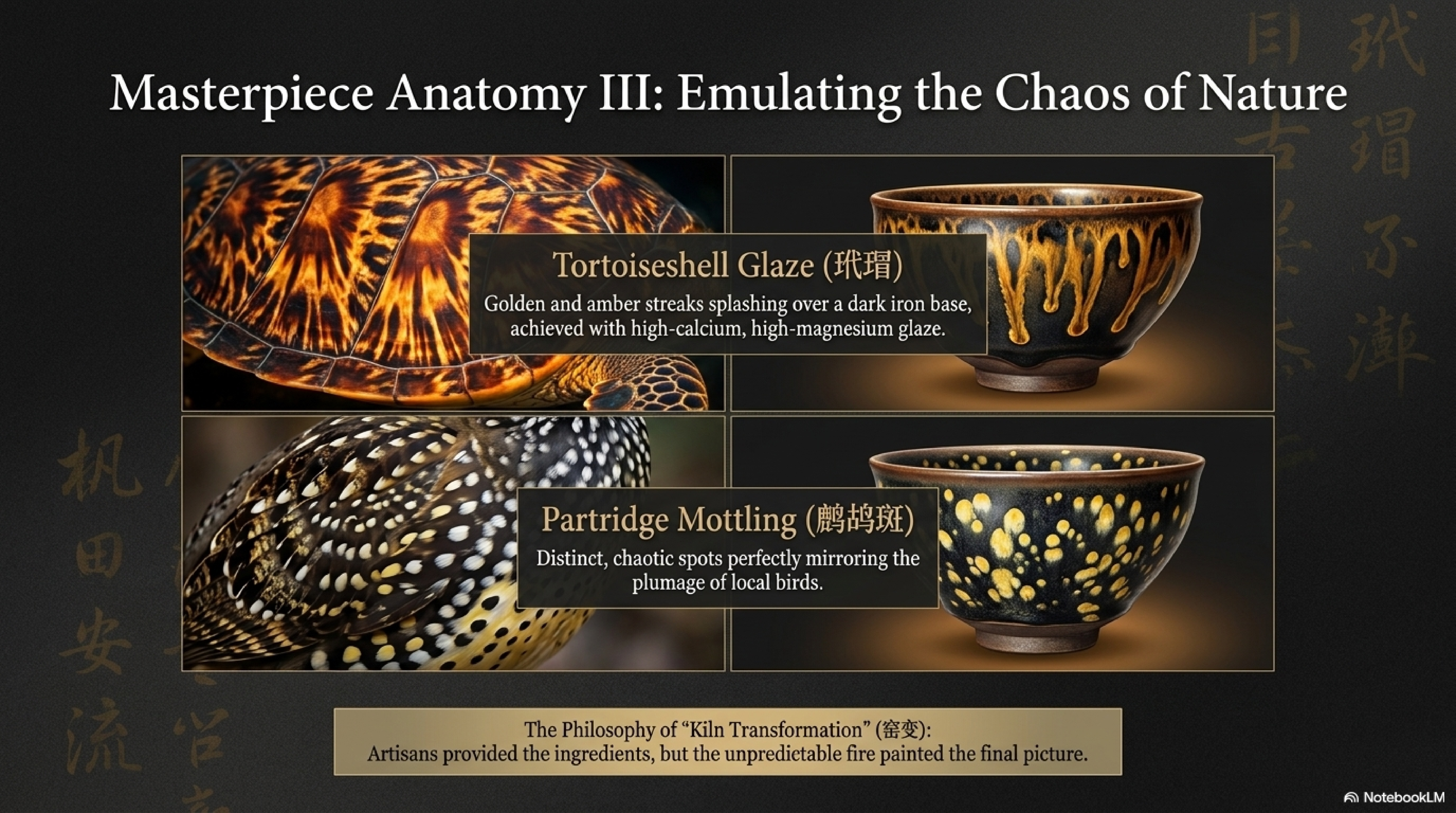
A complex two-layer glaze firing: a base of amber-yellow glaze is applied, then streaks of darker brown-black are added over the top. In the kiln, the layers interact, producing the characteristic mottled yellow-black surface that mimics the shell of the hawksbill sea turtle (玳瑁). The pattern is never fully controllable.

Tortoiseshell glaze (玳瑁釉) close-up — showing the two-layer amber-yellow and brown-black mottled surface formed by glaze interaction in the kiln

Tortoiseshell glaze formation (玳瑁釉). The mottled yellow-black surface is not painted — it is a product of two glaze layers chemically interacting at temperature. The base amber-yellow and the overlay brown-black meet in the kiln and separate according to their differing viscosities, producing a pattern that imitates hawksbill shell but is governed by fire rather than design.

Five Inventions: The Jizhou Decorative Vocabulary

Jizhou's output is unified not by a single glaze type but by a common inventive spirit. Its five primary decorative traditions each represent a distinct category of folk-art translation — each one took something from outside the ceramic world and brought it inside the kiln.

Leaf-Pattern Temmoku 木叶天目 · World-Unique

Real leaves permanently embedded in black glaze. Each piece is unrepeatable. The leaf vein network is rendered at capillary-level precision — finer than any painted equivalent. A world ceramic singularity.

Paper-Cut Resist 剪纸贴花 · Folk Art Ceramicised

Traditional Chinese paper-cut art translated into glaze resist. Silhouettes of birds, phoenixes, flowers, and auspicious characters appear in the glaze surface in the exact negative space left by the removed cut paper.

Tortoiseshell Glaze 玳瑁釉 · The Mottled Luxury

Two-layer firing creates a yellow-black mottled surface imitating hawksbill turtle shell. The interaction of the two glaze layers is partially uncontrollable — each piece is a unique negotiation between the formula and the fire.

Partridge Spot 鹧鸪斑 · The Spotted Pattern

Crystal clusters in the black glaze form layered spots resembling partridge plumage. Less linear than Jian ware's hare's fur; more clustered and varied. Valued for its dimensional depth.

Painted Ware 彩绘 · The Human Story

Underglaze painting in folk styles: children at play, flowers, auspicious motifs, household scenes. Inherits the Cizhou tradition of narrative ceramic surface but with a warmer southern palette and less strict brushwork convention.

Comparison of all five Jizhou decorative types — leaf temmoku, paper-cut resist, tortoiseshell glaze, partridge spot, and painted ware

The five Jizhou types side by side. Each represents a distinct technique but all share the same underlying orientation: folk materials and processes elevated into ceramic form through kiln fire. No other Song kiln operated across this range of decorative invention simultaneously.

Close-up of the leaf pattern in glaze — showing the complete vascular network of the original leaf preserved as mineral residue in the black glaze surface

The leaf vein network at close range. The amber tracery visible on the black glaze surface is not paint — it is the mineral residue of the original leaf's silica-rich cellular structure, fused permanently into the glaze during firing. Secondary and tertiary veins invisible to the naked eye in the original leaf are rendered here in permanent amber, preserved exactly as they were in the living plant.

Reading the Living Surface: Authentication Markers

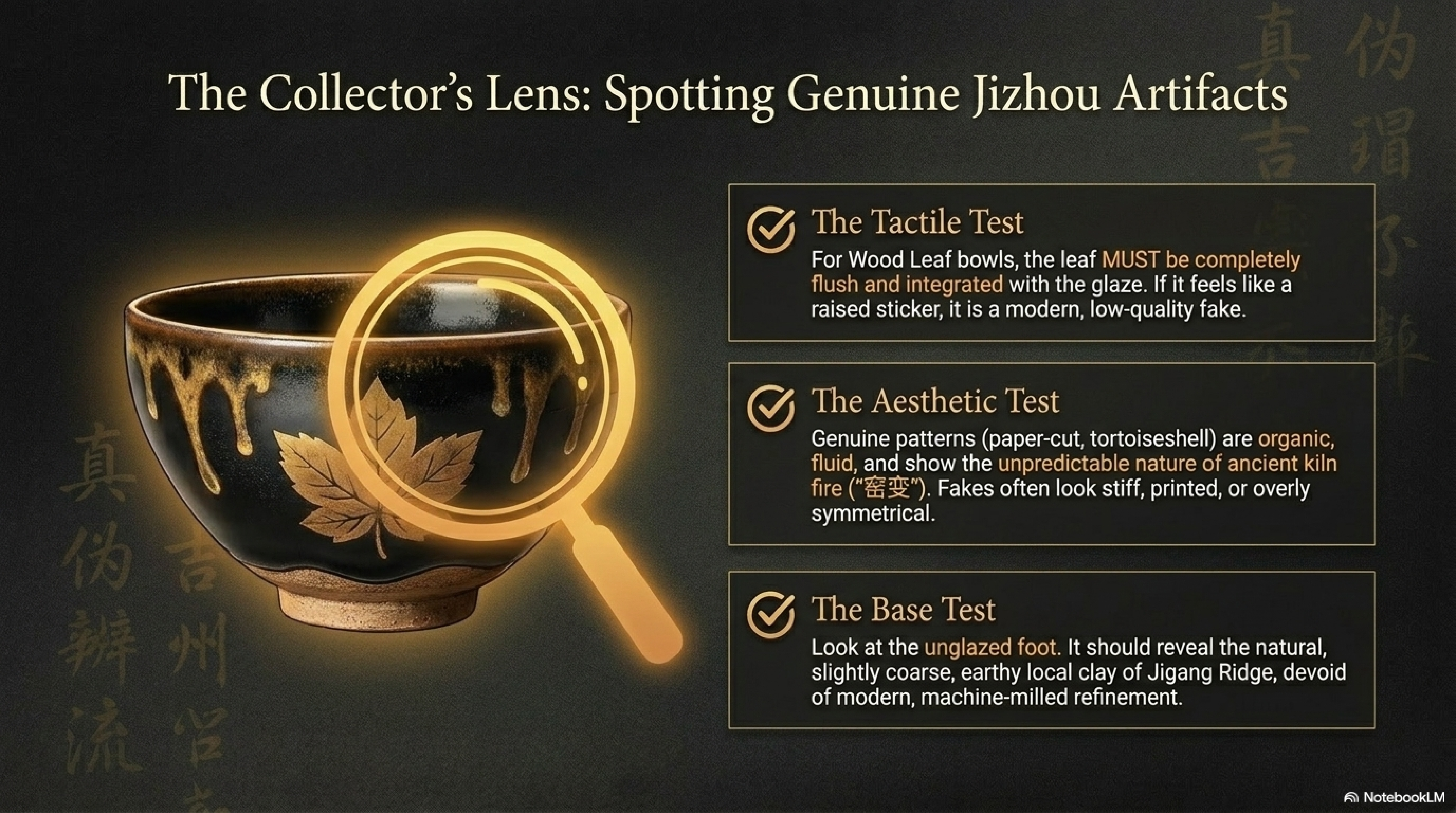
Jizhou's forgeability varies by type. The leaf-pattern temmoku (木叶天目) is the most frequently imitated — it looks extraordinary but the forgery method (hand-painting a leaf pattern) immediately betrays itself under examination. Tortoiseshell glaze fakes are visually closer but typically lack the correct micro-structure.

Leaf vein authenticity test — genuine mineral residue vascular network versus hand-painted forgery with regular, schematic veins

The leaf vein test. Left: a genuine 木叶天目 piece — the vein pattern is flush with the glaze surface and includes secondary and tertiary capillary detail no brush could replicate. Right: a painted forgery — the veins are slightly raised, too regular, and secondary branching is absent or schematic. The tell is immediate under a loupe.

Glaze quality and aging comparison — authentic Jizhou black glaze with centuries of atmospheric micro-patina versus modern fake with artificially dulled surface

Glaze aging. Authentic Jizhou black glaze develops a mellow warmth over centuries of atmospheric exposure — neither glassy nor dull, but living between the two. Modern fakes are either too bright (recently fired, no aging) or artificially deadened with acid washing to remove the glassy sheen — producing a flat, stagnant surface that lacks the inner warmth of genuine aging.

The Kiln That Invented the Possible

The core of Jizhou's legacy is its demonstration that anything could be ceramic decoration — that the boundary between daily life and ceramic art was not fixed. Leaves, paper-cuts, tortoiseshell patterns: none of these had appeared on ceramic surfaces before Jizhou, and most would not appear again after its closure.

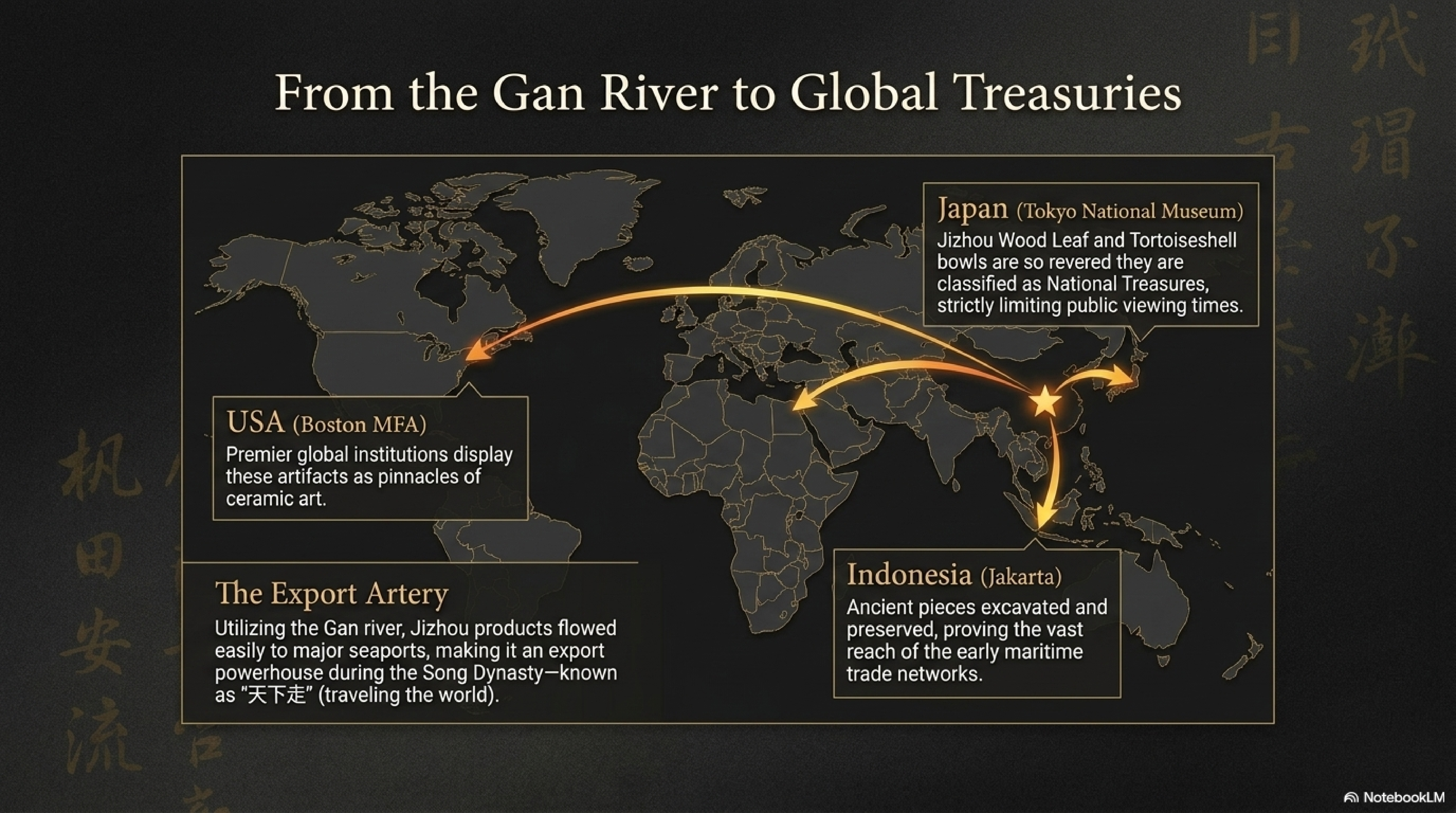
Like Jian ware, Jizhou's black-glaze temmoku bowls were imported and revered in Zen monastery tea culture in Japan. Some leaf-pattern pieces reached Japanese collections, where they were given individual names and kept as national treasures. The legacy of folk innovation — Jizhou's willingness to raid folk craft traditions (paper-cutting, leaf pressing) for ceramic technique — was historically ahead of its time, anticipating by centuries the modernist principle that any material or process can be art material.

Jizhou legacy in Japanese collections — leaf-pattern temmoku bowls revered in Zen tea culture, given individual names and preserved as national treasures

The Japanese reception. Jizhou leaf-pattern temmoku bowls were among the most revered objects in Zen monastery tea culture — prized precisely because no Japanese kiln could replicate the technique. Several pieces in Japanese collections were given individual poetic names and mounted with lacquered storage boxes indicating their status. The same folk kiln that served everyday Song commerce produced objects that became Japanese national treasures.

Archaeological evidence from Yonghe Town excavations — kiln site extent, waster heaps, and the material record of 600 years of production

The Yonghe excavations. Archaeological work at the Yonghe kiln site reveals the physical scale of the operation: multiple overlapping kiln chambers, vast waster heaps stratified across six centuries of production, and tool assemblages demonstrating the breadth of technique in simultaneous use. The site record confirms the historical accounts of a production complex without parallel in Song southern China.

"A leaf fell into the kiln and became eternal."

— On Jizhou's 木叶天目: the simplest possible gesture — pressing a leaf onto wet clay — producing a result that no amount of skilled brushwork could replicate. The natural world as the artist; the kiln as the collaborator; the potter as the arranger.