入窑一色,出窑万彩 · A Thousand Blacks, a Thousand Names
China's supreme iron-glaze tradition. Where tea culture and kiln fire converged to produce surfaces that no other civilization has replicated.
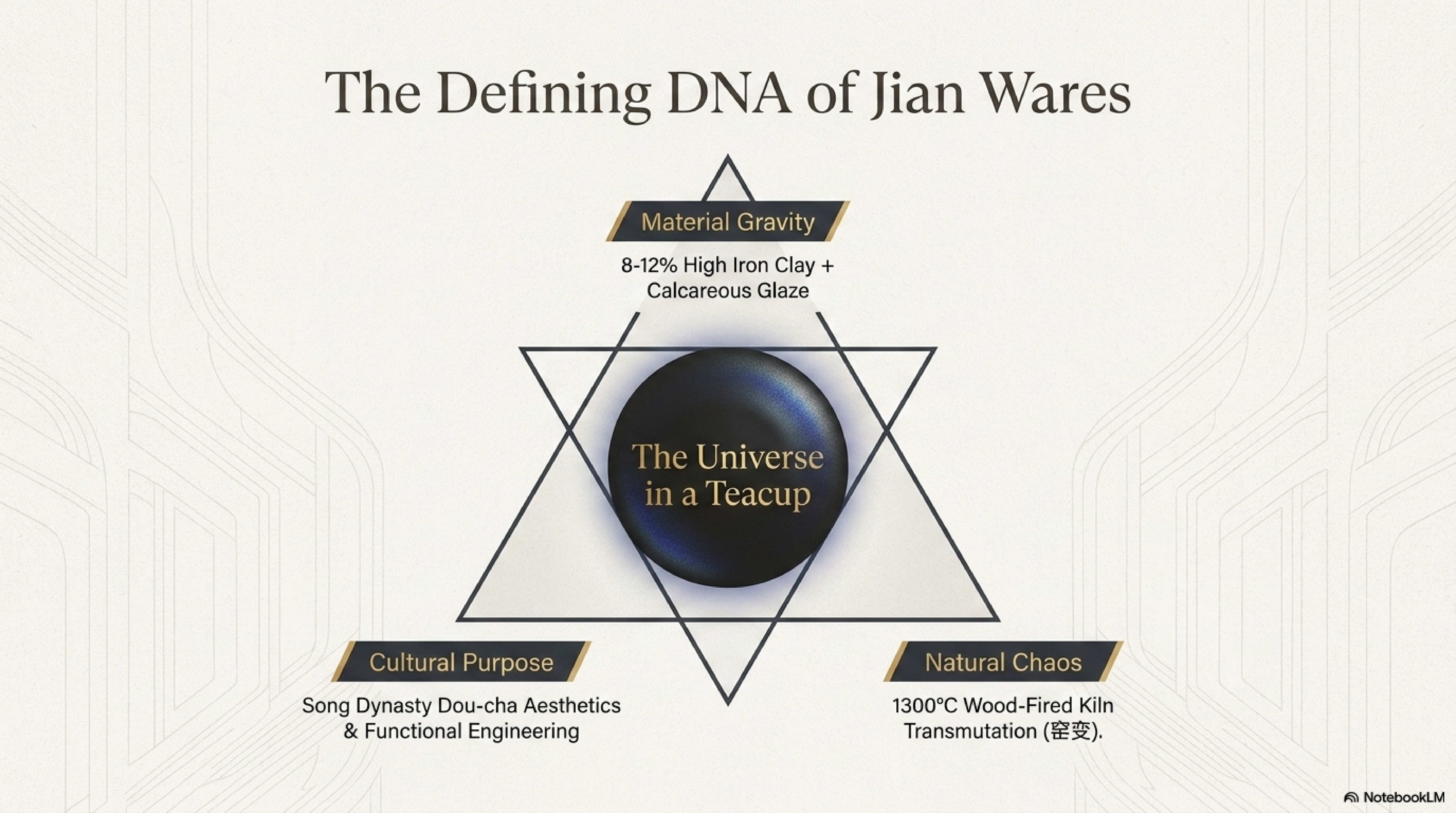
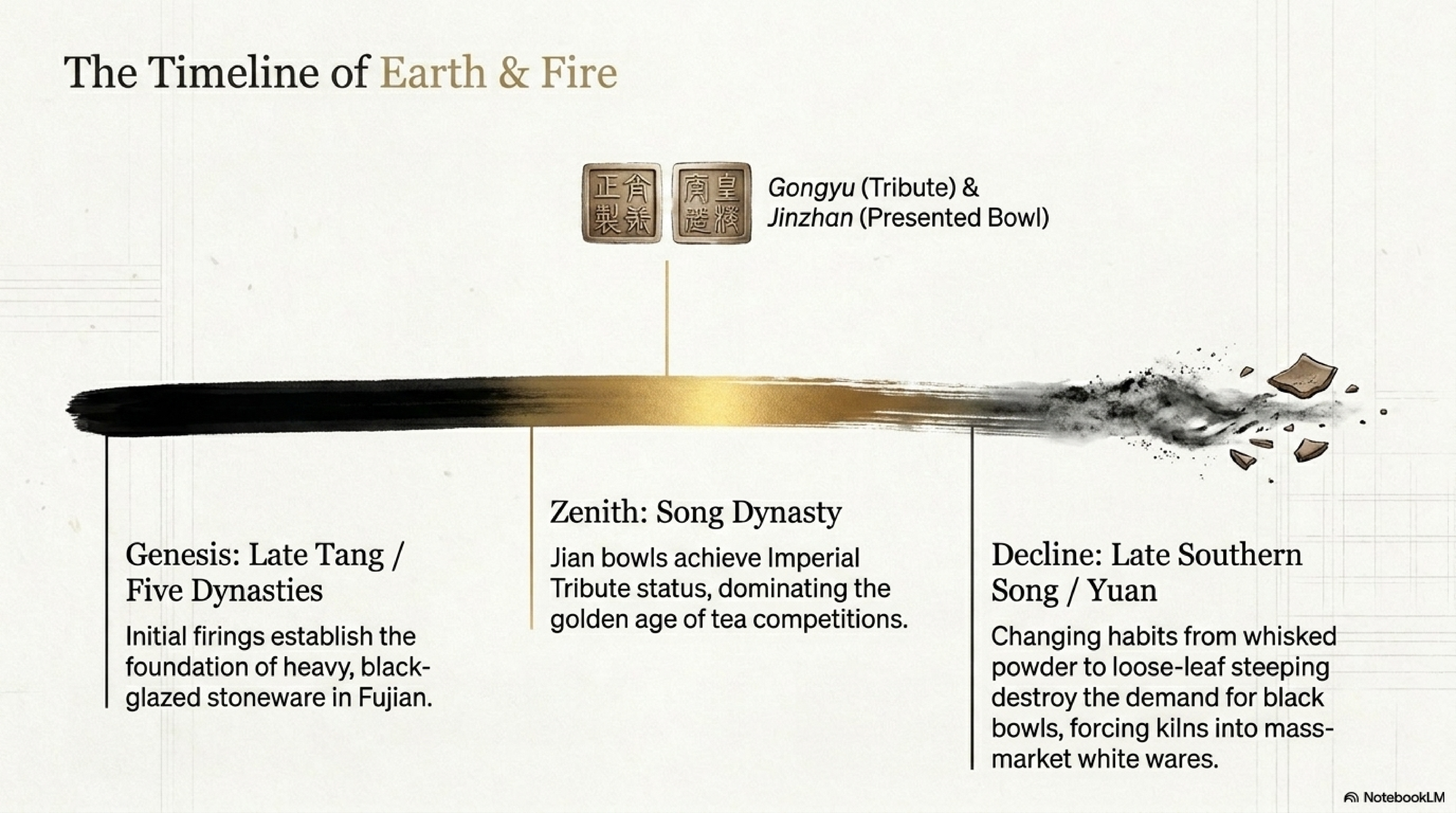
Jian ware is the supreme black-glaze tradition of Chinese ceramics. Born in Fujian Province during the Late Tang, it reached its absolute peak during the Song Dynasty's tea ceremony culture (斗茶). The kilns of Shuiji Town (水吉镇) in Jianyang, Fujian produced a ceramic that was the direct opposite of celadon: where celadon sought jade-like green translucency, Jian ware pursued the deepest, most lustrous black — a surface from which iron crystals would spontaneously emerge during firing to create patterns no artisan could fully control or predict.
Song connoisseurs revered this unpredictability: the kiln gods, not the potter's hand, determined the final surface.
Celadon jade-green. Powder Blue & Plum Green. 1,600 years. UNESCO heritage.
Olive green. Deep blade-carved relief. Northern celadon's undisputed peak.
Black iron glaze. Hare's fur & oil drop. Born for the Song tea ceremony. The subject of this guide.
White ground, black painting. China's greatest folk kiln tradition.
Shadow blue yingqing. White as jade, thin as paper. Jingdezhen's foundation.
"入窑一色,出窑万彩。"
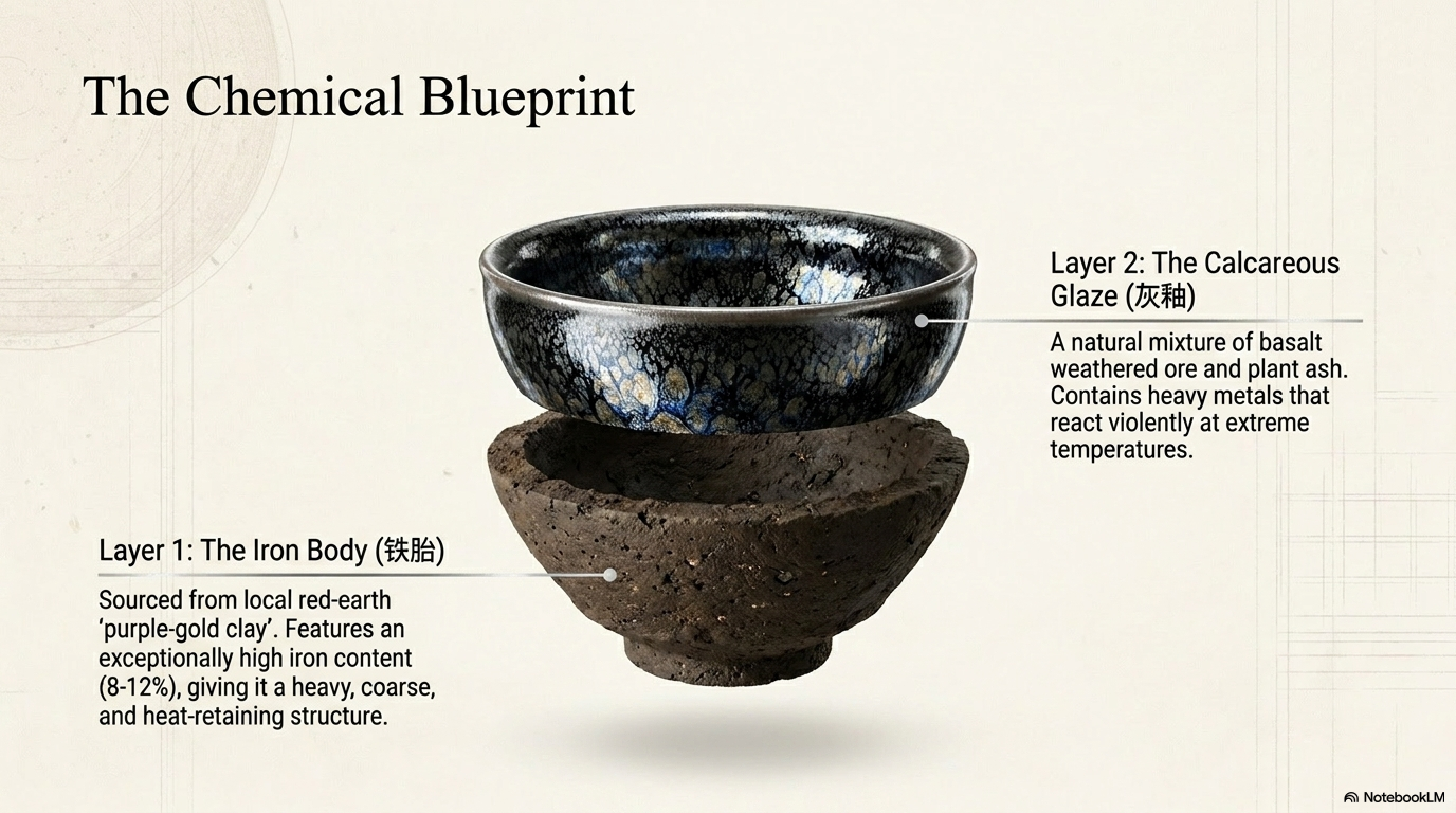
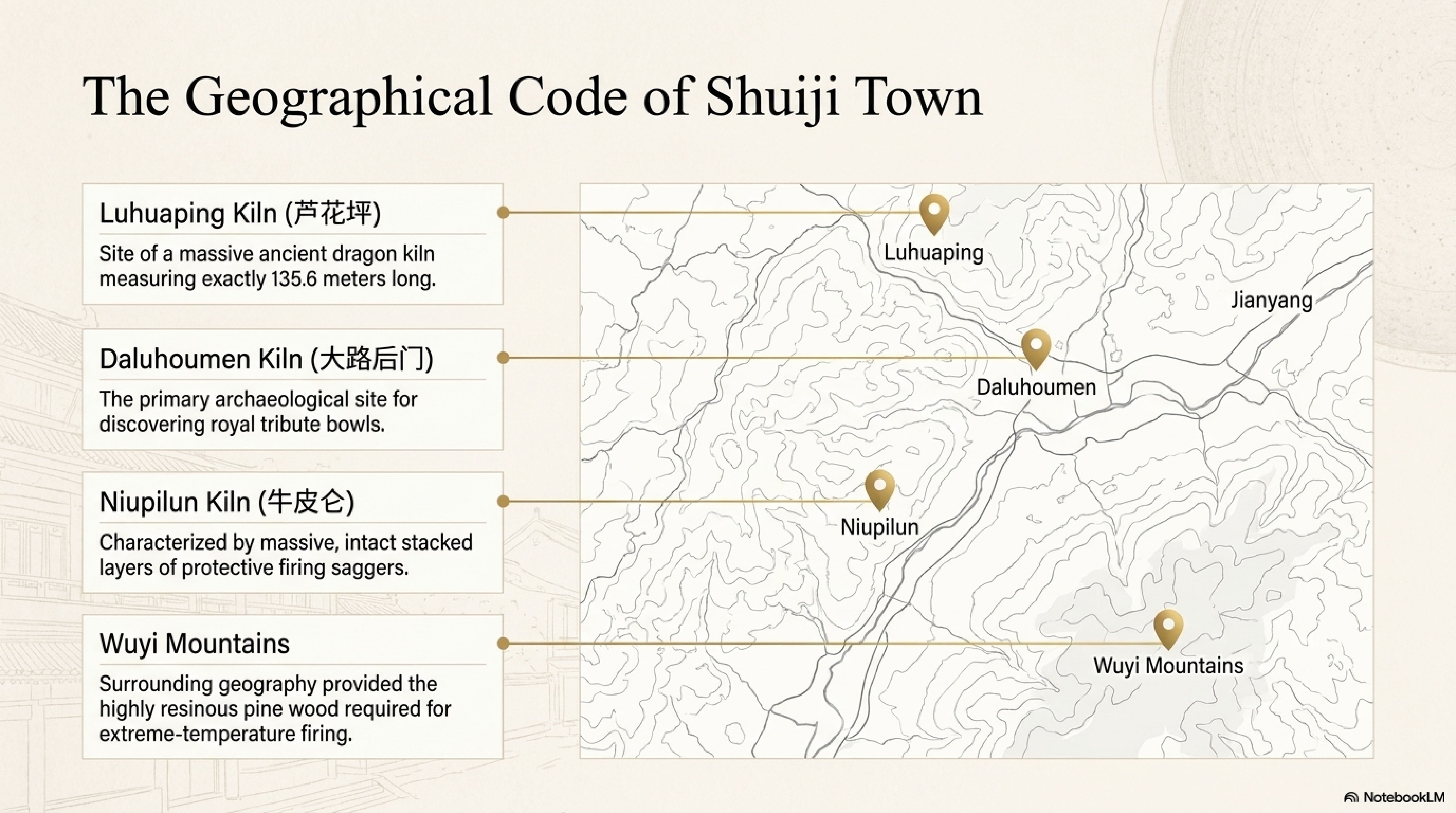
— The definitive description of Jian ware's kiln transformation: "Enter the kiln one colour, leave the kiln ten thousand colours." The single most important phrase in understanding why Song connoisseurs were willing to pay extraordinary prices for pieces that could not be pre-designed.Jian ware takes its name from Jianyang District (建阳区), Nanping City, Fujian Province — specifically the kilns of Shuiji Town (水吉镇). The region's geology was decisive: Fujian's red earth (紫金土) contains 8–12% iron oxide, a concentration far higher than typical ceramic clays. This iron-saturated local material became both the body and the glaze feedstock, giving Jian ware its characteristic metallic density and enabling the crystalline kiln-transformation effects that no other region could replicate.
The Fujian geography. Shuiji Town sits in a river valley ringed by hills of iron-rich red soil (紫金土) — the geological foundation of the entire Jian tradition. This local clay, with its extraordinary iron content, is impossible to substitute: attempts to produce Jian ware using clays from other regions consistently fail to achieve the metallic density and crystallisation depth of authentic Song pieces.
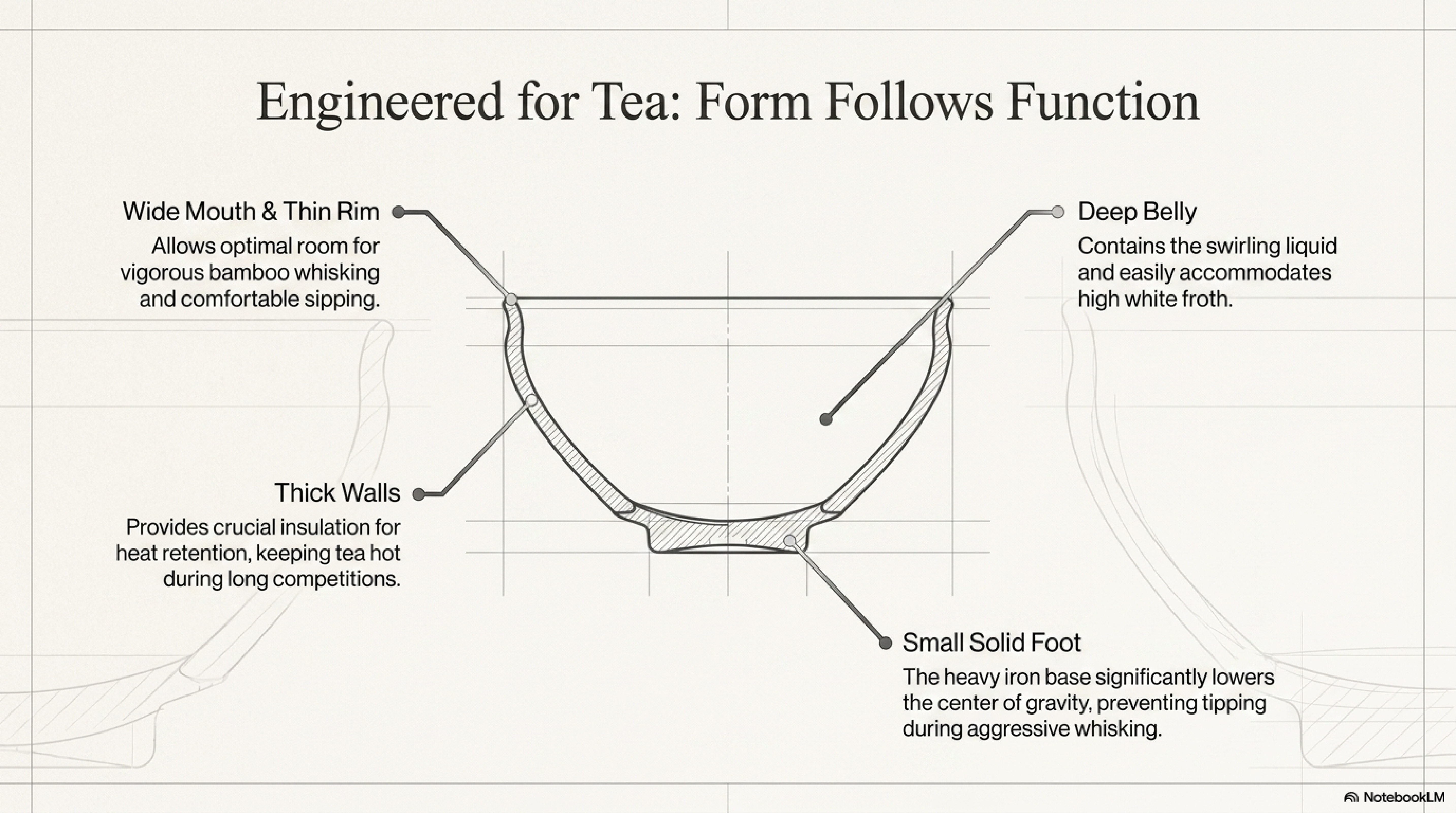
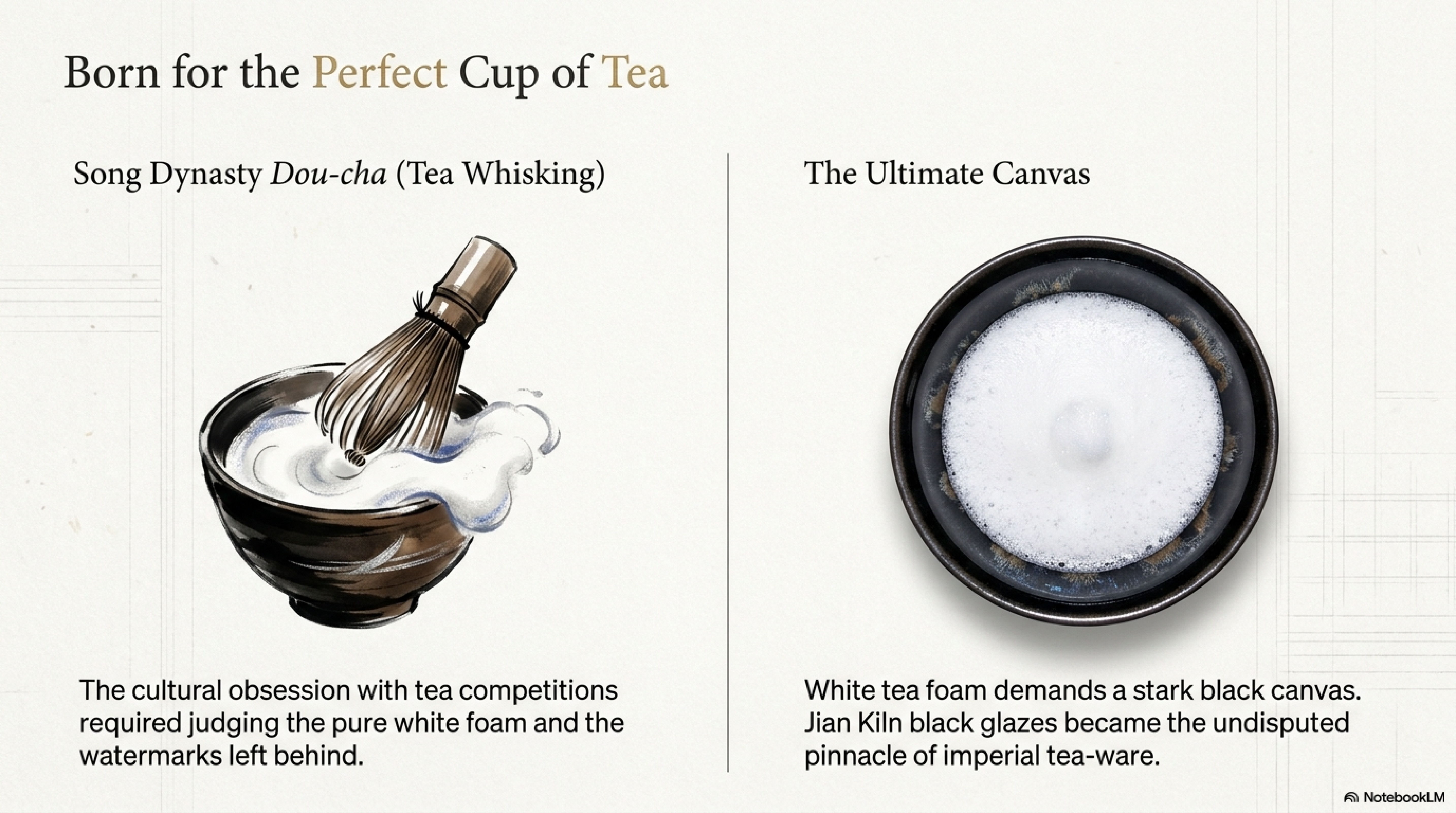
Song dynasty connoisseurs prized white tea (白茶). The black Jian bowl (建盏) provided the perfect dark background against which to evaluate the colour and foam (汤花) of the tea. This ritual competition between tea drinkers was the cultural engine driving Jian ware's imperial status.
The highest-tier Song Jian bowls supplied to court were stamped on the base: "供御" (Imperial Supply) or "进琖" (Presented Bowl). These marks do not appear on commercial production and are among the most diagnostic identifiers of the finest Song tribute pieces.
The iron body (铁胎). Local red soil (紫金土) from the Jianyang hills contains 8–12% iron oxide — an exceptional concentration that fires to a hard, dense, metallic-black body at 1300°C. The result is so dense and iron-rich that striking a finished piece produces a clear metallic ring, distinct from the softer ceramic sound of ordinary high-fired stoneware.
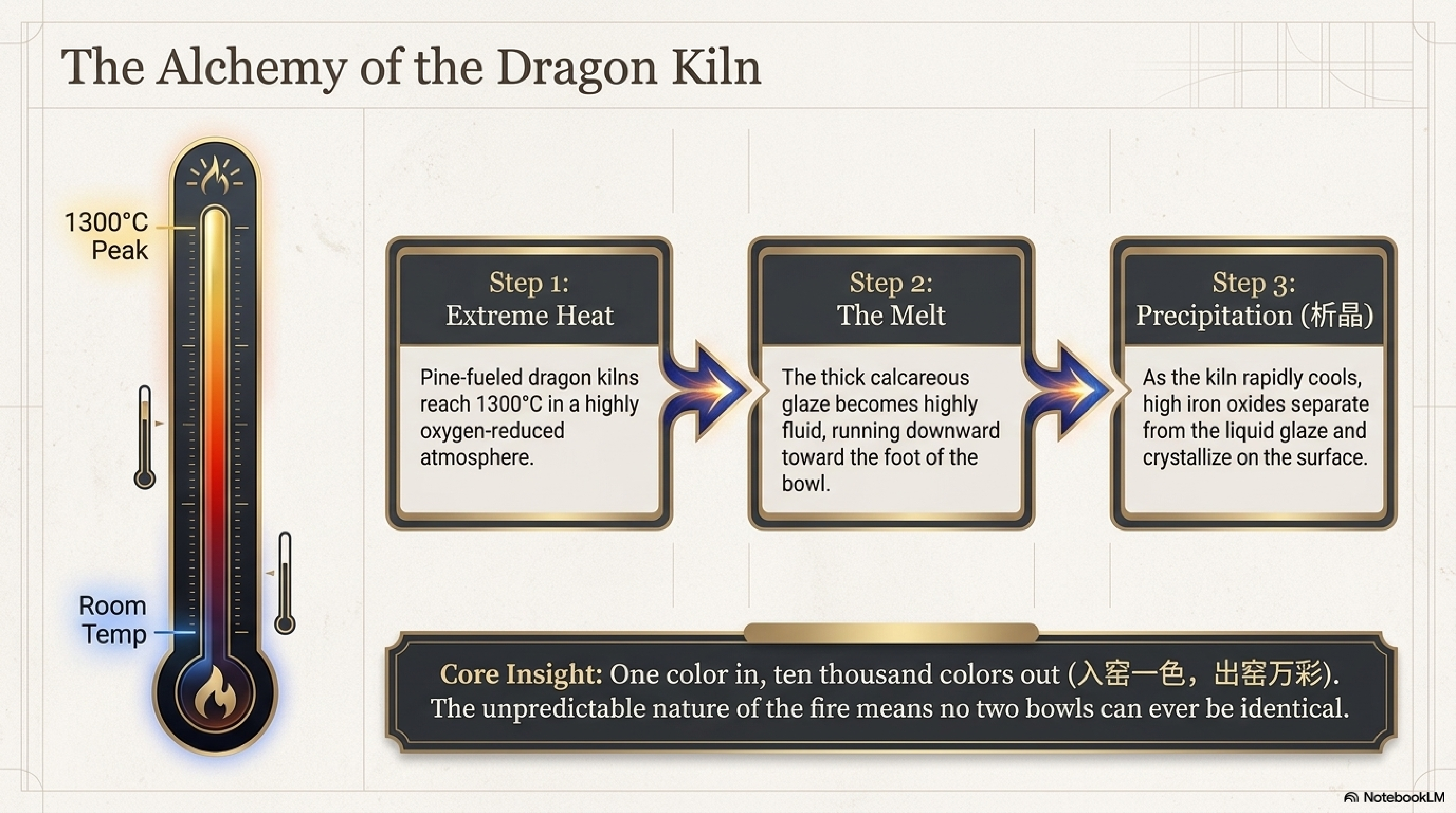
Jian ware's production system was engineered around a single material advantage — Fujian's iron-saturated red earth — and a single firing goal: reaching 1300°C in a vast dragon kiln long enough to allow iron supersaturation to crystallise spontaneously out of the glaze melt. Every technical decision in the process either enables or manages this crystallisation event.
Local Jianyang red earth (紫金土) with 8–12% iron content fires to a hard, dark, metallic density unlike any other ceramic body in the Chinese tradition. Striking a finished piece produces a metallic ring — the reason Song scholars called it "铁胎" (iron body). The body's extreme density is a direct result of the high iron content and peak firing temperature; it provides the structural mass that allows the bowl to retain heat during the tea ceremony.
A high-iron crystalline lime glaze (析晶釉). Raw materials: weathered basalt mineral (乌金釉石) combined with plant ash. The glaze is supersaturated with iron — at peak temperature, excess iron crystallises out of the glaze melt, forming the surface patterns. The potter controls only the base chemistry; the specific crystal pattern that emerges is determined by firing conditions the potter cannot fully govern.
The longest known ancient dragon kiln in China — 135.6 metres excavated at Shuiji — was capable of firing thousands of pieces in a single operation. Temperature reached approximately 1300°C. Pieces were fired upright (正烧法) inside saggars (匣钵) to protect them and direct glaze flow downward under gravity. The exterior of each bowl received only half-glaze to prevent adhesion to kiln furniture during firing.
The crystallisation mechanism. At 1300°C, the iron-supersaturated glaze melt reaches a threshold where dissolved iron can no longer remain in solution — it precipitates as crystalline iron compounds (primarily hematite and magnetite) on the glaze surface. The size, density, arrangement, and metallic sheen of these crystals are governed by temperature gradient, kiln atmosphere, firing duration, and the piece's precise position within the kiln — variables that cannot be precisely controlled by human hands.
The dragon kiln (龙窑) structure. The Shuiji kiln's 135.6-metre length allowed a single firing to include thousands of pieces at different temperature zones simultaneously. Pieces fired closer to the firebox experienced higher temperatures and different atmospheric conditions than those near the exhaust — producing different crystal patterns from the same glaze batch. This variation was not a flaw but an intrinsic feature of the tradition's aesthetic.
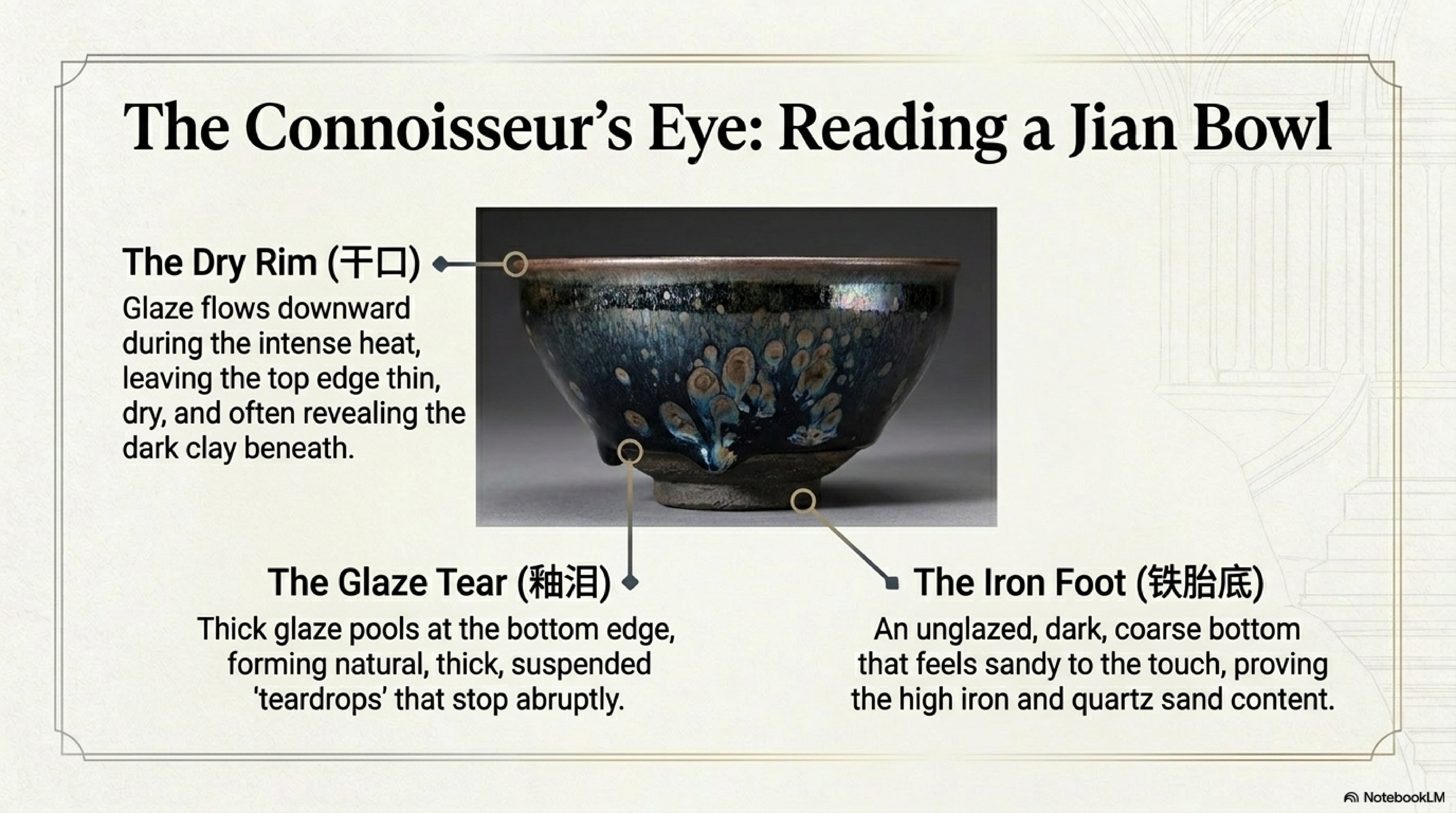
Glaze tears (釉泪). At 1300°C, the iron glaze becomes highly fluid and flows downward under gravity toward the foot. The kiln worker must position the piece so the glaze pools but does not reach and bond to the kiln furniture below. This controlled glaze flow leaves the characteristic pooled drips — "glaze tears" — near the foot rim that are one of the most reliable physical markers of genuine high-fired Jian production.
Jian ware types are classified entirely by their kiln-transformation surface patterns (窑变). The potter determines only body and glaze; everything else is decided by fire. This classification system — from the ubiquitous to the near-mythical — is the essential vocabulary of Jian ware collecting.
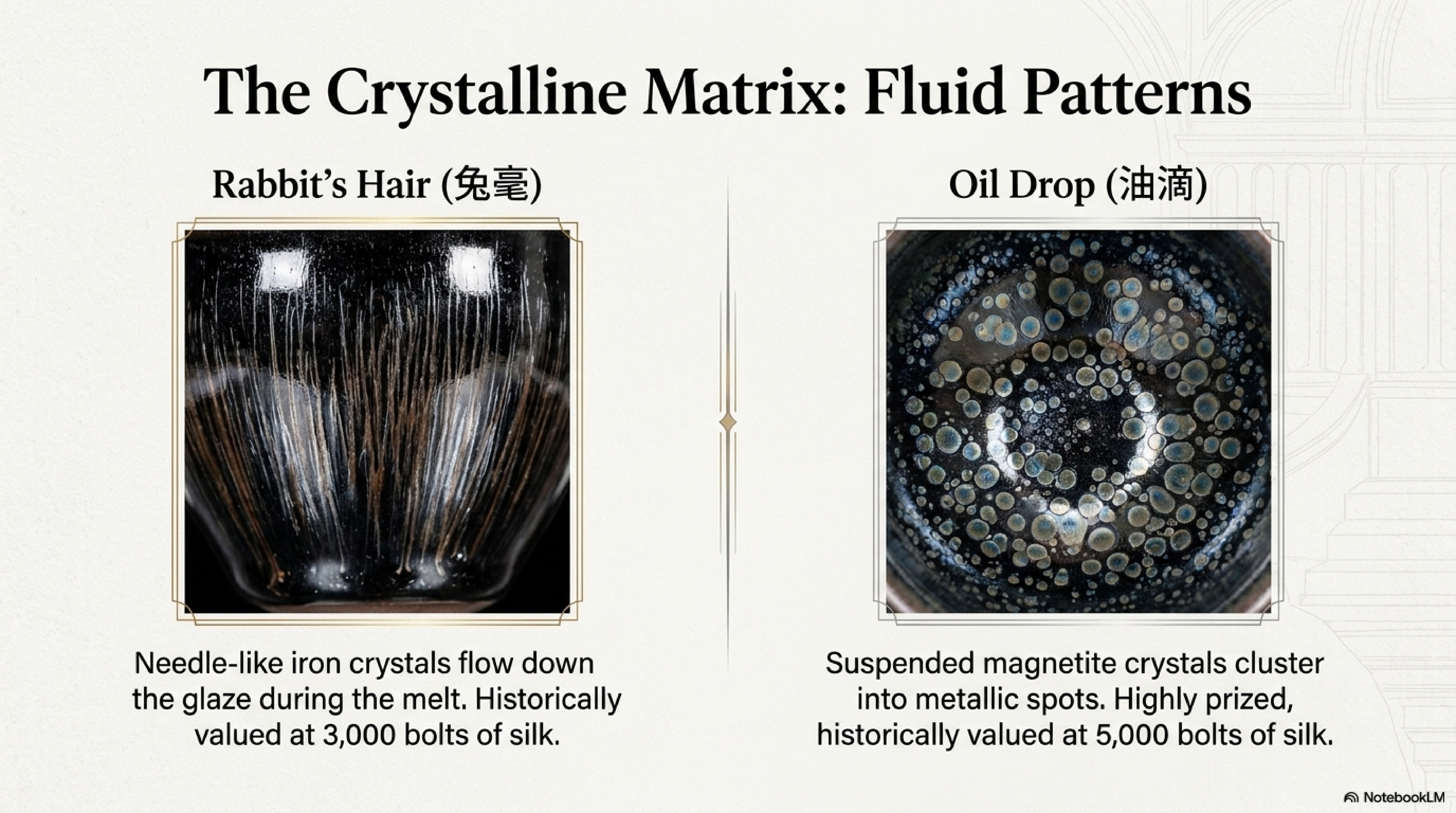
The most common and the baseline of the tradition. Rain-streak iron crystals radiate from centre to rim, resembling rabbit fur. Gold Hare's Fur (金兔毫) and Silver Hare's Fur (银兔毫) variants differ in crystal metallic tone. All authentic Song pieces should show at least trace hare's-fur activity.
Circular iron-crystal spots distributed across the glaze surface, resembling oil droplets on water. The crystals carry strong metallic lustre. Much rarer than hare's fur; commands a significant premium. The circular form results from different crystallisation dynamics than the streak formation of hare's fur.
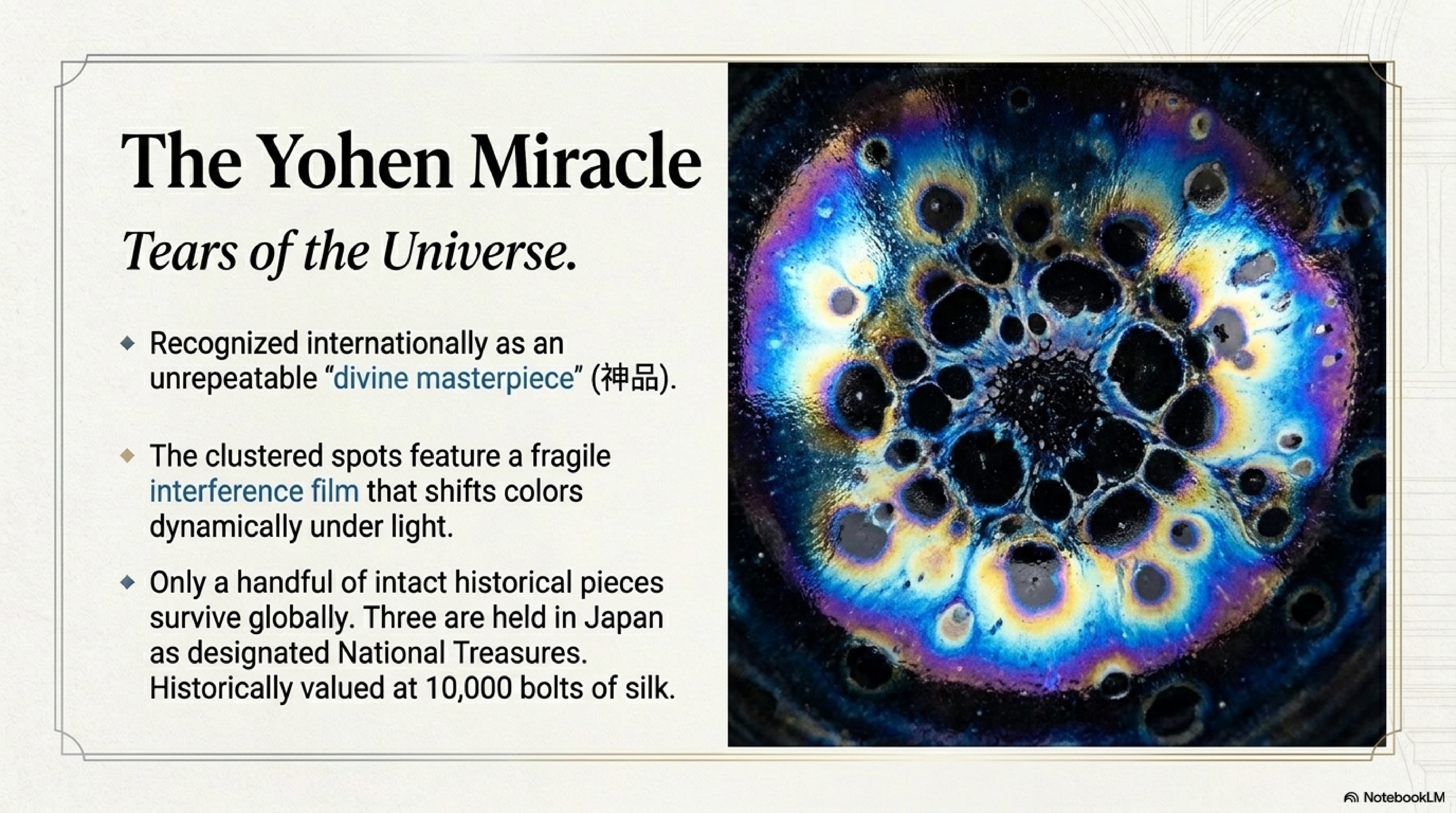
The rarest and most celebrated ceramic surface in Chinese and Japanese history. Concentric ring-shaped crystal clusters surrounded by iridescent haloes of blue, purple, and gold — a structural colour phenomenon, not pigment. Only a handful of authenticated Song examples survive, most now in Japan. The Song court and Japanese connoisseurs classified it as 神品 (divine grade).
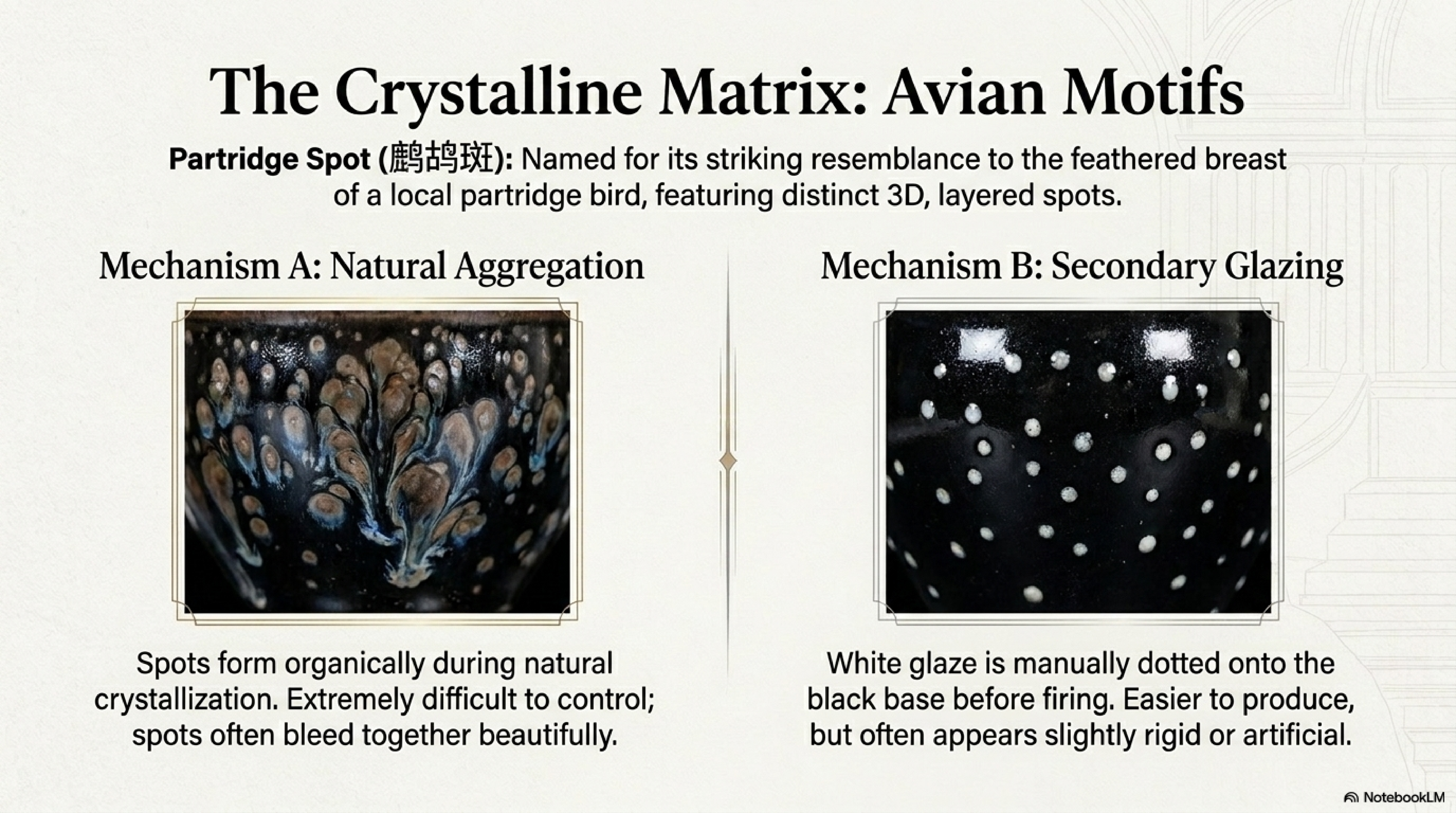
Crystal patterns resembling the layered spots of a partridge's plumage. High contrast, variable scale, strong dimensional quality. Named after the bird (鹧鸪) by Song connoisseurs who saw its feather pattern in the glaze surface.
No crystal pattern whatsoever. A perfectly uniform, deeply lustrous black — the opposite of the kiln-transformation aesthetic. Pure, unvarying, lacquer-like depth. Valued for its severity and technical precision: achieving perfect uniformity in an iron glaze at 1300°C requires complete control of atmosphere and temperature.
The five surfaces of black. From left: Hare's Fur (兔毫) — streak crystals, the baseline; Oil Drop (油滴) — circular crystal spots, rarer and more valued; Yohen (曜変) — iridescent ring clusters, near-mythical; Partridge Spot (鹧鸪斑) — high-contrast plumage pattern; Black Gold (乌金) — no crystallisation, pure uniform depth. Each represents a different outcome of the same iron-glaze chemistry under different kiln conditions.
Yohen (曜変) in close-up. The iridescent haloes surrounding each crystal cluster are not pigment — they are structural colour, produced by thin-film interference in the glaze matrix surrounding the iron crystal. The colour shifts with viewing angle, similar to the iridescence of an oil film on water but physically embedded in the ceramic glaze. This mechanism was not understood by Song connoisseurs, who attributed the effect to supernatural intervention — hence the classification as 神品 (divine grade).
Jian ware is extensively forged. The primary modern forgeries fall into two camps: pieces with chemically applied surface patterns (missing the structural depth of genuine kiln crystallisation) and pieces with electric-kiln firing (wrong body density, wrong glaze viscosity). Authentication requires reading a convergence of physical tells — no single marker is definitive alone.
Iron body (铁胎) identification. The foot rim of authentic Jian ware is the first place to examine: rough to the touch, dark brown to near-black in colour, and visibly dense. Tapping produces an immediate, clear metallic ring. Forgeries using ordinary stoneware clay feel lighter and sound duller; those using modern high-iron clay may achieve the right colour but fall short on density — the consequence of insufficient firing temperature or shorter firing duration.
Glaze tears (釉泪) and kiln crystallisation depth. The glaze pooling near the foot is a physical record of the 1300°C firing: highly fluid iron glaze flowing downward under gravity and being arrested just before it touched the kiln furniture. The depth of crystallisation — visible in cross-section under magnification — shows the three-dimensional structure of genuine kiln-transformation crystals embedded in the glaze matrix, not painted onto its surface.
Crystal depth versus painted surface. Left: authentic Song Jian hare's-fur crystals, photographed in cross-section — the iron structures extend into the glaze matrix, have visible internal crystal geometry, and produce different optical effects at different viewing angles. Right: a modern forgery with chemically applied pattern — flat, uniform distribution, no internal structure, no optical shift with viewing angle. The difference is immediate under any magnifying lens of 10× or greater.
Jian ware's paradox: it was the most culturally specific of all Song kilns — tied directly to 斗茶, a practice that disappeared after the Song — yet it achieved the most internationally enduring legacy of any Song ceramic form. After the collapse of the Song court and the end of 斗茶, Jian ware ceased to be produced in quantity. But in Japan, it had already become something else entirely.
Japanese Zen monasteries had imported Jian bowls (called 天目茶碗, Tenmoku) from the Song court. The term "Tenmoku" derives from 天目山, a mountain in Zhejiang Province where Japanese monks studying at Chinese monasteries first encountered the bowls and brought them back. In Japan, the black tea bowl became central to Zen tea ceremony practice — not the competitive 斗茶 of the Song, but the meditative chanoyu that would define Japanese aesthetics for centuries.
Korea similarly imported and revered Jian bowls during the Goryeo period, though the Japanese preservation record is more complete. The three surviving authenticated Yohen (曜変) examples are all in Japan, and all three are designated National Treasures (国宝) — the highest cultural property classification in the Japanese legal system.
Japanese Tenmoku reverence. The three surviving Song Yohen bowls — held in collections in the Tokyo metropolitan area — are among the most closely guarded objects in Japanese cultural heritage. Each is a National Treasure (国宝). They are rarely displayed publicly; when they are, it is considered a major cultural event. Their survival in Japan is a direct result of the Zen monastery import network of the Southern Song period: they left China precisely because the Song court considered them supreme, and Japanese monks were paying extraordinary prices to acquire them.
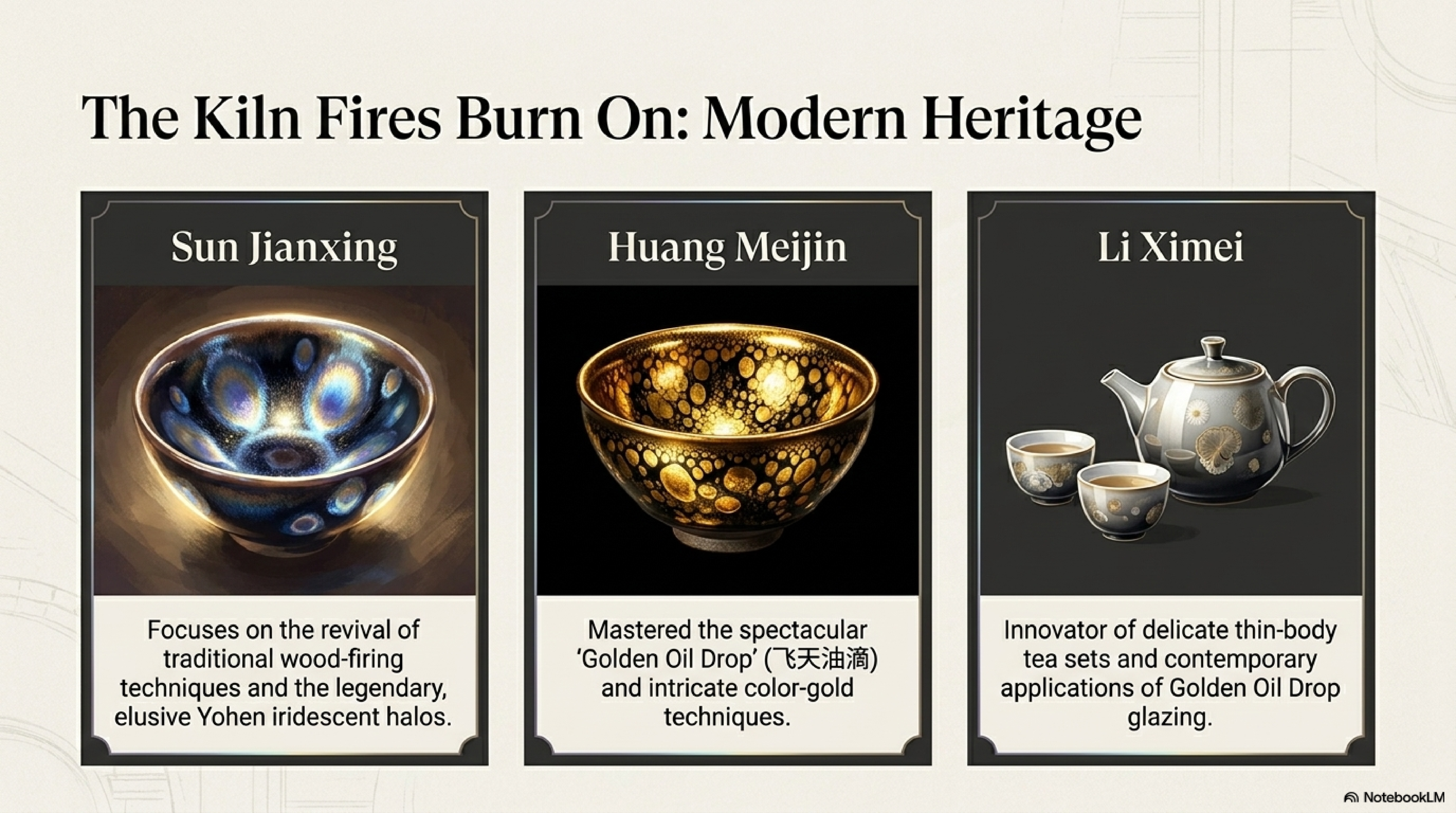
The complete legacy. Jian ware's trajectory: from the iron-red hills of Fujian to the Song imperial tea table, from there to Japanese Zen monasteries, and finally into the collections of Japanese imperial culture as National Treasures. Modern Jianyang has attempted to revive the tradition using computer-controlled kilns and spectroscopic analysis of Song originals — producing technically accomplished hare's-fur and oil-drop pieces — but no contemporary kiln has produced an authenticated Yohen. The variables remain beyond reliable replication.
"The kiln, not the potter, was the artist."
— On Jian ware's irreducible randomness: even today, with modern chemistry and computer-controlled kilns, no one has reliably reproduced an authenticated Song Yohen. The variables that produced the three surviving examples — specific Fujian ore composition, exact kiln position, precise firing atmosphere — remain beyond complete scientific replication.