雨过天晴云破处,便是汝窑天青色
Where the sky breaks through the clouds after rain — that is the sky-blue of Ru
Ranked first among the Five Great Kilns. Active for only 20 years.
Fewer than 100 authenticated pieces survive in the world.
Among the Five Great Kilns of the Song Dynasty — Ru, Guan, Ge, Jun, and Ding — Ru occupies an uncontested apex. The phrase 汝窑为魁 ("Ru Ware is Chief") has been the settled verdict of Chinese connoisseurs since the Ming Dynasty. It is not a matter of aesthetics alone. It is a convergence of rarity, chemistry, imperial patronage, and a golden age that lasted barely a generation before vanishing entirely.
Ru ware is the ceramic embodiment of Song Dynasty aesthetics: restrained, luminous, and seemingly effortless. Its sky-blue glaze, jade-like warmth, and signature crackle network represent the highest realisation of the Song ideal — objects that look like nature rather than craft. To understand Ru is to understand why Chinese collectors have placed it above all others for five centuries.
Sky blue tiānqīng glaze. Agate-enriched formula. Fewer than 100 authenticated pieces survive. Produced for only 20 years at Baofeng, Henan. The subject of this guide.
Celadon & pale blue. The sole kiln built as a royal institution from day one. Distinguished by its thick glaze, ice crackle, and Purple Mouth Iron Foot.
Crème & grey. Gold-wire-and-iron-wire crackle glaze. The kiln's precise location remains unconfirmed by archaeology.
Vibrant purple & sky blue. Copper-based yaobian glaze. Unpredictable colour-play fired at high temperature.
Pure white & ivory. High-fired porcelain with elegantly carved and moulded decoration. Produced across a wide range of forms.
"汝窑为魁,色近雨后天青,温润如玉,不可多得。"
— Ming connoisseur literature establishing the hierarchy of the Five Great Kilns: "Ru is the chief. Its colour resembles the sky after rain — warm and jade-like. It cannot often be obtained."The story of Ru ware is defined as much by what it is not as by what it is. It is not a vast kiln tradition spanning centuries. It is the concentrated output of a single brief window — approximately 1086 to 1125 CE — under Emperors Zhezong and Huizong at the Northern Song court.
The primary production site for Official Ru ware (汝官) is the Qingliangsi kiln complex at Baofeng County, Henan Province (宝丰县大营镇清凉寺). The site was identified archaeologically in 1987 and confirmed by excavation, ending centuries of scholarly speculation about the kiln's location. A secondary site at Zhangguanxiang, Ruzhou City (汝州市张公巷) produced related wares.
The kilns were operated under direct imperial commission. The court at Bianjing (modern Kaifeng) specified the aesthetic — sky blue, crackle, minimal form — and Baofeng's master craftsmen delivered. When the Jin Dynasty armies swept south in 1127 and ended the Northern Song, production ceased permanently. No later kiln ever successfully reproduced the Baofeng formula.
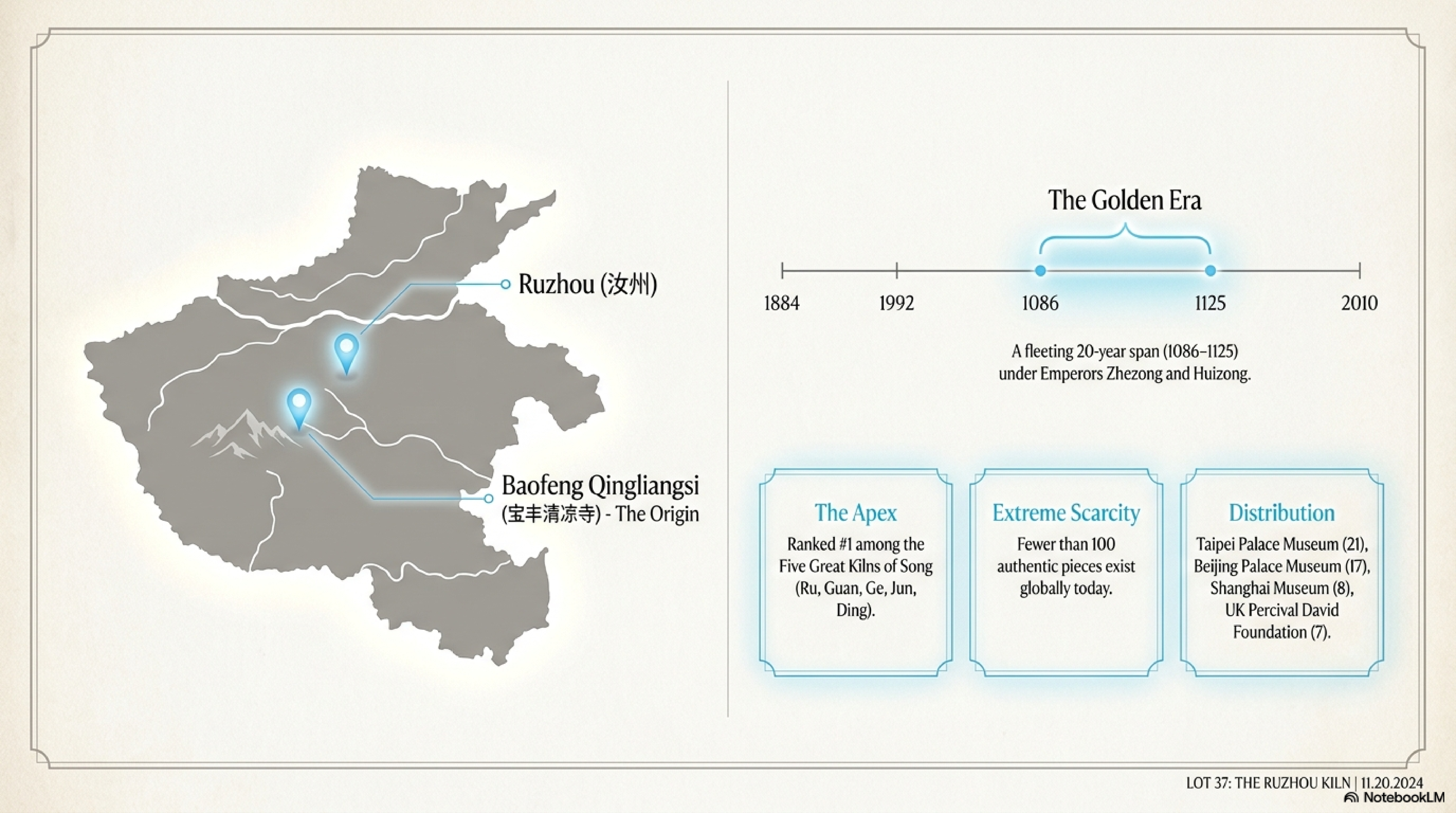
The Ru ware production region in Henan Province. The core Official Ru site at Baofeng Qingliangsi (宝丰清凉寺) was confirmed by excavation in 1987. A secondary production site was later identified at Zhangguanxiang, Ruzhou (汝州张公巷). The Golden Era spans barely 20 years — 1086 to 1125 CE.
The institutional distribution of surviving authentic pieces tells the story of eight centuries of imperial collecting: the Taipei Palace Museum holds 21 pieces, the Beijing Palace Museum 17, the Shanghai Museum 8, and the Percival David Foundation in London 7. Private hands hold the remainder — a scattering of objects that collectively represent one of the rarest artifact categories in human history.
"纵有家财万贯,不如汝瓷一片。"
— Popular Song Dynasty saying: "Better to possess a single shard of Ru ware than ten thousand in gold and silver." The rarity was understood even at the time of production.Not everything produced in the Ruzhou region is "Ru ware" in the collector's sense. The term encompasses two distinct production traditions with fundamentally different purposes, aesthetics, and values. Understanding the difference is essential before examining any piece.
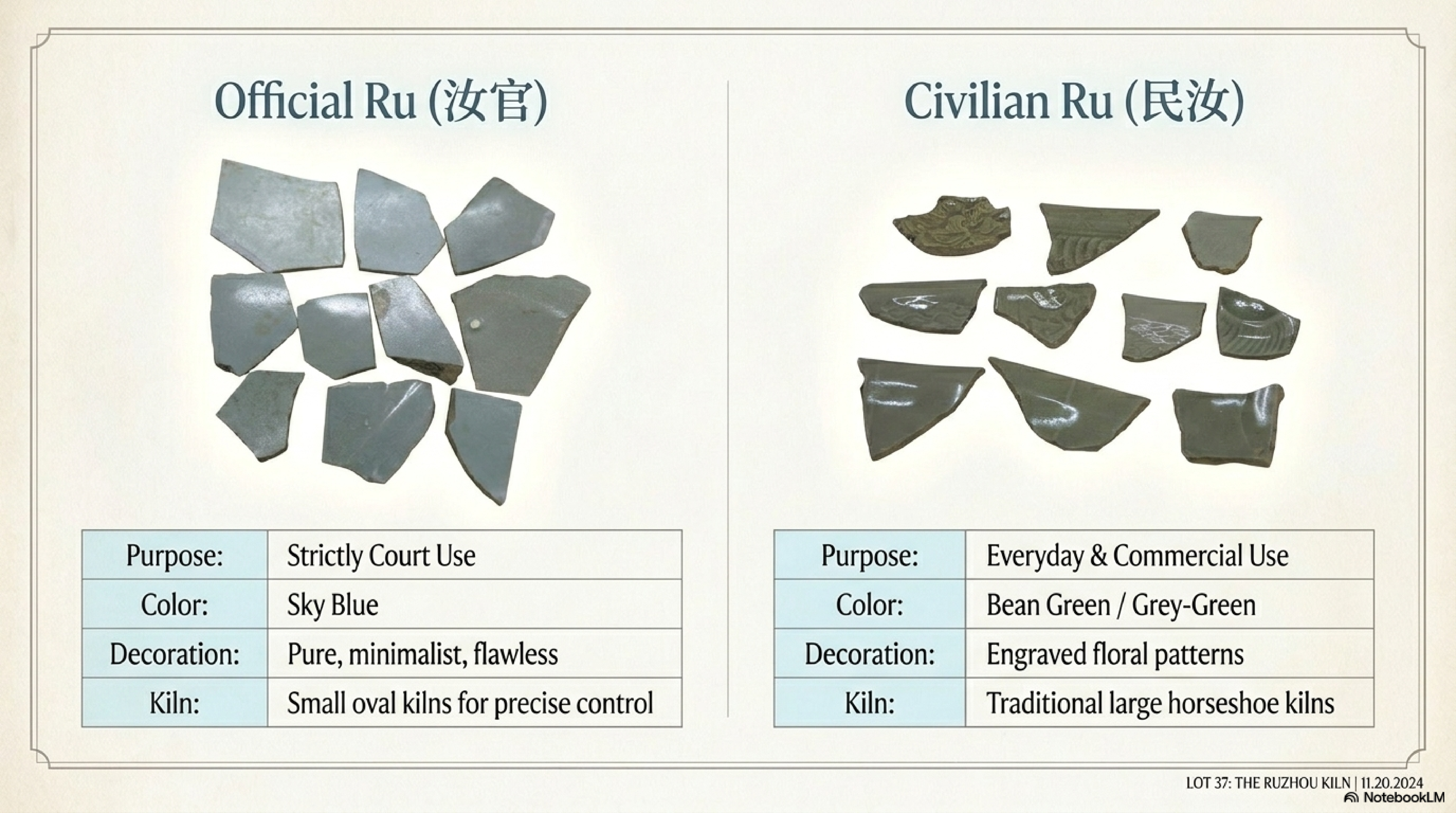
汝官窑 · Court-commissioned production
民汝窑 · Commercial civilian production
Left: Official Ru (汝官) shards — sky-blue, flawless, minimalist. Right: Civilian Ru (民汝) shards — grey-green, engraved floral decoration, thinner glaze. The colour difference alone is decisive to a trained eye.
The vast majority of Ru-region ceramics encountered in the market are 民汝 — commercially produced pieces of genuine historical interest but fundamentally different from the imperial 汝官 wares that command extraordinary prices. Confusing the two is the most common and costly error a new collector can make in this category.
The distinctive sky-blue colour and jade-like surface of authentic Ru ware are not accidents of nature. They are the result of a precisely engineered glaze formula — one that took generations of craft knowledge to develop and that later imitators, despite centuries of effort, have never fully replicated.
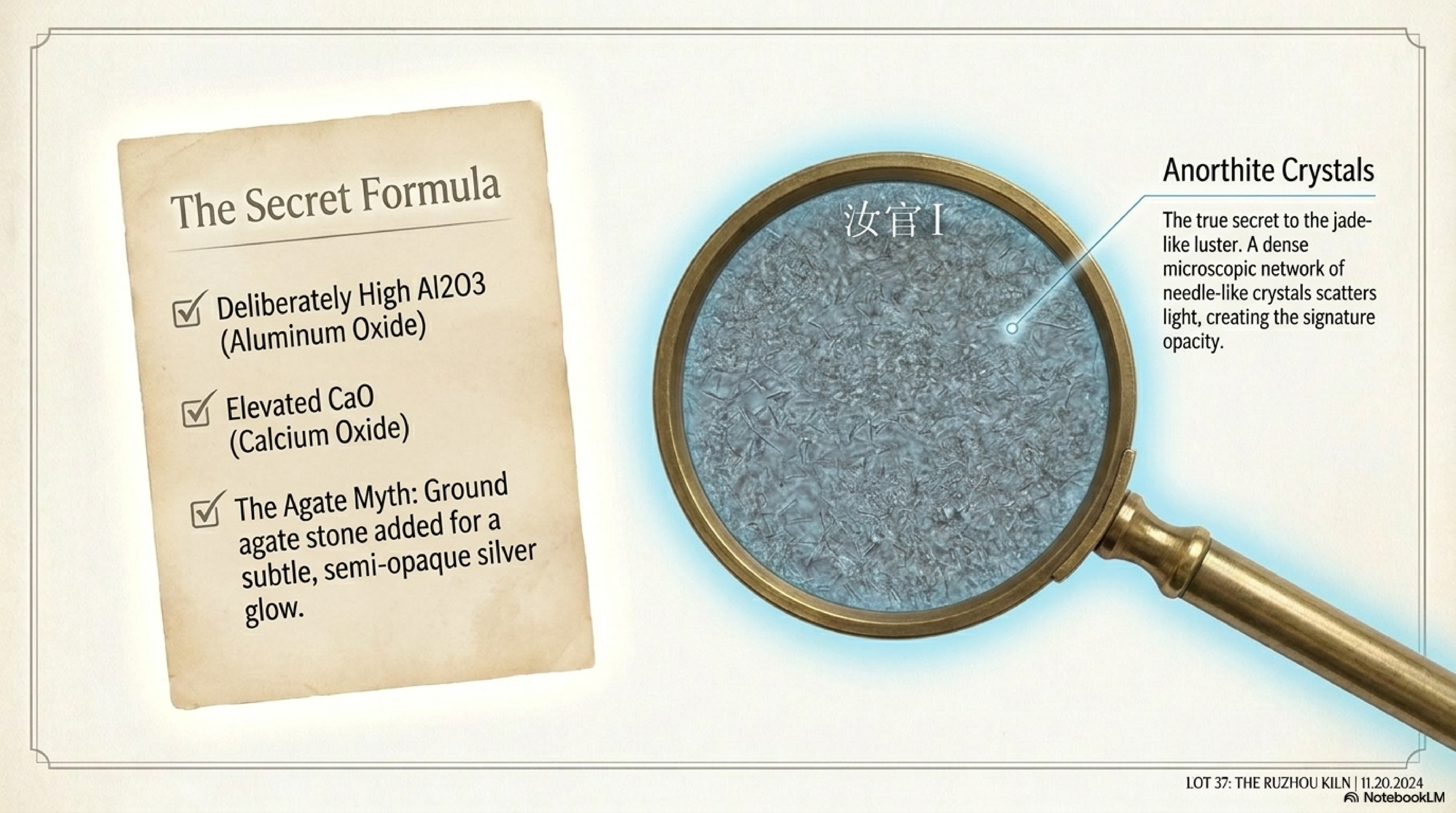
Historical texts record that Ru ware was glazed with ground agate stone (玛瑙入釉). Modern materials science has confirmed this — and explained why it works. The true mechanism behind Ru ware's signature opacity is the formation of anorthite crystals (钙长石) within the glaze during firing.
At Ru's precise firing temperature (~1220°C) and with its specific Al₂O₃/CaO ratio, the glaze develops a dense microscopic network of needle-like anorthite crystals. This crystal network scatters incoming light in all directions — preventing the glaze from becoming transparent and creating instead the characteristic soft, milky depth that resembles polished nephrite jade. The agate addition contributes to the semi-opaque silver glow. No other ceramic tradition of the period achieved this specific crystalline microstructure.
The secret formula and its result: a dense microscopic network of needle-like anorthite crystals within the fired glaze. These crystals scatter incoming light at multiple depths — the physical mechanism behind Ru ware's signature jade-like opacity. No later kiln reproduced this crystalline microstructure.
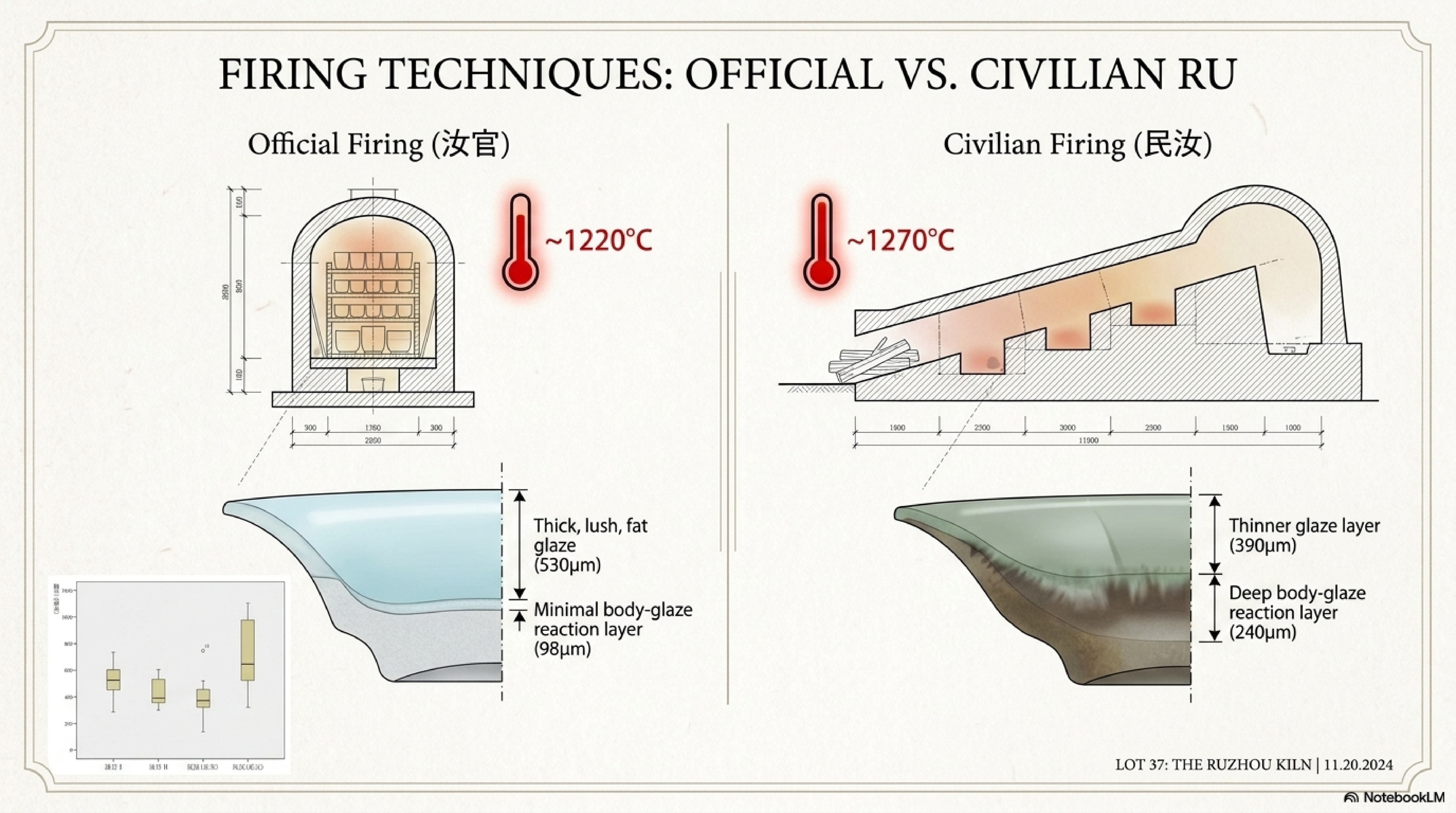
Even a perfect glaze formula produces nothing without the correct firing conditions. The differences between Official and Civilian Ru firing reveal how intentional every aspect of Official Ru production was.
汝官 · Small oval kilns · Controlled reduction
~1220°C民汝 · Large horseshoe kilns · Higher temperature
~1270°C
Firing technique comparison. Official Ru's small oval kiln fires at ~1220°C, producing a thick lush glaze layer (530μm) with a minimal body-glaze reaction zone (98μm). Civilian Ru's large horseshoe kiln fires at ~1270°C, yielding a thinner glaze (390μm) with a deeper reaction layer (240μm) — the cross-sections visible here are the physical record of that difference.
The 50°C temperature difference is not an accident — it reflects a fundamental difference in intent. Official Ru's lower temperature and reduction atmosphere were chosen specifically to keep the iron in the glaze in its ferrous (Fe²⁺) state, which produces blue-green rather than the yellowish tones that would result from oxidation. Every aspect of the firing was a controlled intervention to achieve a single, precisely specified colour.
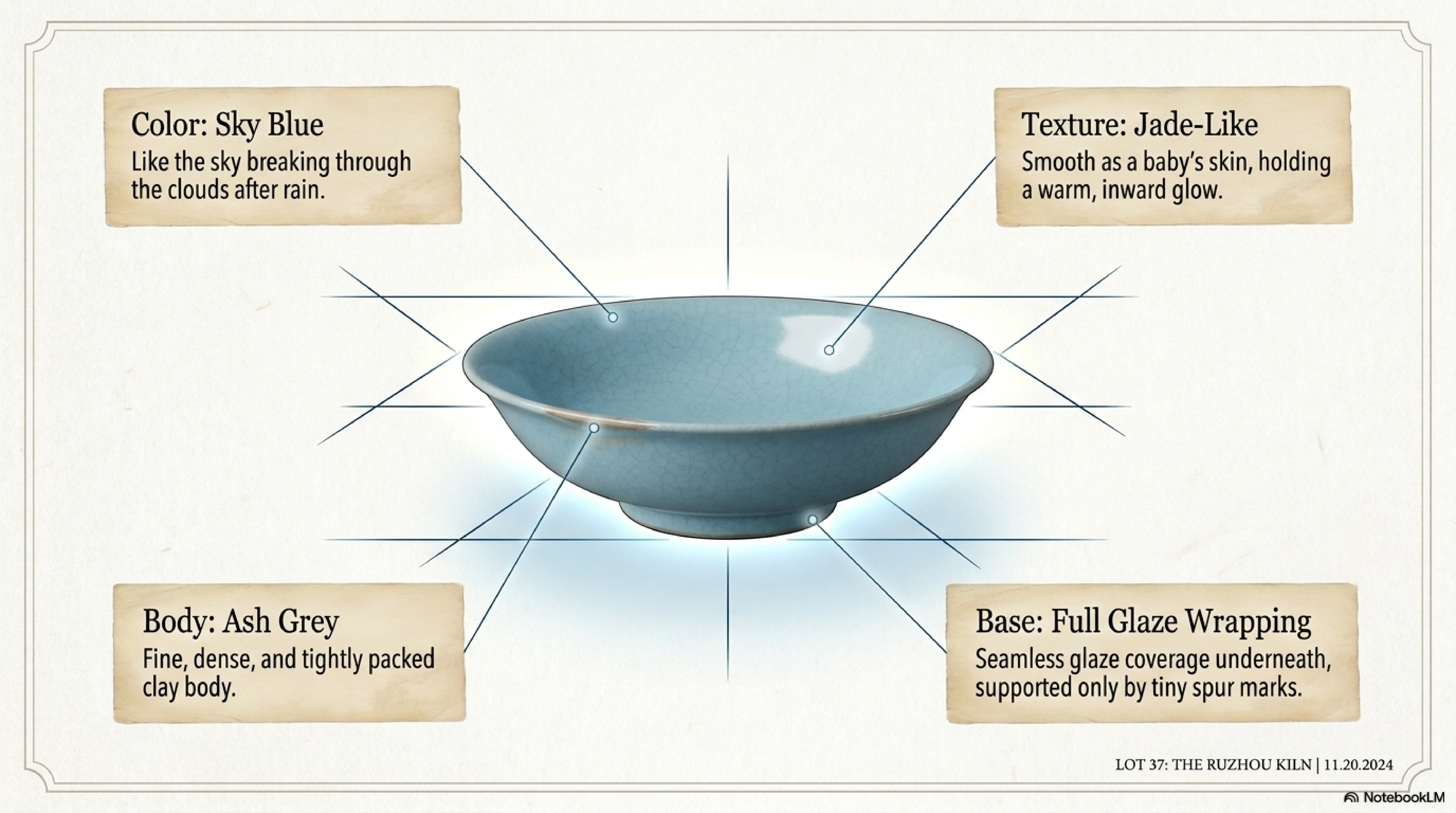
A genuine piece of Official Ru ware can be identified by four physical characteristics that co-occur only when the complete Baofeng formula — materials, chemistry, firing technique — is correctly executed. No later imitation has replicated all four simultaneously.
A Song Ru ware bowl annotated with its four defining signatures: sky-blue tiānqīng colour, jade-like inward glow, ash-grey 香灰胎 body, and seamless full-glaze coverage supported only by tiny sesame-seed spur marks on the base.
The defining colour is not a flat, uniform blue. It is a luminous, shifting sky blue that changes subtly with viewing angle and light conditions — deeper in shadow, brighter in direct light. Song texts describe it as the sky's colour in the precise moment clouds part after rain. This effect is created by the anorthite crystal network scattering light at multiple depths within the glaze. No painted or stained surface can reproduce it.
The glaze surface of genuine Official Ru does not behave like glass — it behaves like polished nephrite. Smooth as infant skin, warm to the touch, with an inward glow that seems to emanate from within rather than reflect from the surface. This is the physical consequence of the anorthite crystal network scattering light internally rather than reflecting it from the surface. Modern fakes almost universally suffer from excess surface gloss — they look "glassy" rather than "jade-like."
The clay body of Official Ru is described as 香灰胎 — incense-ash grey. Fine, dense, and tightly packed, it fires to a distinctive pale grey with a slight warm undertone. Where the glaze is thin enough for the body to show through (at the footring, the spur marks, and the rim edge on some pieces), this distinctive grey-buff colour is clearly visible. It is not white like Ding ware, not dark like Guan ware — it occupies a specific middle ground that is itself an authentication marker.
To achieve complete glaze coverage on all surfaces — including the base — Official Ru pieces were fired not on a flat kiln bed but on tiny support pins (支钉). After firing, these pins leave behind minute contact marks on the glazed base: elliptical, sesame-seed-shaped, yellowish or white in colour, typically arranged in groups of 3 or 5. The base itself shows a natural central organic bulge from the hand-thrown forming process. These sesame spurs are among the most reliable physical authentication markers available without laboratory analysis.
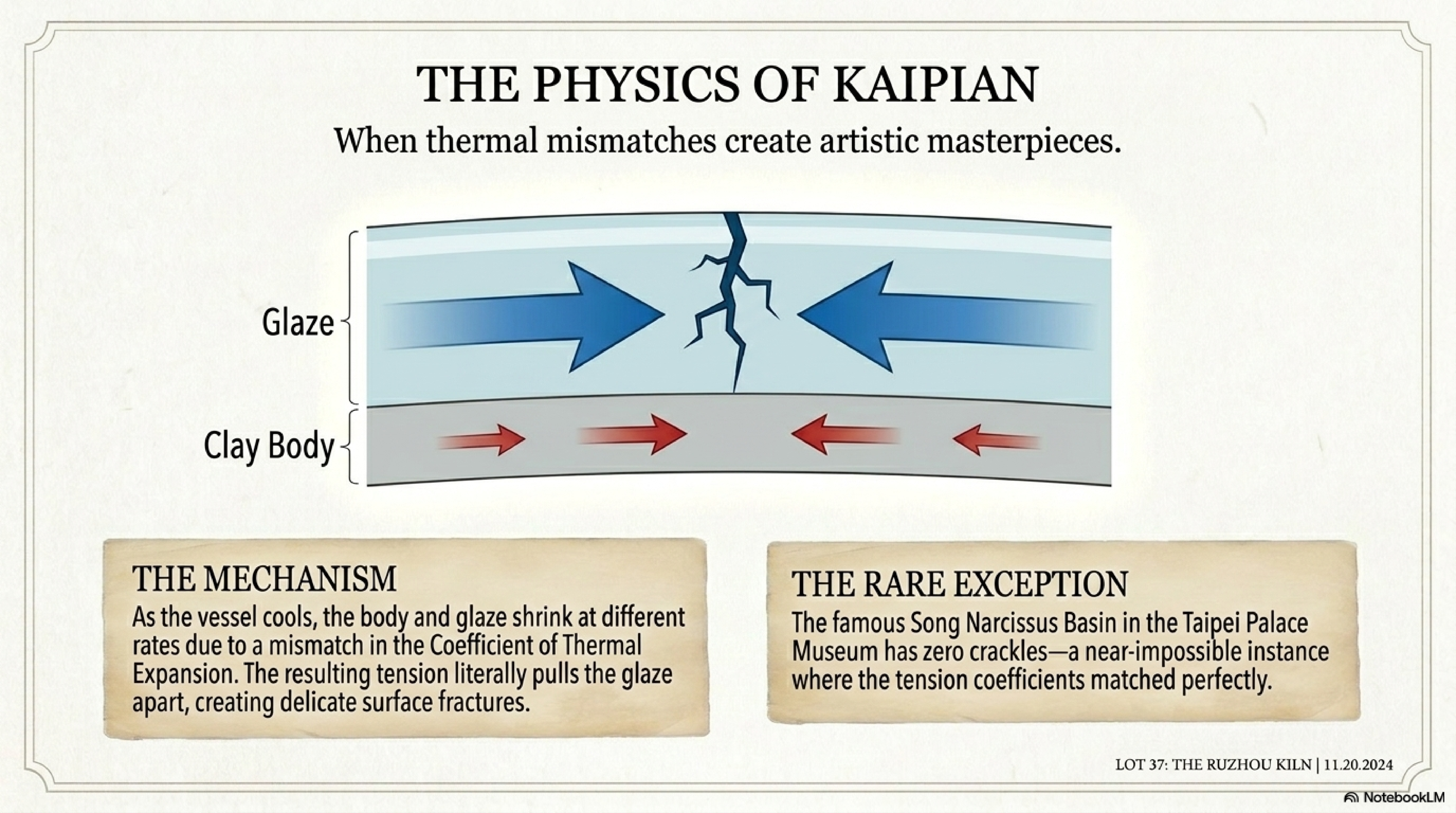
The network of surface fractures covering most Official Ru pieces — known as kāipiàn (开片) or "opening the surface" — is not a defect. It is an engineered consequence of the glaze's physical properties, and it is one of the most celebrated aesthetic features in the history of Chinese ceramics.
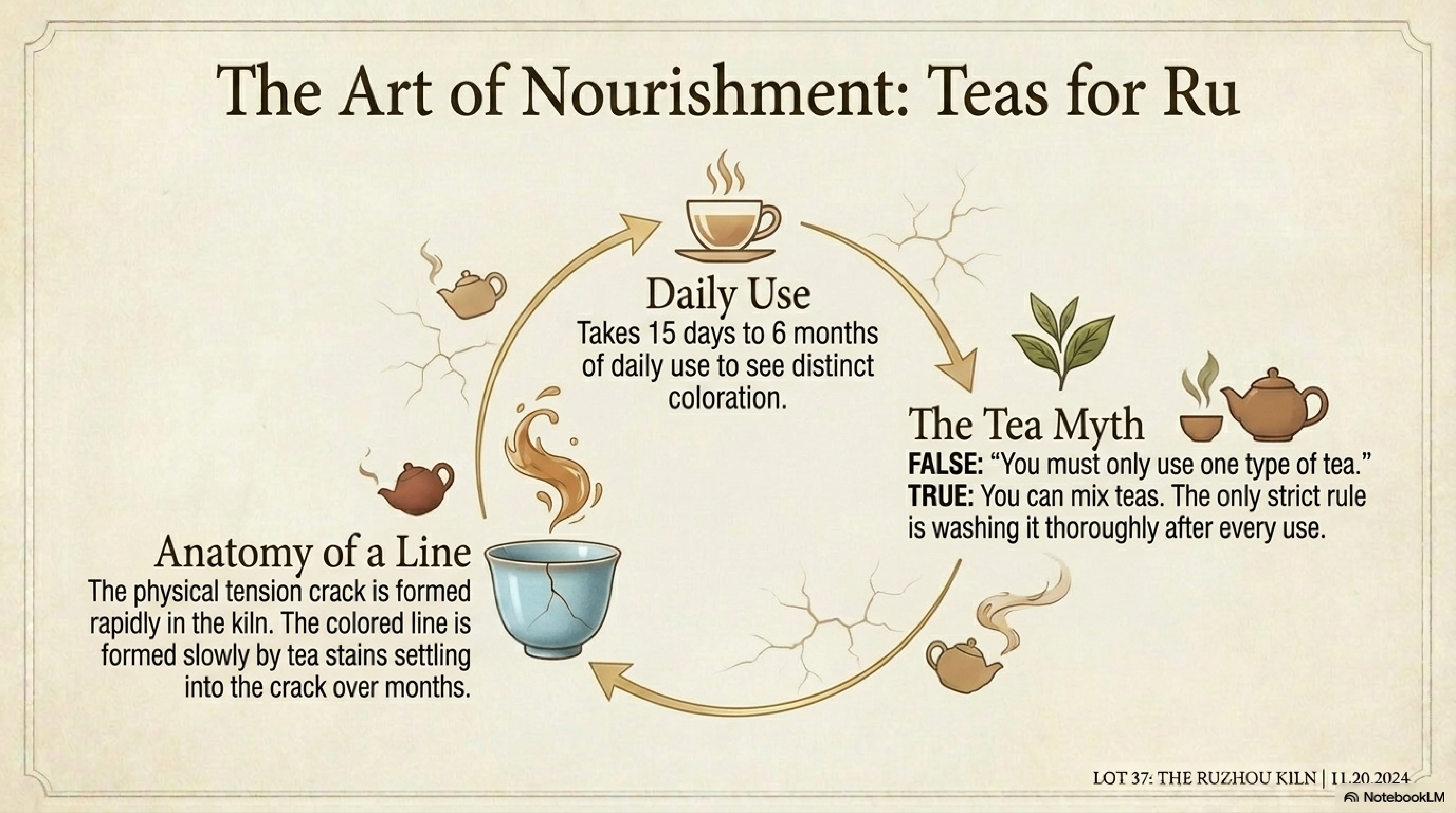
As a fired Ru vessel cools from kiln temperature, the glaze and the clay body contract at different rates — a property measured as the Coefficient of Thermal Expansion (CTE). Because the Ru glaze contracts at a faster rate than the 香灰胎 clay body beneath it, the glaze is placed under tension as it cools. When that tension exceeds the glaze's tensile strength, it fractures across the surface in a delicate, irreversible network of cracks. The physical tension crack forms rapidly in the kiln. The coloured lines visible in aged pieces form slowly — over months and years — as tea stains and mineral deposits settle into the open cracks.
The mechanism of kāipiàn: as the vessel cools, glaze and body contract at different rates. The glaze contracts faster, building tension until it fractures across the surface. The famous Song Narcissus Basin in Taipei is the rare exception — where CTE matched so precisely that zero crackle formed.
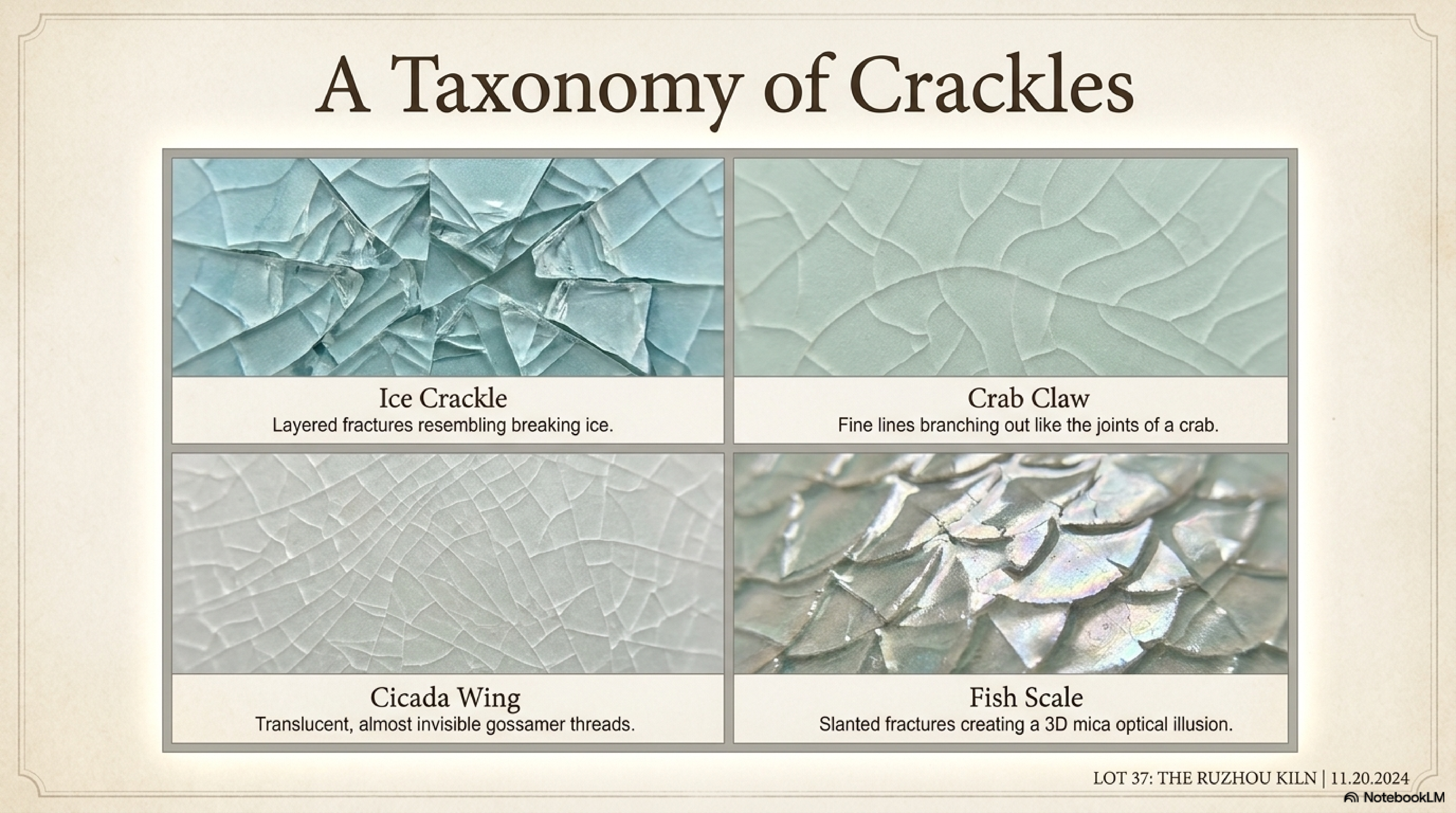
Song connoisseurs identified and named several distinct crackle morphologies, each the result of different combinations of glaze thickness, body composition, and cooling rate.
The four canonical kāipiàn types. Top left: Ice Crackle (冰裂纹) — large polygonal fractures. Top right: Crab Claw (蟹爪纹) — branching fine lines. Bottom left: Cicada Wing (蝉翼纹) — near-invisible gossamer threads. Bottom right: Fish Scale (鱼鳞纹) — slanted fractures creating a 3D mica optical illusion.
Large, irregular polygonal fractures that sweep across the glaze like ice breaking on a winter pond. Found on thick-glazed pieces where differential contraction is greatest. Bold, sculptural presence. Highly prized by Song connoisseurs.
Fine lines branching and forking like the articulated joints of a crab's claw. Most characteristic of Official Ru ware. The branching geometry is natural and irregular — a tell against modern fakes, which cannot reproduce genuine crack branching patterns.
Translucent, almost invisible gossamer threads — an extremely fine crackle network that requires raking light or magnification to see clearly. Found on pieces with precise glaze-to-body CTE matching. Delicate and subtle: the opposite of Ice Crackle in visual character.
Slanted, overlapping fractures that create a three-dimensional mica optical illusion at certain viewing angles — like the iridescent scales of a fish catching light. Formed by unusual combinations of glaze stress and cooling direction. Rare and visually spectacular.
The famous Song Ru ware Narcissus Basin held in the Taipei Palace Museum is one of the very few authenticated Official Ru pieces with zero crackle. This near-impossible achievement occurs when the CTE of glaze and body match so precisely that no tension develops on cooling. It is not a sign of superior quality — it is an extraordinarily rare accident of perfect coefficient matching that Song craftsmen could not reliably reproduce.
Song aesthetics celebrated what later periods tried to eliminate. The kāipiàn crackle was valued precisely because it was an honest record of physics — not painted, not incised, not applied by hand, but written by nature. A piece without crackle is not "more perfect." It is simply rarer — and a different kind of achievement from the signature aesthetic that defined Official Ru as a category.
With fewer than 100 authenticated pieces in existence, the market for "Ru ware" is overwhelmingly composed of imitations. Unlike the refined Ming and Qing imperial imitations that reproduce Guan ware's aesthetics with genuine craft skill, most Ru imitations are transparent fakes that fail all physical tests. The tools below require no laboratory — only knowledge and careful observation.
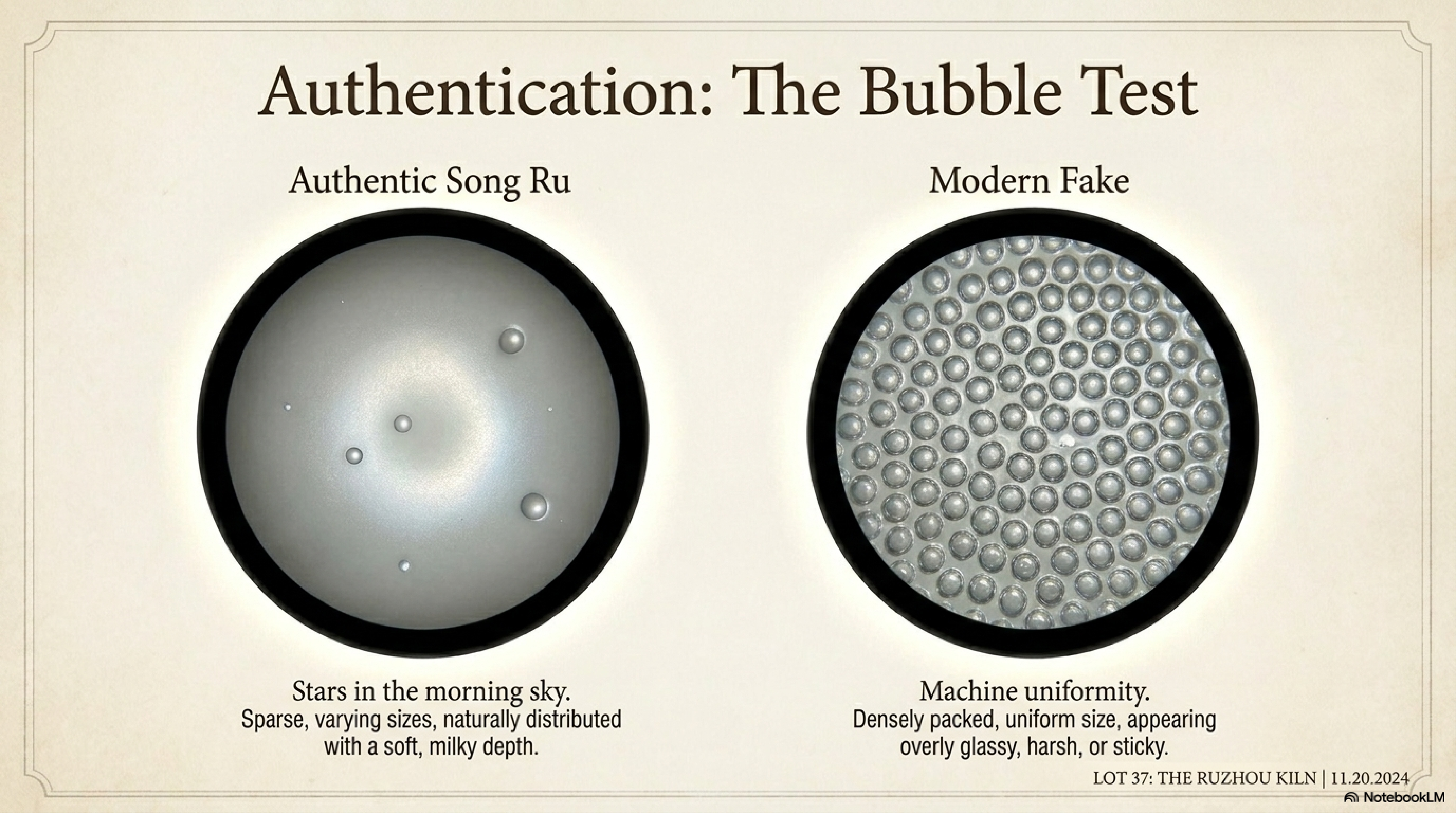
Under magnification (10x–20x loupe is sufficient), the glaze of authentic Song Ru shows a characteristic bubble structure described in classical texts as 寥若晨星 — "sparse as stars in the morning sky." This is one of the most reliable non-destructive tests available.
Bubbles are sparse, varying in size, and naturally distributed — like stars scattered across a dawn sky. The glaze has a soft, milky depth. Individual bubbles sit at different depths within the glaze layer. The overall impression is of quiet, organic naturalness.
Fakes show densely packed, uniform-sized bubbles — mechanically regular, appearing overly glassy and harsh. The uniformity is the tell: industrial glaze application cannot reproduce the natural variation of Song-era hand application and wood-fired kiln conditions.
The bubble test under 10×–20× magnification. Authentic Song Ru (left): sparse, varying-sized bubbles distributed like stars in a morning sky — soft, milky depth. Modern fake (right): densely packed, uniform bubbles of identical size — machine-applied glaze cannot reproduce natural variation.
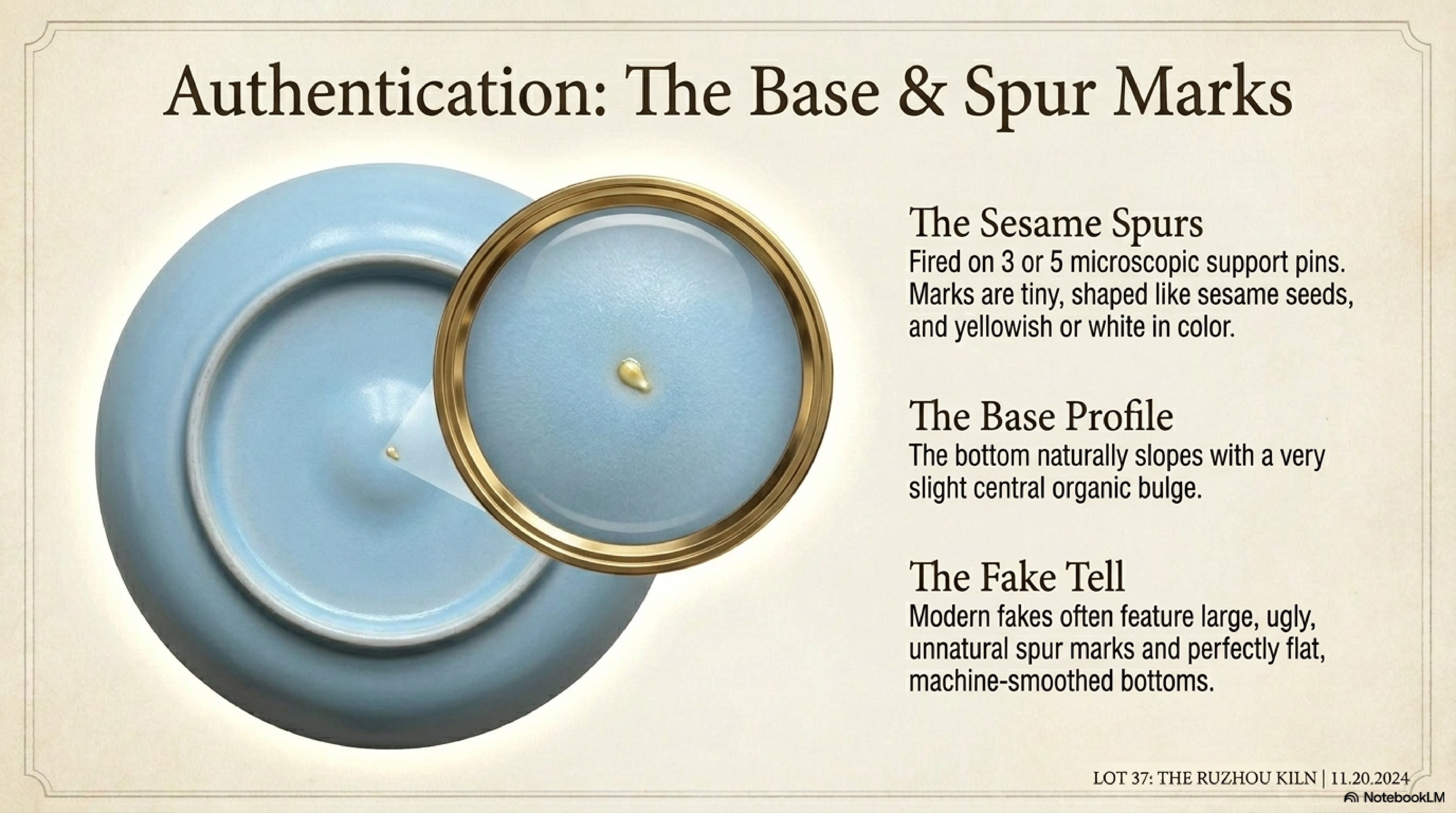
The base of an authentic Official Ru piece is one of the most information-rich surfaces on the object. Three features should be examined together.
Authentic spur marks are elliptical, sesame-seed-shaped, and shallow — hand-pinched onto the kiln support, then broken away after firing. They are yellowish or white in colour.
The base naturally slopes inward with a very slight central organic bulge from the hand-throwing process. It is not perfectly flat. Perfectly flat bases are a sign of machine manufacture.
Modern fakes feature large, round spur marks made from moulds — unnatural in size and symmetry. Bases are machine-smoothed and perfectly flat.
The base of an authentic Official Ru piece: 3–5 tiny sesame-seed-shaped spur marks, elliptical and shallow, yellowish-white in colour. The base slopes naturally with a slight organic central bulge. Modern fakes show large, round, mould-made spur marks and perfectly flat machine-smoothed bases.
| Feature | Authentic Song Ru | Modern Fake |
|---|---|---|
| Shape | Hand-thrown, fluid, organic symmetry — slight variations visible | Slip-cast, rigid dead symmetry; mould lines sometimes visible at seams |
| Touch | Moist, warm, smooth as jade — a "body temperature" sensation without stickiness | Sticky, harsh glassiness, or dry with artificial friction; excess surface shine |
| Sound | Low, dull, wooden thud when tapped — relatively low firing temperature and loose body structure | Clear, ringing tone — modern high-temperature firing produces a dense, vitrified body |
| Glaze bubbles | Sparse, varying sizes, naturally distributed — "stars in the morning sky" under loupe | Dense, uniform, machine-regular — packed and overly glassy under magnification |
| Spur marks | Elliptical, sesame-shaped, shallow; yellowish-white; 3 or 5 marks only | Round, deep, mould-made; oversized; sometimes too numerous or too few |
| Crackle lines | Natural branching geometry; crack depth varies; aged pieces show mineral deposits within cracks | Artificially induced cracking (quenching or chemicals); uniform line width; artificial dirt rubbed into cracks |
| Wear & Aging | Natural soft earth stains settled deeply over centuries; wear patterns consistent with use | Forced aging by acid etching or abrasion; unnatural dirt distribution; inconsistent with claimed age |
When in doubt, do nothing. The market for "Ru ware" is 99% fakes. An authentic piece is a museum acquisition, not a market opportunity. If it seems affordable, it is not authentic.
Ru ware — specifically its modern reproductions made for use — belongs to a category Chinese collectors call "living porcelain." (Song originals are museum objects; they must not be subjected to daily use or temperature stress.) Unlike static display objects, Ru ware teaware is intended to transform over time through use. The kāipiàn crackle network, initially invisible, gradually reveals itself as tea stains settle into the fractures over months of daily use.
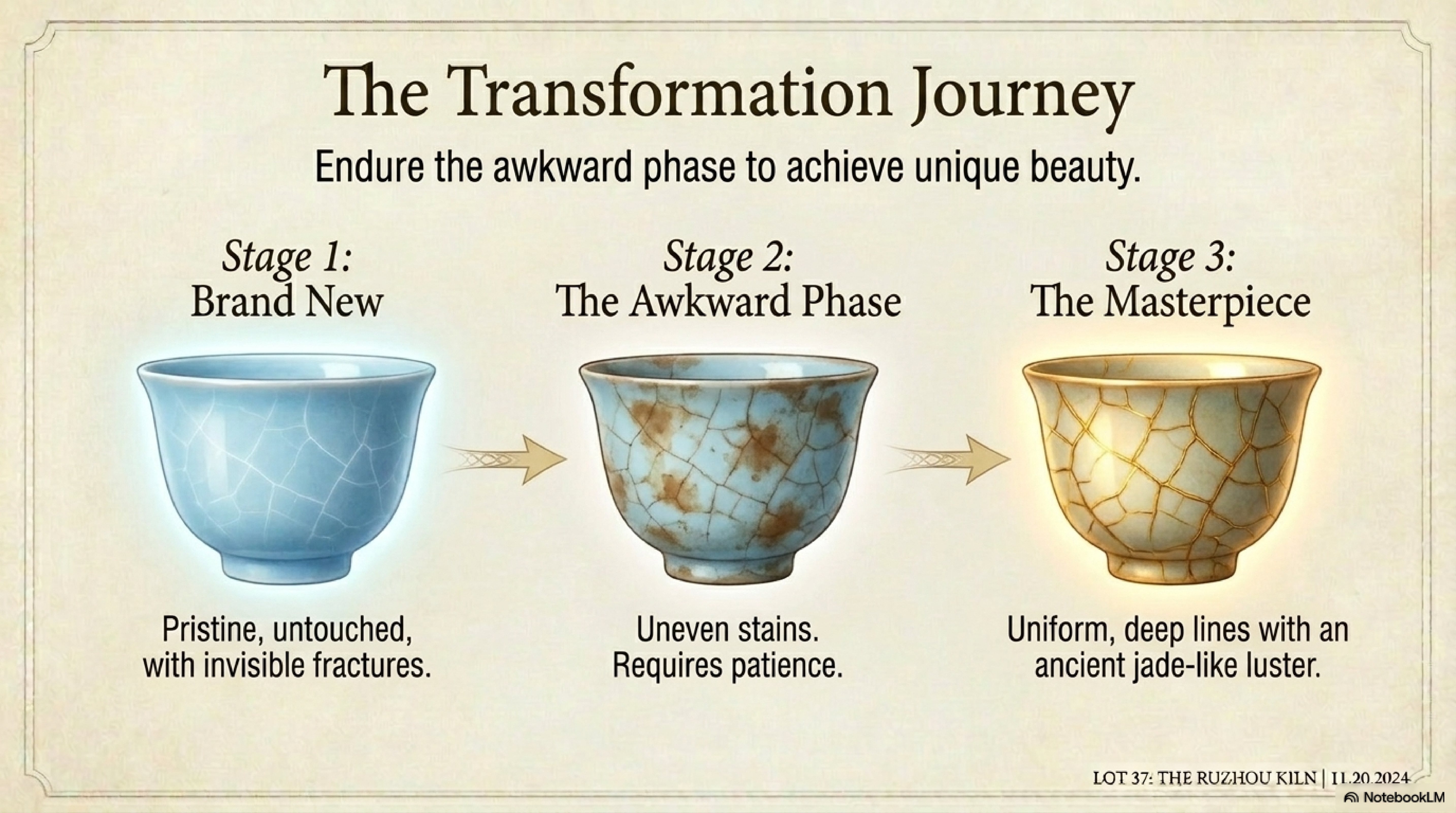
Pristine surface with invisible fractures. The crackle network exists physically but holds no colour. The piece looks uniformly sky blue.
Uneven tea stains begin appearing — patchy, irregular, sometimes brown or ochre. This stage requires patience; the aesthetic is temporarily compromised.
Uniform, deep lines with an ancient jade-like luster. The crackle glows gold against sky blue — the form reaches its intended final state.
The three stages of a Ru ware teacup's life. Stage 1: pristine sky blue, invisible cracks. Stage 2: uneven, patchy stains — the awkward phase that requires patience. Stage 3: uniform deep lines glowing against an ancient jade-like surface — the intended final state.
The timeline from Stage 1 to Stage 3 is 15 days to 6 months of daily use, depending on how frequently the piece is used and which teas are brewed in it. The physical tension crack forms rapidly in the kiln. The coloured line is formed slowly by tea stains settling into the crack over months.
The nourishment cycle: daily use deposits tea stains into the kāipiàn cracks over 15 days to 6 months, gradually building the coloured crackle network. What the kiln creates in an instant, only time and use can make visible.
False: "You must only use one type of tea and never switch." This restriction has no physical basis. The only strict requirement is washing the piece thoroughly with clean water after every use to prevent fermentation residue from souring inside the cracks. Different teas will produce different stain colours — pu-erh produces deep red-brown lines, green tea lighter gold — and mixing teas simply blends these effects. The choice of tea is personal, not prescriptive.
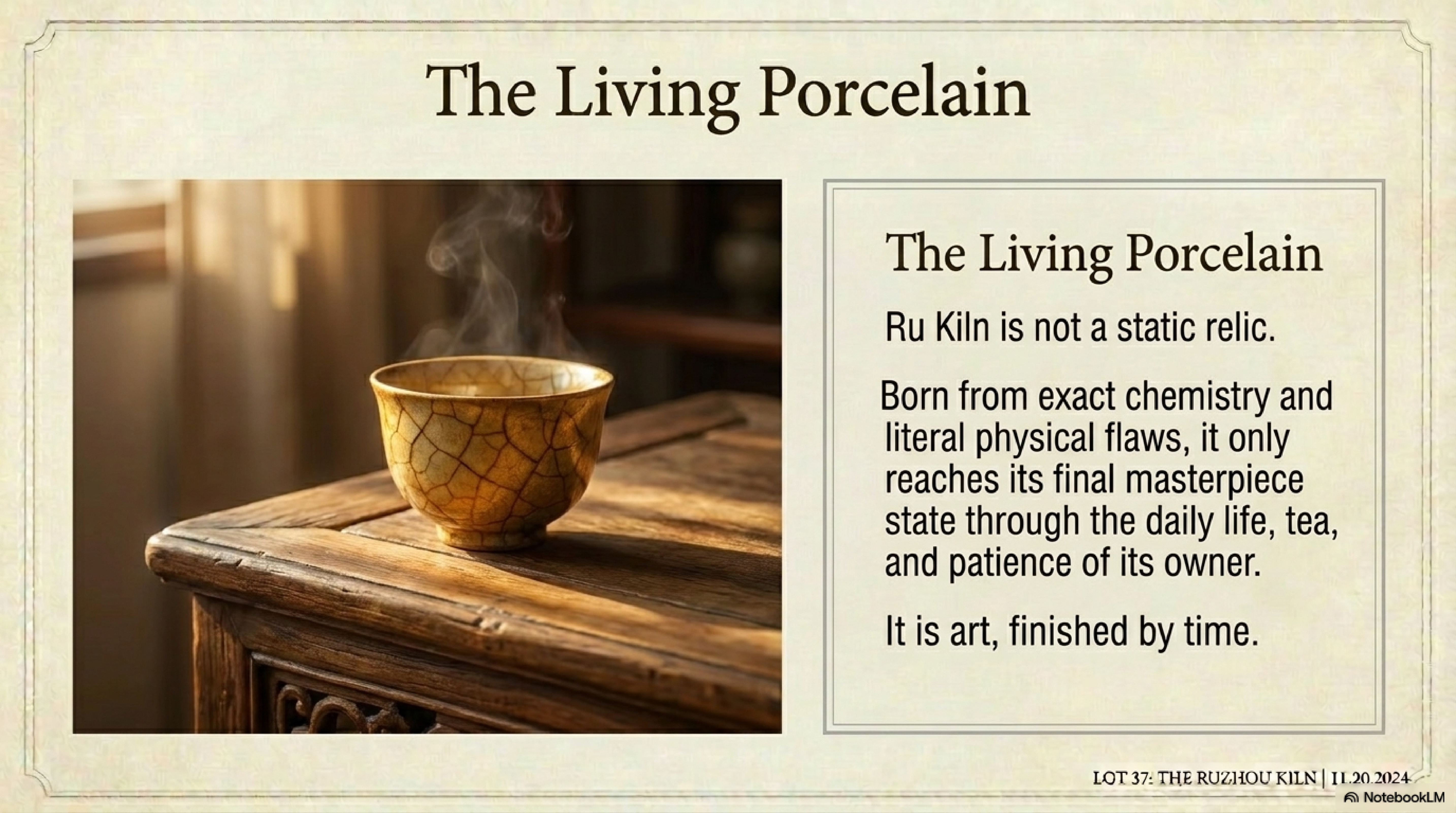
A Ru ware teacup at Stage 3 — the final masterpiece state, reached only through months of daily use, tea, and patience.
Ru Kiln is not a static relic. Born from exact chemistry and literal physical flaws, it only reaches its final masterpiece state through the daily life, tea, and patience of its owner. It is art, finished by time.