One of China's Five Great Kilns

Ding Ware
定窑

白如玉,薄如纸,声如磬
White as jade, thin as paper, resonant as a chime-stone

Among the most refined and technically accomplished white porcelain traditions in the history of Chinese ceramics. A complete guide for collectors and enthusiasts.

Begin the Journey

Purity Without Compare.
White Without Equal.

"定州花瓷琢红玉"

— Su Shi (苏轼), 《試院煎茶》 · describing Lord Lu's Ding ware tea vessel: its decorated porcelain "carved like precious red jade" — a poet's metaphor for translucent ivory perfection

In a tradition that favoured jade-green celadons and dramatic copper glazes, the Ding kilns of Hebei Province chose a different path: the pursuit of absolute white. For four centuries during the Tang and Song dynasties, the artisans of Quyang County refined their craft to produce the finest ivory-white porcelain the world had ever seen — so pure it glowed in candlelight, so thin it was translucent to the light.

Where Jun ware dazzled with unpredictable colour, Ding ware mastered restraint. Its beauty lies in what is not there — no glaze colour, no painted decoration, no theatrical effect. Instead: breathtaking carved and moulded decoration beneath a glaze of unearthly stillness. This is the aesthetic of the Song dynasty scholar — quietude as the highest luxury.

The Five Great Kilns — Where Ding Stands

Later connoisseurs elevated five kilns above all others in the hierarchy of Chinese ceramic production. Ding is the outlier: the sole representative of the white porcelain system, and the only one whose prestige derived from body refinement and carved decoration rather than from glaze colour alone.

Ru

Subtle sky blue. Iron in reducing flames. The rarest of all — fewer than 100 authenticated pieces survive worldwide.

Guan

Celadon & pale blue. Two successive imperial kilns. Celebrated for thick glaze and distinctive ice-crackle networks.

Ge

Crème & grey. Gold-wire-and-iron-wire crackle glaze. The kiln's precise location remains unconfirmed by archaeology.

Jun

Vibrant purple & sky blue. Copper-based glaze. Unpredictable splashes of colour born entirely in the kiln's fire.

Ding

Pure white & ivory. High-fired porcelain. The sole white-ware representative — master of carved and moulded decoration.

Ding ware occupied an unusual position among the Five Great Kilns: it was the only one to supply the imperial court of the Northern Song on a large, systematic scale — yet also the only one ultimately rejected by that same court on grounds of ritual propriety. Its story is one of extraordinary technical achievement, imperial favour, and the peculiar tyranny of the unglazed rim.

Born in the Clay Hills of Hebei

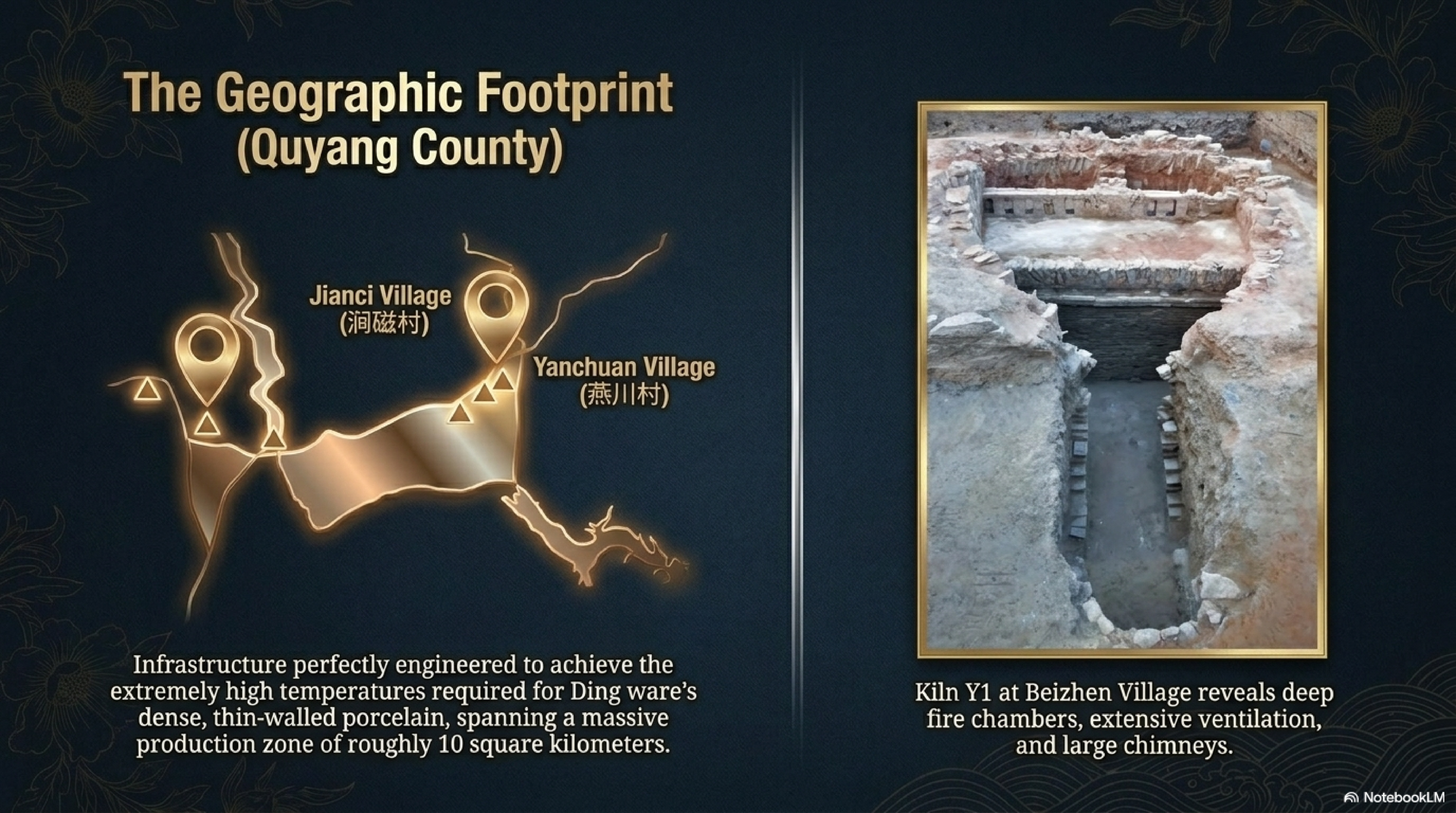
Ding ware takes its name from Ding Prefecture (定州) — the administrative region in which the kilns were located, known today as Quyang County (曲阳县), Hebei Province, in northern China. The heart of production centred on two principal villages: Jianci (涧磁村) — the name means "porcelain village by the ravine," named for the stream running through it — and the secondary site at Yanchuan (燕川村). A further kiln complex at Beizhen (北镇村), revealed by excavation, confirms that production spanned a zone of roughly ten square kilometres.

The choice of location was driven entirely by geology. The hills around Quyang harbour deposits of high-quality kaolin-rich clay — the essential raw material for dense, thin-walled white porcelain. Without this clay, no amount of artisanal skill could have produced the translucent ivory body that defines authentic Ding ware. The geography was destiny.

Geographic footprint of the Ding ware kilns — Jianci Village and Yanchuan Village in Quyang County, Hebei Province, with an excavated kiln chamber at Beizhen Village

The Ding kiln production zone in Quyang County, Hebei. Right: Kiln Y1 at Beizhen Village, revealing the deep fire chambers, extensive ventilation shafts, and large chimneys engineered to reach the extreme temperatures required for dense, thin-walled porcelain.

A Living Archaeological Site

Modern excavation at Jianci has confirmed continuous kiln activity from the late Tang dynasty through the Yuan — a span of roughly five centuries. Fragments, wasters, and kiln furniture from successive periods have allowed scholars to trace the step-by-step refinement of Ding technique with unusual precision, including the precise phase when upside-down firing (覆烧法) was introduced — the technical revolution that would transform both the kiln's output and its defining aesthetic character.

Three Ways to Decorate
a Perfect Surface

Ding ware potters did not rely on glaze colour to carry their aesthetic. The glaze was a vehicle — a transparent or semi-transparent ivory wash that preserved and enhanced the decoration beneath it. The real artistry was in what was done to the clay body before glazing. Three distinct techniques evolved, each with its own character:

划花 Huà Huā · Incised

Incised Decoration

Free-hand lines cut into unfired clay with a fine needle-like tool of iron or bamboo. Fluid, spontaneous, and unrepeatable — lotus scrolls, swimming fish, paired phoenixes. Lines vary in depth and pressure, giving a liveliness that moulded work cannot match.

刻花 Kè Huā · Carved

Carved Decoration

Deeper cutting with a single-bevel blade ('一面坡') — creating angled grooves and raised ridges with a strong three-dimensional, sculptural effect. Often combined with combed hatching backgrounds to add depth and texture across the surface.

印花 Yìn Huā · Moulded

Moulded Decoration

Clay pressed into pre-carved ceramic moulds. Emerged in the mid-Northern Song. Achieved perfectly symmetrical, rapidly produced designs of remarkable complexity — peony sprays, mandarin ducks, coiled dragons — enabling mass production without sacrificing decorative ambition.
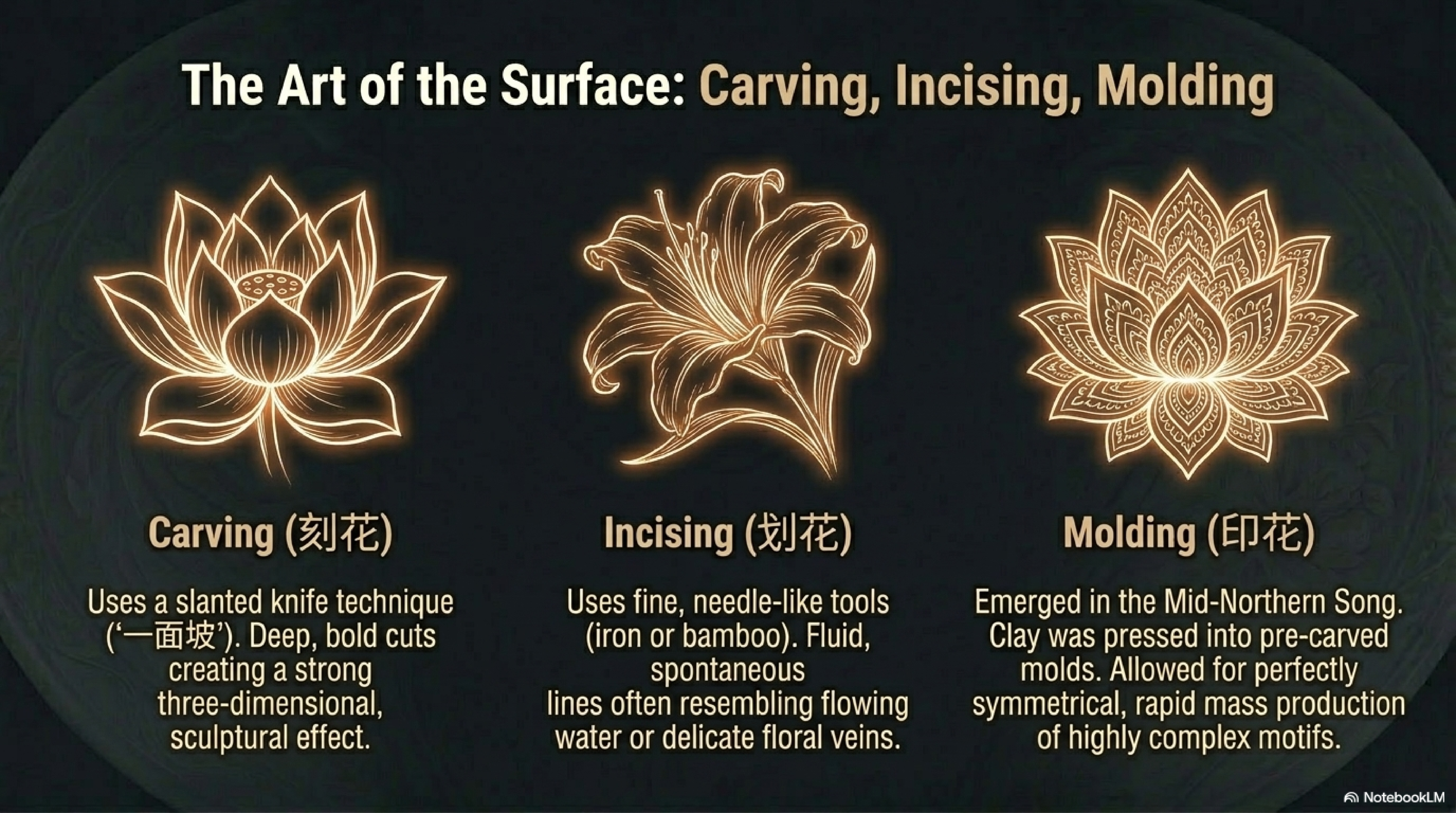
The art of Ding ware surface decoration: Carving (刻花), Incising (划花), and Moulding (印花) illustrated with lotus and lily motifs

The three decorative languages of Ding ware. Carving (刻花) uses a single-bevel blade for bold sculptural relief. Incising (划花) uses fine needle-like tools for fluid, spontaneous lines resembling flowing water or delicate floral veins. Moulding (印花) presses clay into carved forms for perfect symmetry and speed of production.

The Chemistry of Ivory White — 象牙白

The warm, slightly yellowish ivory tone that defines Song Ding ware was not a deliberate invention. It was a chemical consequence of a fuel crisis — and it became the kiln's most celebrated signature.
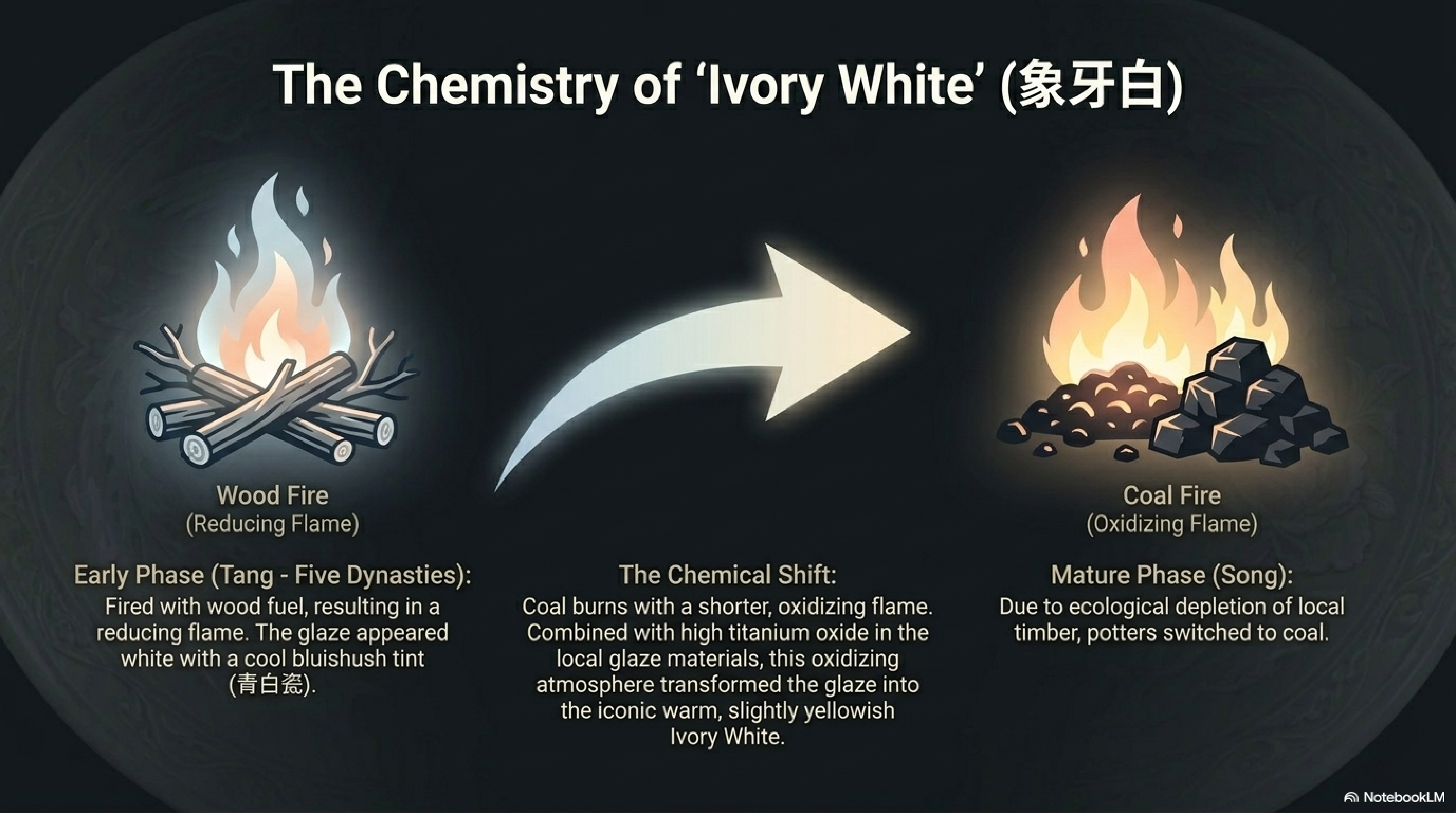
The chemistry of Ding ware's ivory white glaze — the shift from wood-fired reducing atmosphere (bluish-white, 青白) to coal-fired oxidising atmosphere (ivory white, 象牙白) during the Northern Song dynasty

The chemical shift that produced 象牙白. Wood fires burn with a reducing flame, keeping the glaze a cool bluish-white (青白瓷). When local timber was exhausted and potters switched to coal — which burns with a shorter, oxidising flame — the titanium dioxide naturally present in the local glaze materials responded to the oxygen-rich atmosphere, shifting the colour to the warm, slightly yellowish ivory that has defined Song Ding ware ever since.

In the Tang dynasty and early Five Dynasties period, the Quyang kilns fired with wood — producing a reducing atmosphere that left the glaze with a faint cool, bluish-white tint (青白瓷), comparable to other northern kilns of the period. As the Northern Song population expanded and local timber was progressively depleted, potters were compelled to switch to coal. Coal burns shorter and hotter, with an oxidising flame rich in oxygen. This change, combined with naturally occurring titanium dioxide in the local glaze materials, altered the chemistry at the glaze surface during firing. The result: the glaze shifted from cool blue-white to a warm, slightly yellowish ivory. What began as ecological necessity became the kiln's defining aesthetic identity.

The Upside-Down Revolution: 覆烧法

The most consequential decision in Ding ware's history was made not in the decoration studio but in the kiln yard. To meet soaring Northern Song demand, potters invented a radical method: placing bowls and dishes upside down on stepped ceramic setter rings (支圈), resting on their unglazed rims, inside protective saggars.
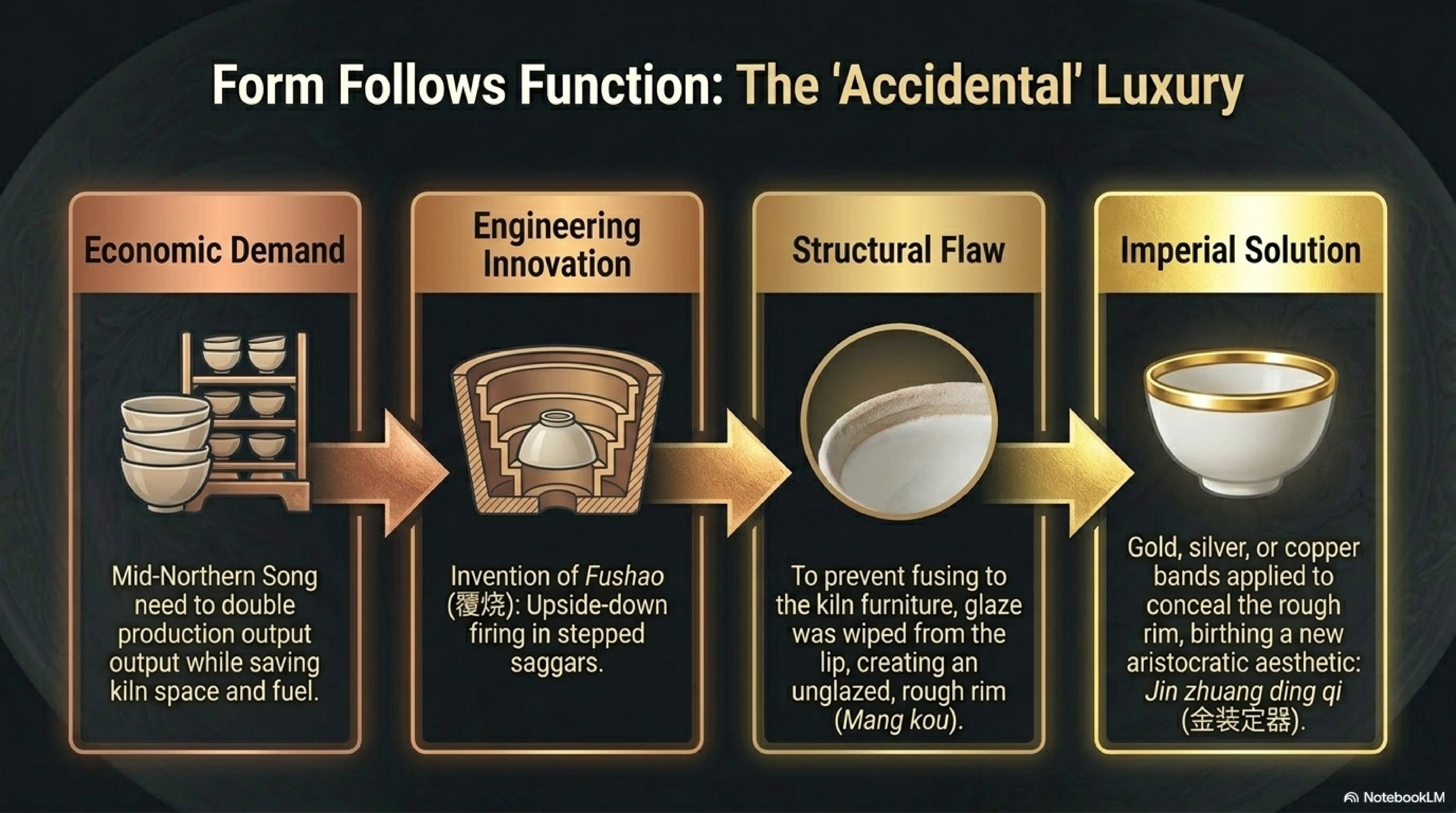
Form Follows Function: the four-stage story of Ding ware's upside-down firing innovation — Economic Demand leads to the Engineering Innovation of Fushao, which creates the Structural Flaw of Mang Kou, resolved by the Imperial Solution of metal-banded rims (Jin Zhuang Ding Qi)

The accidental luxury: economic pressure forced the invention of Fushao; Fushao created the 芒口 flaw; the 芒口 demanded a solution; and the solution — metal-banded rims (金装定器) — became one of the most coveted aesthetics in Song dynasty court culture.

🔄 Upside-Down Firing 覆烧法 vs 仰烧 (upright)
+
📦 Stepped Setter Rings 支圈 — stack without fusing
=
4–5× Kiln Capacity + Unglazed Rim (芒口)
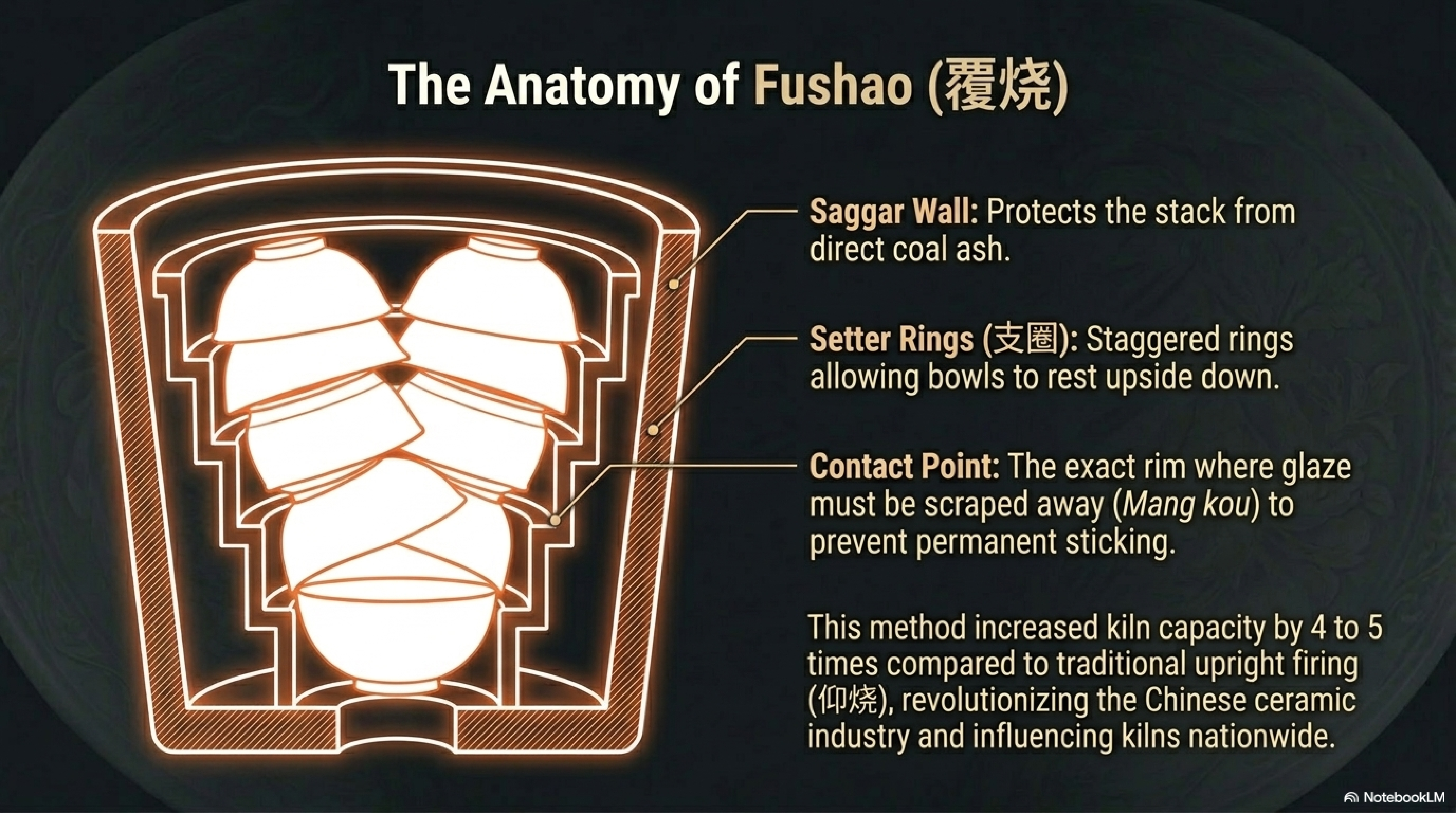
The anatomy of Fushao (覆烧): saggar wall protecting from coal ash, setter rings (支圈) allowing bowls to rest upside down, and the contact point where glaze is scraped away to create the Mang Kou unglazed rim

The engineering of Fushao. Bowls rest upside down on staggered setter rings (支圈) inside a saggar. The saggar wall protects the stack from direct coal ash. The rim — the contact point — must be scraped bare of glaze to prevent permanent bonding to the kiln furniture, creating the characteristic 芒口. This method increased kiln capacity four- to fivefold compared to traditional upright firing (仰烧), revolutionising the northern Chinese ceramic industry.

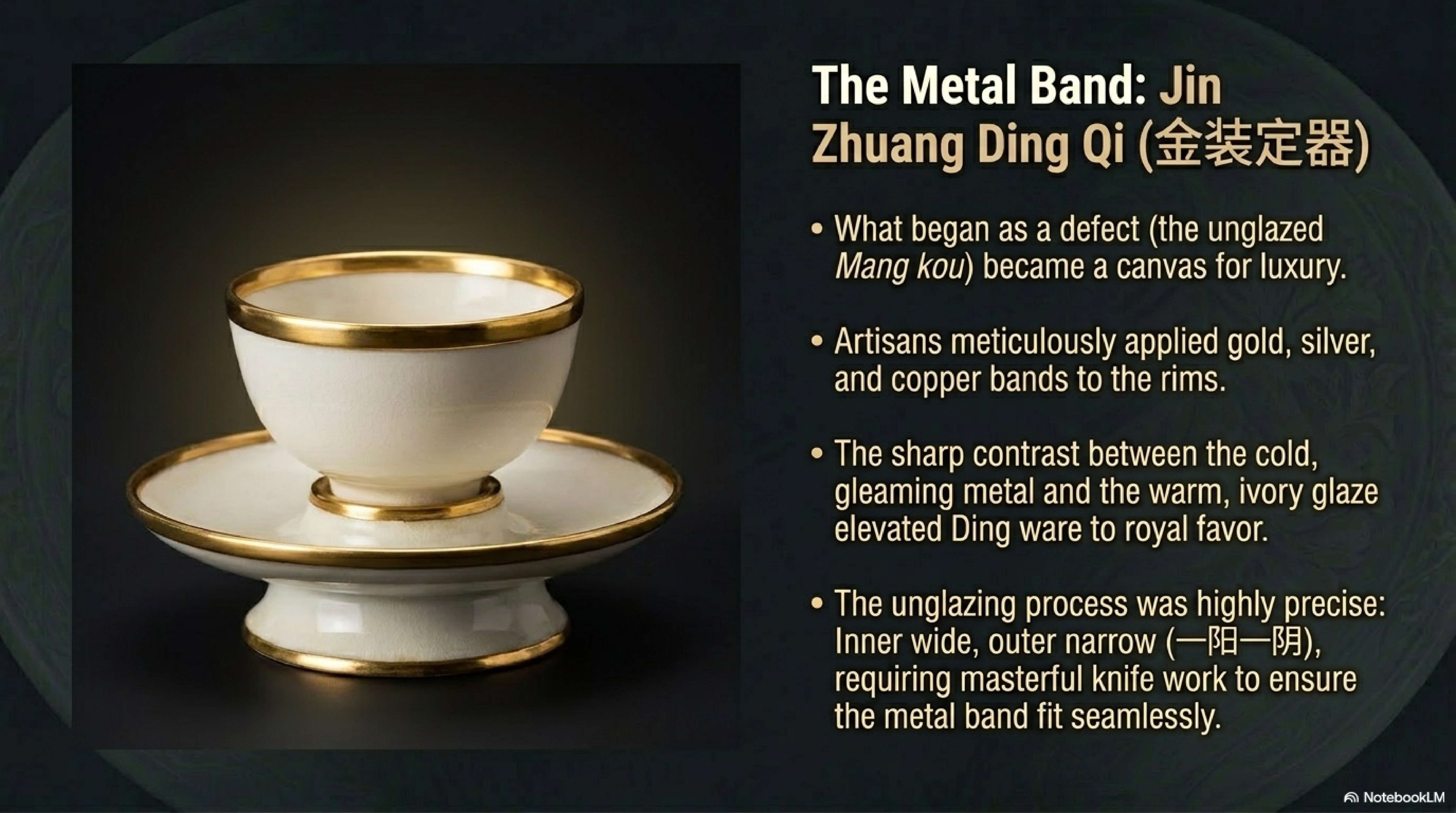
For everyday wares, the unglazed rim — máng kǒu (芒口) — was a minor inconvenience. For imperial court use, it was a ritual problem. The raw clay edge was considered improper for the Emperor's table. Palace pieces had their rims bound in copper, silver, or gold in a process called jīn zhuāng dìng qì (金装定器). Artisans scraped the rim with great precision — inner rim wider, outer rim narrower (一阳一阴) — to ensure the metal band seated seamlessly. The sharp contrast between cold gleaming metal and warm ivory glaze elevated Ding ware to royal favour.

"定器有芒不堪用"

— Lu You (陆游), 《老学庵笔记》 · "Ding wares have raw rims and are unfit for use" — the documented reason for the court's rejection of Ding ware in favour of Ru ware during Emperor Huizong's reign
How to Identify
Authentic Ding Ware

Authentic antique Ding ware — particularly Song dynasty pieces — carries a set of physical markers that modern reproductions struggle to replicate convincingly. Learning to read these signs is the first step toward confident collecting.

Unglazed Rim (芒口)

Máng Kǒu

The defining feature of upside-down-fired Ding ware. A thin band of exposed, lightly fired clay at the rim — the surface that rested on setter rings during firing. On imperial pieces, this rim was covered with copper, silver, or gold banding. Period metal banding shows authentic ageing and patina; later replacement banding does not in itself indicate a fake body beneath.

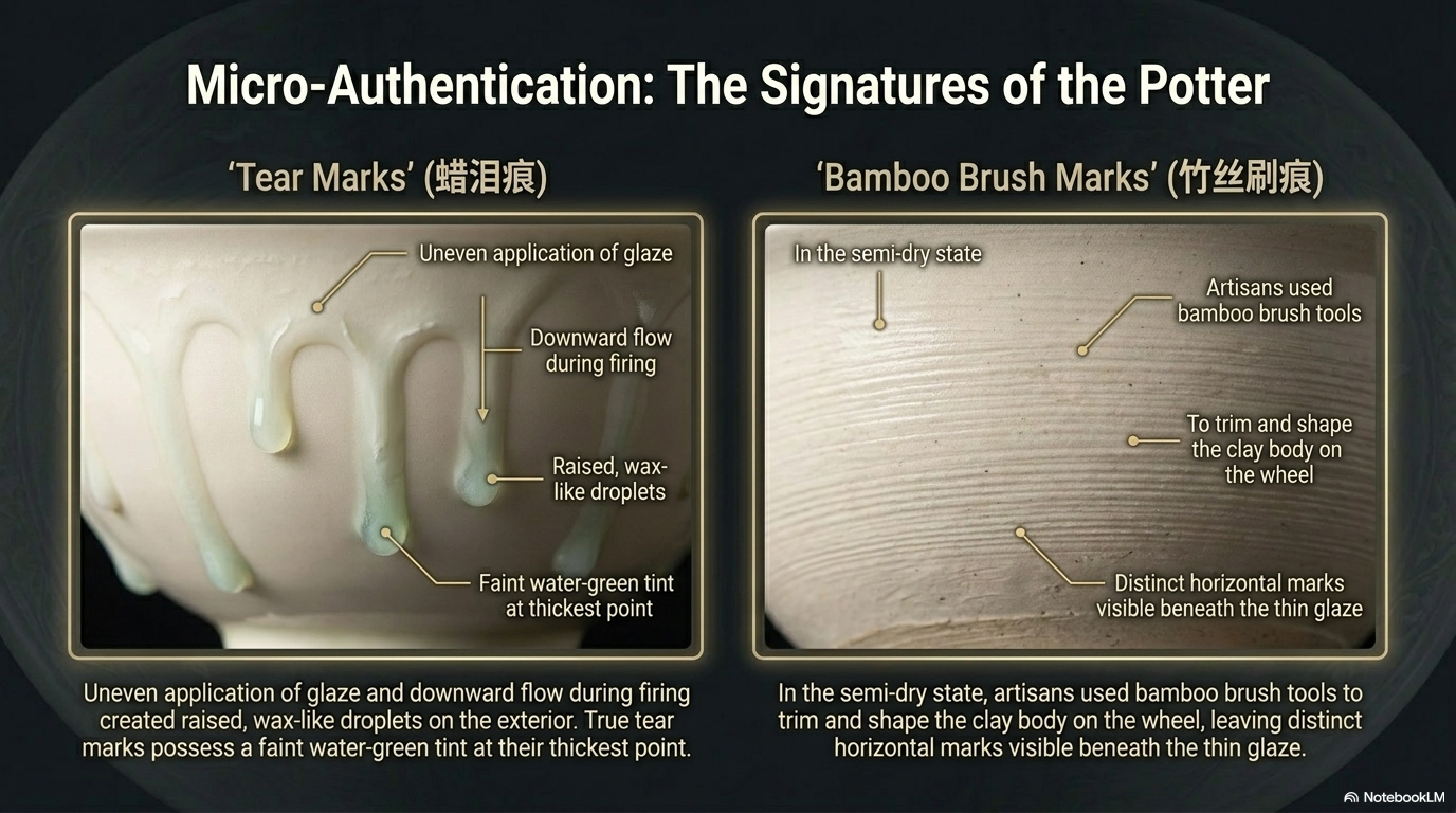
Wax Tear Marks (蜡泪痕)

Là Lèi Hén

Raised, wax-like droplets on the exterior caused by uneven glaze application and downward flow during firing. Authentic tear marks carry a faint water-green tint at their thickest point — where the glaze is deepest. Visible to the naked eye under raking light. Their absence on a supposedly Song Ding piece should invite scrutiny.

Bamboo-Brush Marks (竹丝刷痕)

Zhú Sī Shuā Hén

Distinct horizontal parallel marks visible beneath the thin interior glaze — left when artisans used bamboo brush tools to trim and shape the clay body on the wheel in its semi-dry state. Under raking light or magnification, authentic Song Ding ware frequently shows these regular striations running in one direction across the interior surface.

Ivory Body — Translucent Thinness

象牙白 · Xiàngyá Bái

Hold a fine Ding bowl up to strong light: the thinner sections are translucent. The body colour is not pure chalk white but a warm ivory — "elephant ivory white" (象牙白). This warmth derives from the coal-fired oxidising atmosphere acting on titanium-bearing local materials. Reproductions typically fire too white, too cool, and too opaque.

Glaze Accumulation at Base Interior

积釉 · Jī Yòu

Because pieces were fired upside down, the glaze accumulates toward the base (uppermost during firing). This creates a slightly thicker, often water-green-tinged glaze pool at the centre of the interior — a reliable indicator of the upside-down technique and therefore of authentic Song production. The same mechanism produces the wax tear marks on the exterior.

Ring Foot (圈足)

Quān Zú

The ring foot of authentic Song Ding ware is cut cleanly and fires to a fine pale grey-white. The unglazed foot area is smooth, without the gritty sandy texture common on reproductions. Typically narrow and neatly trimmed — a mark of the high-quality throwing and turning skills of Song-period workshops.

Micro-authentication of Ding ware: Wax Tear Marks (蜡泪痕) showing raised glaze droplets with a water-green tint, and Bamboo Brush Marks (竹丝刷痕) showing horizontal striations visible beneath the thin glaze

The micro-signatures of authentic Ding ware. Left: 蜡泪痕 — raised wax-like glaze droplets with a faint water-green tint at their thickest points, formed by uneven glaze application and downward flow during firing. Right: 竹丝刷痕 — distinct horizontal bamboo-brush marks left during wheel-trimming, visible beneath the thin interior glaze.

Imperial Marks on the Base

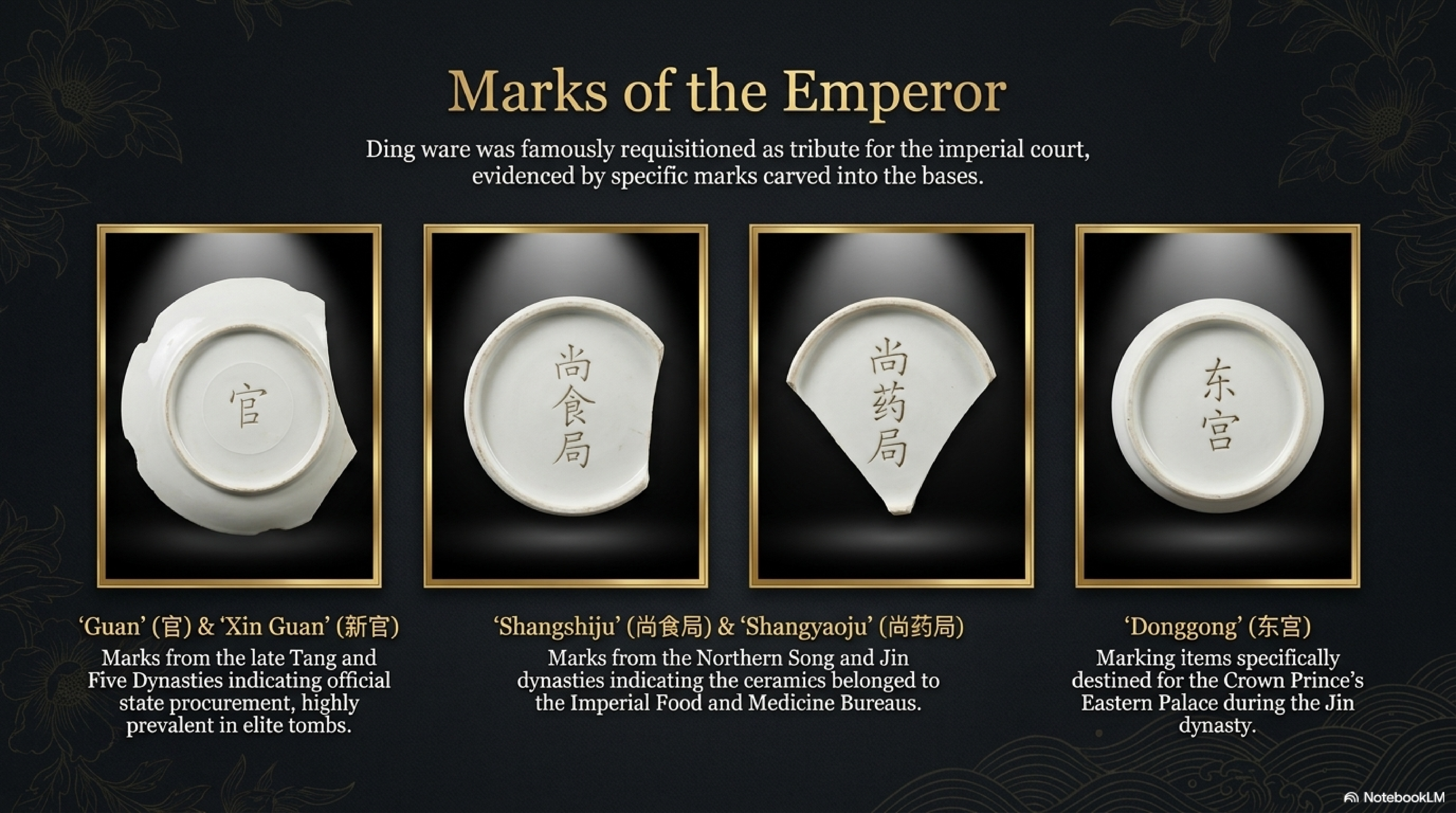
Unlike Jun ware's numerals indicating vessel size, Ding ware's imperial inscriptions record institutional ownership. Pieces requisitioned for the court were carved into the base before firing with the name of the specific bureau or palace department they were destined for. Four marks are documented in the archaeological and literary record:

官 · 新官

Guān / Xīn Guān

Late Tang & Five Dynasties. Indicate general official state procurement. Frequently found in elite tombs of the period; 新官 is associated specifically with early Northern Song tribute supply.

尚食局

Shàng Shí Jú

Imperial Food Bureau. Northern Song & Jin dynasty. Marks pieces destined for the imperial kitchen and dining service.

尚药局

Shàng Yào Jú

Imperial Medicine Bureau. Northern Song & Jin dynasty. Pieces for the court's pharmaceutical and medicine department.

东宫

Dōng Gōng

Eastern Palace. Jin dynasty. Items specifically destined for the Crown Prince's palace. Among the rarest of all Ding marks.

Marks of the Emperor: four imperial Ding ware base inscriptions — 官, 尚食局, 尚药局, and 东宫 — carved into the bases of pieces before firing as institutional ownership marks

Imperial ownership marks carved into Ding ware bases before firing. From left: 官 (Guān) — general official procurement, late Tang/Five Dynasties; 尚食局 (Shàng Shí Jú) — Imperial Food Bureau, Northern Song and Jin; 尚药局 (Shàng Yào Jú) — Imperial Medicine Bureau, Northern Song and Jin; 东宫 (Dōng Gōng) — Crown Prince's Eastern Palace, Jin dynasty.

The Colour Variants: White, Black, Brown, and Red

White is the principal ware by far, but the Ding kilns also produced small quantities of coloured variants using the same high-quality clay body and firing technique, with altered glaze formulations. Red Ding (红定) is the rarest of all — only a handful of examples are recorded — and its precise chemistry and relationship to the other variants remains incompletely understood. Black and brown Ding are better documented:

Black Ding — 黑定 (Hēi Dìng)

Iron-saturated black glaze · Extremely Rare

  • Glaze: Rich, deep black achieved with a high iron content — occasionally approaching the mirror-like surface of fine Jian ware (建盏)
  • Rarity: Far scarcer than white Ding; only a handful of authenticated pieces survive in major public collections
  • Identification: Same ivory body, same upside-down-fired 芒口 rim as white Ding
  • Value: Exceptional — typically exceeds comparable white Ding at auction

Persimmon-Brown Ding — 酱釉 (Jiàng Yòu)

Also known as 紫定 (Zǐ Dìng) · Rare

  • Glaze: Warm brown — the colour of persimmon skin or soy sauce — achieved with iron oxide in an oxidising atmosphere
  • Also called: 紫定 (zǐ dìng, "Purple Ding"), though the colour reads more amber-brown than purple in most authenticated examples
  • Rarity: Scarce but more available than Black Ding
  • Identification: Same clay body and form vocabulary as white Ding; the warm brown glaze never veering toward green
  • Value: Significantly above comparable white Ding

A History Written
in Ivory

Late Tang Dynasty · c. 9th century

Imitating Xing, Finding a Voice

The kilns at Quyang begin producing white wares in the shadow of the celebrated Xing kilns (邢窑) — the dominant northern white ware of the Tang. Wood-fired with a reducing flame, the early output fires to a cool bluish-white (青白瓷). Premium tribute pieces are already marked with the 官 inscription, confirming official state procurement. Ding is still the student; the aesthetic that will define it has not yet emerged.

Five Dynasties · 907–960

Technical Refinement

A period of intensive development. The body becomes thinner and more translucent. Incised decoration grows more confident and fluid. The kiln system expands across Quyang. Ding ware begins to surpass Xing in quality, establishing the aesthetic vocabulary — pure white, fine-walled, carved — that will define the Song golden age.

Northern Song Dynasty · 960–1127

Imperial Choice — and Imperial Rejection

Ding ware's golden age. Ecological pressure compels the switch to coal firing — and the iconic warm ivory glaze is born. The upside-down firing technique (覆烧法) is introduced, multiplying kiln capacity four- to fivefold. Moulded decoration (印花) reaches extraordinary refinement. Pieces are marked 尚食局, 尚药局, and 东宫 for specific palace departments. Then — during Emperor Huizong's reign (r. 1100–1125) — the court establishes the dedicated Ru kilns at汝州 and ceases to commission Ding for imperial use. According to Lu You's 《老学庵笔记》, the stated reason was the raw rim: "定器有芒不堪用." The metal-banded solution was judged insufficient for ritual use.

Jin Dynasty · 1115–1234

Continuation Under New Rulers

The Jin dynasty, having conquered northern China, inherits the Ding kilns intact. Production continues and, in the early Jin period, quality remains high. Pieces for the Crown Prince's palace carry the 东宫 mark. But the aesthetic gradually shifts: forms become heavier, decoration more schematic. The courtly refinement of the Song period gives way to a more populous taste. Ding artisans disperse southward; their influence is felt in later Jingdezhen white ware production.

Yuan Dynasty · 1271–1368

Exhaustion and Decline

The Mongol Yuan court, with its taste for Jingdezhen's blue-and-white porcelain, withdraws patronage from northern white wares. Worse: centuries of intensive production have exhausted the highest-quality local clay deposits. The precise Fushao technique gives way to rough direct stacking (叠烧) — sacrificing aesthetic control for sheer volume. Quality collapses. By the early Ming dynasty, Jingdezhen's dominance is complete and the great Ding kilns fall silent after five centuries of continuous production.

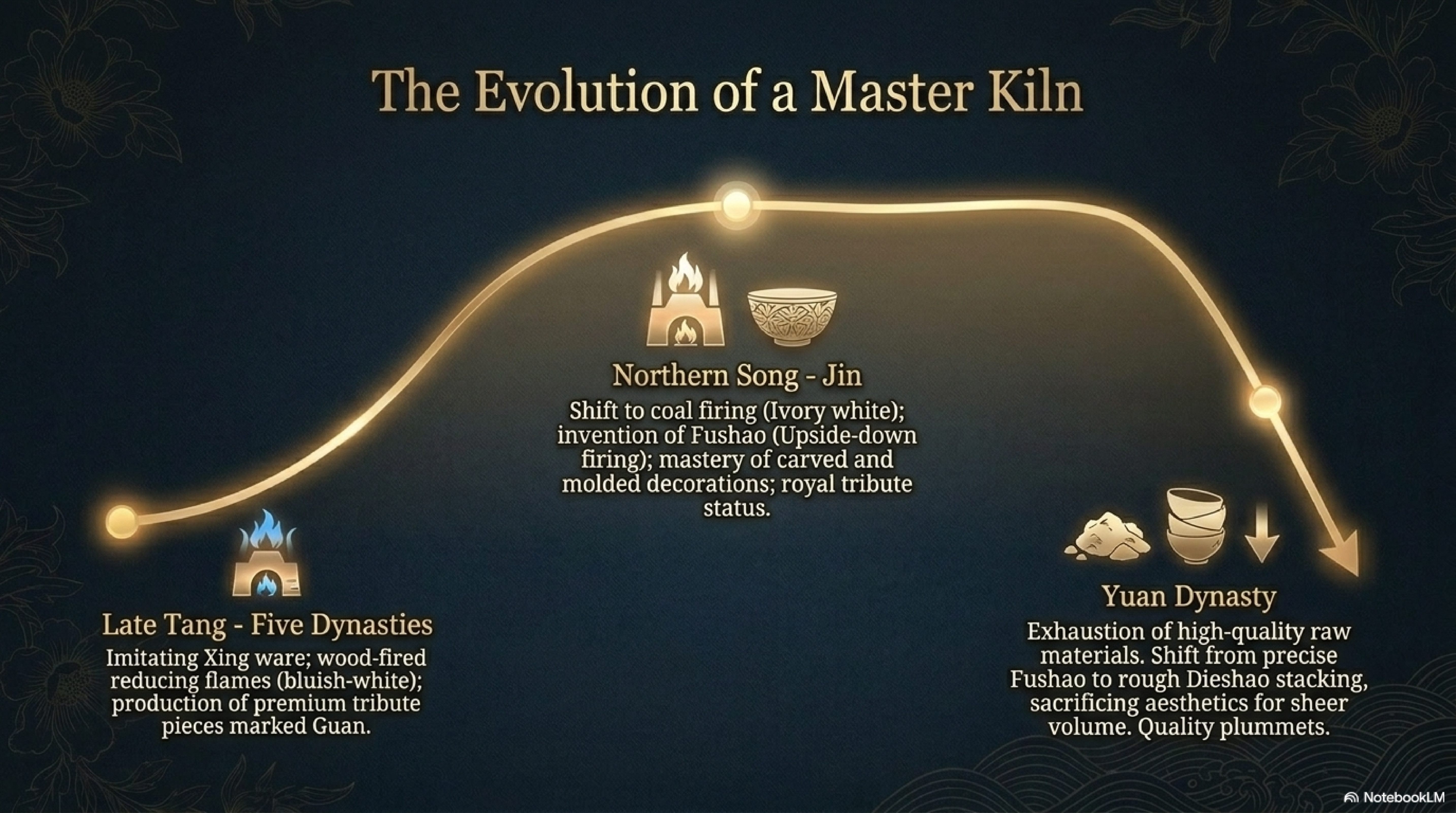
The evolution of the Ding kiln across five centuries: Late Tang to Five Dynasties origins (wood-fired, bluish-white), Northern Song to Jin peak (coal-fired ivory white, Fushao, royal tribute), and Yuan decline (raw material exhaustion, quality collapse)

The arc of a master kiln. Late Tang–Five Dynasties: wood-fired, bluish-white, imitating Xing, marked 官. Northern Song–Jin: coal-fired ivory white, invention of Fushao, carved and moulded masterworks, royal tribute status. Yuan: exhaustion of high-quality raw materials, shift to rough stacking (叠烧), quality plummets, decline.

Imperial Ding vs. Commercial Ding

Song dynasty Ding ware divides into two broad streams — pieces produced for the court and the scholarly elite, and the enormous commercial output serving a broader market across northern China:

Imperial & Elite Ding

Court & Scholar Ware · Northern Song Dynasty

  • Body: Exceptionally thin — translucent at the thinnest points when held to light
  • Decoration: Finest incised (划花) or moulded (印花) work — dragons, phoenixes, lotus, peony
  • Rim: Metal-banded (copper, silver, or gold) — 金装定器 (Jīn Zhuāng Dìng Qì)
  • Glaze: Richest ivory tone, perfectly even, with characteristic 积釉 pooling at centre
  • Base marks: 官, 尚食局, 尚药局, or 东宫 carved before firing
  • Value: Among the most prized of all Song ceramics at auction

Commercial Ding

Everyday Ware · Song to Jin Dynasty

  • Body: Thicker — still correctly ivory-toned, but less translucent
  • Decoration: Simpler incised motifs or plain glaze — floral scrolls, fish, combed grounds
  • Rim: Unbound 芒口, left raw or lightly smoothed
  • Glaze: Slightly greyer or yellower tone; less controlled 积釉 pooling
  • Base marks: None, or informal workshop marks
  • Value: More accessible — an excellent entry point for new collectors
Jin Zhuang Ding Qi (金装定器): a fine Song or Jin dynasty Ding ware bowl and saucer with gold metal banding applied to the Mang Kou unglazed rim, set against a dark ground

金装定器 (Jīn Zhuāng Dìng Qì) — metal-adorned Ding ware. The sharp contrast between cold gleaming gold and warm ivory glaze transformed a manufacturing compromise into one of the most coveted aesthetics in Song court culture. The unglazing was precise: inner rim wider, outer rim narrower (一阳一阴), requiring masterful knife work to ensure the metal band seated seamlessly against the ivory body.