紫口铁足,冰裂如玉
Purple at the rim, iron at the foot, cracked like jade
The sole true imperial kiln among the Five Great Kilns.
Born under Emperor Huizong, perfected in exile, and irreplaceable to this day.
The word Guan (官) means "official." In the context of Chinese ceramics, it carries two entirely distinct meanings — and understanding the difference is the first, non-negotiable step for any serious collector.
Any Official Kiln. Across all dynasties, any kiln commissioned by the government to produce ceramics for state use — including the famous Ming and Qing Imperial Kilns at Jingdezhen — is broadly called a "Guan" kiln. This definition spans over a thousand years and dozens of kiln sites.
The Song Dynasty Royal Kilns. Kilns strictly established, directly owned, and personally managed by the Song imperial court itself. This is the definition that matters to collectors — and the exclusive focus of this guide.
From the 16th century onwards, Ming connoisseur-collectors elevated five Song kilns above all others. Guan occupies a structurally unique position within this hierarchy: it is the only kiln built from its very inception as a strict, top-down state-owned enterprise. Ru, Ge, Jun, and Ding were all initially private enterprises — later co-opted or patronised by the court. Guan was designed as imperial property from day one.
Subtle sky blue. Iron oxide glaze. Fewer than 100 authenticated pieces survive worldwide. Initially a private kiln, later adopted by the court.
Celadon & pale blue. The sole kiln built as a royal institution from day one. Distinguished by its thick glaze, ice crackle network, and the Purple Mouth Iron Foot. The subject of this guide.
Crème & grey. Gold-wire-and-iron-wire crackle glaze. The kiln's precise location remains unconfirmed by archaeology.
Vibrant purple & sky blue. Copper-based yaobian glaze. Unpredictable colour-play. Initially a private kiln, later adopted by the court.
Pure white & ivory. High-fired porcelain. Elegantly carved and moulded decoration. Initially a private kiln, later adopted by the court.
"底足黑如铁、口边紫如檀、釉面厚如玉、气泡密如珠"
— The ideal characterisation of authentic Song Guan ware, preserved in late Ming collector's literature: iron-black foot, sandalwood-purple rim, glaze as thick as jade, bubbles as dense as pearls.Guan ware begins with one of history's most paradoxical figures: Song Huizong (宋徽宗, r. 1100–1125; abdicated 1125, captured 1127) — a man of extraordinary artistic genius and catastrophic political judgement. An accomplished painter, calligrapher, and connoisseur, Huizong channelled imperial aesthetic ambitions into ceramics more directly and systematically than any emperor of his era. The result was the Northern Song Guan Kiln, established in the imperial capital Bianjing (汴京) — modern-day Kaifeng, Henan Province.
This was the only kiln among the Five Great Kilns built as a state enterprise from scratch. No private origin. No gradual court adoption. It was conceived, funded, and managed by the palace with a single mission: to produce the ultimate imperial vessel — refined beyond anything a commercial kiln could conceive, answerable to no market but the Emperor's own taste.
Archaeologically, the Northern Song Guan Kiln is a ghost. Despite detailed descriptions in historical texts confirming its existence, the exact kiln site beneath modern Kaifeng has never been excavated. The reason is geological: the city sits above a notoriously high water table, and Kaifeng has been flooded and rebuilt multiple times across the centuries. The kilns — and potentially a significant portion of their output — lie buried beneath layers of floodwater silt, inaccessible to modern archaeology.
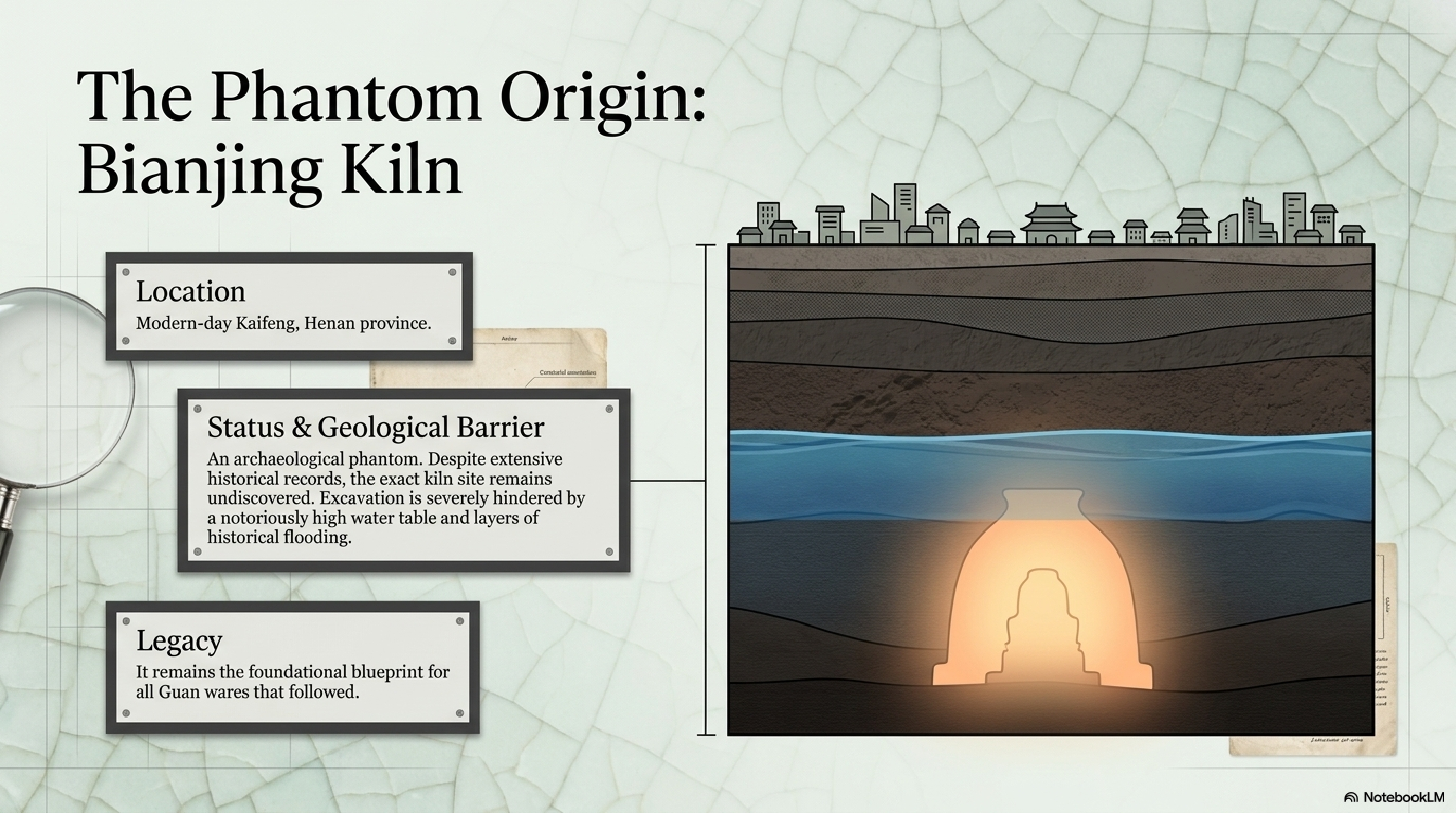
The Northern Song Guan Kiln buried beneath modern Kaifeng. Layered beneath a notoriously high water table and centuries of flood deposits, the site remains an archaeological phantom despite extensive historical documentation of its existence.
What we know of the Northern Song Guan Kiln comes almost entirely from written sources. Its aesthetic legacy, however, is indisputable: every Guan ware piece that followed — across a century of Southern Song production — was made in deliberate pursuit of the blueprint Huizong established at Bianjing.
In 1127, the Jin dynasty armies swept south, captured Bianjing, and took Emperor Huizong prisoner in the catastrophic event known as the Jingkang Incident (靖康之耻). The Northern Song Dynasty collapsed overnight. The surviving court fled south and eventually established a new capital at Lin'an (临安) — today's Hangzhou, Zhejiang Province.
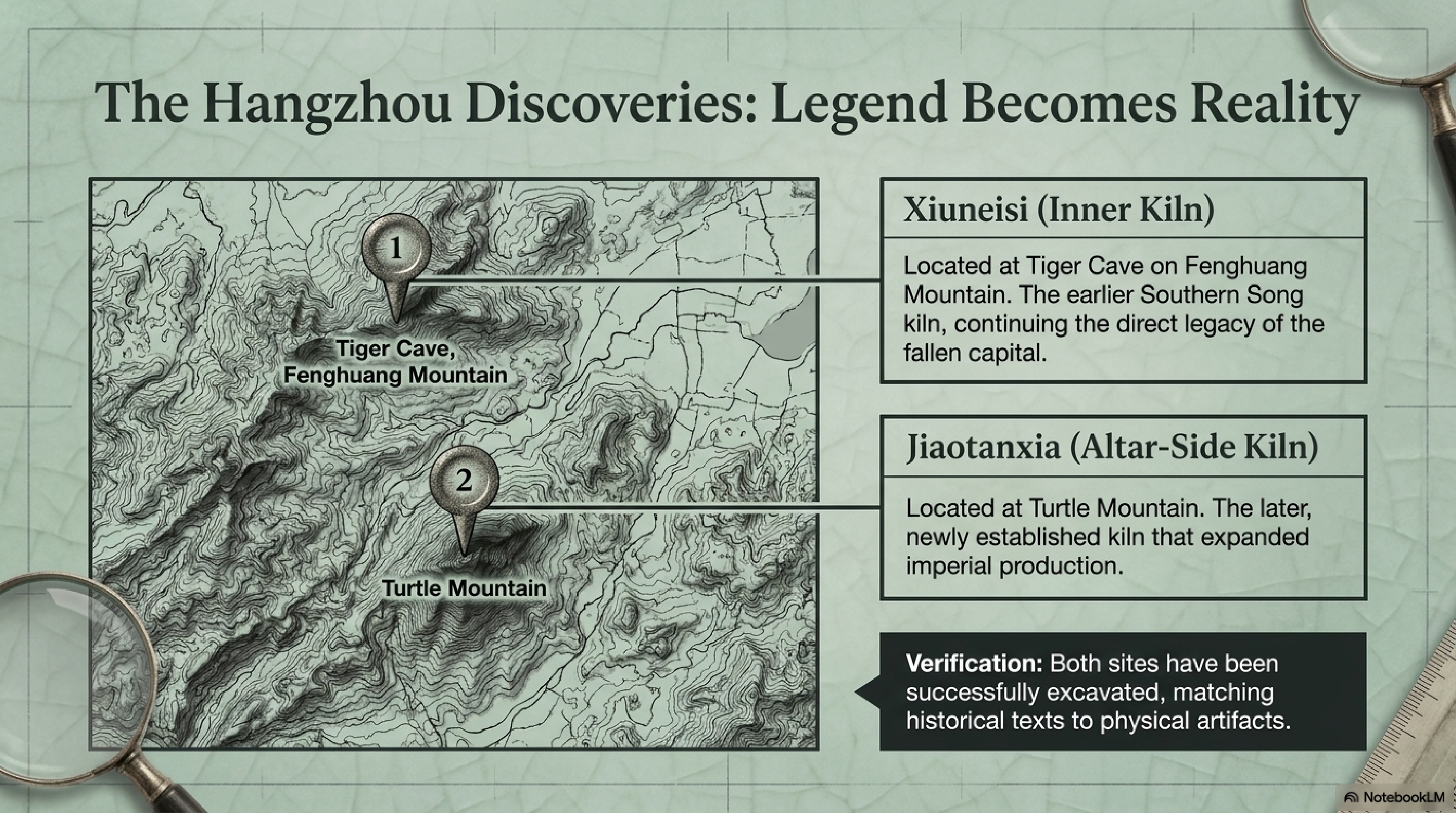
The Southern Song court brought with it the ambition — and the master craftsmen — to re-establish the imperial kilns. Two successive kiln sites were established in the hills around Hangzhou. Unlike their Northern predecessor, both have since been located and excavated by archaeologists, confirming the historical texts with physical evidence.
The two Southern Song Guan Kiln sites in the hills around Hangzhou. Both Xiuneisi (Tiger Cave, Fenghuang Mountain) and Jiaotanxia (Turtle Mountain) have been successfully excavated, matching historical texts to physical artifacts.
Tiger Cave · Fenghuang Mountain · The Earlier Kiln
Turtle Mountain · The Later, Expanded Kiln
Both kilns achieved mastery in the three canonical Guan ware glaze colours: Powder Green (粉青) — considered the supreme achievement, a soft jade-like celadon — alongside Pale White (月白) and Oil-Ash Grey (油灰), so named for its resemblance to the colour of lamp-oil ash. The physical differences between the two kilns' output are among the primary tools used today to attribute individual pieces.
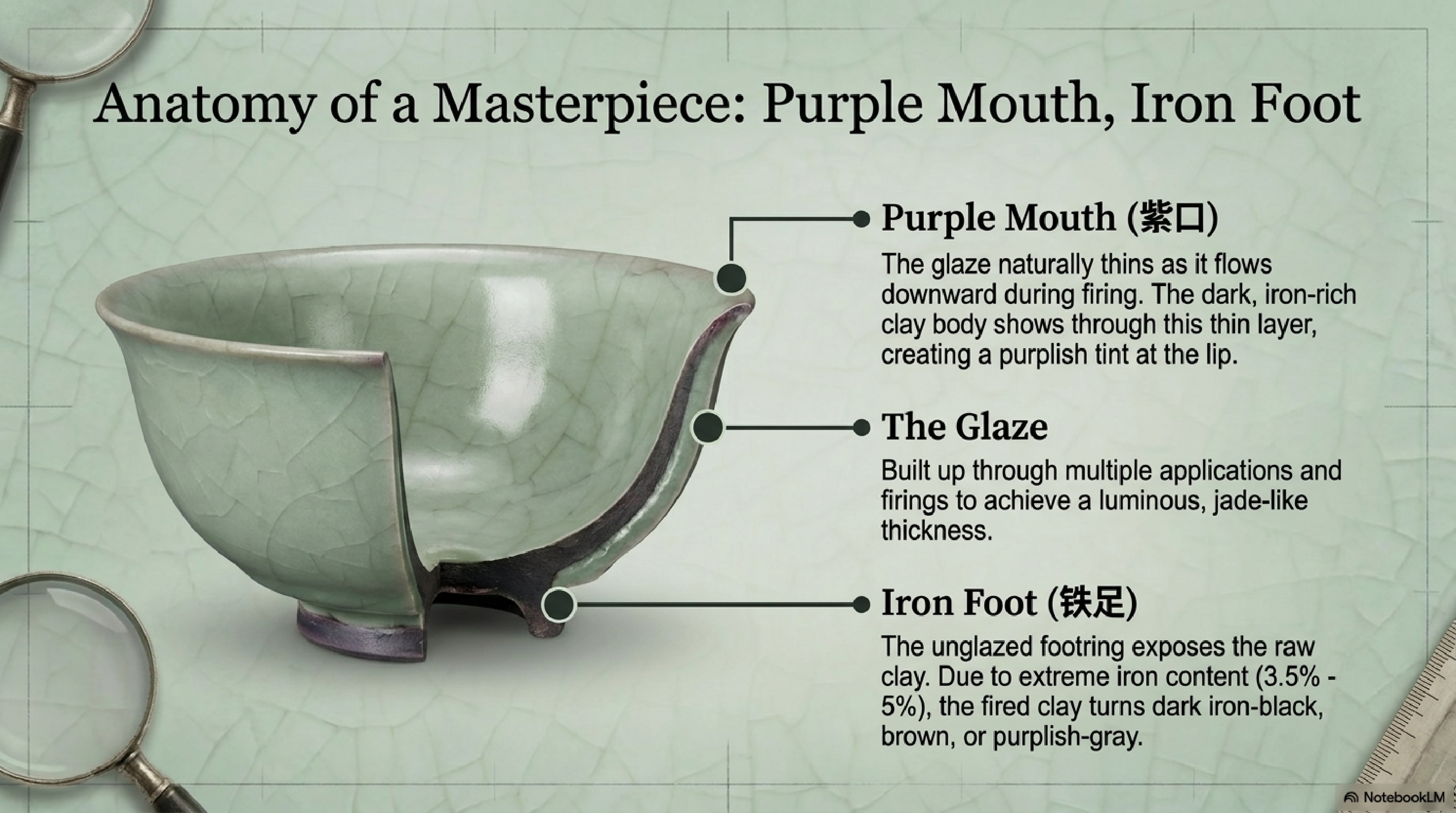
The most celebrated visual feature of authentic Guan ware — the Zǐ Kǒu Tiě Zú (紫口铁足) — is not a decorative choice. It is the inevitable physical consequence of an iron-rich clay body meeting a thick, gravity-obeying glaze. It is also one of the hardest features for later imitators to convincingly replicate.
Cross-section of a Song Guan ware bowl showing the three defining structural features: the thick layered glaze, the thin rim revealing the dark clay body (Purple Mouth), and the unglazed iron-black footring (Iron Foot).
Guan ware's signature jade-like opacity is achieved through a painstaking process almost unparalleled in ceramic history: the vessel is glazed, fired, re-glazed, and fired again — repeated until the glaze layer builds up to an extraordinary thickness. This multi-layer technique creates an internal depth of light that no single-application glaze can reproduce, giving the surface its characteristic luminous warmth. The high-calcium lime-alkali glaze formulation is viscous and slow-moving at temperature, resisting gravity rather than flowing to the base.
Despite its viscosity, the thick glaze is still subject to gravity. Over successive firings, a microscopic amount of glaze flows downward, leaving the uppermost rim slightly thinner than the body. At this thin edge, the dark, iron-rich clay body (with 3.5%–5% iron oxide content) shows through the translucent glaze, creating a warm purplish-brown tint at the lip. Subtle on some pieces, vivid on others — but always natural. It cannot be painted on.
The footring is intentionally left unglazed, exposing the raw clay directly to the kiln atmosphere. During firing, the elevated iron oxide content of the clay (typically 3.5%–5%) becomes fully visible on this exposed surface, producing a characteristic dark iron-black, deep brown, or purplish-grey colour depending on kiln conditions. This creates a dramatic visual tension between the pale jade glaze above and the iron-dark foot below — a contrast the Song court considered the highest expression of restrained aesthetic power. The darker the foot, the higher the iron content, and generally the more prized the piece.
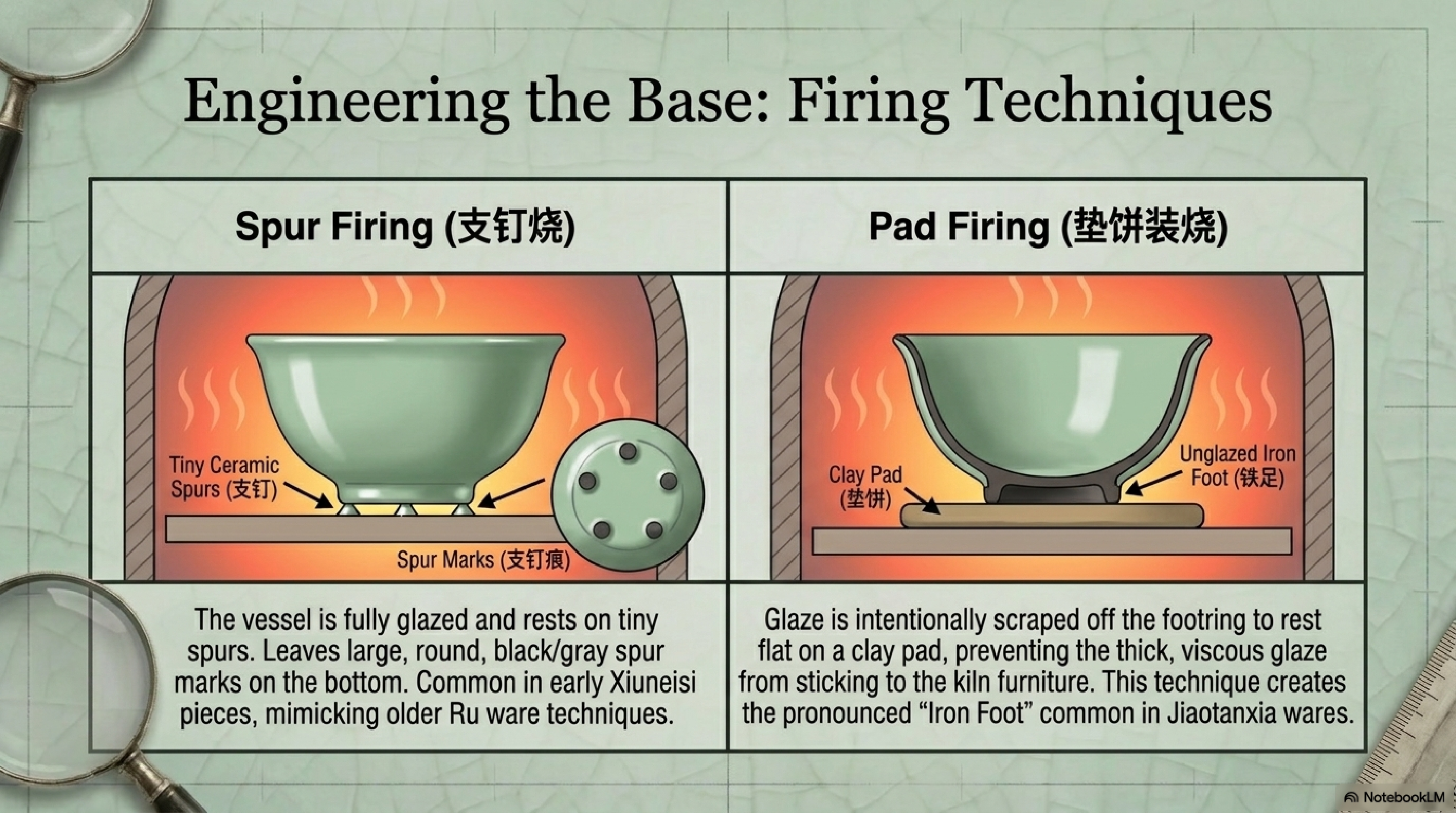
The technique used to support a Guan ware vessel inside the kiln during firing left permanent, physically identifiable traces — traces that specialists use today as a key attribution tool. Two primary methods were used across the kiln's production history.
支钉烧 · Zhī Dīng Shāo · Early Xiuneisi Technique
The vessel is fully glazed to its base and rests on tiny ceramic spurs (支钉) inside the kiln furniture. After firing, the glaze is intact on the bottom, but the contact points leave distinctive large, round, black or grey spur marks on the base — typically three to five marks, clearly visible. This technique was common in early Xiuneisi pieces, apparently influenced by the Ru ware tradition that Huizong had so deeply admired.
垫饼装烧 · Diàn Bǐng Zhuāng Shāo · Jiaotanxia Standard
The glaze is intentionally scraped off the footring before firing, and the vessel rests flat on a clay pad (垫饼). This prevents the thick, viscous glaze from fusing the vessel permanently to the kiln furniture at high temperature. The result is the pronounced Iron Foot — the dark, unglazed footring that became the defining hallmark of Jiaotanxia wares, and the most copied feature by later imitators.
Left: Spur firing — the vessel rests on tiny ceramic spurs, leaving round spur marks on the glazed base. Right: Pad firing — the footring is scraped bare and rests on a clay pad, producing the unglazed Iron Foot.
Two phenomena define the surface world of authentic Guan ware — one visible to the naked eye, one requiring magnification to fully appreciate. Together, they embody the Song aesthetic ideal: infinite microscopic complexity within apparent macroscopic simplicity.
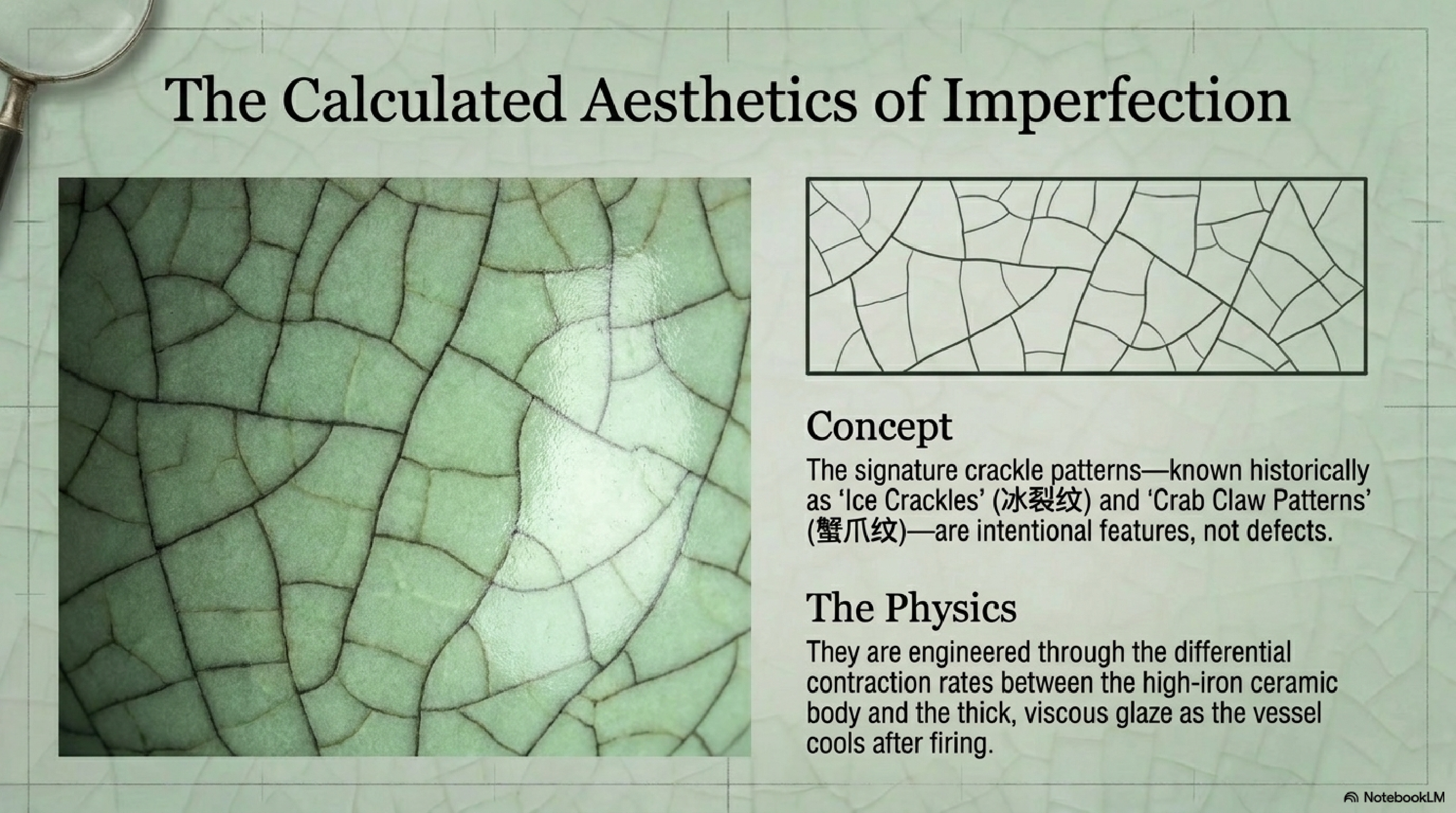
The network of cracks covering the Guan ware surface is not a flaw. It is an engineered consequence — the visible record of physics at work as the vessel cools from firing temperature. The glaze and the clay body contract at different rates. The glaze contracts more rapidly, fracturing across the surface in a controlled, beautiful network that penetrates its full thickness. Song craftsmen could vary the crackle pattern by adjusting glaze thickness and cooling speed.
Close-up of ice crackle (冰裂纹) on a Song Guan ware celadon glaze. The crack network is the result of differential thermal contraction — an engineered feature the Song connoisseurs ranked as the highest decorative achievement possible without human brushwork.
Large, irregular polygonal cracks that sweep across the glaze surface like broken ice on a winter pond. Found on thick-glazed pieces where differential contraction is greatest. The most prized crackle type — Song connoisseurs ranked it highest for its bold, sculptural presence. The finest examples show crack lines filled with dark iron deposits, making them visible in raking light.
Finer, branching crackle networks resembling the articulated legs of a crab. Formed on thinner-glazed areas or pieces. Narrower lines but equal depth. On the finest examples, ice crackle and crab claw patterns coexist in different zones of the same vessel — creating a layered, three-dimensional visual depth found nowhere else in the ceramic world.
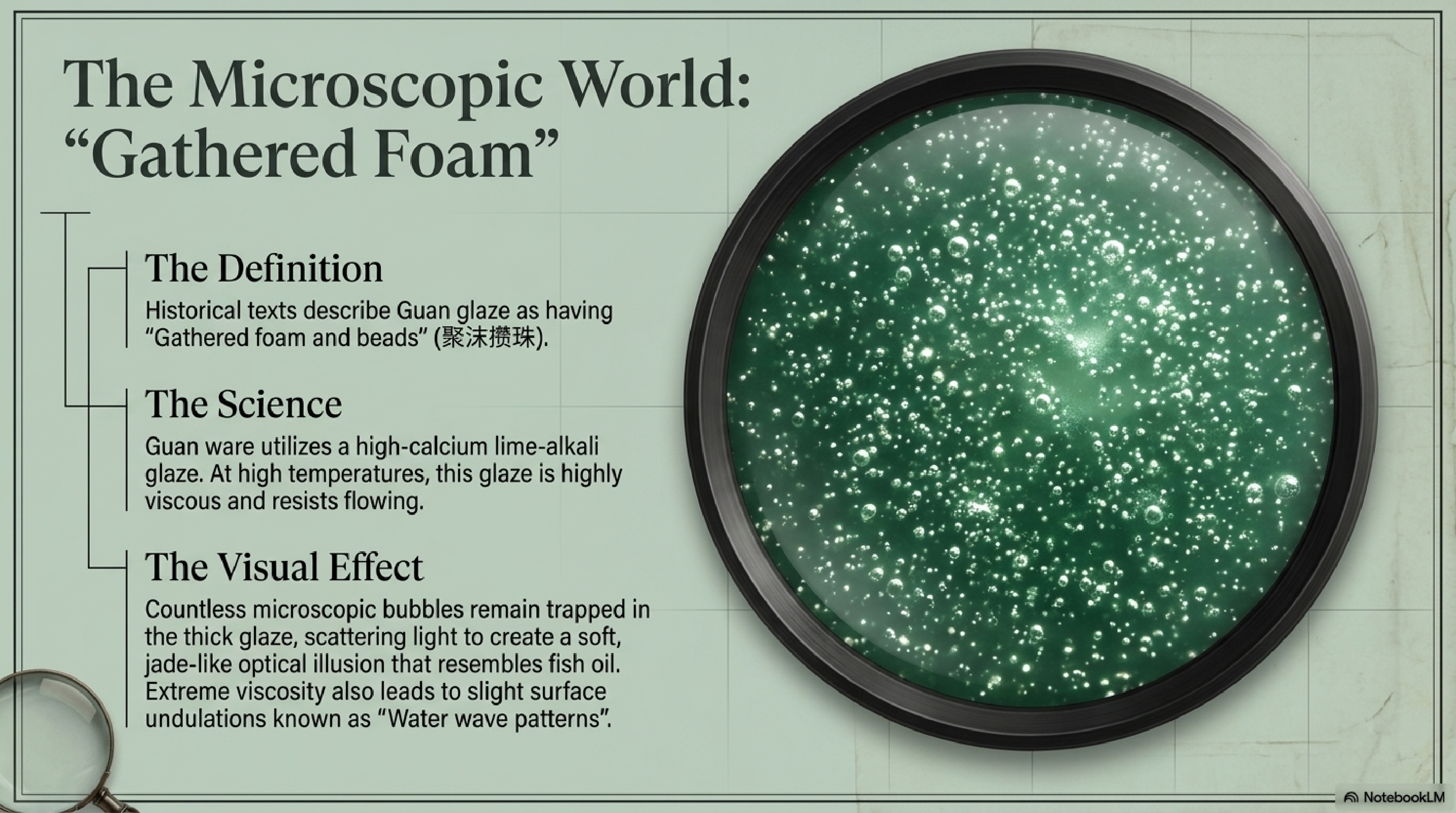
Historical texts describe Guan glaze as having "gathered foam and clustered beads" (聚沫攒珠 — jù mò zǎn zhū). Under optical magnification, this poetic description resolves into a measurable physical feature — one useful marker, among several, for distinguishing Song originals from later imitations.
Microscopic view of Song Guan ware glaze. The countless micro-bubbles trapped within the thick glaze scatter incoming light to create the soft, jade-like luminosity described as "gathered foam and clustered beads." The natural clustering and irregular bubble sizes are distinct from later Jingdezhen imitations.
Guan ware uses a high-calcium lime-alkali glaze. At high temperatures, this specific formulation becomes highly viscous — resisting flow in a way that lower-calcium glazes cannot achieve.
The extreme viscosity traps countless microscopic gas bubbles within the glaze during firing. Gas cannot escape through the dense, slow-moving glass before it cools and solidifies. The bubbles remain — permanently suspended in crystal.
Millions of tiny bubbles scatter incoming light, creating a soft, luminous depth that resembles polished nephrite jade or fish oil. Surface viscosity also produces slight undulations — the "water wave patterns" (水波纹) seen on late Xiuneisi pieces.
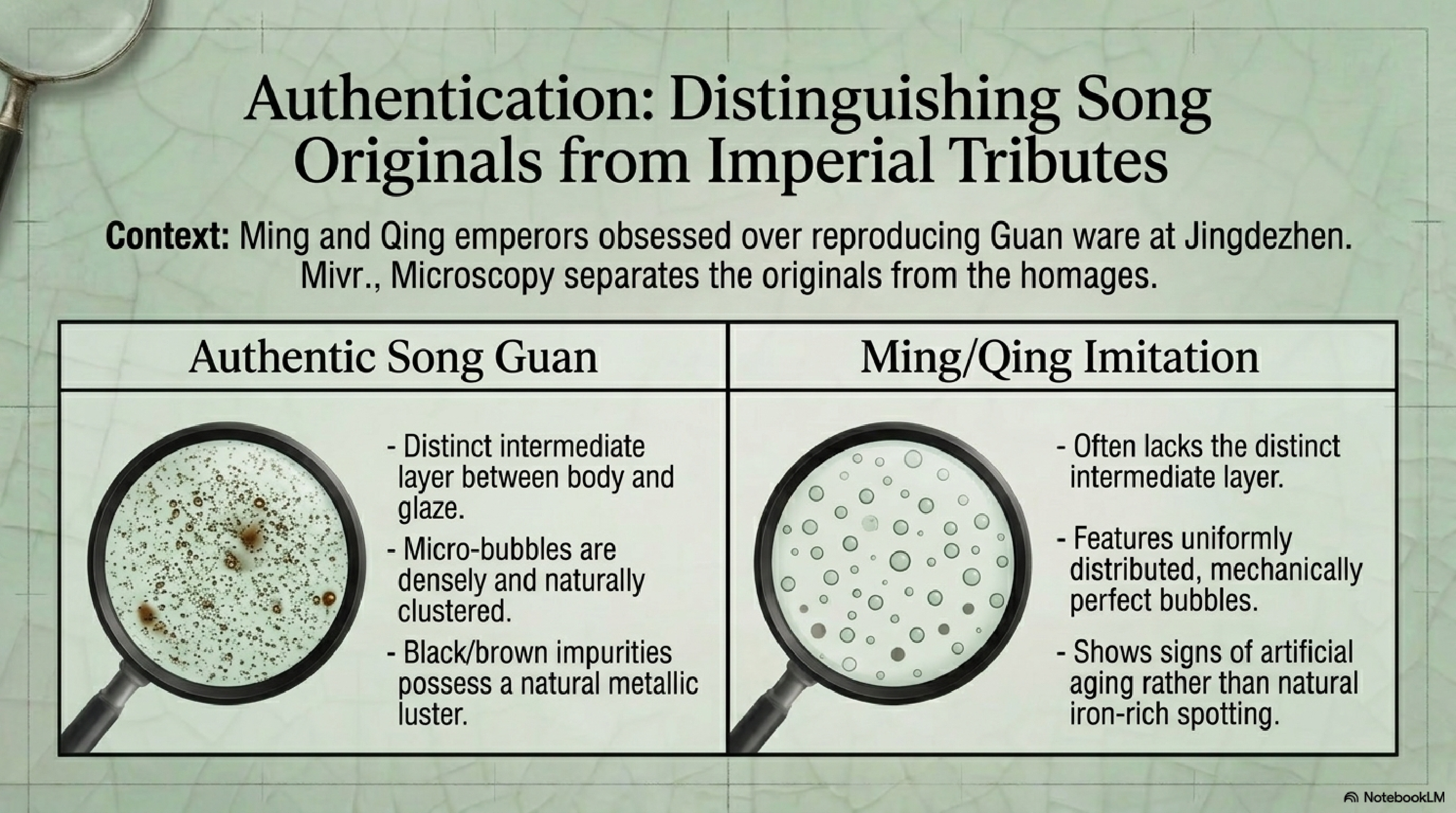
Guan ware has been the most consistently imitated ceramic in Chinese history. Ming and Qing emperors were obsessed with reproducing the Song aesthetic — Xuande, Chenghua, Yongzheng, and Qianlong all commissioned large-scale Guan imitations from the Jingdezhen Imperial Kilns. Many of these imitations are masterpieces in their own right. But they are not Song Guan.
The definitive method for separating Song originals from imperial tributes is microscopic examination of the glaze structure. What separates originals from imitations is not visible macroscopically — it lives in the glaze itself.
Microscopy comparison: Song Guan (left) shows dense, naturally clustered micro-bubbles and distinct iron impurities with metallic lustre. Ming/Qing Jingdezhen imitation (right) shows uniformly distributed, mechanically regular bubbles and artificial aging patterns.
宋代官窑真品 · 12th–13th century
明清仿官 · Jingdezhen Imperial Kiln reproductions
A Yongzheng imitation of Guan ware can be a masterpiece in its own right — but it is not Song Guan. Knowing which you hold is the difference between an informed collector and a very expensive misattribution.
Guan ware has been the defining benchmark of value in Chinese ceramics collecting since the Ming dynasty, when imperial connoisseurs first codified the Five Great Kilns hierarchy. Twenty-first century auction results have confirmed what centuries of patronage established: Song Guan ware commands the highest prices in its category with remarkable consistency.
A 2025 auction of a Southern Song Guan ware celadon mallow-mouth dish (官窑青釉葵口盘) achieved approximately 51.64 million RMB, setting a new record for the category and confirming Guan ware's position at the apex of the Chinese ceramics market. This is not a recent phenomenon. Song Guan has been a consistent store of cultural and monetary value across six centuries of systematic collecting.
Collectors must distinguish among authentic Southern Song pieces from both Xiuneisi and Jiaotanxia, exceptional Ming and Qing imperial imitations that represent masterpieces in their own right, and 20th-century reproductions of widely varying quality — each category requiring distinct technical analysis. Facility with both the macroscopic hallmarks and microscopic glaze markers described in this guide is the essential foundation of confident Guan ware collecting.
官窑就是那种底足黑如铁、口边紫如檀、釉面厚如玉、气泡密如珠的皇家瓷器。每一件作品都体现了宋代极简主义的巅峰美学。
— Guan ware is the quintessential imperial ceramic: iron-black foot, sandalwood-purple rim, jade-thick glaze, pearl-dense bubbles. Each piece embodies the pinnacle of Song minimalist aesthetics.