金丝铁线,紫口铁足,聚沫攒珠
Gold wire and iron thread — the perfect flaw, perfected
The only kiln to transform a manufacturing defect into the highest register of imperial aesthetic culture.
An unresolved mystery for eight hundred years — and China's most exquisitely cracked porcelain.
Among China's Five Great Kilns of the Song Dynasty, four are celebrated for conventional perfection — Ru for its ethereal sky-blue glaze, Ding for its pure ivory-white porcelain, Jun for its volcanic copper-blue and purple glazes with spontaneous red flashes, Guan for its imperial jade-thick celadon. Ge Kiln (哥窑) did something entirely different. It looked at a manufacturing defect — the crazing of a glaze during cooling — and elevated it to the highest register of imperial aesthetic culture.
This was not an accident. Ge Kiln masters understood the physics of thermal shrinkage well enough to control it with mathematical precision, creating a crackle network so deliberately calibrated — in depth, width, colour, and pattern — that no two pieces are alike. The result is a ceramic tradition that embodies a distinctly Chinese philosophical ideal: a counterpart to the Japanese concept of wabi-sabi, finding transcendence not in flawlessness but in the orchestrated imperfection of natural forces.
Ethereal sky-blue. Iron oxide celadon. Fewer than 100 authenticated pieces survive worldwide. The rarest of the five.
Jade celadon. The sole kiln built as a royal institution from day one. Thick glaze, ice crackle, Purple Mouth Iron Foot.
Crème & grey. Gold Wire and Iron Thread dual-coloured crackle. The most mysterious of the five — kiln site unconfirmed, origins debated. The subject of this guide.
Pure ivory-white. High-fired porcelain. Elegantly carved and moulded decoration. Celebrated for its perfect whiteness.
Vibrant purple & sky blue. Copper-based yaobian glaze. Unpredictable, volcanic colour-play in the kiln.
"金丝铁线、紫口铁足、聚沫攒珠"
— The twelve-character formula every Ge collector must memorize: Gold Wire Iron Thread, Purple Mouth Iron Foot, Smashed Pearls. These three hallmarks define everything that makes Ge Kiln unmistakeable.What follows is a systematic guide to those hallmarks — their physical science, their aesthetic logic, and the forensic methods used to distinguish genuine Song and Yuan Ge ware from the extraordinary volume of imitations produced across the following seven centuries.
Ge Kiln is unique among the Five Great Kilns in a critically important way: it does not appear in a single Song Dynasty historical text. The earliest references emerge in Ming Dynasty literature, centuries after the pieces themselves were presumably made. This absence has generated eight hundred years of scholarly debate — and makes Ge Kiln the most contested attribution problem in the entire history of Chinese ceramics.
Two competing theories define the debate, each supported by different types of evidence.
Source: Chun Feng Tang Sui Bi (春风堂随笔), Ming Dynasty
According to the Ming text, two brothers — Zhang Shengyi (章生一) and Zhang Sheng'er (章生二) — ran competing kilns in Longquan, Zhejiang Province. The younger brother mastered the smooth, flawless celadon for which Longquan became famous. The older brother — "Ge" (哥, meaning "elder brother") — created the crackled glaze. His name became the kiln's name.
Source: 1998–2001 Excavations & 2017 Palace Museum Technical Tests
Chemical analysis by the Palace Museum revealed that the "Heirloom Ge Kiln" (传世哥窑) pieces held in Beijing and Taipei share chemical profiles with Yuan-Dynasty layers excavated at the Tiger Cave Kiln (老虎洞, Laohudong) in Hangzhou — not Longquan. This places authentic Ge Kiln output in Hangzhou, very likely as an offshoot of the Southern Song Official (Guan) kilns on Fenghuang Mountain.
Synthesis: Ge Kiln likely began as an offshoot of the Southern Song Official Kilns in Hangzhou, evolving into a distinct crackle tradition that continued into the Yuan Dynasty — with the Longquan "elder brother" story emerging later as popular mythology.
Authenticated "Heirloom Ge" pieces — those whose chemical profiles match the Tiger Cave excavation findings — number approximately 300 pieces worldwide, the majority held in the Palace Museums of Beijing and Taipei. This makes Ge ware rarer than Yuan Blue-and-White by absolute piece count. The scarcity is compounded by the authentication problem: because no Song-era kilns have been definitively identified as producing these pieces, attribution relies entirely on chemical analysis, stylistic criteria, and provenance. Every piece on the market must be treated with commensurate caution.
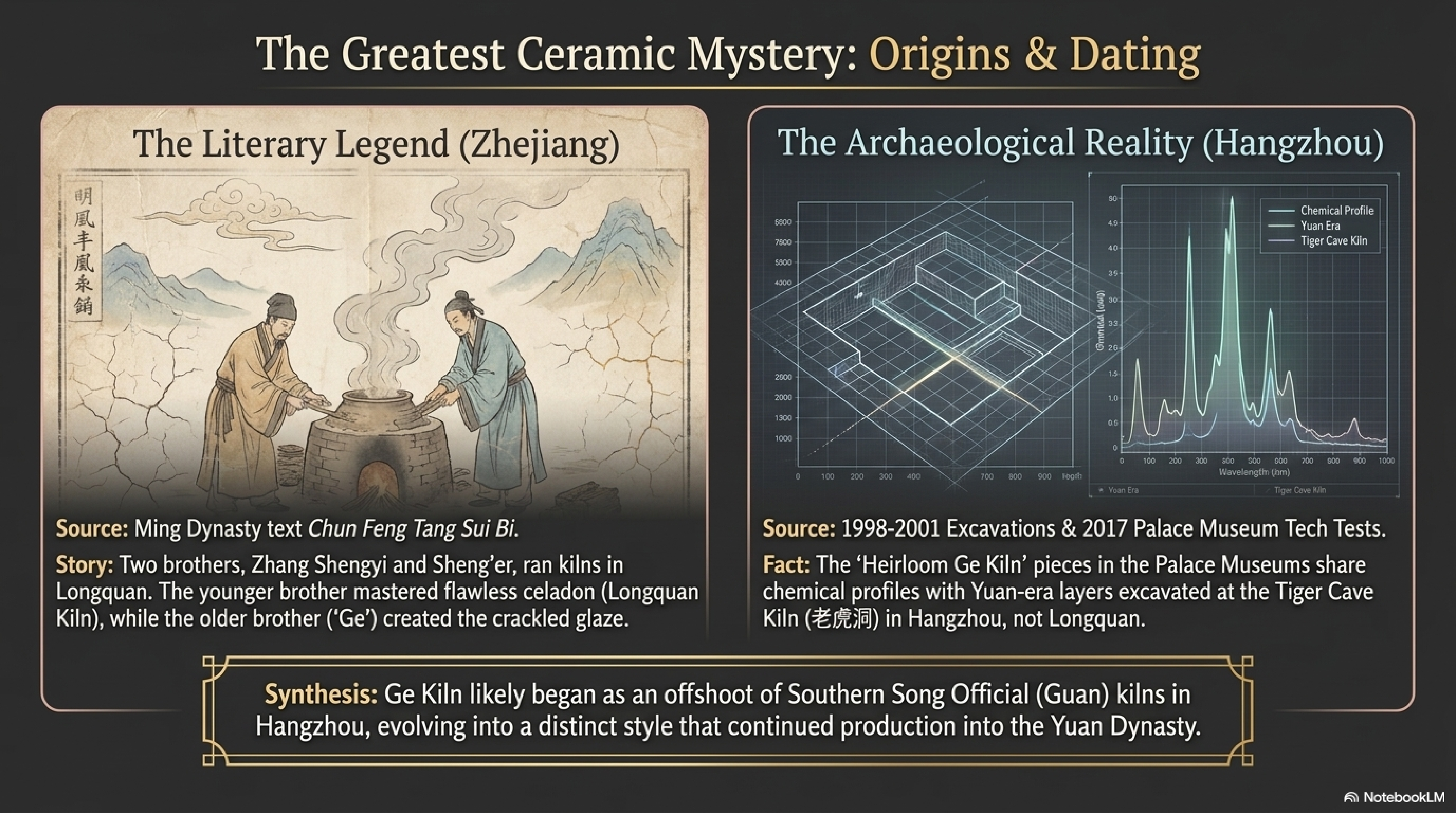
Left: The literary legend from Chun Feng Tang Sui Bi placing Ge Kiln in Longquan, Zhejiang. Right: The chemical evidence from 1998–2001 Tiger Cave excavations and 2017 Palace Museum testing placing authentic Heirloom Ge output in Hangzhou. Current scholarship favours the archaeological record.
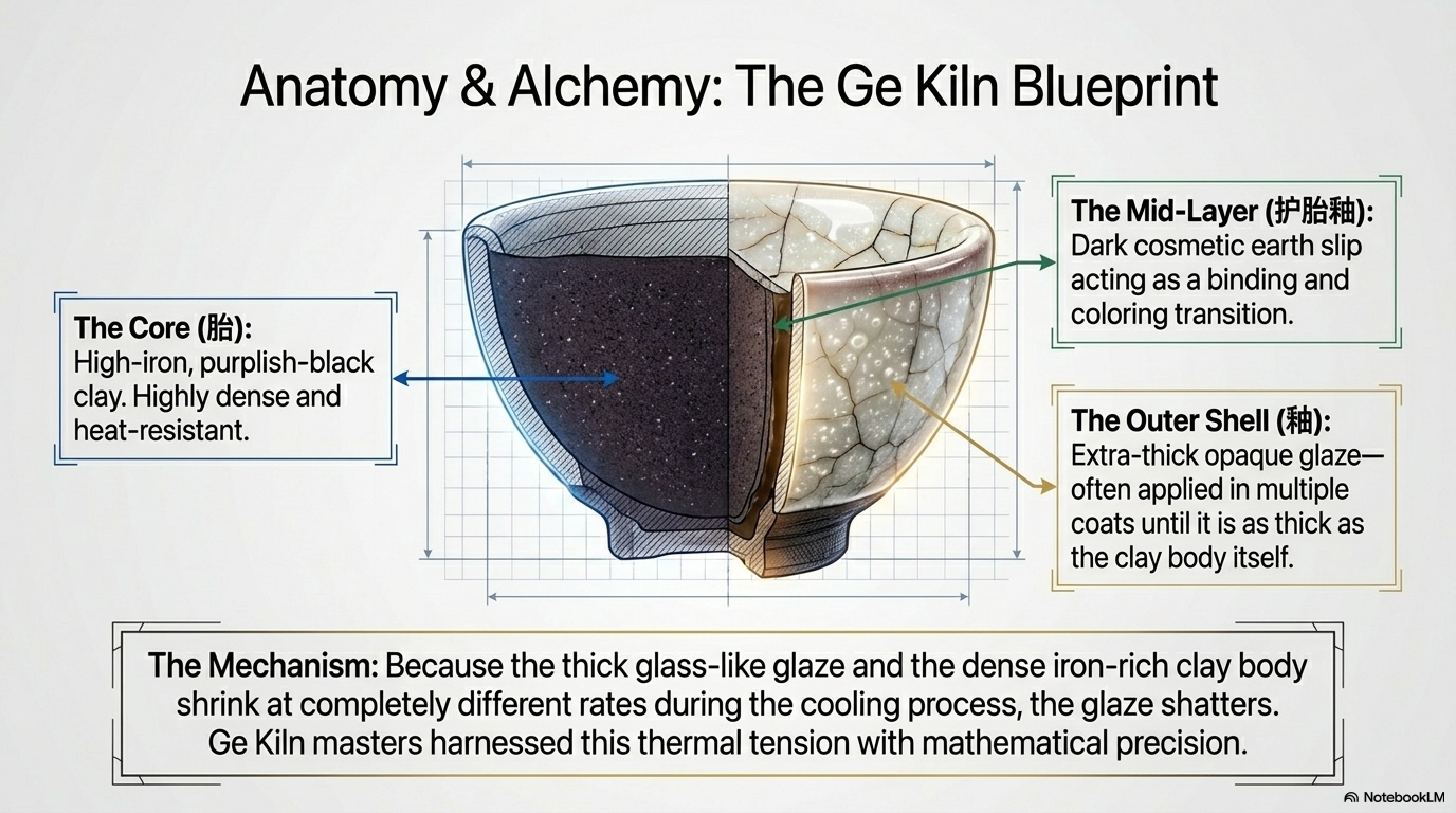
The extraordinary surface of Ge ware is not the product of chance. It is the engineered outcome of a precise three-layer material system — each layer chosen with specific physical properties that interact catastrophically, and beautifully, during the cooling process. Understanding this blueprint is the foundation for understanding every visual feature that follows.
High-iron, purplish-black or deep grey clay. The elevated iron oxide content — far higher than typical Song porcelain — makes the body highly dense and heat-resistant. This iron content is what drives the purple-dark rim coloring and the iron-black foot, and it is chemically distinct from any kiln in Longquan or Jingdezhen. The clay body's specific thermal contraction rate is the critical variable in engineering the crackle.
A thin layer of dark cosmetic earth slip applied over the raw clay body before glazing. This intermediate coating serves as a binding and coloring transition between the dark body and the pale outer glaze. It is responsible for the dark shadowing visible at the rim and foot — and it is one of the microscopic markers that distinguishes authentic Ge ware from later Jingdezhen imitations, which lack this structural layer.
An extraordinarily thick, opaque glaze — applied in multiple coats, fired, re-coated, and fired again — until the glaze layer reaches a thickness sometimes equal to the clay body itself. This is not a transparent liquid-glass coating. It is a dense, semi-opaque, light-scattering structure loaded with microscopic gas bubbles. Its thermal contraction rate is fundamentally different from the iron-rich clay beneath it. That difference is everything.
The Mechanism: Because the thick glass-like glaze and the dense iron-rich clay body shrink at completely different rates during cooling, the glaze shatters under tension. What makes Ge Kiln extraordinary is that its masters harnessed this thermal tension with mathematical precision — controlling the depth, width, and color of each fracture through manipulation of glaze thickness, iron content, and the two-phase cooling sequence.
Cross-section of a Ge Kiln bowl revealing the three-layer blueprint. The outer glaze can equal the clay body in thickness — an extreme ratio unique to Ge and Guan wares. The differential between the glaze's and body's thermal contraction rates is the engineered source of the crackle.
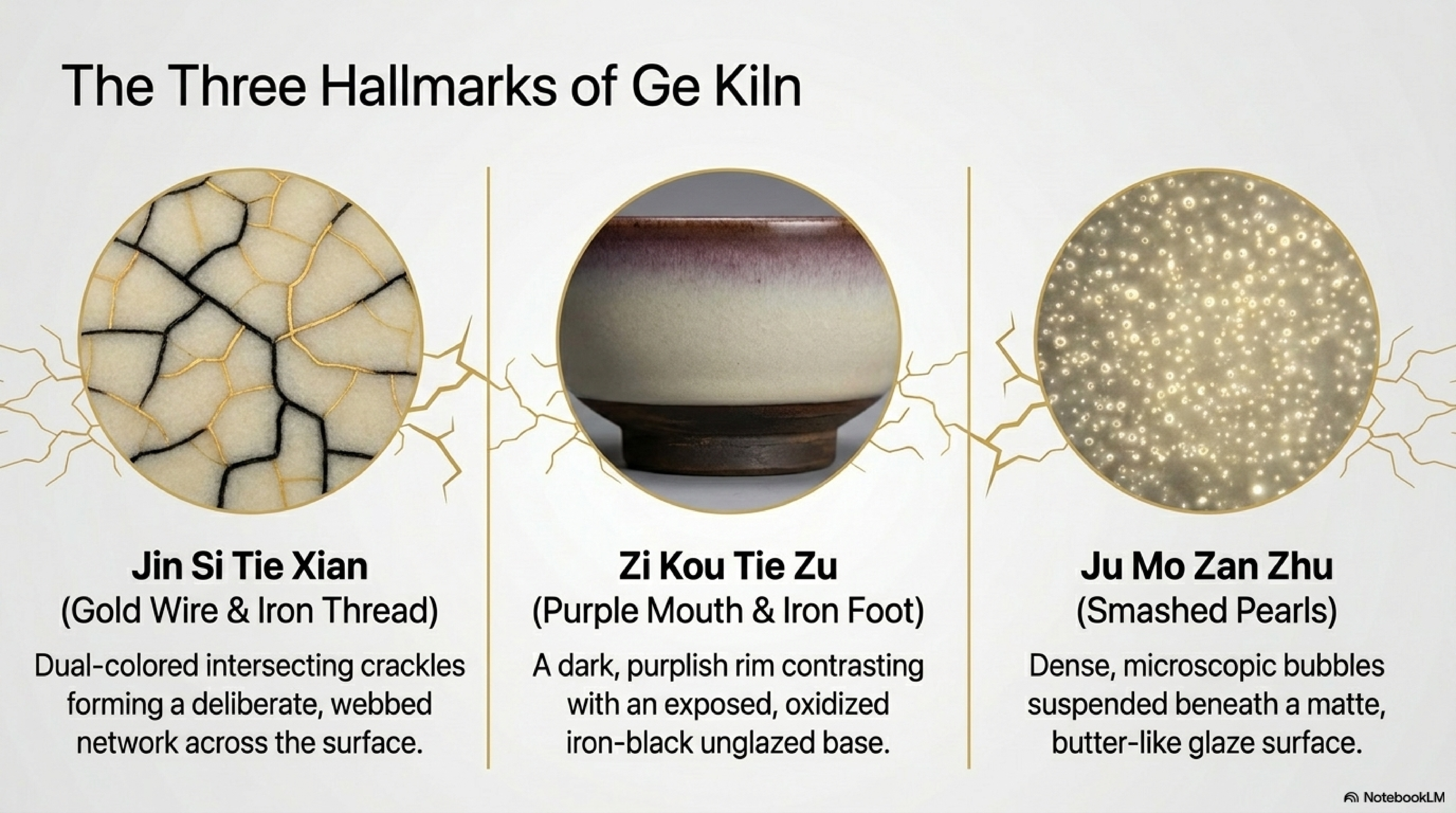
Authentic Ge ware is identified by three visual hallmarks, each the direct physical consequence of the three-layer material system described above. Commit these twelve Chinese characters to memory and you have the complete collector's diagnostic toolkit at your disposal.
The defining surface feature of Ge ware: a webbed network of intersecting crackles in two distinct colors. The large, deep structural fissures appear stark black (Iron Thread, 铁线). Between them, a secondary web of finer, shallower micro-fissures appears in yellowish gold (Gold Wire, 金丝). The two colors are not painted — they are the natural result of a two-phase cooling process. The organic, irregular interlocking of these two crack networks — neither uniform nor forced — is the most difficult feature for forgers to replicate convincingly.
Gravity thins the thick glaze at the rim during high-temperature firing, allowing the dark purplish-black clay body to shadow through the translucent glaze edge — creating the characteristic Purple Mouth (紫口). At the footring, the base is left unglazed to prevent the vessel from fusing to the kiln floor. The high-iron clay, exposed directly to heat and oxygen during firing, oxidises to a dark iron-brown or black — the Iron Foot (铁足). The resulting contrast between a pale cream glaze above and a dark iron foot below is the hallmark of both Ge and Guan wares.
The extraordinarily thick opaque Ge glaze is not homogeneous glass. Under a microscope, it reveals thousands of densely packed microscopic bubbles — suspended permanently within the solidified glaze matrix. These bubbles scatter incoming light in all directions, creating the famously butter-like, matte, soft inner glow described by Palace Museum specialist Sun Yingzhou as "a lustre like sweat on a human face, smooth as butter." Unlike modern glassy porcelain that reflects light harshly from its surface, Ge ware glows from within. The density and irregular distribution of these bubbles is measurable under magnification — and is one of the key forensic markers used to authenticate genuine pieces.
The three hallmarks side by side: (left) Jin Si Tie Xian — dual-coloured interlocking crackle; (center) Zi Kou Tie Zu — dark purplish rim contrasting with iron-black unglazed base; (right) Ju Mo Zan Zhu — dense irregular micro-bubbles visible under magnification, scattering light into a soft inner glow.
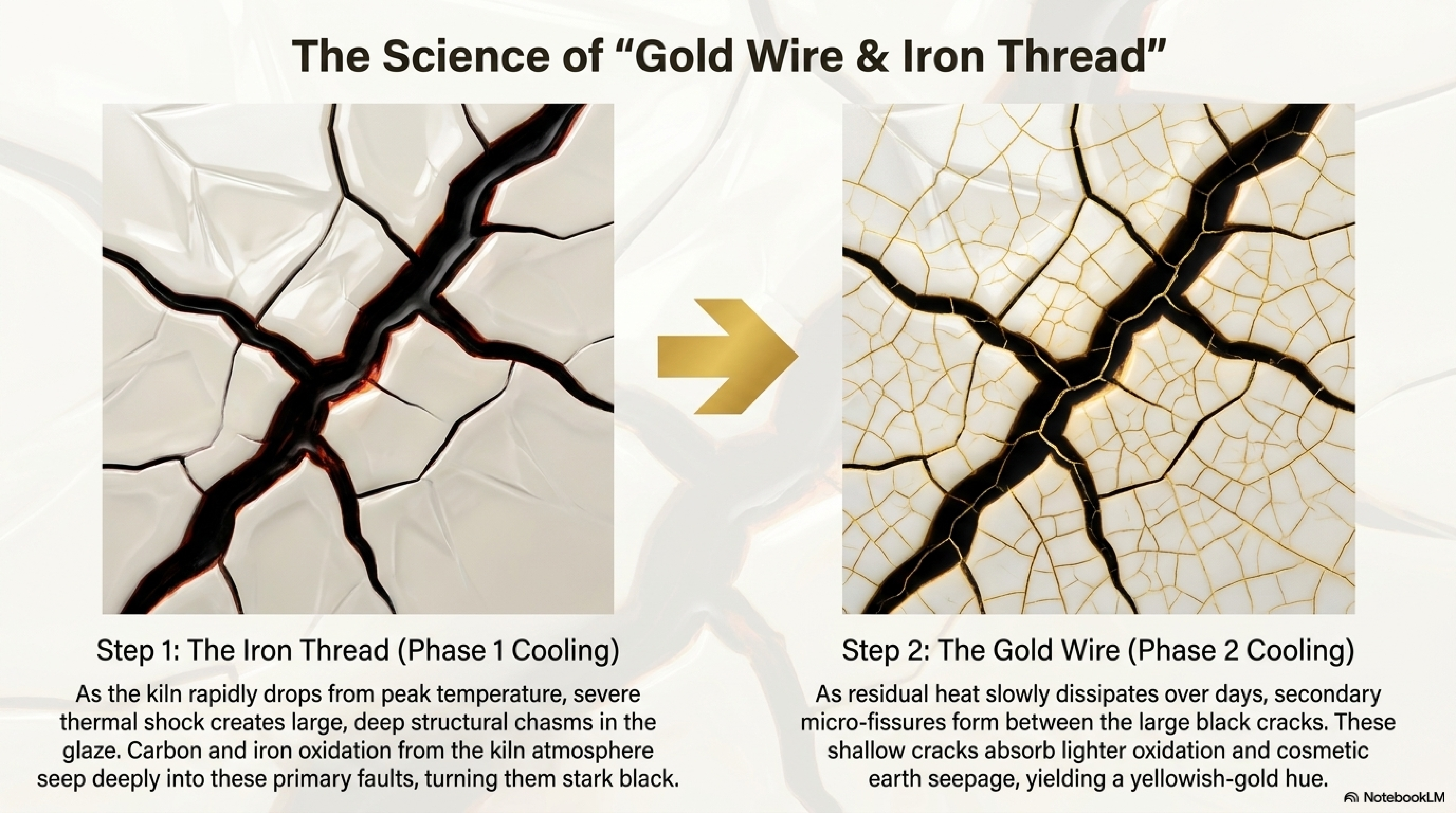
The dual-coloured crackle is not a single event. It is the result of two distinct fracturing phases, separated in time, each producing different crack characteristics — and each absorbing different mineral oxides from the kiln atmosphere. Understanding this two-phase sequence is essential for distinguishing genuine ancient crackle from chemically induced modern forgeries.
As the kiln rapidly drops from peak temperature, severe thermal shock creates large, deep structural chasms in the glaze. Carbon and iron oxidation from the kiln atmosphere seep deeply into these primary faults over hours, turning them stark black. These are the dominant black lines of the crackle network — wide, dramatic, and architecturally dominant.
As residual heat slowly dissipates over subsequent days, secondary micro-fissures form in the spaces between the large black cracks. These shallow cracks absorb lighter mineral oxidation and cosmetic earth seepage from the mid-layer — yielding a yellowish-gold hue. These are the fine gold traceries that fill the panels between the iron-black primary cracks.
Phase 1 (left): Rapid cooling creates large, deep black chasms as carbon and iron seep into primary fractures. Phase 2 (right): Slow residual cooling generates fine secondary micro-fissures absorbing lighter mineral seepage, yielding the characteristic gold-wire tracery between the dominant black cracks.
In a genuine ancient piece, both the black and gold colorings are the result of centuries of natural mineral integration — the oxidation is organically diffused into the glaze matrix at the molecular level, not sitting on top of the crack surface. Under 30× magnification, authentic ancient crackle shows a smooth, gradated organic seepage of iron and carbon. Modern forgeries using chemical dyes (see Authentication section) leave concentrated crystalline particles trapped at the deepest points of the crack — a forensic signature of artificial coloring.
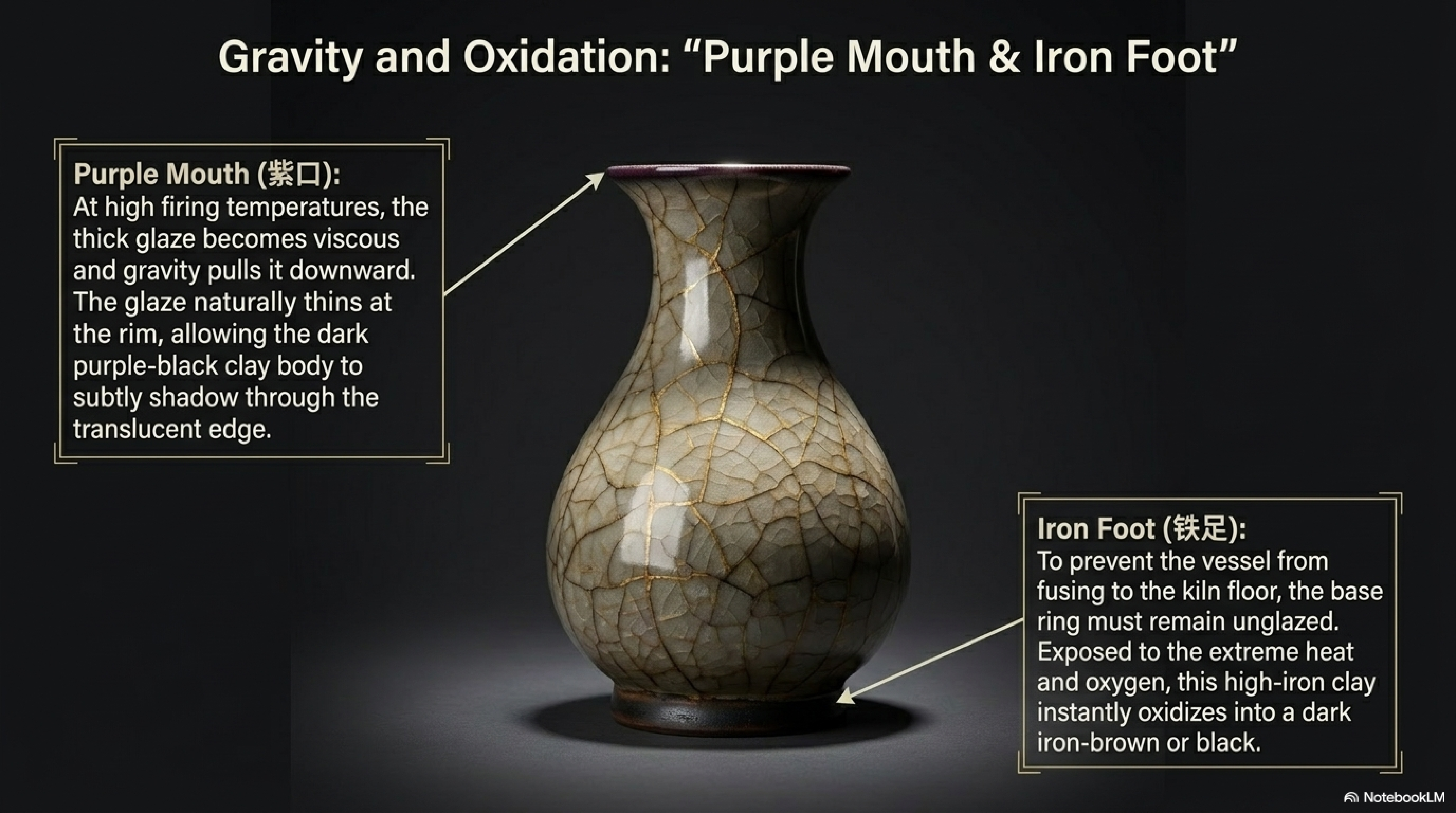
The Purple Mouth and Iron Foot are not decorative choices. Like everything in Ge ware, they are the inevitable physical consequences of high-iron clay meeting a thick, gravity-obeying glaze at extreme temperature. Their authenticity cannot be painted on — and this is precisely why they are the first thing a specialist examines.
The thick glaze becomes viscous at peak temperature and gravity pulls it downward. The glaze naturally thins at the rim, where it has nowhere to accumulate. At this thinned edge, the dark purplish-black clay body shows through the translucent glaze, casting a warm purple-dark shadow. The intensity varies piece to piece depending on the body's iron content and the final glaze thickness at the lip — on the finest pieces it is a deep, dramatic purple ring; on others a subtle darkening.
To prevent the vessel from fusing permanently to the kiln floor, the base ring must remain unglazed. Exposed directly to extreme heat and oxygen during firing, the high-iron clay oxidises to a dark iron-brown or black. The colour runs from deep warm brown to near jet-black depending on kiln atmosphere and iron concentration. A genuine Iron Foot has colour that emanates from within the clay itself — not from surface coating, which would show as uniform, flat, and lacking the characteristic grained texture of naturally oxidised iron-rich stoneware.
A Ge Kiln pear-shaped vase showing both hallmarks in their natural relationship. The purple-dark shadowing at the rim (Purple Mouth) results from glaze thinning through gravity, revealing the dark clay beneath. The iron-black unglazed footring (Iron Foot) results from direct exposure of the high-iron clay to kiln oxidation.
Ge ware's aesthetic vocabulary is remarkably consistent — and deliberately archaic. The forms are almost universally derived from Shang and Zhou Dynasty bronze ritual vessels, reinterpreted in crackled stoneware. The palette is restrained: warm neutral tones that complement rather than compete with the crackle network. This combination of ancient form and fractured surface creates a profound sense of temporal weight — as though the object itself carries the weight of the centuries it commemorates.
Inspiration: Heavily influenced by ancient Shang and Zhou Dynasty bronze ritual vessels — the Ge kiln elevated the archaic form into a new medium, wrapping ancient shapes in fractured light.
Ge ware imitations have been produced continuously since the Ming Dynasty, when imperial connoisseurs began commissioning reproductions from Jingdezhen. Modern fakes range from crude mass-market copies to highly sophisticated pieces designed to deceive specialists. The diagnostic matrix below reflects the physical differences at each level of examination.
传世哥窑 · Song–Yuan Dynasty originals
仿哥窑 · Modern reproductions and forgeries
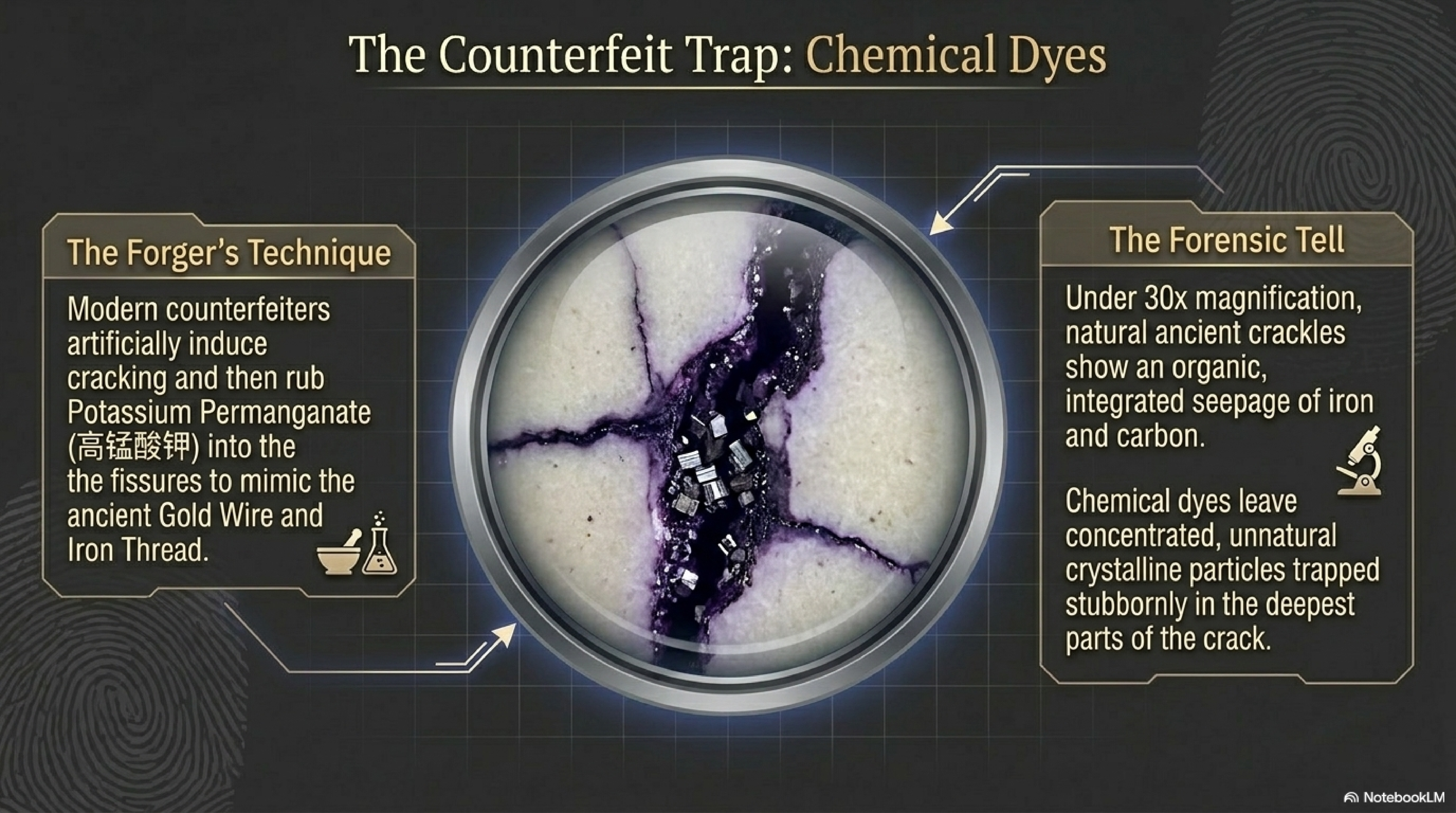
The most sophisticated modern forgery technique involves inducing artificial cracking through thermal shock, then rubbing potassium permanganate (高锰酸钾) into the crack network to mimic the ancient Gold Wire and Iron Thread coloration. To the naked eye, this can be convincing. Under magnification, it is immediately detectable.
Cracks are induced artificially (thermal quenching or chemical treatment). Chemical dyes — typically potassium permanganate — are rubbed into the fissures to produce a brown-black colouring mimicking ancient mineral seepage.
Under 30× magnification, natural ancient crackle shows an organic, integrated seepage of iron and carbon into the glaze matrix. Chemical dyes leave concentrated, unnatural crystalline particles stubbornly trapped at the deepest points of the crack — unmistakeable under a loupe.
Hold the piece at a raking angle under strong light. Genuine ancient crackle absorbs light into the crack depths. Chemically stained cracks tend to show a slight surface sheen at the crack edges — the dye has not penetrated deeply enough to lose its reflective surface quality.
Under 30× magnification: genuine ancient crackle (left) shows smooth organic integration of iron and carbon into the glaze. Chemical dye forgery (right) shows concentrated crystalline particles of potassium permanganate trapped at the crack's deepest point — the definitive forensic signature of artificial staining.
If you remember nothing else from this guide, remember that authentic Ge ware must demonstrate all three hallmarks coherently and simultaneously. A piece with excellent Gold Wire and Iron Thread but a glassy reflective surface (no "Smashed Pearls") is immediately suspect. A piece with correct micro-bubbles but a flat, uniformly coloured foot is suspect. The three hallmarks are a system — each confirms the others, and their coherent co-occurrence in a single piece is the most reliable macro-level indicator of authenticity.
Ge Kiln proves that true mastery does not lie in achieving flawless perfection, but in orchestrating the perfect flaw.
— The crackle is not the imperfection. It is the achievement.