One of China's Five Great Kilns

Jun Ware
钧窑

入窑一色,出窑万彩
One color enters the kiln — ten thousand colors emerge

The most unpredictable and otherworldly glaze in the history of Chinese ceramics. A complete guide for collectors and enthusiasts.

Begin the Journey

Gold Has a Price.
Jun Is Priceless.

"黄金有价钧无价"

— Ancient Chinese proverb on the value of Jun ware

In the long history of Chinese ceramics, no kiln has produced colours quite like Jun. Where other great kilns mastered shades of white, black, or celadon, the Jun kilns of Henan Province achieved something the Chinese called yaobian (窑变) — kiln transmutation. Glazes entered the fire one colour and emerged as cascading skies of violet, crimson, and deep sea blue. No two pieces were ever the same.

For over a thousand years, Jun ware has been coveted by emperors, collected by scholars, and sought by dealers across the world. This guide explains what makes it so extraordinary — and how to recognise the real thing.

The Five Great Kilns — Where Jun Stands

Later connoisseurs — writing primarily during the Ming dynasty — elevated five kilns above all others in the hierarchy of Chinese ceramic production. Each mastered a different aesthetic ideal:

Ru

Subtle sky blue. Iron oxide glaze. The rarest of all. Fewer than 100 authenticated pieces are recorded in public and private collections worldwide.

Guan

Celadon & pale blue. Two successive imperial kilns (Northern and Southern Song). Celebrated for its thick glaze and distinctive ice-crackle network.

Ge

Crème & grey. Distinguished by a gold-wire-and-iron-wire crackle glaze. The kiln's precise location remains unconfirmed by archaeology.

Jun

Vibrant purple & sky blue. Copper-based glaze. Unpredictable splashes of colour. The subject of this guide.

Ding

Pure white & ivory. High-fired porcelain. Elegantly carved and moulded decoration.

Jun broke the mould. For centuries, Chinese ceramic colour was dictated by iron — resulting in a world of greens, blacks, and whites. Jun artisans applied copper oxide — as splashes or washes — over an iron-based sky-blue ground glaze, and discovered that in a reduction atmosphere, copper does not turn green. It produces glowing reds and deep purples, overlaying the iron-blue base to create the famous yaobian colour-play.

Born in the Mountains of Henan

Jun ware takes its name from ancient Junzhou — a city known today as Yuzhou (禹州市) in Henan Province, central China. The heart of production was, and still is, the ancient town of Shenhou (神垕镇), nestled in the Jishan Mountains of central Henan.

This geography was no coincidence. The surrounding mountains provided the specific mineral-rich clays and local glaze materials that gave Jun ware its unique character. In 2001, major kiln site excavations at Hebeidi and Liujiamen within Shenhou were named one of China's top ten archaeological discoveries of the year.
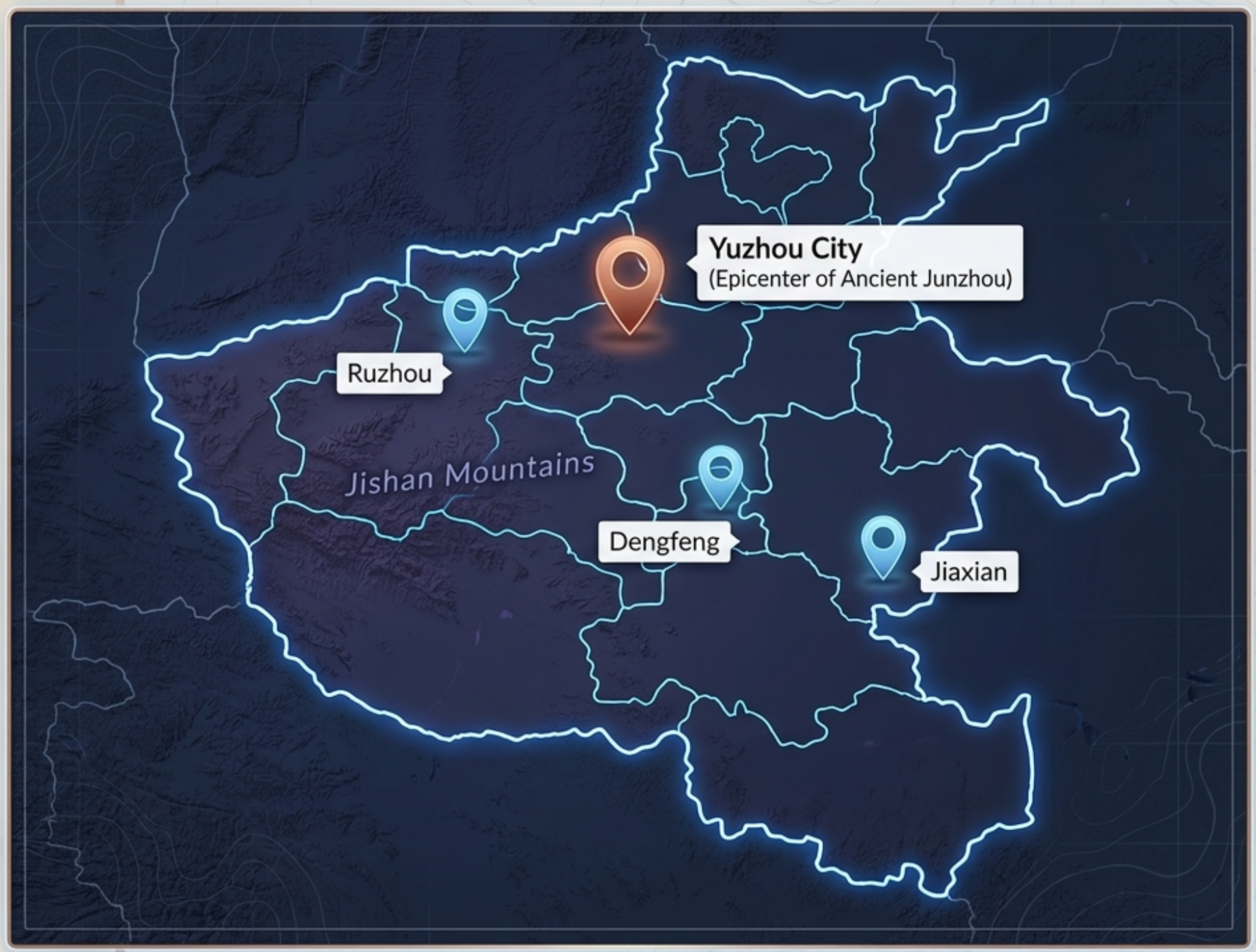
Map of Henan Province showing Yuzhou City, the birthplace of Jun ware

Yuzhou City (ancient Junzhou), Henan Province. The town of Shenhou remains the living centre of Jun ware production to this day.

Key Site: Shenhou Ancient Town (神垕古镇)

Shenhou is one of the few places in China where a traditional craft has remained geographically unbroken for over a thousand years. The town's streets are still lined with kiln workshops, and the old kiln sites from the Ming and Qing dynasties remain visible. Visiting Shenhou is the closest a modern collector can get to witnessing the original environment that produced these extraordinary glazes.
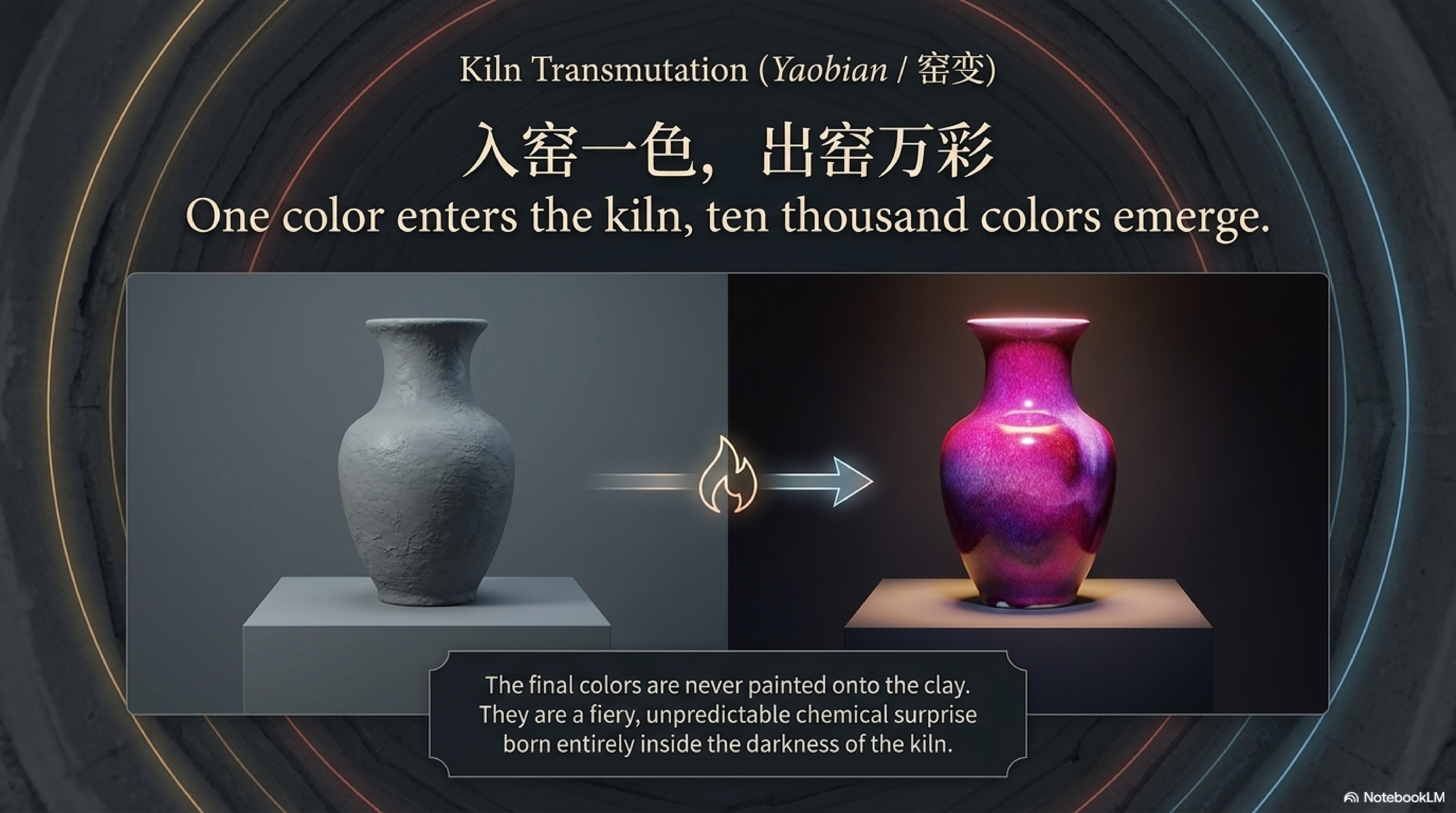
Kiln Transmutation
Yaobian (窑变)

Jun ware yaobian — kiln transmutation before and after firing

The same vessel, before and after firing. The final colours are never painted — they are born entirely inside the darkness of the kiln.

The most astonishing fact about Jun ware is this: the colours are never applied by hand. The glaze enters the kiln an undifferentiated pale grey. What emerges — the sweeping purples, the crimson blooms, the sky blues — is entirely the product of chemistry and fire.

The Chinese named this phenomenon yaobian (窑变), meaning "kiln transmutation." It was considered a collaboration between the artisan and heaven itself. A masterpiece could not be planned. It could only be invited.

The Alchemist's Formula

Modern science has decoded what ancient potters understood through intuition alone:

🔷 Trace Copper (Cu) Primary colorant
+
🔥 Reduction Atmosphere Oxygen-starved kiln
+
🌡️ 1,250–1,280°C High Fire Sustained high fire
=
Yaobian Colours Reds, purples, blues

In an ordinary oxidising fire, copper turns green — as seen in aged bronze. But when the kiln is starved of oxygen (a reduction atmosphere), the chemistry reverses. The copper reacts differently, producing glowing reds and deep purples. The artisan controls the form. The fire dictates the colour.

The ancient saying captures this precisely: "三分做,七分烧"Thirty percent craft, seventy percent fire.

Two Kinds of Colour: Chemical and Structural

Jun ware's colours operate on two distinct levels simultaneously — which is why the glazes appear to glow from within rather than simply sitting on the surface:

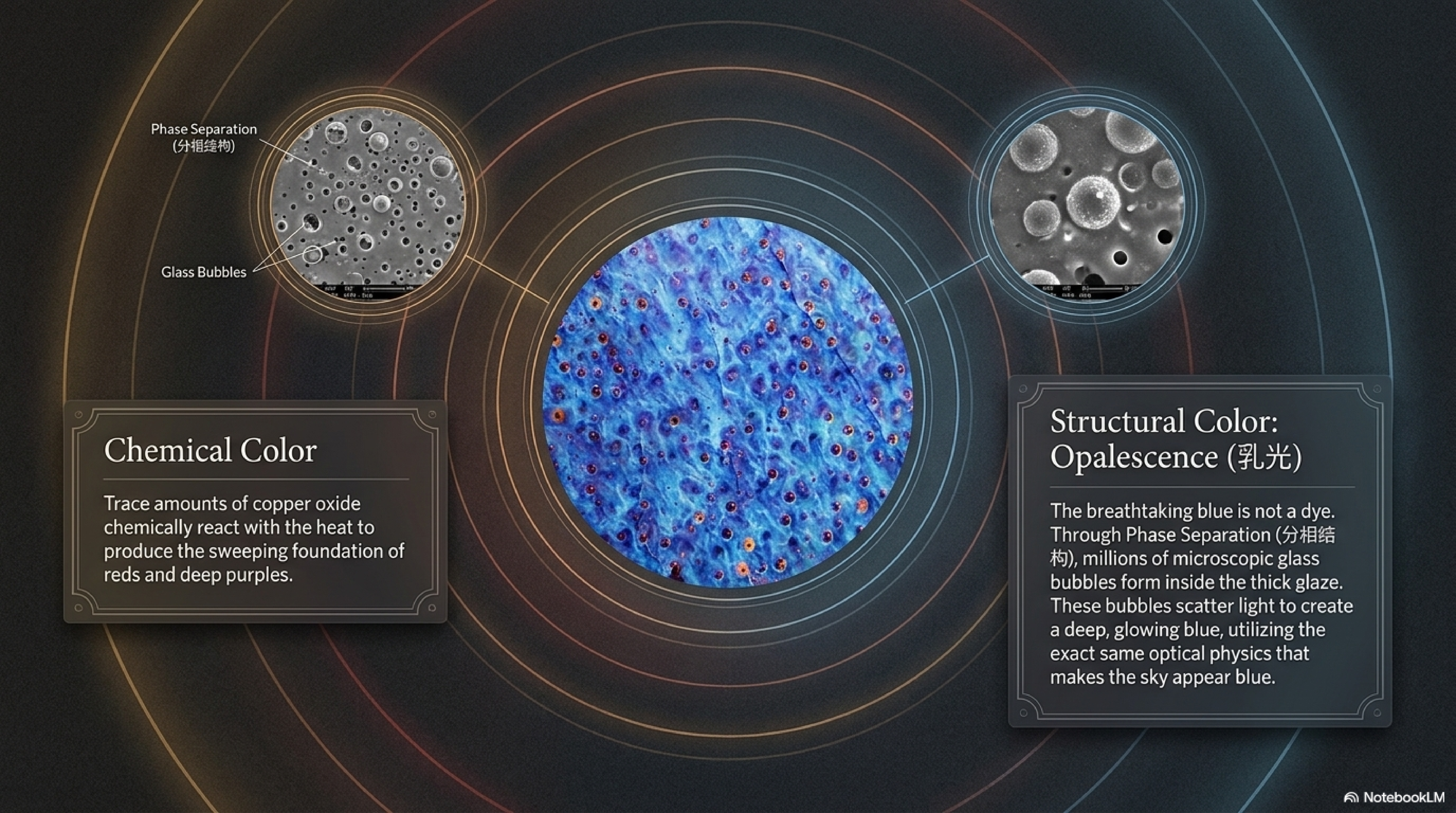
Chemical Colour

Trace amounts of copper oxide react with heat to produce the sweeping foundation of reds and deep purples. This is straightforward chemistry — the same copper that turns bronze green, reversed by an oxygen-starved kiln.

Structural Colour: Opalescence (乳光)

The breathtaking blue is not a dye. Through liquid-liquid phase separation (分相结构), the thick glaze separates at the nanoscale into silica-rich and silica-poor regions. These nanoscale structures scatter short-wavelength light — the same Rayleigh scattering that makes the sky appear blue — producing Jun ware's signature opalescent glow.

Microscopic cross-section of Jun ware glaze showing phase separation and opalescence

Electron microscope image of Jun glaze. The millions of microscopic glass bubbles within the glaze layer scatter light to create the signature opalescent blue — the same physics as a clear sky.

How to Identify
Authentic Jun Ware

Knowing what to look for is the first step toward confident collecting. Authentic antique Jun ware — particularly Song and Yuan dynasty pieces — exhibits a consistent set of physical characteristics that modern reproductions struggle to replicate convincingly.

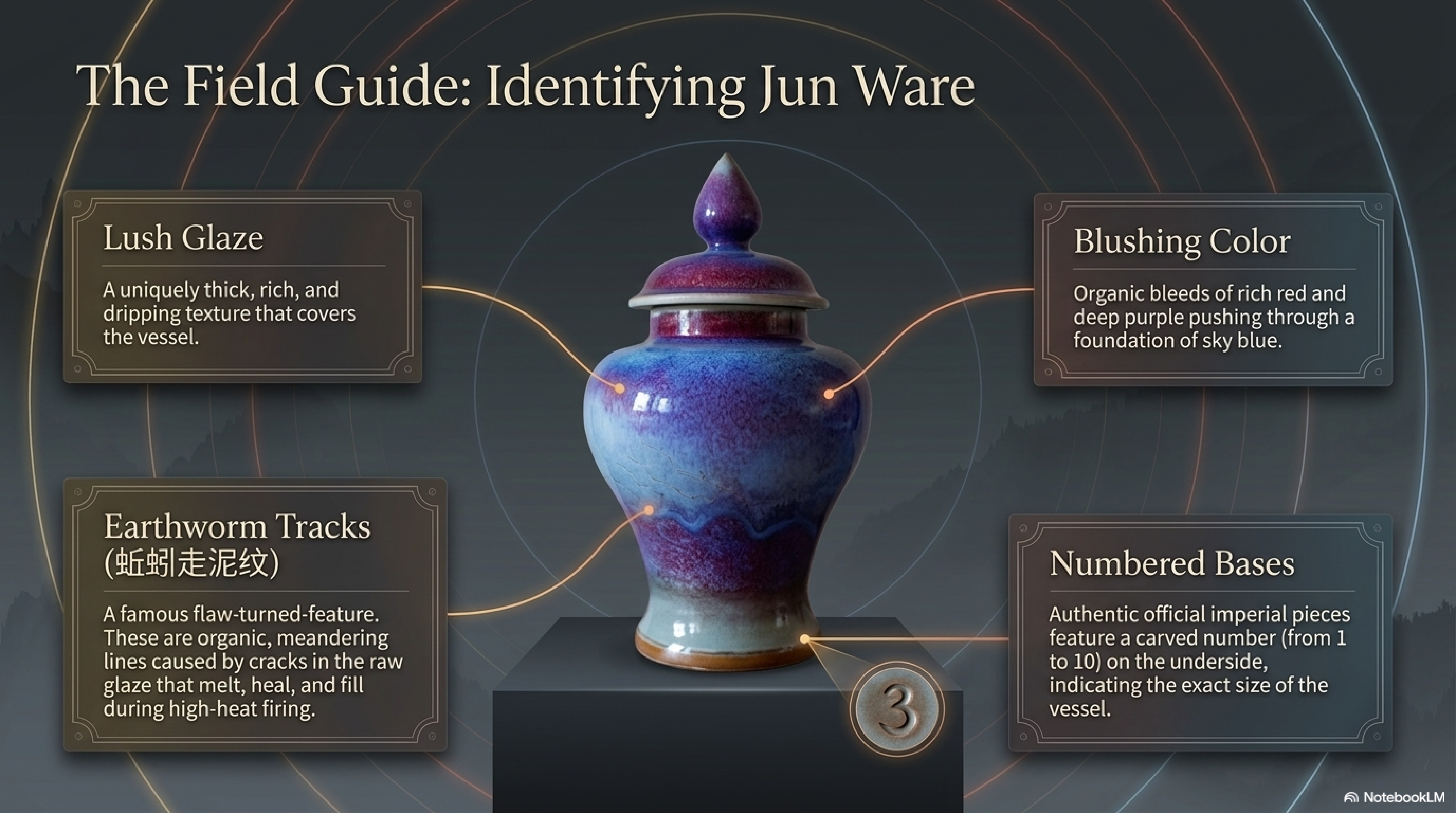
Annotated Jun ware identification guide — earthworm tracks, pinholes, numbered base

The four primary identification markers on an authentic Jun ware vessel.

Earthworm Tracks

蚯蚓走泥纹 — Qiūyǐn Zǒu Ní Wén

The most celebrated feature of Jun ware. Natural winding lines on the glaze surface. They are organic and irregular — never perfectly straight, never repeated. The precise formation mechanism remains a subject of scholarly discussion, though the widely accepted theory holds that cracks in the raw glaze melt, heal, and fill during high-heat firing. A key marker of authenticity.

Pinholes

棕眼 — Zōng Yǎn

Tiny pinholes visible on the thick glaze surface, caused by gas escaping through the viscous molten glaze during firing. Present on virtually all authentic pieces. Their absence in a supposedly antique piece should prompt scrutiny.

Ridge Exposure

出筋 — Chū Jīn

Where a vessel's form features ribs or ridges, the thick glaze thins along those raised edges, exposing the pale grey body beneath — a feature called 出筋. The base typically shows drip marks from the heavy glaze pooling downward during the long high-fire.

Grey Stoneware Body

灰白胎 — Huī Bái Tāi

The stoneware body of authentic antique Jun ware fires to a distinctive pale grey, visible at the foot ring and areas where the glaze does not reach.

Official Jun: The Numbered Bases

Official Jun ware produced for the imperial court carries a unique and easily verifiable marking: a Chinese numeral (一 to 十, 1 to 10) carved into the base of the vessel. This numbering system indicated size within a matched set. The rule is consistent:

The smaller the number, the larger the vessel.
Number One (一) is the largest. Number Ten (十) is the smallest.

This numbered system is exclusive to official palace ware. While traditional accounts long attributed these pieces to Emperor Huizong's reign (c.1100–1125), archaeological excavations at the Juntai kiln site (钧台窑) in Yuzhou — named one of China's top ten archaeological discoveries of 2001 — have led current mainland scholarship to favour an early Ming dynasty date (Yongle–Xuande period, c.1403–1435) for the bulk of numbered flower vessels. This remains an active scholarly debate, and collectors should be aware that auction catalogues and museum labels reflect this evolving attribution.

A History Written
in Fire

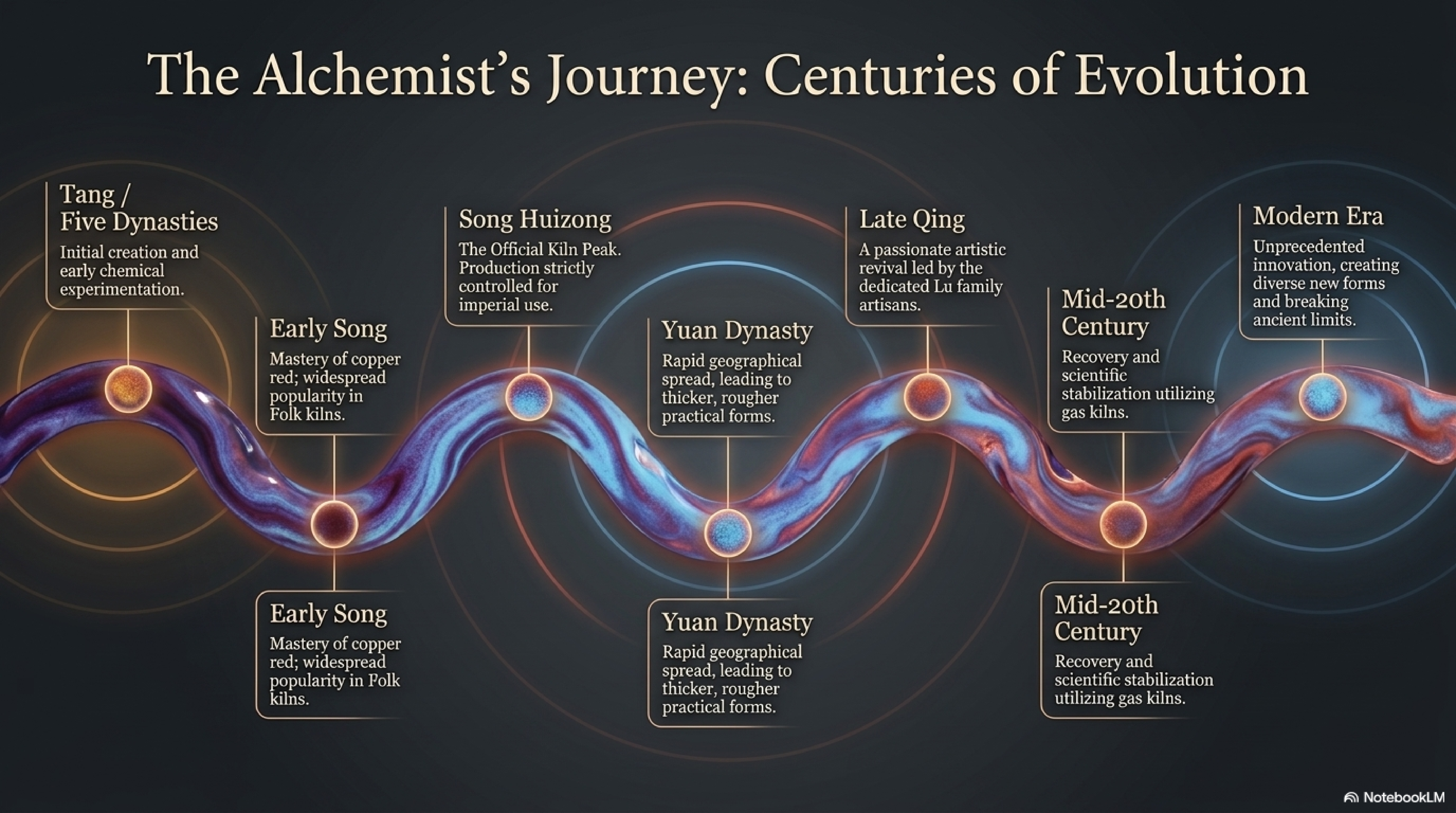
Jun ware historical timeline from Tang Dynasty to modern era

Jun ware's evolution across ten centuries of Chinese history.

Tang Dynasty & Five Dynasties · 618–960

Birth of the Kiln

The earliest Jun-type wares appear — black glazes with distinctive blue splashes, known as "Tang Jun." Initial experimentation with copper in glazes begins. The chemical foundations of yaobian are laid.

Early Song Dynasty · 960–1100

Mastery of Copper Red

Jun ware achieves widespread popularity across northern China. Folk kilns proliferate. The characteristic sky blue and moon white glazes with purple-red splashes become established. The kiln system begins to mature.

Song Huizong Period · c. 1100–1125

The Imperial Peak

Traditional accounts attribute the establishment of official Jun kilns to Emperor Huizong, one of history's great connoisseurs of art, who commissioned wares exclusively for the imperial palace gardens. Archaeological work at the Juntai kiln site has since led current scholarship to favour an early Ming date for most numbered flower vessels — though the question of Song imperial Jun production remains actively debated.

Yuan Dynasty · 1271–1368

Geographic Expansion

The Jun kiln system spreads rapidly across northern China. Production becomes more utilitarian — forms are thicker and heavier to meet broader demand. The refined delicacy of Song official ware gives way to robust folk production.

Ming Dynasty · 1368–1644

The Imperial Flower Vessels

Current archaeological evidence places the production of the celebrated numbered flower pots and display vessels at the Juntai kiln in Yuzhou during the early Ming — most likely the Yongle and Xuande reigns (c.1403–1435). These wares, long attributed to Northern Song imperial patronage, are now understood by mainland scholars to represent Ming imperial commissions. Their extraordinary quality and rarity make them among the most coveted objects in all of Chinese ceramics.

Late Qing Dynasty · 19th–early 20th century

The Lu Family Revival

After a long period of decline, the Lu family artisans of Shenhou lead a passionate revival of traditional Jun techniques. The ancient craft is rescued from near-extinction through dedicated personal effort and generations of accumulated knowledge.

Modern Era · Mid-20th century – present

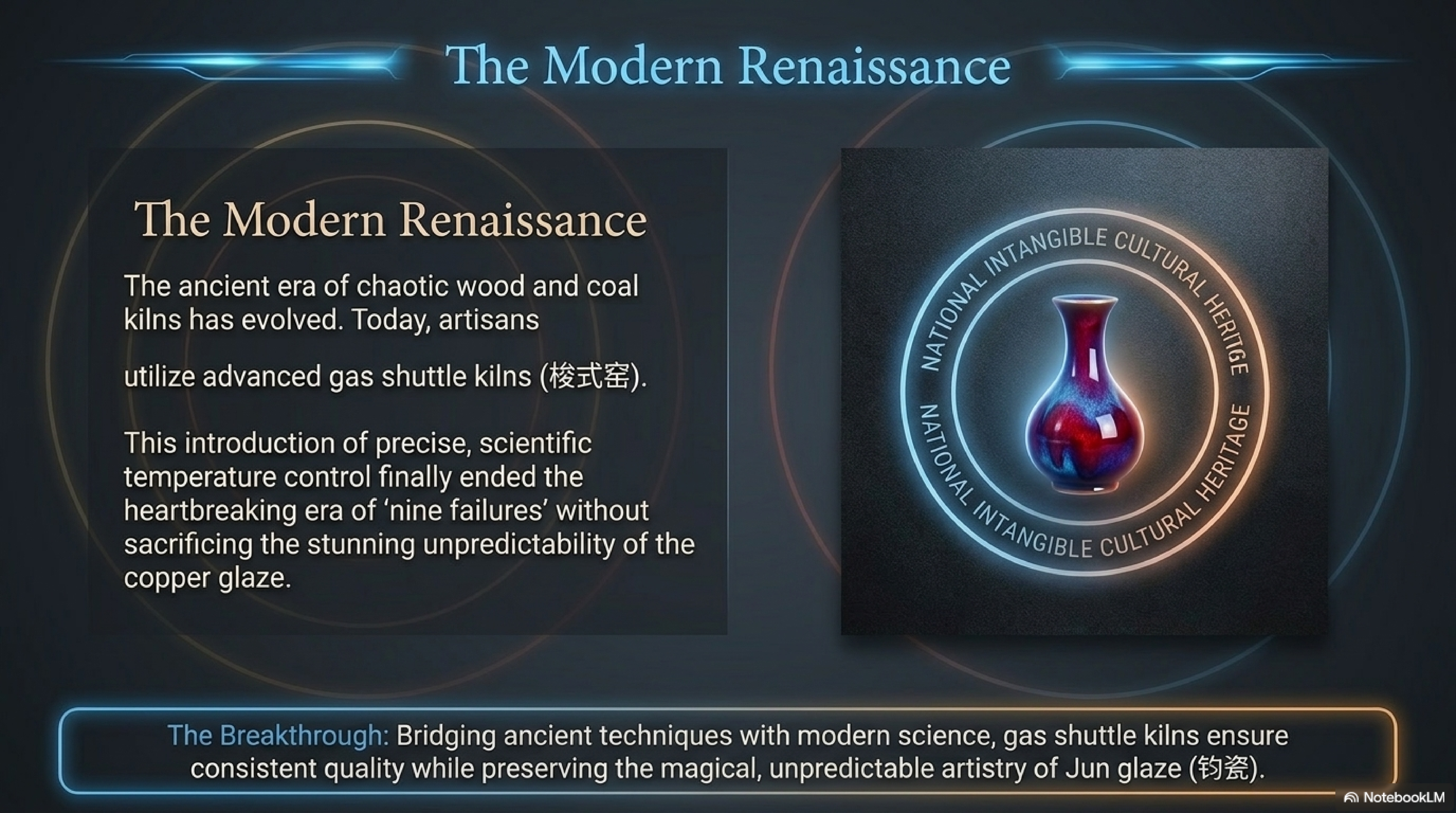
Scientific Renaissance

The introduction of gas shuttle kilns (梭式窑) brings precise temperature control to a process that had always depended on luck and intuition. The heartbreaking era of "nine failures" ends — without sacrificing the magical unpredictability of the copper glaze. Jun ware is now designated a National Intangible Cultural Heritage.

Official Jun vs. Folk Jun

Jun ware divides broadly into two categories, produced for entirely different purposes and carrying very different values on the collector market:

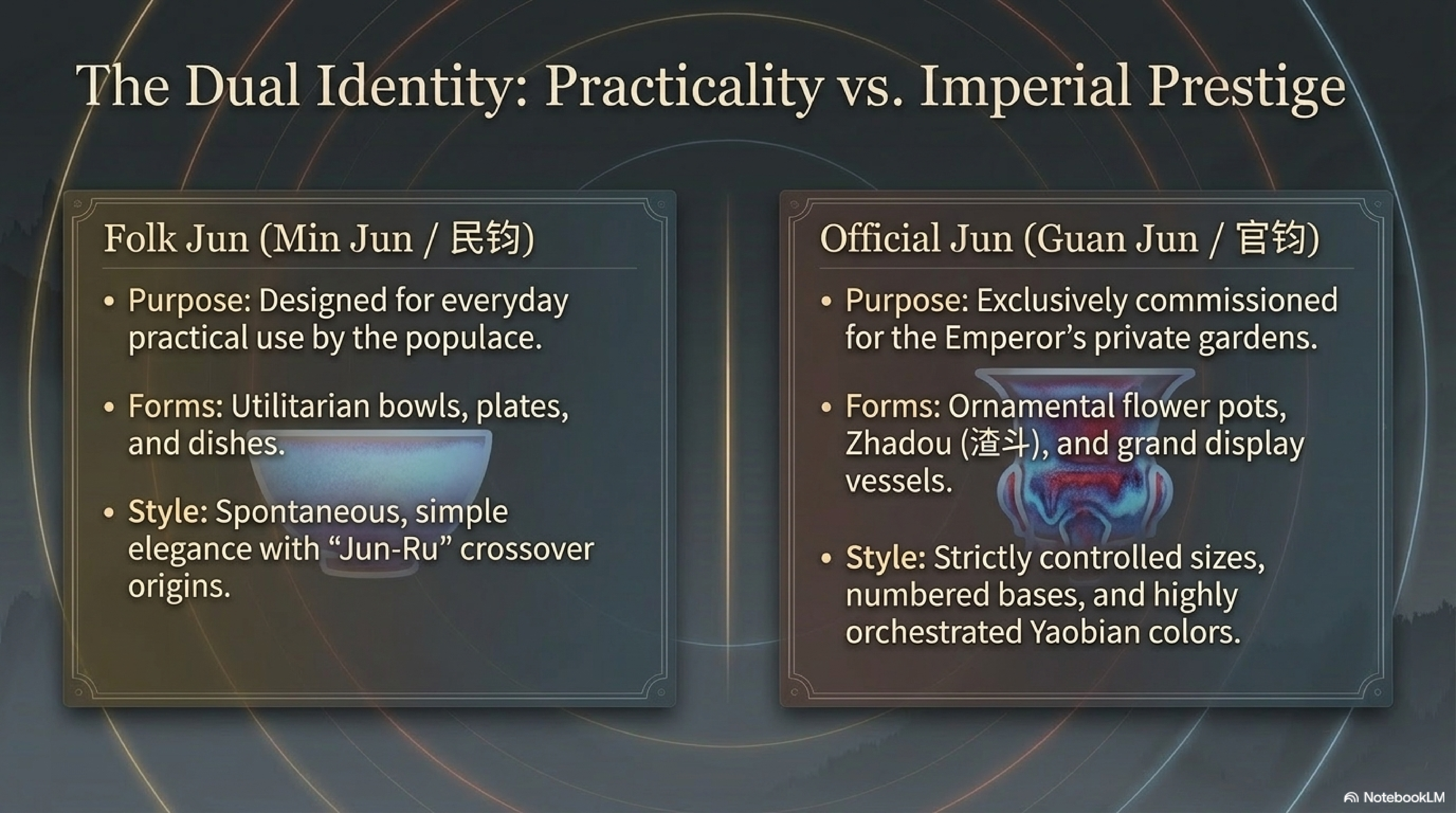
Official Jun — Guan Jun (官钧)

Palace Ware · Song to Ming Dynasty

  • Purpose: Exclusively commissioned for the Emperor's private palace gardens
  • Primary forms: Flower pots, basin stands, ornamental zun vessels, zhadou (渣斗) waste bowls
  • Key marker: Numbered base (一 to 十 carved beneath)
  • Glaze: Highly orchestrated yaobian with dramatic colour transitions
  • Rarity: Extremely rare — major pieces in world-class museum collections
  • Value: Among the most valuable of all Chinese ceramics

Folk Jun — Min Jun (民钧)

Daily Ware · Song Dynasty Onwards

  • Purpose: Everyday practical use across Chinese households
  • Primary forms: Bowls, plates, dishes, ewers, censers and storage jars
  • Key marker: Spontaneous, unplanned purple-red splashes on sky blue or moon white ground
  • Glaze: Looser, more improvisational — less controlled, more expressive
  • Rarity: More available, though fine examples remain collectible
  • Value: Ranges widely — accessible entry point for new collectors
Folk Jun (民钧) versus Official Jun (官钧) — comparison of forms and characteristics

Left: Folk Jun bowl with spontaneous sky-blue glaze. Right: Official Jun flower pot with numbered base and orchestrated yaobian colours.

十窑九不成
Ten Kilns, Nine Failures

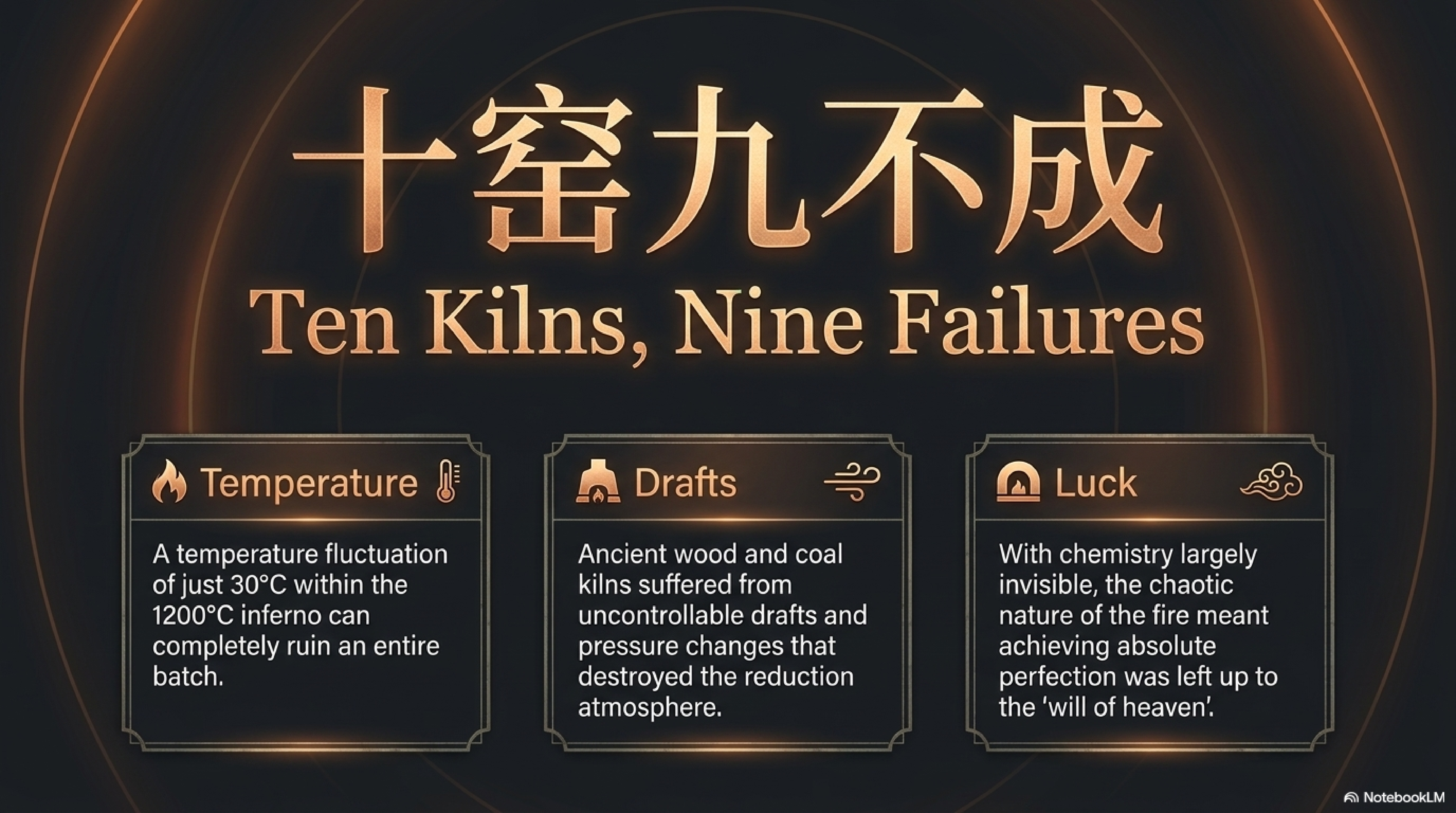
十窑九不成 — Ten Kilns, Nine Failures: the extreme difficulty of Jun ware firing

The ancient proverb shí yáo jiǔ bù chéng (十窑九不成) — "ten kilns fired, nine fail" — is not an exaggeration. It was the lived reality of Jun ware production for the better part of a thousand years. Achieving the perfect flambé effect required the simultaneous alignment of multiple variables, any one of which could ruin an entire kiln load.

🌡️

Temperature

A fluctuation of just 30°C within the 1,250–1,280°C firing range can completely ruin an entire batch — and that is before accounting for the even more critical requirement of maintaining a precisely timed reduction atmosphere throughout. Ancient wood and coal kilns had no instruments — only the eye and intuition of the master.

💨

Drafts

Wood and coal kilns were vulnerable to uncontrollable air drafts and pressure changes that could destroy the oxygen-starved reduction atmosphere at any moment during the long firing.

☁️

Luck

With the chemistry largely invisible to the naked eye, achieving absolute perfection was ultimately left up to what the ancients called "the will of heaven." No two perfect pieces could ever be intentionally repeated.

This inherent unpredictability is precisely what makes authentic antique Jun ware so precious. Every surviving piece from the Song, Yuan, or Ming dynasty is, in a very literal sense, a miracle of probability. The modern introduction of gas kilns has reduced failure rates dramatically — but collectors prize the ancient pieces precisely because of the impossible odds they survived.

Ancient Fire,
Modern Science

The modern renaissance of Jun ware — gas shuttle kilns and National Intangible Cultural Heritage designation

The ancient era of unpredictable wood and coal kilns has given way to a new chapter. Today's Shenhou artisans work with advanced gas shuttle kilns (梭式窑) that allow precise, programmable temperature control throughout the firing cycle.

This is not simply a technical upgrade. It is a transformation that brought to an end a millennium of irreversible kiln losses. Kiln masters can now reliably achieve the reduction atmosphere that produces yaobian colours, without the catastrophic failures that destroyed nine batches out of ten in the ancient world.

Crucially, the scientific control does not eliminate the magic — it preserves it. The copper glaze's chaotic interaction with heat and oxygen remains fundamentally unpredictable at the microscopic level. The colours that emerge are still unique to each firing, each vessel. The collaboration between human craft and natural alchemy continues.

In recognition of this living cultural continuity, Jun ware craft has been designated a National Intangible Cultural Heritage (国家级非物质文化遗产) of China.